A brief history of the gold standard
The gold standard was a monetary system under which almost all countries fixed the value of their currencies according to a certain amount of gold. But why was it abolished? And will it come back? 11Onze agent, Aitor Canudas, gives us a summary.
In a scenario where the continued printing of money has led to too much of it circulating, which has devalued its value and caused a bubble in the sovereign debt of states, we take a brief look at the history of the gold standard and its possible viability at the present time.
As Aitor Canudas explains, there are several reasons why President Nixon put an end to the gold standard. Experts in geopolitics have divergent opinions when it comes to identifying the causes behind this paradigm shift or, even the possibility of returning to this monetary system.
Gold standard
If you want to discover the best option to protect your savings, enter Preciosos 11Onze. We will help you buy at the best price the safe-haven asset par excellence: physical gold.



This 2022 comes with fiscal changes in the purchase of real estate. From January, the land registry will set a reference value that will establish what we should pay tax on. This has been determined by the Ministry of Finance. If until now we paid taxes according to the market price, now it may cost us a little more. We give you the keys to all of this.
Until now, if you bought a second-hand flat, you had to pay 10% transfer tax (ITP); and when you inherited a property or received a donation, the corresponding inheritance and donation tax. Even so, if the tax office proved that the property had been sold below market value, it could then force the property to pay more.
To avoid the litigation that this entailed, the cadastre has created this new reference value, without retroactive effects. These changes come hand in hand with the reform of the Law against tax fraud, which affects ITP, stamp duty and inheritance and gift tax.
Thus, from now on, the cadastre will take into account the deeds of sale of the year prior to each area. To find out what the value of our property is, therefore, we will have to consult this index, which is already published on the cadastre’s website. It is on this amount that we will have to pay the transfer and transfer taxes. In this way, the tax will no longer depend on the market value, and some consider that, as a result, the exact condition of the property at the time of purchase will not be taken into account.
Requesting a rectification
In fact, if the buyer believes that the price assigned to his property is higher than it is worth, and he is paying more than he considers fair, then he can rectify his self-assessment and ask for a refund for undue income. Let’s say for example that the land registry has valued our property at 280,000 euros, but we think it is worth 180,000 euros.
Then, we will have to provide the necessary evidence to prove that the conditions of the property are not adequate and that the price should be lower. From this point on, the cadastre will analyse the case and determine whether we are right and deserve a refund. However, the tax office warns that the reference value is already slightly below the market value.
The seller, in the tax return
In the case of the seller, he/she has to include the sale and purchase in the tax return and will have to pay the corresponding taxes for the difference between the sale and purchase price; or the acquisition price, in the case of inheritance or donation, if it is positive. In fact, article 14 of the General Tax Law makes it explicit that the transfer tax does not affect the income tax and, therefore, if the property has been sold below its reference value, it is taxed at the price of the sale.
The property tax, known as IBI, which is paid every year in our municipality, depends on the cadastral value, and not on the reference value and, consequently, will not be affected by this new reference value.
11Onze is the fintech community of Catalonia. Open an account by downloading the super app El Canut on Android and Apple and join the revolution!
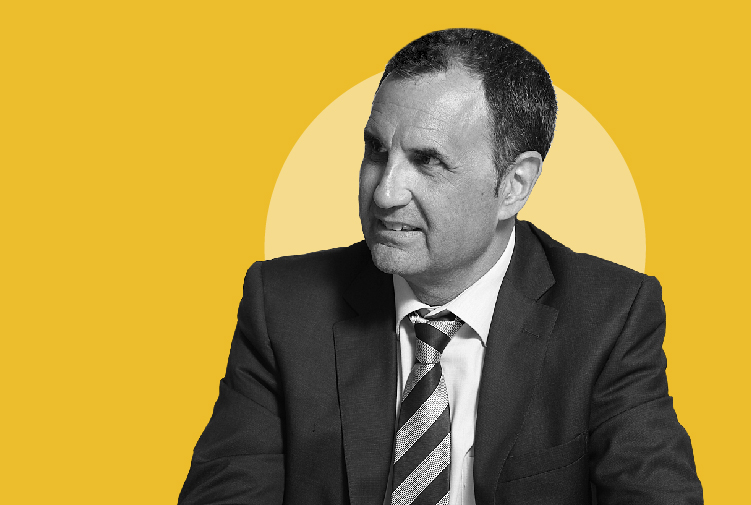


The scenario we will face in 2022 can be scary. But we in the 11Onze community are preparing for it. We talk to 11Onze’s chairman James Sène about national indebtedness, the possible collapse of the international financial system and superinflation. How will we get out of this? 2022 will be our touchstone.
The scenario in Europe is bleak. The European Central Bank (ECB) has been warning for months about the excess debt accumulated by traditional banks in declining energy companies. In a new episode of the podcast Ens Interessa, the president of 11Onze, James Sène, analyses the international economic context, in conversation with content director Toni Mata. And Sène is categorical: “If the ECB is so clear, things are much worse than they want us to believe. There are a series of geopolitical circumstances and a crisis in the international monetary and financial system that are causing the perfect storm.”
However, the economic consequences of all this, Sène warns, will not come overnight, but will accumulate, if we do not remedy them, until we reach a situation of collapse. This explains why, in practice, traditional banks are already in a situation of bankruptcy, but are still being sustained by the inertia of the ECB, which has not stopped printing money and offering pandemic aid.
“The ECB has wanted to plug the hole so much that we have printed too many banknotes, and we are entering a phase of superinflation, with values of 7% to 10%. This means that the money saved is worth 10% less,” the president of 11Onze argues. On top of all this, there are stagnant financial structures. “And we are all paying the consequences: sky-high interest rates, fees for everything, reductions in customer service staff, a service that is getting worse and worse. It’s a death foretold,” Sène says.
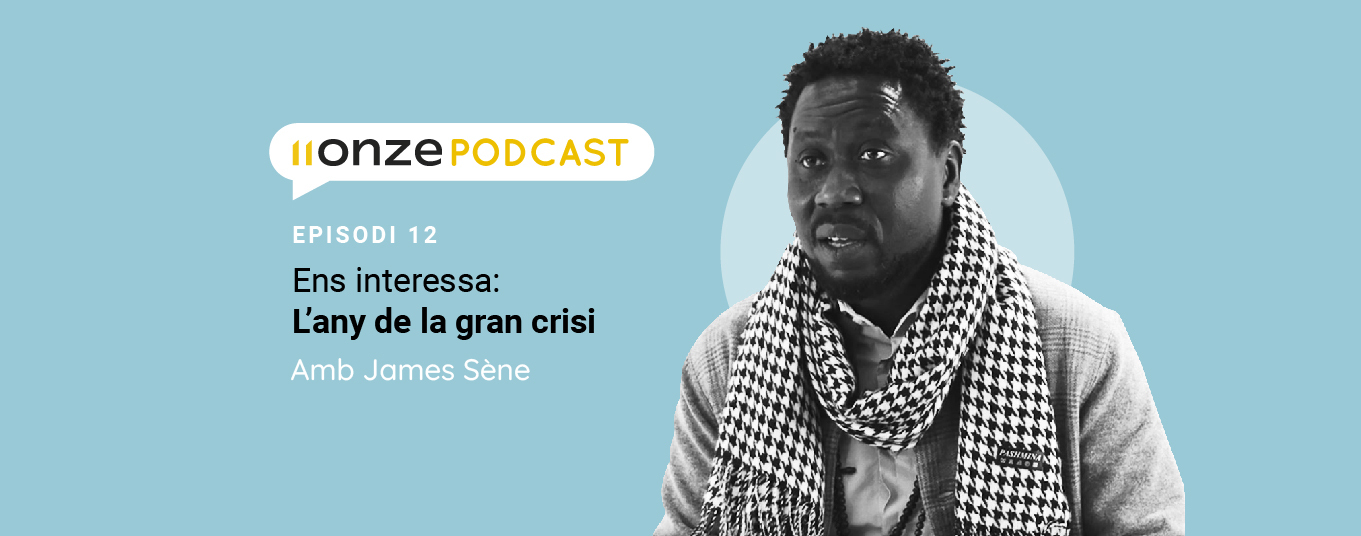
Episode 12 | The year of the great crisis
The United States on the brink
On the other side of the Atlantic, things are no better. The United States is, as the president of 11Onze admits, in a very difficult situation. “With debt absolutely off the charts, inflation reported at 7.8% last quarter, this means it’s probably worse. The US economy now represents 24% of the world economy, the lowest percentage in its history,” he sums up. This is causing the dollar to lose more and more of its value and, in turn, the purchasing power of citizens.
“The consequences will be radical and very important for us, without a doubt. The United States will have to defend its economy, and the measures it takes are likely to leave many people in the lurch,” Sène argues. American debt is also the debt of Europe, Japan and other economies of the capitalist West.
“Companies are often blamed for the crisis, but the reality is that it is the states that are bankrupt. They have no money, and they are increasing the fiscal pressure on citizens. This debt has been caused by their inability to manage everyone’s resources,” Sène says. And he exemplifies this with the pension system currently in force in Spain, which is close to bankruptcy. “Every year, the Mercer CFA Institute Global Pension Index rates the pensions of 43 countries and, in Europe, in 2021, Spain is third from the bottom. They calculate that pensions have a 28 out of 100 chance of lasting. We are paying more than we can afford,” Sène explains.
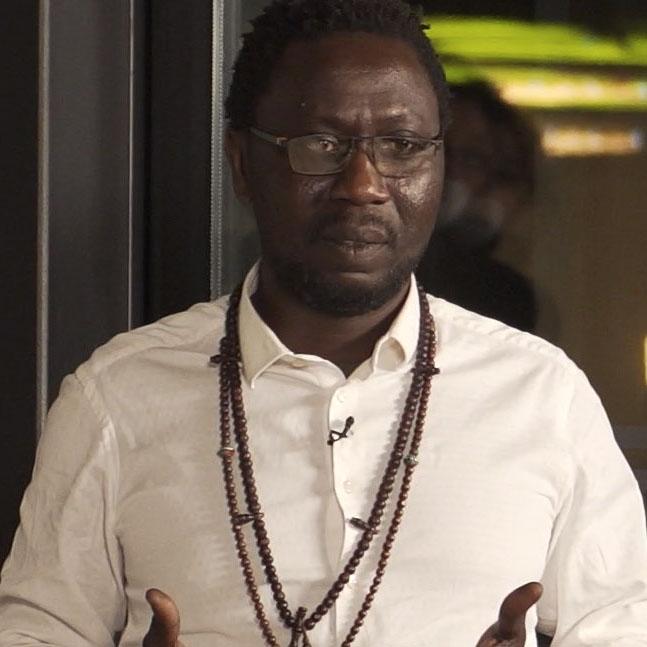
“The crisis is often blamed on companies, but it is the states that are bankrupt. This debt has been caused by their inability to manage everyone’s resources.”
Options for weathering the crisis
Let’s look for solutions. The crisis seems inevitable because there is too much accumulated debt. What can we do as citizens to avoid the impact of this crisis as much as possible? We need to educate ourselves financially and be able to manage our resources responsibly. “We have to start opening our eyes and learn how to manage our money. We cannot correct this global mistake, because it is in the hands of governments, but, individually, we have to try to generate value with the money we have, which is greater than the decrease produced by inflation or the CPI…,” the chairman of 11Onze defends.
And this, it is clear, cannot be done with savings in current accounts, without doing anything. “In Spain, 40% of people have their money saved in current accounts. We don’t understand what’s happening,” Sène warns. That’s why, above all, the money must be kept in financial institutions that protect their clients: in 11Onze, the money in the accounts is off the company’s balance sheet. Even if the depository financial institution were to go bankrupt, the clients’ money would not suffer. It cannot be touched, it is 100% guaranteed with no limit to the amount. “It’s like a safe, you can’t lose it in any way,” Sène says.
Secondly, savings should be kept in deposits that give a minimum return. And thirdly, a small part of these savings should be invested, without putting our assets at risk, whether in real estate, precious metals, cryptocurrencies or ETF packages. “That we can at least generate what we are losing. This year, for example, gold has returned 25%, and silver 70%,” he says. The idea is, at the very least, to correct the devaluation of salaries caused by inflation.
“It’s not about being a broker and reading twenty investment panels at the same time. That’s a nightmare. We have to look for products that we understand,” Sène encourages. In fact, 11Onze has set out to educate, in La Plaça and with its superapp, El Canut, so that anyone, whatever their age, can move their savings without running any risk.
So: yes, all indicators point to 2022 being the year we will see one of the biggest economic crises in history. But we have the opportunity to prepare ourselves as a community to find ways around the bumps. At 11Onze, we are working to make it happen.
11Onze is becoming a phenomenon as the first Fintech community in Catalonia. Now, it releases the first version of El Canut, the super app of 11Onze, for Android and Apple. El Canut, the first universal account can be opened in Catalan territory.


The strong post-Covid economic recovery continues, but the presence of the new Omicron variant of the coronavirus and its rapid spread could have a significant impact on the slowdown in global economic growth. Let us take a look at what the experts have to say.
While it is true that the measures imposed by states were necessary to contain the pandemic, the restrictions paralysed the global economy with a historic drop in world GDP. Progress in vaccinations, especially in the most developed countries, and the expansive fiscal policies applied by governments and central banks have laid the foundations for an economic recovery that began at the end of 2020 and which seemed unstoppable until this new variant of the coronavirus came into play.
It is still too early to know with certainty the final impact of the resurgence of a pandemic that seemed under control, however, the Bank of Spain has confirmed that the recovery is deflating, and the Spanish economy is expected to grow by 4.5% this year (a point and a half below the 6% forecast in September). The uncertainty also lowers the growth forecast for next year by half a point, to 5.4%, and calls into question the optimism for 2023.
Forecasts in the International Monetary Fund (IMF) reports coincide when it comes to predicting a global economic slowdown caused by Omicron. It has also revised its growth forecasts downwards, given continuing supply chain logistics problems and uneven vaccination between countries.
Moderate optimism
Even so, the Organisation of the Petroleum Exporting Countries (OPEC) states in its monthly report: “The impact of the new variant Omicron is expected to be mild and short-lived, as the world becomes better equipped to manage Covid-19 and its related challenges”. Even so, it foresees continued growth in oil demand by 2022 with production at 4.2 million barrels per day.
OPEC’s encouraging statements coincide with studies that have been published on the efficacy of existing vaccines to combat this new variant of the coronavirus and have been reflected in stock market indexes around the world. Investment banking groups such as Goldman Sachs have not significantly altered growth projections, but do not rule out more negative scenarios, depending on whether the speed of transmission and hospitalisations of the omicron worsens the figures recorded with the Delta variant.
Although the majority of the world’s population is already vaccinated against Covid-19, the Omicron wave is once again cracking the economies of many countries that were just beginning to recover. Governments are once again under pressure to find a balance to protect the economy, jobs, and businesses without putting people at risk.
11Onze is becoming a phenomenon as the first Fintech community in Catalonia. Now, it releases the first version of El Canut, the super app of 11Onze, for Android and Apple. El Canut, the first universal account can be opened in Catalan territory.
11Onze launches a podcast where young people raise their voices to talk about the economy. It is presented by the comedian Guillem Estadella and the first guest is the influencer Joan Grivé. With this premiere, 11Onze takes the opportunity to open a new channel on Spotify.
Young people have to talk about young people. With their tone and their way of doing things. That’s why 11Onze is launching Pasta Z, to find out what young people think about a world that seems to be exclusively adult, but which affects their daily lives and their future: the world of money. What do they think about it, how do they organise themselves, what are their expectations?
Pasta Z is, therefore, the podcast that will give a voice to a generation hitherto excluded from the economic debate. And it will do so with the help of comedian Guillem Estadella. At just 24, Estadella has built up a solid career in the audiovisual world in Catalonia. He has presented and scripted the shows Estoy madurando and Quin pollastre! and has collaborated in radio and television programmes such as Molta canya!, Fricandó matiner, Tabús, El Foraster and Ahora Caigo. Now, he presents Pasta Z, where he will talk to young people “with more privileges than their parents, but who live in precarity.” The podcast can be heard on 11Onze Podcast and also on 11Onze’s Spotify channel.
“Young people are put in a lot of obstacles to entrepreneurship, when we are supposed to have more opportunities to do so. And yes, we have very little financial culture. Many young people don’t know how to pay taxes… And, at the same time, I have a lot of colleagues who are hooked on the cryptocurrency market and think they are Bill Gates. We go from one extreme to the other,” Estadella explains. Pasta Z was born, the comedian says, with the aim of bringing order to the confusion.
Influencers also work hard
In the first episode, Estadella talks to Joan Grivé, better known by his digital avatar, Sir Joan. “He’s a guy in his early twenties, who works in the digital world, who is an influencer, who works odd hours, creates content and all his income comes from the internet,” the comedian explains. Estadella is fascinated by Grivé’s ability to make a living. “I’m interested to know how he organises himself as a freelancer, and how he sees the human-money relationship… And he sees it as fucked up, like me,” he laughs.
Sir Joan earns a lot of money, but he has realised that he has so many expenses that he will never get rich. “We have very stigmatised influencers, as they don’t work in an office… But Joan Grivé works more hours than anyone else,” he continues. Like Sir Joan, Pasta Z will feature other young people, some well-known and others anonymous, and there will be times to change the world and to criticise the globalised financial system and the legacies of previous generations, such as boomers.
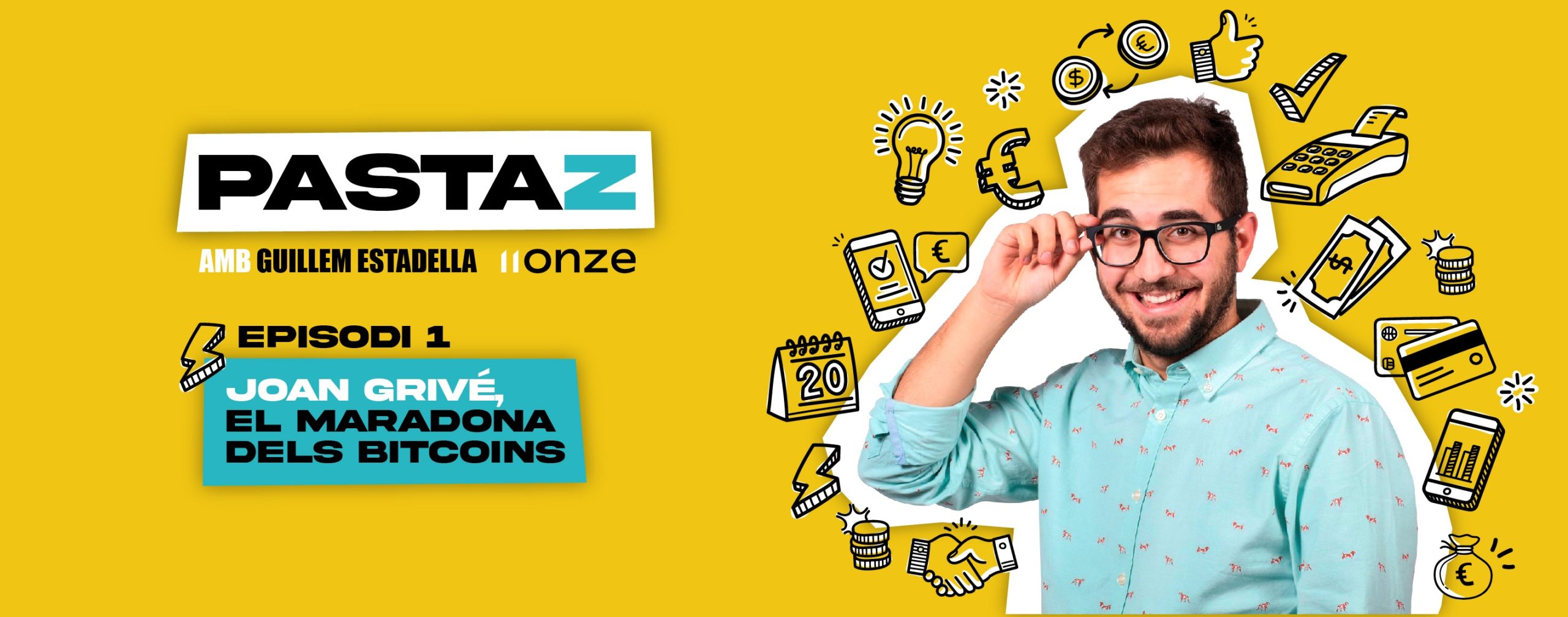
Pasta Z | Joan Grivé, the Maradona of bitcoins
Localism against “the swamp of uncertainties”
“I find it amusing that boomers criticise us for ‘eco-anxiety’, when they were the first to buy toilet paper because the pandemic was going to wipe out the world. Although I’m not really in favour of the term ‘eco-anxiety’ either. I do think about the future, but I prefer to do it in the present,” Estadella says. In preparing the podcast, the comedian realised that young people have many fears because they have been painted a threatening scenario and because social networks force them to want to solve everything immediately. The combination of the two, he says, has been lethal to the mental health of Generation Z. “We are always navigating a swamp full of uncertainties,” he says.
But he is convinced that change will come if selfishness is put aside. “Yes, we young people quickly jump on the drama, but in a globalised world, what will save us is localism. That’s why 11Onze, which has a national outlook, can help us understand how we manage money,” says Estadella, who sees 11Onze as the savings bank of the future. “Savings banks were a national structure, there was one in every town and the money stayed where it was generated. But everything has grown so much that it has clipped our wings,” he continues. Young people want to change everything, to make a real revolution, and Pasta Z will contribute to this.
11Onze is becoming a phenomenon as the first Fintech community in Catalonia. Now, it releases the first version of El Canut, the super app of 11Onze, for Android and Apple. El Canut, the first universal account can be opened in Catalan territory.



Negotiations continue over the general state budgets. Is it true that they will benefit Catalonia? How has it gone in the last few years? Marta Sibina of Octuvre explains it.
The promise of more millions for Catalonia is recurrent, but it is necessary to look at the data to know what really happens. Do politicians execute what they budget for? Are these budgets progressive? Marta Sibina of Octuvre analyses this question.
The reality of budgets
Whether it is because of the COVID-19 pandemic or the fact that they are reinventing themselves in terms of customer relationship services, banks are revolutionising this year, turning banking as we know it upside down. Apart from the 10 trends that can change in the banking industry this year according to expert Alan McIntyre, let’s go back to the beginnings of banking in Catalonia, because to understand the revolution, it is interesting to understand the beginnings of banking in our country.
Due to our current frenetic lifestyle, we often forget the moment when the most important changes happen: we take it as a fact that life has always been as we know it or as we make it work. In the case of banks, the first Catalan bank in the Middle Ages, called Taula de canvi de Barcelona, consisted of a few wood boards on the street where money was counted, banking operations were carried out, and payments were also made. From this table of change, created in 1401 thanks to the Consell de Cent in Barcelona and considered the first public bank in Europe, the banking world has spun many times. But why do we talk about history at 11Onze? Well, simply because, to understand the world today, we have to understand the beginning of things, and if Catalonia made a change in the banking relationship after the plague of 1348, why not make a banking revolution in the relationship with new customers, which has also been transformed following the 2020 pandemic?
But what does revolution mean? The dictionary defines revolution as “a total, radical change.” To make this change real, the revolutionary gaze focuses on people’s needs. We need to adapt to the new way of living in society, in which we are using less and less cash, therefore the customer no longer looks for an ATM at every corner, nor do they want to go to their branch. The client wants good care that is fast and is carried out through a good web and mobile operating system.
Expert Alan McIntyre of the technology services consulting company Accenture has drawn, in Accenture’s webpage, his annual list of the 10 trends most likely to affect the banking industry in 2021.
- The first trend on the McIntyre banking revolution list tells us that we must go for it with all possible resources, otherwise we should not even attempt to start a project; this trend can relate much to the context of change that society needs right now, following the 2020 pandemic, when many sectors have been forced to regenerate or die.
- The second McIntyre trend is this new normality, which was so widely talked about in the media last year. We link it with the banking world as a new standardization of traditional banking to future banking.
- McIntyre’s third trend is defined as the new era of banking applications, where banks will stop interacting with customers as they have done so far, and will be more than banking services within their apps, offering new opportunities to customers.
- Fourthly, in this famous banking list we have the tendency towards radical transparency in a bank, where all the information that the customer needs is shared. Here we find an added value: the customer has the power to think for themselves with the information they receive from their bank, which gives them the opportunity to decide by themselves what to do with their money and how.
- McIntyre’s fifth tendency reminds us that you must be acknowledged not as being the best in something, but as the only one to make change in the banking world possible, be the innovator.
- Sixthly, McIntyre points out that cash will no longer be the main point of operations, attaching greater importance to a world that we already have internalised, that of digital payments.
- As a seventh trend, he says that banking is embarking on sustainability for a world that acknowledges the macroeconomic consequences of climate change.
- McIntyre’s eighth trend is defined as uncertainty in American regulations after the 2021 election period, which may have a direct impact on international economic efforts.
- Ninthly, we find the importance of the digital regulator and, as McIntyre’s last trend.
- We find that digital banking environments will become much more open and secure, leaving behind the archaic and closed environments typical of the worn-out banking world.
We must wait and see how these McIntyre trends come true. In the meantime, we must see the path every bank takes in this banking revolution, and to what extent this change in the relationship with new customers is made.
Download your app El Canut by 11Onze



Digital money has come to stay, although for many it is a big unknown. Could this be the end of physical money as we know it?
We are becoming more and more accustomed to paying by electronic means, because it is easy, convenient, and you do not need to carry cash on you. We have already heard about cryptocurrencies, bitcoins, and cryptocurrencies. For this reason, Europe does not want to be left behind and will create its own digital currency, as countries such as China, Sweden, and Uruguay have already done.
According to the European Central Bank (ECB), this digital currency could come to life 4 to 5 years from now.
The digital euro is what we know as an electronic currency managed and supervised by the ECB that can be used by both citizens and businesses to pay, and will not in any way replace cash, but will complement it. It is what is known as a digital currency issued by a central bank, that is, a CBDC (Central Bank Digital Currency).
What is clear is that the digital euro will not be a cryptocurrency or a crypto asset, says the ECB, as it has the support of the Eurozone and will remain the currency of all member states.
When can we use it?
No release date has been set yet. All we know is that it will possibly be operational in about 4 or 5 years. In any case, creating a type of currency like this, digital, secure, accessible, and efficient takes time. The ECB recently conducted a public survey of the population to see what the interest was on the need to create this digital currency, which indicated that there is a real need and demand.
What are its advantages?
It would be an alternative to cash in extreme situations, such as catastrophes, in which cash cannot be used and in which traditional means of payment, such as POS, do not work. It would allow you to make safer and faster payments without intermediaries. It would also promote financial innovation as well as the inclusion of developing countries in the world of finance, which is now difficult for them.
What is the difference between digital euro and cryptocurrencies?
Cryptocurrencies are not Central Bank money, so the main difference is that cryptocurrency prices are volatile and are backed by companies or private investors.
With the launch of the digital euro, the ECB would shield the euro and allow citizens to use this form of payment securely. But not all is good news. Using the digital euro takes away the privacy we now have with physical money.
The competitors of the digital euro
A good number of Central Banks are working on the development of digital currencies, but some countries are much more advanced than others. We can highlight three: firstly, China, whose digital currency (called eYuan) launch date, is unknown, but tests are being carried out on the operation of this currency in retail transactions; secondly, e-Krona, which is Sweden’s cryptocurrency and has already begun testing by the Central Bank. And finally the e-Peso, which was tested in 2017 in order to analyse its suitability.
According to Christine Lagarde, director of the European Central Bank, the digital euro is a means of payment under study that could be tested in 2021, although its operational launch will still be long in coming. In any case, the advent of digital currency would be a real revolution in the economy as we know it.
11Onze is becoming a phenomenon as the first Fintech community in Catalonia. Now, it releases the first version of El Canut, the super app of 11Onze, for Android and Apple. El Canut, the first universal account can be opened in Catalan territory.
If you liked this article, we recommend you read:
 Economy
The heart of economics
3 min readAt 11Onze we want people to become financially empowered. You can start doing so with the


More than 20,000 bank branches have closed in Spain since 2008, according to data from the Bank of Spain. While a few years ago the popularity of a financial institution could be measured by the number of existing branches, today this figure no longer measures success and has become secondary. In fact, it is precisely those who are currently dominating the market that are distancing themselves from the branch as the central axis and opting for the digital services, focused on the customer and his or her needs, as the main channel for interacting with the public.
There is no single cause, but the consequences are clear: traditional offices as we know them are going away, never to return. Digitalisation processes have accelerated this paradigm shift, making it possible for customers to manage their finances more autonomously. We are facing a new banking era in which the relationship between the customer and his or her bank is being redefined. A change that can be transformed into an opportunity to help improve this relationship, for the benefit of both parties.
The new era of banking, online customers
Today, there is a growing willingness on the part of customers to buy online, a fact that has also been transferred to banking. However, as has already happened in other sectors, willingness is outweighing actual sales. Against this backdrop, banks have opted to prioritise advice as a strategy to maintain the flow of customers in branches and thus ensure that the sales pitch for their products is not lost through a screen, where the customer receives multiple stimuli. The risk of this practice is that it blurs the line between banking operations that can be carried out digitally and advice that must be given in person, so that the digital weight loses its strength and the full potential that technology offers in a very advantageous way, also on the advice side, is not exploited.
Banks face the challenge of meeting customer expectations and providing them with all the necessary tools to offer a full, agile and secure digital experience. It has been proven that those institutions that show empathy and care for the customer experience are much more likely to maintain customer loyalty. Therefore, prioritising the customer is no longer just a matter of principle, which is often blurred, but a matter of survival for institutions. Only those that manage to see this and take the gamble will have their place in the market assured. Therefore, it is a question of promoting personal advice that does not necessarily involve a face-to-face interaction at branches, but which does not distance the customer from a personalised service that allows them to be digitally connected with their bank.
Democratisation of information and how to build trust
The process of digitalisation of banking and financial products brings a new problem for today’s banking, but an opportunity for customers and digital banking: access to information. Buying a banking product means knowing and understanding it, and this implies an exhaustive control of the information that reaches the customer before making any decision. Agile digital banking is not compatible with excessively long contracts where not even the nomenclature is understood. Transparency and clarity of information will be a decisive factor in gaining the trust of customers.
Putting the customer at the centre of the business model will mean embracing the experience to make it more attractive. In the digital sphere, this will require analysing each of the actions the user has to make on their device and finding a way to make it simpler and more intuitive. A commitment to creating smart services and platforms that offer a sufficiently compelling value proposition for the user to operate in full. This attractive proposition also goes beyond digital operations and becomes pricing policy or the dynamics of attracting customers. In the digital market, current customers are just as important as potential customers, and the marketing and sales strategy will be key to materialise this idea through all the tools offered by digital processes to reach customers.
Another key point in the banking of the future will be the personalisation of the banking experience. Digitalisation allows access to data and its analysis through artificial intelligence, a reality that institutions can use to identify needs and offer personalised solutions. Knowing the customer is key, and the revolution involves doing so from their point of view, from outside the market, to determine their positioning vis-à-vis the institution and to generate a real reading of needs that brings the institution closer to the customer and not the other way around.
Technology for economic sustainability
The economic environment, with low or negative interest rates and a period of economic uncertainty, puts pressure on banks to free up structural and operational costs. Accelerating the digital transformation could be one way to achieve two objectives. The first is to reduce the cost of processes, which will be made more efficient through digitisation. The second is to secure a competitive market position vis-à-vis other institutions. Whoever succeeds in winning this “digital race” will undoubtedly shape the market in the coming years.
In addition, the creation of a connected enterprise architecture will help to move away from manual and paper-based processes into the cloud era. Databases, information, process automation, greater security, a series of advantages that, provided they are used correctly, will have two major beneficiaries. Customers, who will see their queries resolved more quickly, thanks to automated chats.
And on the other hand, workers will achieve significant time savings by eliminating cumbersome processes, freeing up time they can invest in quality actions towards their customers.
As we have already said, the customer is the centre, and this connectivity process is also linked to the customer experience, as it allows the right product to be offered in a personalised way, at the right time and through the right channel.
Digitalisation, a continuous learning process
The main conclusion is that the future of banking involves a digitalisation process that can bring many benefits for all those involved, customers, employees and the institution itself. Institutions can focus on placing the customer at the centre, providing all the necessary tools to give them decisive capacity, always in an individual and personalised way to the highest standard. Digital transformation is a daily learning process where consumer feedback is constantly needed to find the right path. Thanks to this feedback, small changes can add up to a significant transformation that can create impact. The big challenge is to maintain the person-to-person relationship in the digital age and not allow artificial intelligence to detract from quality human relationships. It is necessary to keep the experience real, both for customers and employees.
11Onze is becoming a phenomenon as the first Fintech community in Catalonia. Now, it releases the first version of El Canut, the super app of 11Onze, for Android and Apple. El Canut, the first universal account can be opened in Catalan territory.
PSD2 is the European directive that regulates electronic payment services in the euro area. The new regulation, which updates the one from 2007, introduces strong measures in the field of cybersecurity. 11Onze will be guided by this directive. We explain its advantages to through agent Jordi Oller.

The new PSD2 directive came into force in Spain in December 2020, following the approval of Royal Decree-Law 19/2018 on payment services. This regulation sets out the rights and obligations of both institutions and customers with regard to payment services. “It seeks to meet the security needs in a context of strong technological advances in the field of e-commerce,” Oller explains.
PSD2, therefore, regulates all payment transfers, direct debits, card payments and other banking transactions in Europe, and aims to make all payment services in the financial sector more transparent, more competitive and more innovative.
Protecting ourselves from cyber-attacks
First, PSD2 introduces strong measures in the field of cybersecurity. Among other things, a double authentication or reinforced authentication when allowing banking transactions, a procedure that substantially reduces the risk of identity theft. It is for this purpose that financial services institutions have to offer their customers an API, i.e. an Application Programming Interface. “The new APIs give flexibility, simplify design and use and allow innovation in new services,” says our agent 11Onze. At the same time, these financial institutions have to share information with other companies, as long as they have the customer’s consent.
In addition, now, with PSD2, companies cannot access customers’ sensitive financial data. And banks have to establish account access, the so-called XS2A, which is popularly known as open banking, because they are obliged to provide the necessary interfaces so that people can access their account data, provided they have given their consent. “So, for example, users can view all their accounts in one place or make online payments by bank transfer,” Oller explains. You may have read it at La Plaça. From October 1st, 11Onze’s interface will be El Canut, a state-of-the-art application, a digital wallet where you can make all kinds of different transactions and manage several accounts at the same time.
The new PSD2 also offers solutions to ensure that transferring of sensitive data, via APIs, is carried out without any risk for the client and that data protection is guaranteed by two different means: the QWAC certificate and the QSealC certificate. For online transactions, therefore, it is no longer sufficient to ask for the customer’s debit or credit card, but a double authentication (Strong Customer Authentication, or SCA) is also required. In short, at least two of the following three factors are required for a transaction to take place:
- What the client has, such as a debit/credit card or mobile phone.
- What the client knows, e.g. a bank password or a PIN that is sent to the mobile phone.
- Who the client is, i.e. an ID, be it a fingerprint or facial recognition, some biometric identification parameter.
Payment schemes in Europe: PSD2
Less fraud, better online shopping
All in all, PSD2 makes e-commerce much safer, because it prevents fraud through stolen or duplicate cards and avoids chargebacks. In addition, it also makes online shopping more user-friendly. “It facilitates authentication processes, thanks to biometric identification parameters or mobile payments instead of card payments,” explains our agent 11Onze.
Last but not least, PSD2 provides incentives to reduce the costs of online transactions. “It frees up access to banking interfaces, and allows more companies to compete in this payment ecosystem,” Oller concludes. It should be noted, however, that only transactions where the card issuer is European, i.e. from the 27 EU countries, or where the acquirer, or the financial institution that processes the transaction on behalf of the merchant, are also European, will be subject to PSD2. Undoubtedly, what is clear is that with 11Onze you are going to be secure.
Want an 11Onze account? Order batch in Get in line. With the code we’ll give you, you can open an account on October 1st.