The virtues of gold as an investment asset
How can you preserve the value of your investments when everything seems to be falling apart? Gold is an indispensable ingredient in any diversified investment portfolio because of its long-term performance and liquidity.
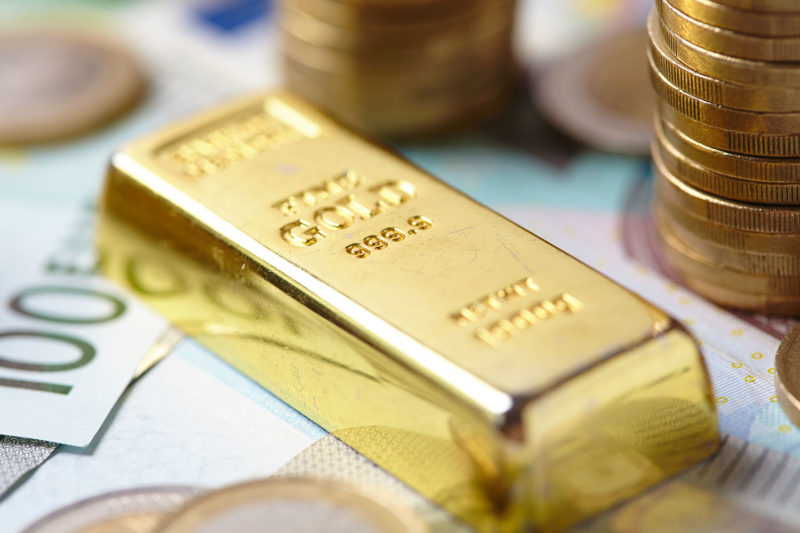
Gold is the precious metal par excellence. Scarce and highly prized, it has been used for thousands of years to preserve wealth. And this has not changed in the 21st century, as it has appreciated in 16 of the last 20 years, according to Statista.
Three key characteristics make it an attractive asset for any investment portfolio: long-term profitability, as the data is positive if we analyse its appreciation over the last decades; its role in diversifying and reducing the overall risk of our investments; and its liquidity, as it can be easily bought and sold, even when conditions in other markets are difficult.
A shield against inflation
Gold generates relatively strong returns in all economic cycles. As the World Gold Council points out, over the past 50 years the price of gold has risen by almost 11% per annum on average. This is comparable to US equities and considerably better than US bonds.
Gold offers a good return in good times, when demand for gold in jewellery and technology increases. But its attractiveness grows especially in times of difficulty as it is seen as a safe-haven asset.
The World Gold Council points out that gold has appreciated by more than 20 % on average in periods with inflation above 5 %. According to data from this organisation, almost half (47 %) of the demand for gold in 2021 was for investment and more than 7 % went into the vaults of central banks.
Value of precious metals as an investment
The need to diversify
A golden rule, no pun intended, for any investor is not to put all your eggs in one basket. In other words, putting all your savings into a single asset class is very risky because it exposes you to the ups and downs of a single market. This is why it is recommended to diversify investments and include various types of assets in investment portfolios so that gains in some assets can offset unexpected losses in others.
Hence, gold’s great attractiveness as a complement to other assets, especially at times when equities and other riskier investments are under pressure. Portfolios that include gold are less likely to experience extreme ups and downs.
On the other hand, if we compare the evolution of the gold price with the US dollar and other currencies that have been used as safe havens, we find that in the 21st century the major currencies have depreciated by more than 90% against gold. And if we look further, we see that in the last 100 years the major currencies have lost 99% of their value compared to gold.
No liquidity problems
The third advantage of gold is that it is a very liquid asset. The value of gold bullion is closely linked to the world market price for unrefined metals, which is updated 24 hours a day and is accessible to buyers and sellers at all times.
Investors can buy and sell gold whenever they wish, even during periods of extreme stress in the financial markets. This is obviously not the case for other assets as art or antiques, for example.
Given all these factors, it is not surprising that the World Gold Council’s analysis has concluded that adding 6-10% of gold to the average US investor’s portfolio will tangibly improve their performance, with good long-term returns.
If you want to discover the best option to protect your savings, enter Preciosos 11Onze. We will help you buy at the best price the safe-haven asset par excellence: physical gold.

Historical precedent has taught us that gold tends to rise in price in the face of geopolitical tensions. However, the gold price is multifaceted and rarely responds to a single trigger, but is driven by several factors. What geopolitical risks should be taken into account in the current context?
Despite some fluctuations during the year, the price of gold rose by 15% in 2023 to an all-time high of USD 2,130.20 per ounce. The US banking crisis, geopolitical tensions, war conflicts and the US Federal Reserve’s stance on maintaining interest rates were some of the main factors that contributed to the fact that gold continued to be a safe-haven asset for investors.
This year, aside from war and geopolitical conflicts, the lack of clarity around the timing of the US Federal Reserve’s monetary easing cycle and the growing popularity of Donald Trump’s candidacy may substantially impact the 2024 election, the geopolitical landscape and gold’s appreciation. But let us focus on geopolitics.
De-dollarisation and reserve diversification
As for the economic sanctions against Russia in the wake of the war in Ukraine, these drove up the prices of hydrocarbons and other commodities, while undermining the credibility of the global financial system by weaponizing the dollar and seizing Russian reserves, leading to an increase in central banks’ demand for gold.
A survey of 85 sovereign wealth funds and 57 central banks by Invesco, a global asset management firm, showed that almost 60% of respondents are concerned about the precedent of sanctions against Russia and consider that these developments have made gold a more attractive asset, while 68% hold reserves in their coffers compared to 50% in 2020.
In this context, the growing trend of dedollarisation shows no signs of stopping. According to the IMF, the market share of the US dollar as the world’s reserve currency has fallen from 66% in 2003 to 58.4% at the end of the fourth quarter of 2023. This seems to confirm that the international financial system is facing an unstoppable transformation process, encouraged by the large emerging economies that are part of the BRICS group.
Rising tensions in the Middle East
The armed conflict unleashed between Israel and Palestine on 7 October caused the price of gold to rise by more than 10%, reaching a high of over 1,900 euros per ounce. This rise in the price of gold was driven not so much by the armed conflict between these two actors, but by the possible ramifications if other countries in the region and the West became involved.
While the tug of war between Hezbollah and Israel as a result of the massacre in Gaza was in danger of spiralling out of control, Ansar Al-lah, the Islamist resistance group better known as the Houthis and operating in Yemen, also showed solidarity with Palestine by attacking ships transiting the Red Sea bound for Israel and other countries that continue to fuel the genocide.
This exponentially increased shipping costs and the risk of reigniting the flames of war in Yemen after the last ceasefire, driving up the price of gold. The response from the US and some of its client states was swift, and the bombing of Yemen continues to this day.
As for the US military’s illegal occupation of Syria, it continues to provoke a response by armed resistance groups. The attack on one of the US military bases has been followed by an increase in US bombings in Syria and Iraq against military targets that Washington links to the Iranian government.
In this context, US threats against Iran, accusing it of supporting Syria, Yemen and Palestine, are a clear attempt to widen the current conflict. This would also have ramifications for the global economy, financial markets and the value of gold as a safe-haven asset for investors.
To discover the best option to protect your savings, enter Preciosos 11Onze. We will help you buy at the best price the safe-haven asset par excellence: physical gold.


In times of uncertainty, savers seek refuge. Traditionally, sovereign bonds were considered a safe asset, guaranteed by governments. But today, with wars threatening global stability, persistent inflation and very high levels of public debt, many are asking: are government bonds still the best option?
For decades, government bonds have been synonymous with security. When a government issued debt, the implicit message was clear: ‘we will always pay’. This perception made them the natural refuge for savers in times of uncertainty. But the world has changed. With public debt skyrocketing, persistent inflation and growing geopolitical tensions, many are wondering whether bonds are still the safe bet they once seemed to be.
The numbers speak for themselves. According to Eurostat, Spain has accumulated public debt of close to 102% of GDP, France already exceeds 110% and Italy is close to 137%. In the United States, federal debt has exceeded $34 trillion. These figures force governments to constantly refinance their liabilities, relying on financial markets to maintain their solvency.
The problem is that the cost of that debt has risen significantly. Following the rise in interest rates between 2022 and 2023, maintaining it has become a huge budgetary burden. Although the ECB and the Fed have begun to moderate monetary policy, real rates remain high and the fiscal pressure on citizens is not easing. In this context, bonds are no longer an absolute safe haven, but rather an asset exposed to budgetary tensions and austerity demands, such as those currently being experienced by France under the supervision of Brussels.
When bonds do not protect savings
The security of bonds is also relative when inflation is taken into account. A bond may offer 3% annual interest, but if inflation is 2.5%, the real gain is almost zero. And if inflation rises above the coupon rate, the investor loses purchasing power.
This scenario is not theoretical: we experienced it first-hand in 2022 and 2023. With inflation skyrocketing due to the war in Ukraine, the energy crisis and supply chain bottlenecks, bonds generated significant real losses. Today, inflation has moderated—it is around 2.4% in the eurozone and 2.8% in the United States—but it remains a latent threat.
Furthermore, governments have a perverse incentive: when prices rise, the real value of debt falls. Inflation provides relief for public coffers, but it erodes citizens’ savings.
Gold: millennia of stability
In this scenario, gold reaffirms its status as the ultimate safe haven. Unlike bonds, it does not depend on any government or central bank. No one can print more gold, and this natural scarcity makes it a tangible, universal and trusted asset.
Its historical track record is indisputable. When economic systems falter, gold regains prominence. This happened during the European debt crisis of 2012, the global financial crisis of 2008 and also during the pandemic of 2020. And it is happening again now, with open conflicts in Ukraine and the Middle East.
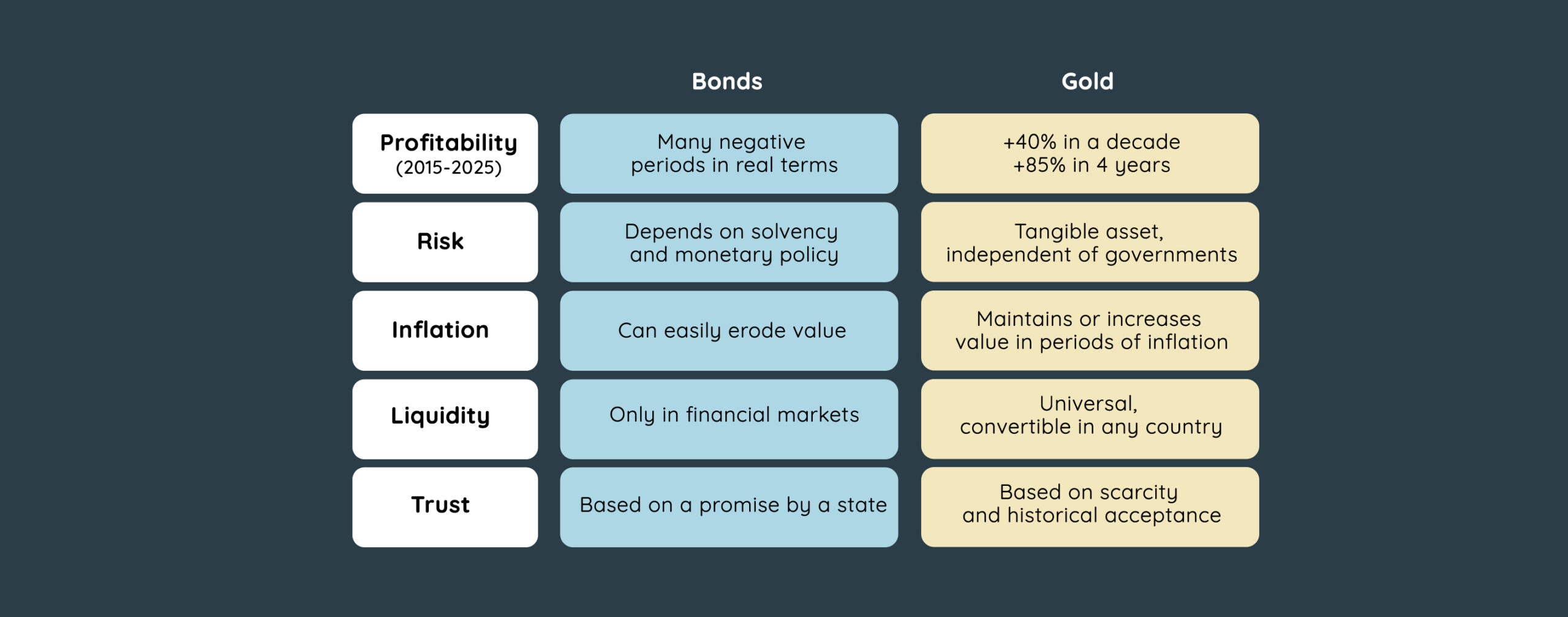
Data from the World Gold Council makes it clear: the price of gold has risen by nearly 85% in the last four years and more than 40% in the last decade. In 2024 and 2025, historic highs have been reached thanks to the purchase of more than 1,000 tonnes per year by central banks, especially China, which is seeking to reduce its dependence on the dollar.
Geopolitics and de-dollarisation
Global multipolarity also plays in favour of the yellow metal. China, India, and Russia are promoting initiatives to reduce the hegemony of the dollar and strengthen monetary alternatives. Although the dollar continues to dominate, this process has increased demand for gold as a neutral hedge. If even governments use gold to protect themselves from financial volatility, it makes sense for individual savers to consider doing the same.
The comparative analysis is clear. Over the last decade, many good sovereigns have offered negative real returns, while gold has maintained an upward trajectory. Bonds depend on the solvency of states and interest rate fluctuations; gold is independent and universally convertible in any market.
In high inflation, bonds lose value, while gold acts as a hedge. And in terms of confidence, while bonds are based on a state’s promise to pay, gold is based on its scarcity and millennia of recognition as a store of value.
Source. Eurostat & World Gold Council
And for savers?
For small investors, the difference is decisive. Bonds may seem safe, but they carry risks of loss of purchasing power and losses if sold before maturity. Gold, on the other hand, does not offer spectacular short-term gains, but it does offer what many are looking for: stability and security.
In a world of recurring inflation, growing debt and geopolitical uncertainty, blindly trusting bonds is risky. Gold, on the other hand, has weathered every crisis known to man and continues to consolidate its position as the safe-haven asset par excellence.
If you want to discover the best option to protect your savings, enter Preciosos 11Onze. We will help you buy at the best price the safe-haven asset par excellence: physical gold.


El Forex o mercat de divises és un mercat global i descentralitzat en el qual es negocien divises. Núria Rambla, CEO Executive Assistant d’11Onze, ens explica el funcionament del mercat que mou el volum més gran d’inversions.
Forex, de la unió de les paraules Foreign i Exchange, també és conegut com a FX o mercat de divises, i és el mercat financer més gran del món. És un mercat global per al comerç de divises on es poden negociar les principals divises mundials les 24 hores del dia, de dilluns a divendres. Però com apunta Rambla, “no hem de confondre el mercat de divises amb el mercat de la borsa, són diferents”.
Es tracta d’un mercat amb molta liquiditat on operen un gran nombre d’agents i inversors de tot el món, com ara bancs, institucions financeres i empreses que gestionen fons d’inversió. Per tant, representa una gran oportunitat per tota mena d’inversors que es veu reflectida en el volum d’inversió, “cada dia si negocien 2,9 bilions de dòlars i 1,1 bilions d’euros”, detalla Rambla.

Entenent el mercat de divises - Forex
Negociar els tipus de canvi entre dues divises
L’objectiu dels inversors és el d’obtenir beneficis amb la diferència de preus entre les diferents divises que cotitzen en el mercat. Cal tenir en compte que el valor d’una divisa pot variar depenent de nombrosos factors. La situació econòmica actual amb una inflació desbocada pot jugar un paper determinant en la demanda, però existeixen altres circumstàncies que poden fer pujar o baixar el valor d’una divisa.
Els inversors compren i venen divises basant-se en la seva previsió que un parell de divises experimentaran un moviment a l’alça o a la baixa en relació amb el seu valor inicial. En aquest sentit, Rambla apunta que el mercat de Forex “ens permet pactar preus i cobrir riscos, el que es coneix com a opcions i futurs”.
Si vols descobrir la millor opció per protegir els teus estalvis, entra a Preciosos 11Onze. T’ajudarem a comprar al millor preu el valor refugi per excel·lència: l’or físic.

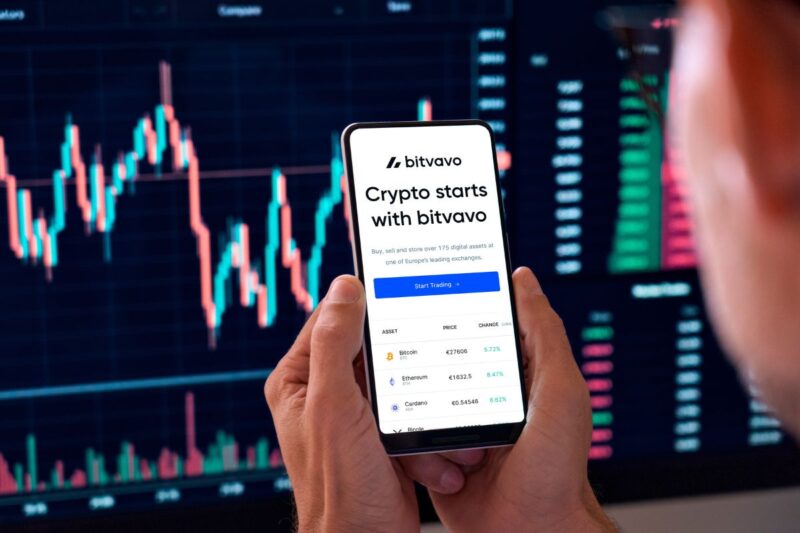
If you already trade cryptocurrencies through the Bitvavo platform that 11Onze Recommends, we give you 6 tips to increase the security of your account. Take advantage of Bitvavo’s tips and promotions and learn how the world of cryptocurrencies works.
During this month of July Bitvavo is offering two promotions for those users who sign up to the platform. But not only this, it also gives us ideas to improve the security of our account. To explain:
- Enabling two-factor authentication. The first step in securing your Bitvavo account is to enable two-factor authentication (2FA). This adds an extra layer of security in a very simple way: by requiring a unique code generated by an authentication application. This makes unauthorised access much more difficult, so it’s a great barrier against hackers.
Another thing: if you use an authentication application, one of those that recognise you on all devices, do not synchronise Bitvavo codes with your personal account. Keep them only on your device. - Use a strong password. How can you create a strong password? Well, it’s not complicated: avoid using common words, phrases or personal information that can be easily guessed. A combination of upper and lower case letters, numbers and special characters is always recommended. But do yourself a favour and write it down somewhere so you don’t forget it!
- Keep your account information private. It’s a no-brainer, but it’s worth remembering: never share your Bitvavo account details with anyone. This includes your password, security question and API keys. Also, beware of phishing scams and fake emails that may try to steal your personal information. Remember, neither Bitvavo nor 11Onze will ever ask for your account information via email or a phone call.
- Secure your email. Your email is linked to Bitvavo, so it would be a good idea to enhance your security as well. That’s why you can activate two-factor authentication and regularly check for account leaks. There are tools to check for this, such as haveibeenpwned.com. Another option is to create an email address just for your Bitvavo transactions.
- Use the anti-phishing code. If you activate the anti-phishing code, it will be included in all automatically generated emails sent by Bitvavo. With this code, you can check if the email really comes from Bitvavo. You can change your anti-phishing code by following the instructions here. Or by watching the video linked below.
- Try to stay informed. Regularly check your accounts, the official blogs and La Plaça. This will help you stay informed about any security issues or updates to the platform.
- EXTRA: Blocking fund withdrawals. Bitvavo also allows you to totally block withdrawals. This way, you can only trade in cryptocurrencies, but you can never withdraw money in euros. This prevents the possibility that someone can impersonate the user and download the money. The Dutch platform explains in this article how to block deposit withdrawals and how to re-enable them when necessary.
How to use the anti-phishing code.
11Onze Recommands Bitvavo, cryptocurrencies easily, safely and at a low price.
How much do we spend on beauty products? What is the impact of natural cosmetics in this sector? We talk about all this and more with Esther Vallès, co-founder of El Mirall Blau Perruquers, and Gemma Vallet, Director of 11Onze District, in a new episode of La Plaça of Territori 17.
The recovery of the perfumery and cosmetics sector is consolidating after the slowdown caused by the health pandemic. Last year’s turnover was 9,205 million euros, 11.3% more than the previous year, according to data from the National Association of Perfumery and Cosmetics (STANPA).
Per capita consumption has set a new record, approaching 185 euros per person per year. Even so, Esther Vallès thinks that the real figure is much higher, at over 250 euros: “I think we spend a little more because we are increasingly aware that we have to put quality products on our skin“. In fact, the data shows that all product categories have grown and exceeded pre-pandemic levels for the second year in a row.

Natural cosmetics are gaining market share
People have become aware of the advantages of natural cosmetic products. More and more people are joining the trend to buy cosmetics made traditionally and with ingredients that are less harmful to the environment and our skin.
As Vallès explains: “If you use a type of cosmetic that contains parabens and silicones, what it fixes on the one hand, it undoes on the other”. Moreover, these are products that are more sustainable because they are made with plant-based ingredients, so they do not generate chemical residues that are harmful to the environment.
Beyond the possible benefits of natural cosmetics, the co-founder of El Mirall Blau points out that customers value, above all, honesty and that the benefits of the product are palpable. “Often, modern cosmetics can give good immediate results, but in the long run they are damaging your hair”.
If you want to wash your clothes without polluting the planet, 11Onze Recommends Natulim.


En un moment d’elevada incertesa econòmica, amb tensions geopolítiques globals, inflació persistent i una confiança minvant en les monedes fiduciàries, molts estalviadors es pregunten com protegir el seu patrimoni. I cada cop més, la resposta apunta en una direcció molt concreta: l’or.
Aquest metall preciós, amb milers d’anys d’història com a reserva de valor, torna a ocupar un lloc central en les estratègies de protecció financera. I no és casualitat. Més enllà del seu simbolisme, l’or ofereix una sèrie de característiques que el fan únic en temps d’incerteses.
L’or no és un actiu financer convencional. No depèn de cap emissor, no comporta risc de crèdit i no es pot crear arbitràriament, com sí que passa amb les divises. És un actiu tangible, escàs i universalment reconegut. Aquestes qualitats el converteixen en un refugi natural davant la inflació, la incertesa i els cicles econòmics adversos.
Quan les borses cauen, quan els bancs centrals imprimeixen diners a gran escala o quan el valor dels diners es dilueix, l’or manté —i sovint incrementa— el seu valor. I això és exactament el que està passant.

El moment actual
Durant els darrers quatre anys, el preu de l’or s’ha revalorat prop d’un 85 %, i només en el darrer any ha pujat més d’un 30 %. Es tracta d’una tendència clara i contundent, impulsada per la debilitat estructural del dòlar, la previsió de recessió als Estats Units i una inflació global que no s’ha pogut contenir del tot. Aquestes xifres no són promeses de futur: són fets que han cridat l’atenció tant d’inversors institucionals com de particulars.
Amb data d’agost de 2025, l’or cotitza prop dels 3.380 dòlars per unça, assolint màxims històrics. Paral·lelament, els bancs centrals —especialment el de la Xina— acumulen or mes rere mes, amb nou mesos consecutius de compres, en una clara estratègia per reduir la seva exposició al dòlar i blindar el seu sistema monetari.
També la demanda individual es manté elevada: a l’Índia, tot i el preu elevat, la compra de joies d’or continua sent massiva, reafirmant el metall com una reserva de valor familiar per excel·lència.
I què diuen les previsions?
Les principals entitats financeres internacionals apunten cap a una continuïtat de la tendència alcista en el valor de l’or durant els pròxims mesos i anys:
- HSBC preveu una mitjana de 3.215 $ l’unça el 2025, amb pics de fins a 3.600 $.
- Goldman Sachs va més enllà i estima que, si s’agreuja la recessió, podríem veure valors superiors als 3.800 $.
- J.P. Morgan apunta a una mitjana de 3.675 $ al quart trimestre d’aquest any, amb possibilitats reals de superar els 4.000 $ el 2026.
- D’altres informes, com el de WisdomTree, arriben a estimar un escenari extrem que podria portar l’or fins als 5.000 $ per unça si es desencadenen nous xocs inflacionaris o polítics a escala mundial.
Tot plegat dibuixa un escenari on l’or consolida el seu paper com a actiu estratègic per preservar valor i oferir estabilitat en carteres cada cop més exposades a riscos sistèmics.
I per als petits inversors?
Avui, invertir en or ja no és patrimoni exclusiu de grans fortunes ni de bancs centrals. Qualsevol inversor amb criteri i visió pot accedir-hi de manera segura i transparent, sense necessitat d’intermediaris opacs ni productes financers complicats.
Existeixen opcions accessibles per a tots els perfils: des de la compra directa de lingots o monedes, fins a la inversió fraccionada amb custòdia professional, o sistemes híbrids que permeten gestionar el teu or com un actiu patrimonial real, físic i assignat.
El més important no és només adquirir or, sinó com i amb qui ho fas. Els inversors més exigents busquen:
- Transparència contractual i preus clars.
- Or físic 100 % assignat, no paper ni promeses.
- Custòdia segura i auditada, amb accés immediat al teu actiu si el necessites.
- Tracte personalitzat, amb acompanyament expert, no simples processos automàtics.
Invertir en or avui significa protegir el valor dels teus diners en un entorn on tot fluctua… menys el que és real. És una forma de diversificar amb seny, de refugiar-se sense renunciar al control, i de construir un futur sòlid sobre un actiu que ha resistit totes les crisis conegudes. L’or no canvia. Però la manera d’accedir-hi sí. I això ho canvia tot.
Un tancament amb perspectiva
Invertir en or no és cap moda passatgera ni una resposta impulsiva davant la por. És una decisió estratègica, arrelada en la història i avalada pels fets. En un món on la confiança en les institucions financeres es veu sacsejada, on les polítiques monetàries són cada cop més intervencionistes i on el valor dels diners es dilueix any rere any, l’or emergeix com una de les poques certeses tangibles que queden.
Aquest metall no promet rendiments espectaculars a curt termini. No ven la il·lusió d’un enriquiment ràpid. El que ofereix, però, és una forma sòlida de conservar valor, de garantir independència financera i de resistir els embats que ja estan transformant el sistema econòmic global.
Mantenir una part del teu patrimoni en or no és una aposta, és una assegurança. És blindar els teus estalvis davant escenaris que escapen al teu control: inflació desbocada, caigudes borsàries, crisi de deute sobirà, pèrdua de poder adquisitiu o canvis geopolítics imprevisibles.
A més, fer-ho ara, en un moment en què els bancs centrals acumulen reserves i el mercat consolida una tendència alcista, és actuar amb anticipació. No quan tot s’enfonsa, sinó quan encara tens marge per decidir.
Per això, si estàs pensant en com protegir el que has guanyat amb esforç, si no vols deixar els teus estalvis exposats a riscos sistèmics i vols començar a construir una estratègia patrimonial amb cara i ulls, l’or mereix un espai al teu horitzó. No és una resposta per a tothom. Però potser sí que és la resposta que tu estaves buscant.
Si vols descobrir la millor opció per protegir els teus estalvis, entra a Preciosos 11Onze. T’ajudarem a comprar al millor preu el valor refugi per excel·lència: l’or físic.

In an increasingly volatile and inflationary economic context, futures trading is once again gaining prominence. Although it seems like a modern and complex instrument, futures trading is a commercial mechanism with thousands of years of history. Civilisations such as the Egyptians and Romans already agreed on prices for goods before the harvest, thus protecting themselves from future fluctuations.
Today, this system remains fully in force and sophisticated, especially in organised futures markets such as the Chicago Mercantile Exchange (CME) or Euronext. In these markets, all kinds of assets can be traded: agricultural commodities (such as wheat, coffee, sugar, or cotton), precious metals (such as gold, silver, or copper), energy sources (such as oil, natural gas or electricity), international currencies (dollar, euro, yen) as well as stock indices and other derivative financial products.
The variety of tradable assets and their standardisation make these markets an essential tool for companies, institutional investors and governments seeking to hedge against price risks, diversify portfolios or secure the supply of strategic resources.
But what exactly is a forward purchase?
A forward purchase is a contract between two parties who agree, in the present, on the price of a product or asset that will be delivered or settled at a future date. Unlike an immediate purchase, physical delivery or payment is not made at the time of signing, but later, according to the agreed schedule.
These types of transactions are carried out in regulated markets, with standardised rules that guarantee legal and financial security for both parties. To protect the agreement, both parties must deposit an initial guarantee (called a “margin”) that serves as a commitment to execute the transaction.
Long positions and short positions
In financial jargon, the terms long position and short position are fundamental to understanding how futures trading works. Taking a long position means committing to buy an asset on a specific future date; conversely, having a short position means committing to sell that asset at that time. These positions do not necessarily involve physical possession of the product—in fact, the contract is often settled before the expiry date through financial compensation.
This mechanism allows both producers — who want to secure the sale price — and industrial buyers or distributors — who want to guarantee a stable purchase price — to protect themselves against market uncertainty.
The futures contract must include all the essential information to be enforceable:
- The asset or product being traded (e.g., 1,000 barrels of crude oil).
- The specific quantity.
- The agreed price (set at the time of signing).
- The expiry or execution date.
- The form of settlement (this may be by physical delivery or by price difference).
- The place and conditions of delivery, in the event of physical exchange of goods.
This system allows conditions to be set well in advance, which is particularly valuable in sectors where prices can change radically in a matter of days.
The advantages of forward purchases
- Stability in times of inflation. In times of inflation or scarcity, forward purchases are a tool for protecting against price volatility. Agricultural companies, manufacturers, distributors, and even investors can secure today the price of a product they will need tomorrow.
- More reliable planning. Being able to anticipate costs or revenues facilitates financial and logistical planning, reducing the risk of unforeseen events that can affect an entire supply chain.
- Agile access and moderate cost. The daily operation of futures markets ensures high liquidity and a certain ease of trading or unwinding positions. In addition, the initial entry cost (the margin) is usually relatively low compared to the total value of the contract, allowing large volumes to be traded with less capital.
But they also carry risks
Despite the obvious benefits, forward purchases are not a magic formula and carry significant risks that must be carefully considered before making any move:
- Market risk: If the actual price of the asset on the expiry date is lower than the agreed price, the buyer will have to pay more than the current value, incurring a loss. Conversely, if the price rises, and you are the seller, you may be forced to sell below the market price. This can directly impact the profitability of the transaction and, in serious cases, destabilise a company’s budget.
- Binding contractual commitment: Futures contracts cannot be broken without consequences. Once formalised, they are binding, and failure to comply with them can result in significant financial penalties or loss of the deposit. It is therefore essential to carefully assess your ability to comply with the agreed conditions before signing anything.
- Technical complexity: Futures markets are highly specialised environments. Understanding how settlement, leverage, collateral and daily adjustments work requires solid prior training. Trading without knowledge can easily lead to wrong or hasty decisions, especially if they are confused with short-term speculative trades.
- Volatility and leverage: In some cases, futures are used with leverage, i.e. trading with borrowed money or with a small guarantee for a large volume, which can amplify both gains and losses. A small variation in price can have a very large impact on the final result of the trade.
A simple example
Imagine a coffee roasting company that needs large quantities of beans every month. If it fears a price increase due to climatic phenomena or geopolitical instability, it can choose to buy coffee futures. It agrees on the price now, secures the stock, and avoids unpleasant surprises in three months’ time.
This same system is used worldwide with wheat, oil, sugar, gas, gold and even electricity.
A strategy, not a gamble
Forward purchases are much more than a financial tool: they are a risk management strategy with great potential to protect the economic stability of a company or sector. In skilled hands, they make it possible to anticipate adverse scenarios, protect profit margins, secure supply and reduce dependence on market fluctuations.
When prices fluctuate sharply —due to causes such as inflation, geopolitical tensions, logistical disruptions or droughts— this type of operation can mean the difference between surviving or losing control of costs. That is why many large companies use futures as a regular feature of their financial forecasting plans.
However, it should be remembered that they are not a gamble or a speculative game for those who do not master the field. They are a complex strategy that requires knowledge, rigour and discipline. And like any good strategy, they should not be applied blindly. It is necessary to understand them, assess their scope and adapt them to the real needs of each business or operation.
After all, futures markets offer no absolute guarantees, but they do offer something very valuable: the ability to anticipate, manage and mitigate risk in an increasingly unpredictable world.
If you want to discover the best option to protect your savings, enter Preciosos 11Onze. We will help you buy at the best price the safe-haven asset par excellence: physical gold.


Es consideren dipòsits de valor aquells actius, divises i mercaderies que no es devaluen amb el temps. L’or i altres metalls preciosos han estat històricament els dipòsits de valor per excel·lència, mentre que en les últimes dècades s’han fet evidents les grans deficiències de les monedes fiduciàries.
Com indica la Investopedia, “un dipòsit de valor és essencialment un actiu, mercaderia o divisa que pot guardar-se, recuperar-se i intercanviar-se en el futur sense que es deteriori el seu valor” quan l’intercanviem per productes o serveis: si avui equival a deu pomes, passat un temps haurem de poder intercanviar-lo per, com a mínim, deu pomes també.
L’or i altres metalls preciosos han estat considerats al llarg de la història els dipòsits de valor per antonomàsia perquè la seva vida útil és pràcticament il·limitada. I, si comprovem l’evolució del preu de l’or en les últimes dècades, veurem que una unça ha passat de cotitzar per sota dels 300 dòlars quan va entrar en circulació l’euro l’any 2002 a superar els 1.900 dòlars en l’actualitat.
En l’altre extrem, productes peribles com les pomes són pèssims dipòsits de valor perquè en pocs dies es descomponen i perden tot el seu valor. Tot i que determinats productes bàsics com els aliments poden pujar de preu temporalment en funció de la situació del mercat, el seu caràcter perible impedeix considerar-los dipòsits de valor.
Els diners moderns suspenen com a dipòsit de valor
Òbviament, l’euro i la resta de les monedes fiduciàries són dipòsits de valor molt deficients perquè no es revaloren al mateix ritme que els productes i serveis que permeten adquirir. Encara que les nostres monedes haurien de ser un dipòsit de valor raonablement estable, la inflació fa que el cafè que fa uns anys compràvem en un bar per un euro avui dia ens costi bastant més. Els nostres diners es deprecien dia rere dia.
Richard Nixon va posar fi al patró or l’any 1971, que fins llavors obligava als països del Fons Monetari Internacional (FMI) a mantenir un tipus de canvi fix respecte al dòlar i a la Reserva Federal dels Estats Units a recolzar la seva divisa amb or. Des de llavors, utilitzem monedes fiduciàries, és a dir, monedes que són de curs legal però que no estan recolzades per cap bé valuós. Tots els bancs centrals poden fabricar diners segons la seva conveniència i el seu únic aval és la confiança dels ciutadans.
Com és lògic, si la quantitat de diners en circulació augmenta a un ritme més elevat que els béns i serveis que es poden adquirir amb ells, el desequilibri entre l’oferta i la demanda fa que s’apugin els preus. Per tant, els nostres diners es devaluen.
Una moneda raonablement estable és essencial per a la salut de l’economia. Una unitat monetària que funciona malament com a dipòsit de valor desincentiva l’estalvi i dificulta el comerç. Els seus efectes nefastos són evidents si donem un cop d’ull als casos d’hiperinflació que han viscut alguns països al llarg de la història.
Els metalls preciosos com a valor refugi
Al llarg de més de dos mil·lennis, moltes economies han utilitzat l’or i altres metalls preciosos com a moneda de canvi per la seva durabilitat, relativa escassetat i fàcil transport. A més, en les últimes dècades l’or ha tingut un paper important com a valor refugi. La seva demanda ha tendit a disparar-se en moments d’incertesa econòmica, com demostren les dades de l’any passat, el de major demanda des de 2011. La llarga experiència amb l’or permet avalar la seva capacitat per exercir com a dipòsit de valor a llarg termini.
En general, altres actius com els béns immobles, les obres d’art, les antiguitats o alguns objectes de col·lecció també han demostrat que poden tenir aquest rol. Tot i que el seu valor pot caure en moments puntuals, tendeixen a revaloritzar-se a llarg termini gràcies a una demanda més o menys constant i una oferta molt limitada.
El seu gran inconvenient respecte a l’or és que es tracta d’actius molt poc líquids: és difícil vendre’ls de manera immediata si volem fer-ho per un preu raonable. A més, aquests mercats exigeixen un bon coneixement i es ressenten especialment en les crisis econòmiques, quan més es tendeix a recórrer als dipòsits de valor.
I els criptoactius?
Més difícil és valorar si els criptoactius arribaran a considerar-se algun dia com a dipòsits de valor, ja que són massa recents. És cert que el bitcoin es basa en el principi d’escassetat, una característica pròpia dels dipòsits de valor: cada any es genera un número limitat de bitcoins i existeix un topall predeterminat. No obstant això, com tants altres criptoactius, el seu gran inconvenient és que manca d’un valor intrínsec. Gairebé tot el seu valor és ara com ara subjectiu, la qual cosa és terreny adobat per a la volatilitat.
Això sí, en la mesura que el bitcoin sigui acceptat de manera massiva com a mitjà de pagament i s’empri en un nombre creixent de transaccions, el seu valor s’enfortirà i augmentaran les probabilitats que arribi a ser un dipòsit de valor a llarg termini, més enllà de volatilitats puntuals.
Si vols descobrir la millor opció per protegir els teus estalvis, entra a Preciosos 11Onze. T’ajudarem a comprar al millor preu el valor refugi per excel·lència: l’or físic.
Is it safe to buy gold and why do investors choose to buy it? In times of economic instability, when the financial system and the global economy are faltering, buying gold makes more sense than any other asset. Sara Casals, from the 11Onze product team, explains why.
“Gold continues to be the safest bet for protecting our savings and even for making a profit,” Sara Casals says. This explains, according to the product team expert, why gold has represented a very important part of the strategic reserves of central banks for many years. “It must be made clear that when we talk about security in the purchase of gold, we are talking about physical gold, and not as an investment in digital funds or through funds or shares in the mining sector,” Casals clarifies.
Physical gold, he says, will always have value and will survive the passage of time. “Gold is a safe haven because of its ability to preserve wealth,” the product team member says. Therefore, when inflation is expected to rise, one of the preferred assets is gold, which is also highly liquid. Want to know more about it? Just watch the video below.

Is it safe to invest in gold?
If you want to discover the best option to protect your savings, enter Preciosos 11Onze. We will help you buy at the best price the safe-haven asset par excellence: physical gold.