The body as productive capital
Physical health is not an aesthetic matter or an aspirational luxury: it is a key economic asset. A fit body—strong, mobile and functional—reduces future expenses, increases autonomy and protects personal wealth. Exactly like a good financial decision. What today looks like time invested, tomorrow translates into freedom and room for manoeuvre.
We invest time and money to protect savings, but we often neglect the asset that supports everything: the body. Poor physical condition does not only take a toll on health; it also erodes income, multiplies expenses and limits opportunities. Being fit is a silent investment, not very visible in the short term, but decisive when the unexpected arrives.
Recurring sick leave, chronic fatigue, lower productivity and increasing use of medication are part of the invisible bill of a neglected body. Added to this are frequently avoidable conditions—lower back pain, osteoarthritis, type 2 diabetes—that end up becoming structural expense, both personal and public. According to the World Health Organization, a large part of chronic diseases is associated with modifiable lifestyle habits. In other words: not taking care of the body is taking on a mortgage of future expense that is paid in instalments, but with increasing interest.
The economic reading is clear. Physical energy conditions the capacity to work; mobility guarantees everyday autonomy; chronic pain, on the other hand, steals focus, time, and performance. A neglected body is an asset that depreciates quickly. A cared-for body, by contrast, maintains value over time, exactly like a well-managed investment.
Strength, autonomy, and future: the return of an active body
Muscle strength and mobility are, probably, the cheapest insurance that exists. Training the body is not an aesthetic or sporting matter, but profoundly preventive. Reducing the risk of falls, protecting joints, strengthening bones and preserving functional capacity is key, especially from the age of 40 or 50. In the case of women, maintaining strength is also an essential tool against osteoporosis and the loss of future autonomy.
Medical research is clear: it is not about doing sport, but about being able to live. Walking without pain, lifting everyday weights, maintaining balance and moving safely. Strength is not display; it is accumulated autonomy. Every muscle trained today is one less limitation tomorrow, an avoided expense and preserved freedom.
Dependence does not arrive all at once. It is built over the years, often silently. Passive ageing brings high family costs, loss of personal dignity and increasing pressure on public systems. By contrast, active ageing makes it possible to preserve autonomy, reduce healthcare spending and maintain quality of life. Eurostat data show accelerated ageing of the European population, while reports from the Bank of Spain warn about growing pressure on healthcare expenditure. Physical health, in this context, is also a collective good.
And all of this is not a matter of time or money, but of priorities. Being fit does not require a gym or large resources: everyday movement, basic strength and consistency. Walk more, sit less, train essential muscles. From 11Onze’s perspective, the logic is the same as with saving: it does not have to be perfect; it has to be sustained. Consistency, not heroism, is what generates return… also when we talk about the body.
The body is also wealth
The body is also wealth. Taking care of it is one of the most profitable decisions that can be made over a lifetime. It is not listed on the stock market, and it does not generate headlines, but it conditions all other investments: the time we can dedicate, the money we can earn or save, the freedom to decide and the quality of life we can sustain over the years.
Just like savings, the body needs attention, judgement, and consistency. It does not accept miraculous solutions or immediate returns, but it responds reliably to sustained decisions. Because, in the end, it is the personal capital that supports everything: without health, no other wealth is fully usable.
If you want to discover fair insurance for your home and for society, check 11Onze Segurs.
If you would like to learn more about this topic, we recommend:
 Wellness
Train hard and short: a New Year’s wish
4 min readWith the new year, we all want to achieve some personal...

Even though financial literacy is a necessary skill that is essential for our daily lives, only one in three adult European citizens have minimal financial literacy. We explain which steps you can take to optimise your finances.
Having finances under control, i.e. financial well-being is essential for our peace of mind and a basic pillar for achieving our personal goals. Knowing the basics of home economics and personal finance will help you to optimise your money and be more efficient with your spending.
Set financial goals
Clearly define your short, medium and long-term financial objectives, setting realistic and achievable goals. Whether you want to save for an emergency, buy a house or pay for your children’s education, breaking down your financial goals into smaller, achievable steps will allow you to celebrate achievements as you go along.
Create a budget
Write down how much money you earn each month and how much you spend in an Excel spreadsheet, diary or personal finance application to create a budget tailored to your situation. This budget should include income such as wages, investments, state benefits and fixed expenses such as rent/mortgage, credit, food and other non-essential expenses such as eating out, holidays and savings.
Pay bills on time
Ensure you are up-to-date with your bill payments by setting up a direct debit, i.e., authorising your bank to automatically debit your current account regularly and recurrently for the services you use: water, electricity, gas, mobile phone, etc. You can also use bill payment applications and set up payment reminders by email or SMS.
Prioritise debt repayment
Less debt means more funds available for unforeseen expenses and more emotional well-being. Prioritise repayment of debts with higher interest rates, and consider possible debt consolidation to reduce interest.
Save regularly
Establish an automatic savings routine with a reverse budgeting strategy, which involves choosing a savings goal, such as paying for school fees, deciding how much you want to contribute each month and setting this amount aside before spreading out the rest of your expenses. Of course, you don’t have to set a goal, but having a purpose can always motivate you to make the effort if none other than for an emergency fund.
11Onze is always by your side
Empowering citizens through financial education has been at the heart of 11Onze since its inception. Expanding our community’s knowledge of economics and finance, making all the necessary tools available to them, is one of the founding pillars of the first community fintech in Catalonia.
Since the launch of 11Onze Escola, a project that offers training sessions on the world of fintech so that schools, companies and professional associations throughout the country can teach their students the basics of economics and financial matters, we have a unique platform that complements the school curriculum by educating young people in monetary matters and provides them with tools for the creation of wealth.
With the same purpose of training our community, we promote the lessons in the Learning section, which offers content such as the series El Diner, the Formacions 11Onze made by the employees themselves or our short Courses. In addition, in the Descobreix section of 11Onze TV you will also find pieces by our agents on topics of interest for our day-to-day work. Because from the very beginning it was clear to us that without a good financial education, we will hardly be a free society that can decide its future.
If you want to discover the best option to protect your savings, go to Preciosos 11Onze. We will help you buy at the best price the ultimate safe-haven asset: physical gold.


Amb l’entrada d’any, tots ens proposem assolir algunes fites personals. I, possiblement, el propòsit que suma més adeptes és el de fer exercici. Ara, un estudi de la Universitat de Boston demostra que l’entrenament intens i breu pot millorar la forma física molt més que els exercicis suaus, com caminar 10.000 passes al dia. T’ho expliquem!
Ens passem el dia davant de la pantalla, a l’oficina o teletreballant, i sovint és un miracle si aconseguim arrencar-li al dia una mitja horeta per fer esport. Aquests 30 minuts, però, poden ser la clau per compensar les vuit hores de treball. Els investigadors de la facultat de Medicina de la Universitat de Boston, liderats pel doctor Matthew Nayor, han analitzat l’esforç de més de 2.000 persones i han conclòs que l’exercici és saludable sempre, és clar, però si s’entrena fort i breu s’obté un resultat millor.
“Hem constatat que, en la millora del cos, l’activitat intensa, però amb menys temps d’esforç, és més eficient que caminar”. El doctor Nayor, que també exerceix com a cardiòleg al Centre Mèdic de Boston, el principal hospital universitari de la ciutat, assegura en un article al World Economic Forum, que “l’efecte negatiu que té el sedentarisme en la forma física pot compensar-se amb nivells molt alts d’activitat”.
A partir de l’estudi, publicat al ‘European Heart Journal’, els investigadors també van descobrir que, curiosament, els valors alts d’activitat i els valors baixos, ambdós realitzats amb vuit anys de diferència, tenen nivells equivalents en l’aptitud física. “Això fa pensar que pot haver-hi un efecte memòria”, afirma Nayor. Sense dissuadir les persones de complir amb les 10.000 passes diàries, els científics demostren que l’esforç intens és tres vegades més eficient que només caminar.
La fita: 75 minuts setmanals d’exercici intens
Així, en una taula d’exercicis, els investigadors consideren que un exercici de nivell baix com caminar és fer entre 60 i 99 passes per minut, un nivell moderat és fer entre 100 i 129 passos per minut i un nivell intens és fer més de 130 passes per minut.
Amb aquesta classificació, els investigadors recomanen o bé dedicar entre 150 i 300 minuts setmanals a fer un exercici moderat o bé invertir entre 75 i 150 minuts a la setmana a fer exercici intens, és a dir, exercitar-nos entre 25 i 50 minuts tres dies a la setmana. Amb qualsevol de les dues rutines, obtindrem els mateixos resultats físics. Així que, endavant amb els propòsits d’any nou!
11Onze és la fintech comunitària de Catalunya. Obre un compte descarregant la super app El Canut per Android o iOS. Uneix-te a la revolució!
We love Christmas… until it runs us over. Meals that never end, impossible schedules, obligatory shopping and an unforgiving ambient pressure. Every year we promise to live it “calmly”, but we end up trapped in the same cycle. The question is simple: how can we enjoy the holidays without ending up exhausted, broke or emotionally overwhelmed?
Christmas arrives each year wrapped in a postcard of perfection with flawless tables, idyllic families and a happiness that seems mandatory. But reality goes elsewhere. The holidays concentrate family, social and economic pressures in just a few days, and everyone tries to keep up while the pace accelerates. We move from one meal to another, from one visit to a gathering, often without time even to breathe. Saying no is not perceived as acceptable, and this leads us to chain obligations that leave us exhausted.
These demands clash with the permanent mirage of social media, where everything appears bright, perfect, and pleasant. But if your family is complicated, if there are tensions, or you carry emotional fatigue, that shop window can make you feel that your Christmas experience is “not good enough”. Expectations multiply and reality, frequently imperfect, weighs heavily. When days pass between rushing, impossible schedules and conversations we would rather avoid, emotional strain becomes inevitable.
Saturation usually arrives quietly. It shows up as insomnia, irritability, digestive problems or the feeling of operating on autopilot. These are clear warnings that must not be ignored, because the body is asking for a pause. And here we must remember the essential idea that Christmas is not something to survive, but something to live. Setting boundaries, adjusting expectations and accepting that there is no such thing as a perfect Christmas is what truly allows us to enjoy the holidays in a healthier, more human way.
Mindful eating tips
Eating well during the holidays doesn’t mean giving anything up, but knowing how to balance. The issue is not Christmas lunch itself, but turning every gathering, every “sobremesa” and every appetizer into a full banquet. This is why serving yourself small portions and repeating only if you are genuinely hungry is a simple strategy that saves hundreds of calories without sacrificing pleasure. Eating consciously rather than out of obligation is the first key to a lighter Christmas.
Another fundamental pillar is taking care of what we often forget: hydration and rest. Alcohol dehydrates, disrupts sleep and intensifies accumulated fatigue, so alternating each drink with a glass of water makes a real difference the next day. Sleeping seven to eight hours is a reliable protector that regulates digestion, improves mood and prevents excesses from turning into prolonged discomfort. When the body rests, the mind rests too.
Finally, small daily habits can transform the way we live the holidays. A walk after a heavy meal speeds up digestion and activates the body; avoiding hidden sugars in prepared sauces, soft drinks and industrial pastries reduces excess calories without us noticing; and balancing a very heavy day with vegetables, soups, or fruit helps recover your natural rhythm. The body also celebrates Christmas, but it doesn’t need a permanent gastronomic festival to do so.
Emotional wellbeing to survive the holidays
Christmas is, paradoxically, a moment when mental health often takes a back seat. Everyone wants the holidays to go well, for harmony to prevail, for tensions not to appear and for excitement not to break. But this pressure can override what we truly feel. Uncomfortable emotions—sadness, fatigue, stress—are swept under the rug because “they don’t fit”, and this only intensifies discomfort.
This is why it is essential to reclaim the right to say “no”. There is no need for long explanations or elaborate justifications, since a simple “I need to rest” or “this year I prefer a quieter Christmas” should be enough. Setting boundaries is a form of self-care and at the same time a way to prevent conflict in complicated family gatherings. Adjusting schedules, choosing neutral spaces or agreeing on forbidden topics—such as politics or personal issues—can turn a tense meal into a bearable encounter.
There are also those who experience Christmas with loneliness, a feeling that postcards, advertising and social networks tend to amplify. Dismantling the idea of the “perfect Christmas” is deeply liberating, because you don’t need to be radiant or have a calendar full of events. Simple activities like volunteering, going to the cinema, spending time reading or meeting someone who shares the same calm can turn the holidays into a gentle space. Christmas is not a competition of joy; it is an opportunity to support ourselves, take care of ourselves and give ourselves permission to be human.
Responsible consumption: the key to a healthier Christmas (also mentally)
Christmas consumption not only affects your wallet, but also shapes your self-esteem and how you interpret the holidays. The pressure to get gifts right, to buy more than necessary or to live up to an advertising ideal can turn an affectionate gesture into a source of tension. Reducing the number of gifts or agreeing to clear limits is a way to free up time, money and, above all, the feeling of never keeping up.
By breaking the cycle of impulsive consumption, Christmas becomes more breathable. Buying “because you have to”, “because the other expects it” or “to avoid looking bad” generates anxiety and guilt, and often leaves us with a feeling of emptiness once the holidays are over. Deciding in advance what we want to give and what budget we have is a powerful tool for avoiding rushed purchases. This way, the gift recovers its original meaning: a gesture, not an obligation. Consumption returns to serving people, not the other way around.
The alternatives are many and often more meaningful. A shared meal, a hike, or an activity creates more lasting memories than an object. Offering time—caring for children, helping with a move, preparing a meal—is an emotionally powerful gift. And handmade or personalized details carry meaning without the need to overspend. Moderate consumption is also more conscious consumption, and this awareness is the foundation of a healthier, simpler and much kinder Christmas.
For this reason, enjoying Christmas does not depend on what you buy, but on what you experience. Rest, boundaries, balanced eating and responsible consumption are not concessions but ways to protect physical, emotional and financial health during one of the most intense times of the year. When you take care of your rhythm, Christmas stops pushing you and starts accompanying you. That’s when you can truly celebrate it.
11Onze is the community fintech of Catalonia. Open an account by downloading the app El Canut for Android or iOS and join the revolution!


Precarity is not an accident of the system — it is its new structure. It connects us all through uncertainty, dependence, and debt. And only by understanding this can we break the circle and regain sovereignty over our lives.
Polish sociologist Zygmunt Bauman captured the essence of our time like few others. What he called liquid modernity is now a tangible reality: everything that was once solid —work, relationships, economic security— has become fragile and fleeting. The worker who could plan a life, take out a mortgage, or raise children with some peace of mind has been replaced by an individual juggling temporary jobs, subsidies, and debts. This instability is not only economic: it is emotional, psychological, and civic. A citizen who lives in fear is easier to govern, but also far less free.
Insecurity as a Tool of Control
Crises —financial, health, energy, climate— have become constant. Uncertainty is no longer an exception but a structural condition. Each new wave of difficulties justifies another “temporary” package of measures that, over time, become permanent. Meanwhile, the population grows accustomed to living on the edge: wages that fail to cover the cost of living, inflation that erodes savings, rents that consume salaries, and ever-rising taxes that suffocate the middle classes.
This widespread precarity breeds dependence. Governments manage it through subsidies and one-off aids, while banks and major corporations offer easy credit to sustain consumption. It’s a vicious circle that turns social rights into favours and the worker into a perpetual debtor. The fear of losing one’s income or home becomes a powerful instrument of submission.
The result is a society obsessed with the next economic rebound or inflation index, confusing mere survival with progress. As Bauman warned, “freedom without security is a sentence, but security without freedom is an invisible prison.”
From Stable Work to Fragile Work
In just a few years, the concept of employment has changed radically. Flexibility —a seemingly positive word— has become synonymous with temporariness, outsourcing, and insecurity. Short-term contracts and part-time jobs have become the norm to the point that they no longer surprise anyone. Meanwhile, a permanent contract or a 40-hour week seems almost a privilege.
According to Spain’s INE, over 25% of young workers hold temporary contracts. In Catalonia, the real average salary has lost more than 7% of its purchasing power in the past five years, while housing costs have risen by 30%. The gap between wages and prices is now structural: having a job no longer guarantees a dignified life.
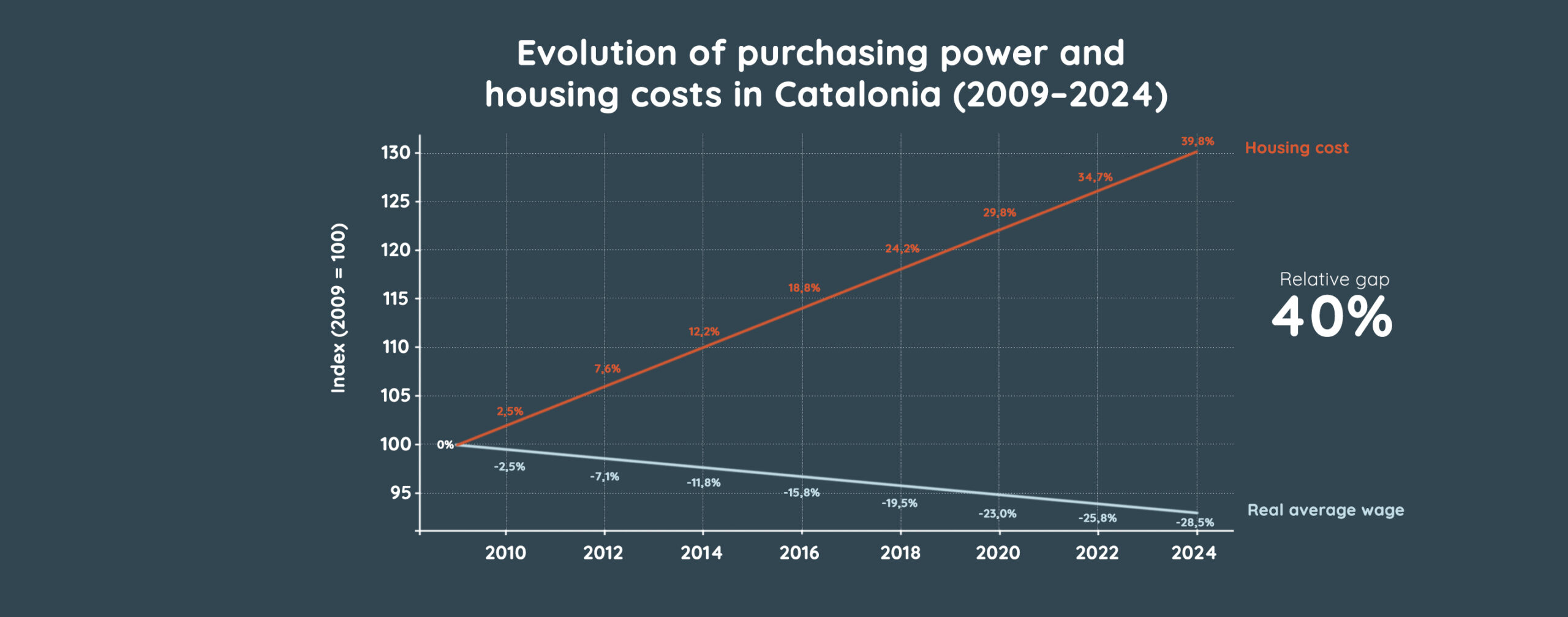
In fifteen years, the cost of living has risen by 30%,
but real wages have fallen by 7% in Catalonia. (Source: INE)
This fragmented labour model creates a permanently available and easily replaceable population. The worker cannot plan for the future or accumulate assets. When work ceases to provide stability and becomes a daily struggle for survival, the social contract breaks down.
Labour precarity is also civic precarity. A citizen without a horizon does not participate, protest, or demand — they simply survive. And that is perhaps the system’s new victory: transforming the worker into an obedient and exhausted consumer.
The Loss of Freedom and the Need for Economic Sovereignty
Economic insecurity silently erodes freedom. When everything depends on the month’s salary or a granted loan, personal autonomy fades away. We live in societies that appear free, yet are subjected to subtle forms of control: debt, technological dependence, and constant misinformation.
The challenge is to rebuild sovereignty. At the collective level, this means regaining control over basic resources —energy, housing, finance— and promoting resilient local economies. At the individual level, it means relearning self-management habits: saving, investing wisely, avoiding unnecessary debt, and embracing financial education as a tool for liberation.
Economic education is the key to transforming fear into power. When we understand how the system works, we no longer submit blindly to it. At 11Onze, we’ve long defended this idea: saving is sovereignty, information is freedom, and community is strength.
The path toward a less precarious society does not depend on waiting for external solutions but on building security from below —through cooperation and awareness. Perhaps Bauman was right: precarity is the new social bond. But there’s still time to turn that bond into a network of solidarity, not submission.
11Onze is the community fintech of Catalonia. Open an account by downloading the app El Canut for Android or iOS and join the revolution!

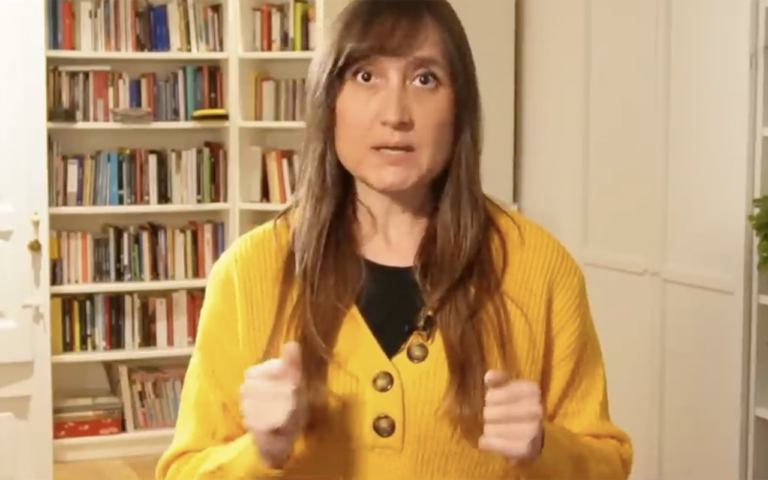

Food production generates one-third of global greenhouse gas emissions, yet it is insufficient for millions of people suffering from food insecurity. Some studies advocate for a shift towards a more sustainable system, focusing on both human and environmental well-being.
A report by the World Economic Forum’s New Frontiers in Nutrition community, in collaboration with Accenture, calls for a significant shift in strategy to transform the global food system based on human and planetary health. A pathway to a sustainable food system that would enable people to lead happier, healthier and more productive lives.
It is an initiative that integrates the public, private and community sectors, focusing on increasing the availability, access, and uptake of nutritious food choices, while keeping sustainability goals in mind. It underlines the need for cross-sectoral collaboration to transform food systems and policies with the ultimate goal of achieving a more equitable and sustainable food landscape with improved global health outcomes.
The initiative details the steps to follow for healthier diets, with an emphasis on nutrient-rich, minimally processed and predominantly plant-based foods. Key suggestions include encouraging the production of organic foods that are affordable and accessible, while strengthening the link between food and health in consumer awareness.
It also advocates for facilitating a retail environment that makes nutritious choices the default option. Although most indicators of inadequate diets affecting the most vulnerable sectors of society focus on malnutrition, malnutrition is also defined by a lack of vitamins, minerals, fibre, and other key micronutrients.
An economic opportunity in transforming food systems
The World Economic Forum’s findings are in line with another global report by leading economists and scientists at the Food System Economics Commission (FSEC), which finds that existing food systems destroy more value than they create, especially because of environmental and health costs.
A poor diet is also linked to an increased risk of common mental illnesses. Depression alone costs the global economy $1 trillion per year in lost labour productivity.
In this context, a study by the Food and Agriculture Organisation of the United Nations (FAO) estimates that the hidden environmental, social and health costs of current agri-food systems amounted to an additional 11 trillion euros in 2020.
In this sense, shifting to a more sustainable global food system could generate up to 7.9 trillion euros of benefits per year, as well as improving our health and alleviating the climate crisis. The cost of the transformation would therefore be far less than the potential dividends, providing a better life for hundreds of millions of people.
The study proposes to divert subsidies and tax incentives from large-scale monocultures that are destructive and dependent on fertilisers, pesticides and forest clearance, to small and medium-sized producers. At the very least, as an alternative to the current system that pushes farmers to run large, intensively industrialised farms.
However, the main challenge of a transition to this new agri-food model is the rising cost of food. A paradigm shift that requires not only consumer awareness but also taking into account the current economic situation, unless we want to see farmers’ protests turning into a globalised popular revolt.
11Onze is the community fintech of Catalonia. Open an account by downloading the super app El Canut for Android or iOS and join the revolution!

If you don’t quite understand why, despite living in a so-called meritocracy, your efforts are not rewarded, don’t worry, a computer model of wealth creation overturns the notion that economic success is linked to talent and individual effort, concluding that luck plays a much more important role.
The lottery of opportunity is handed out at birth, but we have little chance of winning. This seems to be the conclusion of the thesis defended by a group of scientists led by Alessandro Pluchino, professor of Theoretical Physics and Mathematical Modelling at the University of Catania.
Pluchino and his team developed a computer model that uses simulations to analyse the distribution of wealth and success in a hypothetical population, to test the extent to which factors such as human talent and luck play a role.
The aim was to dissect to what extent the role of chance influences the widely dominant meritocratic paradigm in Western cultures, which is based on the notion that success is mainly, if not exclusively, due to personal qualities such as talent, intelligence, skills, effort or risk-taking.
How does the computer model work?
The team fed data from a hypothetical population of people with the average distribution of talent and intelligence into the simulator. The computer model then generated a simulation equivalent to a 40-year working life, introducing fortunate and unfortunate events over time, which equate to opportunities to increase or decrease wealth.
Following this method, the researchers found that, more often than not, wealth is linked to luck rather than talent: “Our model shows that while it is true that some degree of talent is necessary to succeed in life, the most talented people rarely achieve the highest peaks, being outperformed by moderately talented but significantly luckier individuals.
In the end, the team checked whether the resulting wealth distribution matched that of the real world, where 80% of the population owns 20% of the wealth. And it did, again and again. Put another way, the results confirmed that, despite differences in talent and effort, chance plays a crucial role in determining who becomes extremely wealthy. This means that many talented and hard-working people will not be rich simply because they have not been as lucky as others.
On the other hand, the simulations also showed that opportunities are unevenly distributed. People who already have certain advantages, such as a good level of education or a good network of contacts, are more likely to encounter opportunities that can lead to large economic gains, while those who start from a less privileged position often find it more difficult to access the same opportunities.
If you want to find out how to get returns on your savings with a social justice product, 11Onze recommends Litigation Funding.



La tornada a la rutina després d’unes vacances sempre ha estat una mica feixuga. Però en els darrers anys, el fenomen conegut com a “síndrome postvacacional” s’ha convertit en una realitat força comuna per a moltes persones.
Malgrat que no es tracta d’una malaltia reconeguda, ni tampoc d’un trastorn clínic com la depressió, els seus efectes poden ser prou intensos per alterar el benestar emocional i la capacitat de concentració durant els primers dies —o setmanes— de retorn a la feina.
Aquest malestar s’expressa de formes molt diverses:
- Algunes persones senten una sensació difusa de desgana.
- Altres noten cansament físic sense causa aparent, dificultat per dormir, poca motivació o una irritabilitat persistent.
- Hi ha qui se sorprèn de no reconèixer-se, de no tenir ganes de reprendre la feina ni les activitats habituals, ni tan sols les que normalment li agraden.
En el fons, el cos i la ment estan fent un esforç d’adaptació a un canvi brusc de ritme. I aquest procés, lluny de ser immediat, pot trigar dies a resoldre’s.
Per què ens passa?
Les vacances suposen una alteració substancial de les nostres rutines. El rellotge s’atura, els horaris s’alliberen, la ment es desconnecta del soroll constant del dia a dia i recuperem una mica de control sobre el nostre temps. Aquesta sensació de llibertat, de respir, és precisament el que s’esvaeix quan arriba l’hora de tornar. I no tothom ho encara igual.
La situació actual tampoc hi ajuda. Vivim en un context marcat per la incertesa econòmica, la precarietat laboral i una exigència constant que sovint ens manté en estat d’alerta. Si a tot això hi sumem una tornada abrupta al món laboral —de vegades amb agendes plenes des del primer dia—, no és estrany que el cos i la ment protestin.
Prevenir el xoc de tornada
Aquest malestar, però, no és inevitable. De fet, es pot prevenir o, com a mínim, alleugerir si es fa una tornada intel·ligent i progressiva. El primer consell que molts especialistes comparteixen és evitar tornar de vacances el dia abans de reincorporar-se a la feina. Reservar-se dos o tres dies de transició ajuda a posar ordre, descansar, preparar la logística familiar i planificar amb calma la setmana. És un marge que ens permet reconnectar a poc a poc amb la realitat quotidiana.
També és útil reprendre les rutines de descans uns dies abans. Recuperar uns horaris de son més regulars —anar a dormir i llevar-se a la mateixa hora cada dia— permet que el cos es vagi reajustant. Sovint oblidem que el nostre sistema nerviós necessita pautes estables per funcionar bé, i un dels factors clau és el descans reparador.
Trobar espais de benestar dins la rutina
Un altre element fonamental per fer més suportable la tornada és mantenir alguna activitat gratificant fora de la feina. Les vacances no haurien de ser l’únic espai de plaer de l’any. Fer esport, caminar, ballar, cuinar, veure amics… qualsevol d’aquestes activitats pot ajudar a contrarestar l’estrès i estimular la producció d’endorfines, les hormones naturals del benestar. En definitiva, es tracta de no passar d’un extrem a l’altre, sinó de conservar espais de qualitat dins de la rutina.
També pot ser molt útil fixar-se petits objectius motivadors a curt termini. No cal que siguin grans fites: una excursió el cap de setmana, un concert, començar un nou curs, reprendre una afició oblidada… Qualsevol estímul positiu ens pot ajudar a veure que la vida quotidiana no és només feina i responsabilitats. I, de retruc, ens ajuda a reconstruir una certa il·lusió de cara al futur immediat.
I si el malestar no desapareix?
Ara bé, cal estar alerta si els símptomes persisteixen més enllà de les dues o tres primeres setmanes. En aquest cas, potser no estem davant d’una simple síndrome postvacacional, sinó d’una insatisfacció més profunda amb la feina, d’un desgast emocional acumulat o, fins i tot, d’un trastorn de salut mental que requereix atenció. No podem normalitzar un malestar crònic ni resignar-nos a viure amb l’ànim per terra. Si cal, convé consultar amb un professional que pugui orientar-nos.
En el fons, la síndrome postvacacional ens fa una pregunta incòmoda: vivim al ritme adequat? Si la resposta és que no, potser és hora de revisar les nostres prioritats i d’explorar formes de viure més sostenibles, més humanes. Potser la tornada a la feina no hauria de ser un xoc, sinó una oportunitat per fer les coses una mica millor.
11Onze és la fintech comunitària de Catalunya. Obre un compte descarregant l’app El Canut per Android o iOS. Uneix-te a la revolució!



Bio-construction or sustainable architecture are hashtags that go along with conventional architecture to revolutionise it, from the foundations up, with a key premise: human beings must live inside houses. An idea as obvious as it is challenging. We spoke to the architect and expert in bio-construction, Sonia Hernández-Montaño.
Have you ever wondered what materials your home has been built with, what lighting prevails, or how the distribution of spaces is affecting your mood? Arquitectura sana is the name of the project, and also the philosophy, that Sonia’s team took to Catalonia in 2009 with the aim of making our homes more habitable from a human and well-being point of view.
Most of our time is spent in enclosed spaces, but we are generally unaware of the extent to which these spaces can have a direct impact on our physical and mental health. In a new episode of People, Hernández-Montaño highlights all the elements and practices we need to take into account to improve our lives.
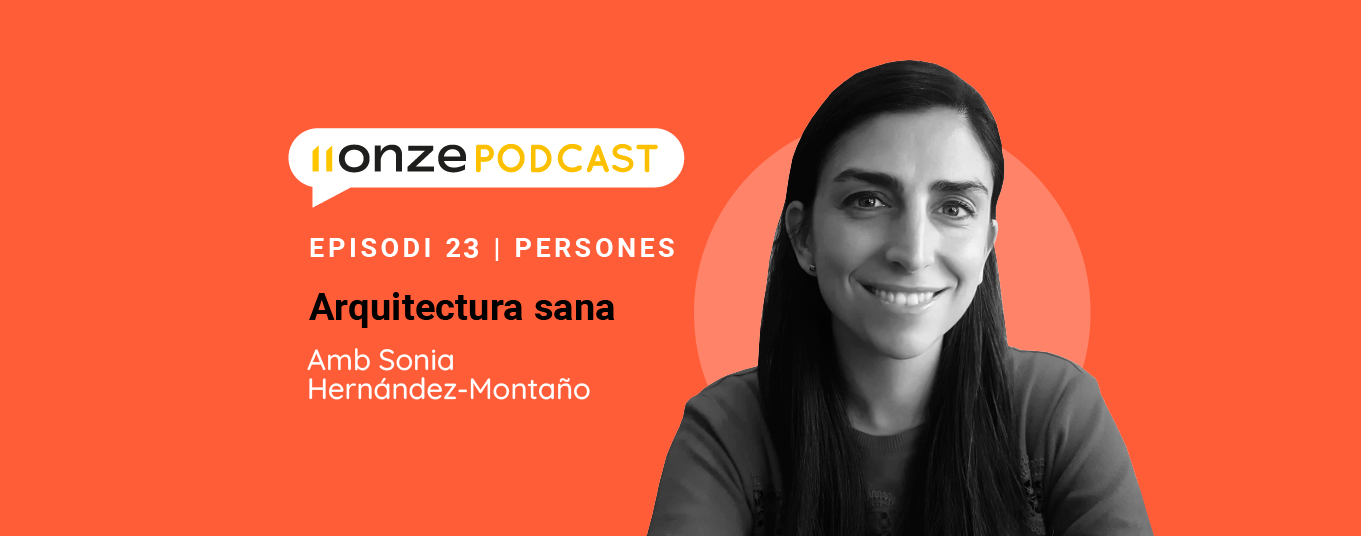
Episode 23 | People: Healthy architecture
The unseen well-being
Construction is constantly evolving, and in recent decades has incorporated technological elements and new materials. Hernández-Montaño points out, however, that “along the way we have forgotten that there are people inside buildings, that buildings not only have to consume less energy and minimise the resources used, but that we also have to sustain life inside”. He argues that we are all architects, and we can all use this health tool to support people’s well-being.
Among the most important aspects, we find some key actions to maintain the quality of life inside the spaces, starting with ventilation, a key point if it is carried out in the right way and that can even reduce pollution that may come from outside. The second key point is lighting, the “conductor of our biological clock” which has to change according to the time of day to follow our circadian rhythm.
It is also essential to take into account and reduce the presence of pollutants in the interior spaces, an objective that is reflected in the choice of materials, whether in construction, furniture, or cleaning products. Listen to the entire conversation to discover the rest of the tips that will make your home a healthy space.
If you want to discover how to drink the best water, save money and help the planet, go to 11Onze Essentials.



There are now more mobile devices in the world than people. Mobile phones have changed the way we live, work, communicate and even our quality of life, wellbeing and health.
An app is a standalone piece of software that is made to perform a specific task and is optimised for use on smartphones, tablets or smartwatches based on the features available. Health apps are known as mobile Health (mHealth), and according to the World Health Organization (WHO) it is a “delivery of health information and services using mobile technologies”.
What is a health application?
It falls within the field of eHealth, understood as the use of communication and information technologies applied to health services (computers, mobile phones, GPS, connected medical instrument monitors, medical robots, etc.). These are computer programmes that are used on mobile platforms and are often connected to medical devices that tell us how to improve our health or prevent risks. There are also diagnostic applications for treating patients or communicating with our healthcare system.
The European Commission states that medical and public health practice is compatible with mobile phones, patient monitoring devices, personal digital assistants and other wireless devices. It also includes in this category applications related to health information to the population, medication reminders sent by SMS, telemedicine, training and guidance systems and even lifestyle and wellness applications created with the aim of maintaining or improving the population’s healthy habits through the practice of sport and wellness.
How are they monitored and what quality criteria is used?
In Catalonia, a method for evaluating mobile health applications using objective variables, called iSYScore, has been used for some time now.
The criteria used by iSYScore to select the most suitable mobile health apps is based on the opinions of users, developers and health professionals, and is based on three key factors: popularity, trust and usefulness.
What are the problems with these applications?
Basically, the lack of loyalty. There are few apps that have achieved long-term stability. A study confirms that 70% of chronically ill people who have used them stop using them after six months. And 80% of apps are abandoned after only two weeks. To improve these figures, personalisation based on different profiles would be advisable. Each person is unique, and these apps act in a generic way.
Another problem to be faced is that of data ownership and data protection, as well as the loss of credibility the product may have if it doesn’t work for the first users who try it.
Tips for choosing a reliable application
- Be informed: Search and compare applications on search engines such as Google.
- Reviews: Search forums for user opinions.
- List of options: Choose between 4 or 5 applications.
- Reliability: Make sure they are based on scientific evidence, and a good place to do this is to look for references in PubMed (National Center for Biotechnology Information).
- Test: It would be advisable to test (try out) the application with a friend. If, for example, you suffer from insomnia, it is important that your friend does not suffer from insomnia so that you can share how it went.
- Who is behind it? To be a quality (reliable) application, it is important that technicians, health professionals (who will be different depending on the purpose of the product) and experts in legislation and data management have been involved in the process.
- Obsolescence: Clinical studies require time and in the world of new technologies time passes very quickly and therefore needs to be taken into account.
Following these simple steps will ensure that the applications you use are quite reliable.
11Onze is the community fintech of Catalonia. Open an account by downloading the super app El Canut for Android or iOS and join the revolution!