Litigation Funding: it's time to make money!
After the latest ECB rate cut, Spanish banks have reduced even further the already low returns they offer on deposits, which barely compensate for inflation. We offer you an alternative that triples the yields of a fixed-term deposit.
After almost a decade of zero interest rates, the returns on Spanish bank deposits are still at an all-time low and 25% below the European average. The banking sector continues to fail in offering deposits with interest rates that compensate for inflation to its customers, who do not see an improvement in savings remuneration.
Although at the beginning of September the European Central Bank (ECB) cut interest rates by 25 basis points, reducing the reference rate by a quarter of a point to 3.5%, banks have cut the remuneration of deposits to protect or increase their profits. The best Spanish banks’ fixed-term deposits offer interest rates of up to 3.6% for a one-year term, while the average yield is 2.4%, compared to the 3.2% offered by European banks.
With this low remuneration for their savings offered by large banks and the collapse of Treasury bills in the latest auctions, customers see their alternatives for obtaining a good return on their savings reduced. Even so, there are still other options that allow us to more than compensate for inflation and protect our savings.

Triple the return of a fixed-term deposit
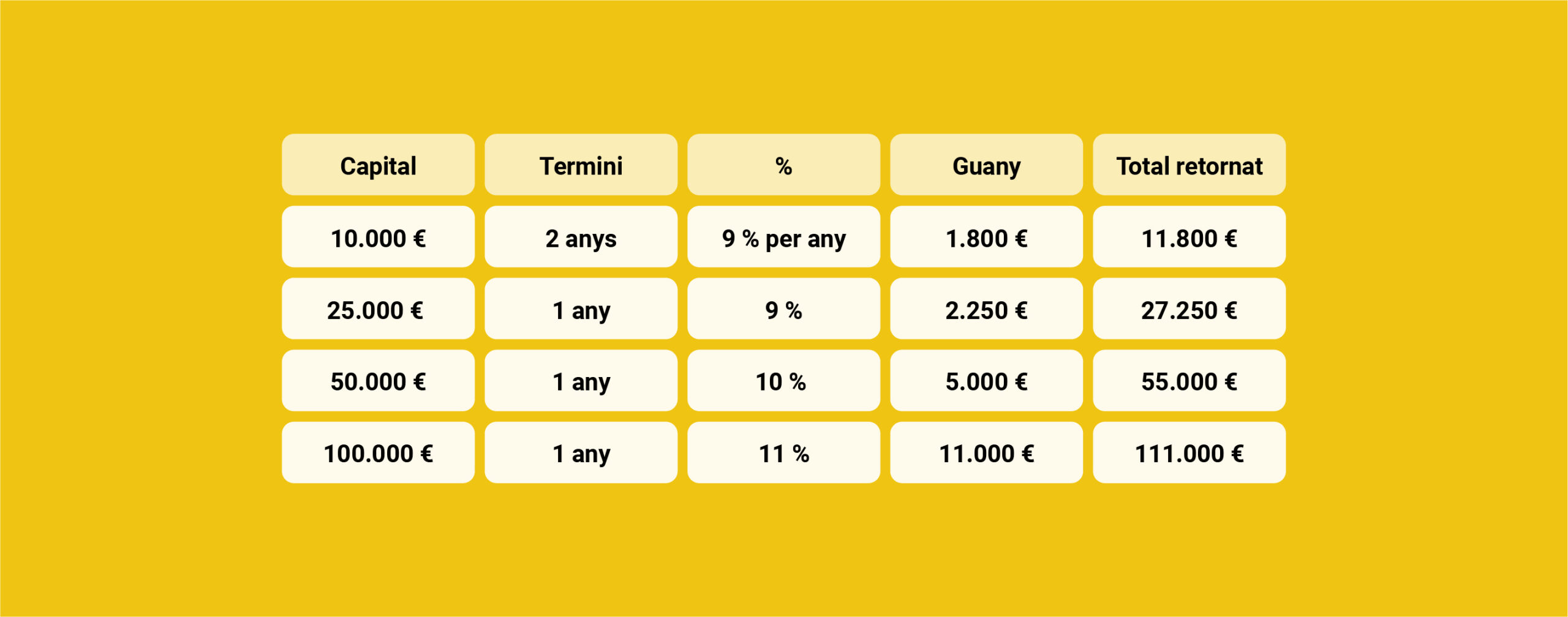
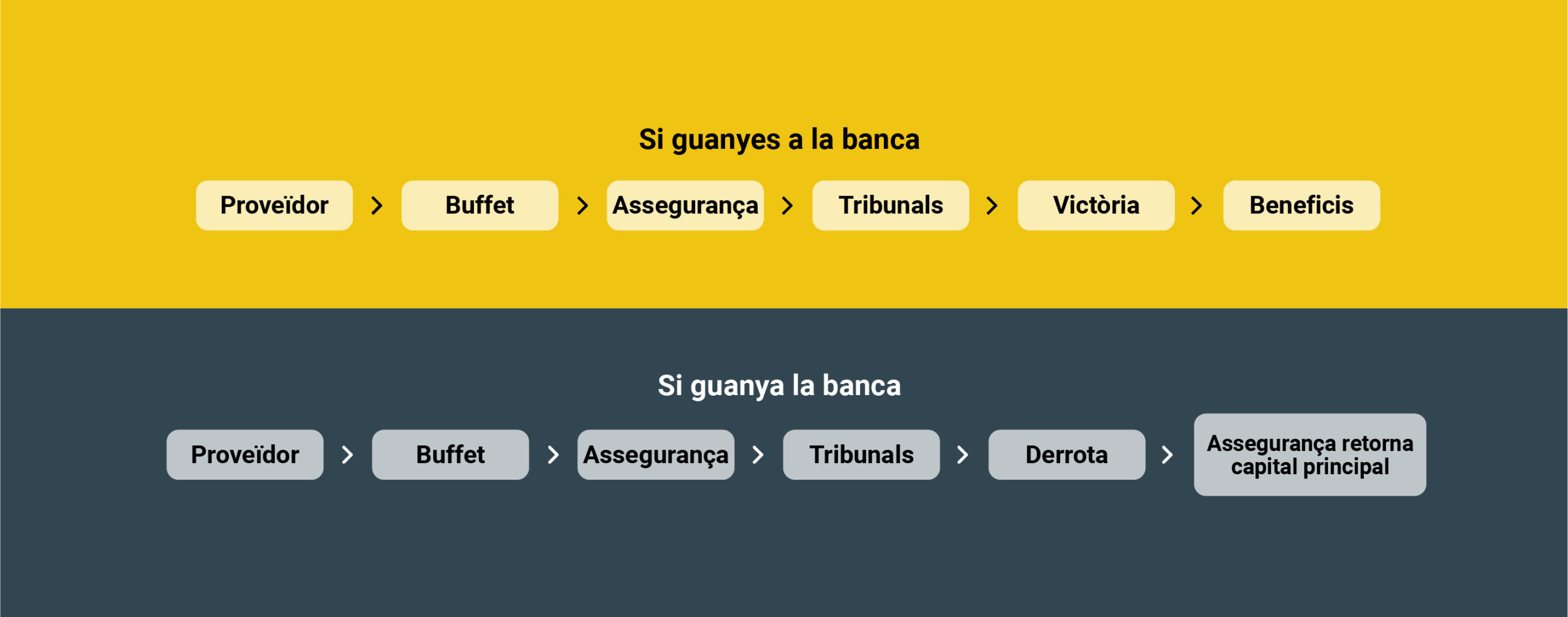
Litigation Funding, which 11Onze recommends, offers returns ranging from 9% to 11%, depending on the amount contributed, by financing the legal costs of law firms pursuing claims against banks and institutions that have used illegal practices against their clients.

This is a social justice product that offers high returns at very low risk and has been structured exclusively for members of the 11Onze community. You have two ways to participate: a first option that returns your capital and possible profits after one year, or a second option where your capital works for a few years and provides you with a monthly return after six months.
At the request of our community, we now offer the possibility of a group contribution, either among family or friends, so that the financing can be shared, but maintaining the percentage of the profits. Therefore, 11Onze makes it easy if you want to put your savings to work and get returns well above those offered by traditional banks.
If you want to find out how to get returns on your savings with a social justice product, 11Onze recommends Litigation Funding.


Litigation Funding, which 11Onze Recommends, is simplified and adds housing claims. It achieves returns of between 9% and 11% for a minimum contribution of €10,000.
At the request of its community, 11Onze has worked to get its UK provider to offer the best conditions on one of the products that 11Onze Recommends: Litigation Funding. What are the improvements?
A simplified calculation
Litigation Funding will provide a fixed annual return. Until now, the return was calculated according to the average inflation rate in Spain during the period of the litigation. To make the calculations simpler, the returns will now range from 9% to 11% depending on the amount contributed.
More affordable access
Until now, Litigation Funding was designed for people who could contribute a minimum capital of €25,000. Now, however, the entry barrier has been lowered to allow savers from €10,000 to participate. In the case of the minimum contribution, however, the duration of the contract is two years at 9% per annum.
Social housing claims
In the UK, if you live in rented social housing that is in poor condition, the law requires the landlord to make repairs to ensure a decent standard of living. But the UK has the oldest housing stock in Europe, as many of the buildings were built during the industrial revolution and the Victorian era. Although these dwellings are appreciated for their aesthetic features, their age requires a conservation and maintenance effort that is not always carried out.
Many of these dwellings are owned by local councils or Social Housing Associations, which are creating a grievance for tenants with few resources.
Profit and social justice
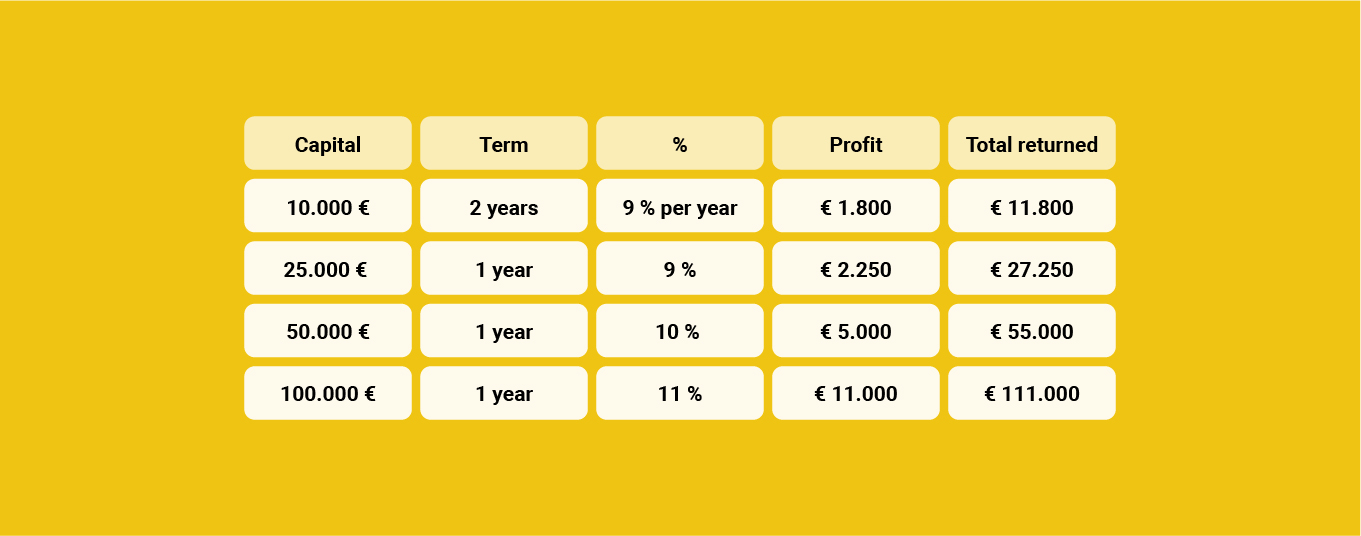
Litigation Funding that 11Onze Recommends is a social justice product because it lets us finance lawsuits against banks and institutions that abuse citizens. Right now, our UK provider is arranging litigation funding with a win rate of over 90%. This is due to the fact that many large banks have been proven to have committed illegal practices against their clients and have had to provide more than 60 billion euros. For their part, municipalities are responsible for having neglected their social housing, causing damage to tenants who will have to be compensated. Litigation Funding, which 11Onze recommends, enables these claims to be pursued by financing the court cases of the pertinent law firm. In return, the profits are shared between the plaintiffs and those who finance the lawsuits.
Safer and more profitable?
Litigation Funding is a product that in the short term, for 1 or 2 years depending on the amount, generates high returns, between 9% and 11%, well above the average of Spanish investment funds (1.91% average return in the last 15 years) or the returns of the accounts offered by Apple to its American clients. Apple offers 4.5% while the minimum return of Litigation Funding is double this amount. In any case, it is a low-risk product because the capital contributed by the litigation is insured with an AM Best insurance that fully covers it, regardless of the amount contributed.
If you want to find out how to get returns on your savings with a social justice product, 11Onze recommends Litigation Funding.



The report commissioned by the European Commission from former ECB president Mario Draghi proposes an 800 billion euro investment and tax cuts to improve the EU’s competitiveness with the US and China. Is it feasible?
In his long-awaited report commissioned by the European Commission on how to improve European competitiveness, former European Central Bank President Mario Draghi details a strategic plan to cope with growing global competition. Although the report identifies Europe’s main challenges, it includes some questionable and difficult-to-implement recommendations.
Draghi presents an ambitious proposal that touches on strategic sectors such as energy, telecommunications, defence, and automotive through structural reform in European economies. Aiming to close the gap with China and the US, Draghi warns that the EU faces an ‘existential challenge’ and the threat of ‘losing its raison d’être’ if it does not significantly increase investment and reform its industrial policy.
The former banker points out that Europe has fallen behind the US and China in the productivity and innovation race, and argues that the European continent needs investments twice the size of the Marshall Plan and much more innovation. In this context, the paper calls for large public debt-financed investments of up to 800 billion per year in key areas such as the green transition, digital transformation and general reindustrialisation.
Main objectives of the Draghi plan
The 300+ page document focuses on four core pillars: decarbonisation, innovation, competitiveness and security, warning that Europe is failing to take advantage of its breadth and scale because of fragmentation and lack of coordination. In this regard, it puts forward several proposals to reduce regulation and improve decision-making, as well as to exponentially increase cooperation between national governments that has so far proved difficult for member states to agree on.
In the energy sector, it proposes lowering and equalising energy taxes in different EU countries, setting a common cap on electricity and gas surcharges, as well as granting tax credits to industries linked to the use of clean energy solutions to decarbonise the sector.
This means massively increasing investments in infrastructure and green energy while reducing regulation, to return to solid and steady growth. Similarly, the document calls for diversifying natural gas supply arrangements and developing new strategic natural gas supply infrastructure, while coordinating storage between member states.
While the report supports the reduction of CO₂ emissions, it questions the setting of ambitious decarbonisation targets without it being backed up by a solid supply chain transformation strategy, as has been the case for the car industry, and criticises Brussels’ failure to back it up with a strategy to boost battery and recharging point manufacturing to a sufficient extent. The automotive sector is a key example of the lack of planning in the EU, which implements a climate policy without an industrial policy’, it says.
On the other hand, the study promotes the creation of robust digital infrastructures, as well as investment in artificial intelligence and emerging technologies, as the competitiveness of the European economy will increasingly depend on digitisation and the development of new technologies.
In this regard, he warns of the current dependence on imports of these technologies and the lack of European companies with the capacity to compete with their US and Asian rivals. It argues that a paradigm shift in this sector will necessarily involve institutional support for emerging technology companies and mergers between telecoms companies to avoid fragmentation and boost EU autonomy.
Similarly, according to the report, EU countries buy too much defence equipment abroad, almost two-thirds from the United States, and do not invest enough in joint military projects. Therefore, in order to reduce dependence on third countries, it will be imperative to develop an EU defence industrial policy that improves funding and incentive mechanisms to boost European industrial solutions.
Criticisms and challenges ahead
Divisions among some countries over the viability of the Italian technocrat’s plan have not been long in coming. Germany and the Netherlands have expressed concern about the impact of some proposed reforms, as a first warning that some recommendations may not be politically feasible.
‘Joint EU indebtedness will not solve the structural problems: companies are not lacking in subsidies,’ German finance minister Christian Lindner, leader of the liberal FDP party, wrote in X. ’They are bound by bureaucracy and a planned economy. ‘They are bound by bureaucracy and a planned economy. And they have difficulties in accessing private capital. We have to work on this.
‘More money is not always the solution,’ Dutch Finance Minister Eelco Heinen, a member of the conservative People’s Party for Freedom, was quoted as saying by Dutch news agency ANP. Finance Minister Dirk Beljaarts of the far-right Party for Freedom (PVV) made a similar assessment: ‘Additional public investments are not an end in themselves, they are only necessary in case of unfair competition or market failure’.
Other critical voices argue that the report lacks a fundamental economic justification for the role of the state as an active investor, especially in terms of transferring high entrepreneurial risks to taxpayers. On the other hand, protectionist measures that make it easier for European firms to grow in isolation from non-EU competitors are likely to conflict with other objectives and neuter innovation.
Implementing these reforms in an institutional framework as complex as the EU’s can be difficult and slow, and it is clear that some Member States are better placed to take advantage of the opportunities detailed in the report than others with less infrastructure, industry, or reliance on more traditional sectors, others, which could be left behind.
Given the massive investment required, it will not be easy to raise the necessary finance. Particularly for the most indebted economies, which may find it difficult to justify this new expense without clearly defined country objectives and detailed direct benefits to their taxpayers.
11Onze is the community fintech of Catalonia. Open an account by downloading the app El Canut for Android or iOS and join the revolution!


According to the annual survey carried out by the OCU, this year’s school year in Catalonia will cost an average of 2,700 euros per pupil, almost 400 euros more than last year. School materials alone could cost more than 500 euros per pupil on average.
On Monday 9 September next week, the school year starts in Catalonia and, despite the recent fall in the CPI, this year’s ‘back-to-school’ will be the most expensive since records began. Spending per pupil will be 13% higher than last year, which was already a record year.
The report drawn up by the Organisation of Consumers and Users (OCU) calculates that Catalan families will spend an average of 2,708 euros per pupil during the school year. This figure places Catalonia as the third most expensive autonomous community, behind Valencia (2,725 euros) and Madrid (3,422 euros).
The level of studies influences the cost, but one of the most determining factors is the school chosen. The average annual cost in a public centre is 1,200 euros per student, while in a subsidised centre it rises to 3,396 euros and in a private centre it can be as much as 7,961 euros.
Averting the red numbers in the family account
Uniforms, textbooks, and other school materials alone can cost more than 500 euros on average per pupil. This is an expense for which the Generalitat gives a 60-euro voucher to help primary and secondary school pupils, designed for families who cannot afford the cost.
The OCU recommends that, before starting to buy, we make a list of all the school supplies we already have at home that can be reused without the need to buy new ones. In other words, buy what is necessary and no more. He also points out that it is not necessary to buy everything at the beginning of the school year, as there are school materials that students do not need until later on.
Likewise, when it comes to books for recommended reading, we always have the option of going to a library. For textbooks, we can consult the free book programmes available in the autonomous communities through the schools or even consider buying second-hand books.
11Onze is the community fintech of Catalonia. Open an account by downloading the app El Canut for Android or iOS and join the revolution!



ACCIÓ has recognised this year’s 10 most innovative companies with the Catalonia Exponential Leaders’ award. They specialise in artificial intelligence, robotics and blockchain technologies, and are focused on revolutionising the fields of health, mobility, energy and food.
To give visibility to start-ups and companies that challenge established norms and reshape themselves through innovation, the Agency for Business Competitiveness (ACCION) organises the event known as ‘Catalonia Exponential Leaders’ every year.
In this year’s edition, a total of 213 projects were presented, of which 74% are emerging companies or start-ups and the rest are consolidated companies. The 10 chosen companies specialise in sectors and fields such as health and life sciences, mobility, energy, and food.
- BlindStairs. The platform proposed by BlindStairs works like an ‘anonymous Linkedin’. Its innovation begins with its anonymisation methodology, with a proprietary system of specialised AI models to anonymise professional profiles, to a level that until now has been unfeasible to automate and scale, eliminating any type of bias by gender, age or any other socio-demographic factor.
- Cuatrecasas. The Cuatrecasas law firm has been working in the field of generative artificial intelligence since 2015. Grouped under the CELIA division (Cuatrecasas Legal Expert – AI), they have enabled the firm to improve the quality, efficiency, and impact of its legal services. For example, the Harvey project, a digital legal assistant capable of answering legal questions and making legal comparisons and strategies, already has more than 1,000 users.
- Magnetika. This company offers a new wireless charging solution for electric vehicles, such as electric bicycles, urban vehicles, mobile robots or drones. New wireless charging solutions are changing the market, offering a more efficient, convenient and sustainable alternative to conventional wired or contact charging.
- Navozyme. Leading the transformation of the maritime industry with disruptive solutions that use blockchain technology to introduce pioneering electronic certificates, ensuring data integrity and real-time verification of documentation during port processes. In addition, thanks to the use of artificial intelligence to analyse data in real-time, Navozyme optimises the arrival of ships in port, reducing waiting times and minimising the carbon footprint.
- Ocean Ecostructures. Ocean Ecostructures has developed a technological solution to offset the impact of port and offshore structures by regenerating marine biodiversity. This solution is based on the installation of biomimetic, multi-technological and digitally monitored micro-shells (LBU) using robotic technology and AI.
- Oniria Therapeutics. Oniria Therapeutics is focused on the fight against cancer by offering an innovative approach to the oncology market with the oral drug ONR-001 (currently at TRL 4/5). This drug achieves, for the first time, over-activation of TET2, an essential tumour suppressor and dynamic factor that modulates many aspects of the tumour cell related to cancer persistence. It aims to reduce patient relapse or persistence and resistance to current treatments, which are responsible for 90% of cancer deaths.
- ScentXP. The technologies developed by ScentXp aim to reinvent the olfactory industry, starting with perfumery and cosmetics, transforming the industry’s value chain by orienting it towards digitalisation, sustainability, visualisation and graphic representation of odours, making it more democratic, transparent and accessible.
- Suara Cooperativa. Suara Cooperativa’s Social Digital Lab is implementing new services to improve people’s mental and physical health and wellbeing, using immersive and virtual reality. These services are materialised thanks to collaboration in three areas and between three actors: the social axis, Social digital Lab, the technological axis, Broomx, and the scientific axis, Consorci Sanitari de Terrassa.
- Time Is Brain. For every hour it takes to receive treatment for a stroke, the chances of recovery fall by 20%. In this context, Time Is Brain has developed BraiN20, a medical device in the form of an easy-to-install tablet that uses sensors to monitor the brain’s viability in real-time.
- Uobo. Despite the exponential growth experienced in recent years in terms of alternatives to animal products, there is little in the way of products that can replace chicken eggs. Uobo markets a 100% vegetable liquid egg mixture that offers the same versatility as traditional eggs and makes it possible to prepare all kinds of dishes without having to resort to the exploitation of animals.
11Onze is the community fintech of Catalonia. Open an account by downloading the app El Canut for Android or iOS and join the revolution!


Despite the increase in the tax burden, the Tax Agency has collected 55% less than it had planned to collect and 34% less than in the previous year. What explains the final result and the discrepancy between forecasts?
Although 24,013,000 million tax returns have been completed, 4.9% more than last year, the Tax Agency has collected less than half of what it had planned at the start of the 2023 Income Tax Campaign.
According to elEconomista‘s analysis of the official data, a total of 16.2 million returns have resulted in a refund of 13,576 million euros, compared to the 11,650 million that had been expected. Therefore, taking into account the lower collection and the increase in the amount to be returned, the net collection will be 3,216 million euros, 55% less than the 7,258 million euros expected to be paid this year and 34% less than the 4,900 million euros collected in 2022.
These figures may seem contradictory when taking into account the increase in the tax burden and the fact that the Spanish economy grew by 2.5% in 2023, five times higher than the eurozone average. Specifically, domestic demand accounted for 1.7 points of growth in 2023, while external demand accounted for the remaining 0.8%. So how can this drop in revenue be explained in the face of GDP growth and tax rises?
Has the data been manipulated?
Marc Vidal, technology and economic analyst, has examined the results and points out that the government’s forecasts are unreliable, as they are based on data that do not reflect reality: “The tendency to manipulate the data to make them look more favourable generates serious distortions, and this is a clear example of it”.
On the other hand, Vidal does not rule out the possibility that the increase in taxes is stifling people. “It is possible that the higher tax burden and the increase in taxes are reducing the capacity of Spaniards to generate wealth or invest, which in turn reduces the final tax collection”. A fact confirmed by the latest report presented by the Institute of Economic Studies (IEE), according to which the tax burden in Spain is almost 18% higher than the European Union average. This places Spain among the OECD economies with the highest taxation, in 31st position out of the 38 countries analysed.
This situation can end up hurting economic activity, so that tax revenues and refunds are not spent on goods, services or investments, but rather on survival. As the analyst warns: “A government that does not know how to reduce the size of the administration and believes that everything can be solved by raising taxes will only amplify this disconnect between what it wants to receive and what can be given”.
To discover the best option to protect your savings, enter Preciosos 11Onze. We will help you buy the safe-haven asset par excellence at the best price: physical gold.


The latest data from the Tax Agency show that the Spanish state has never had so many ultrarich citizens. Inflation, soaring rents, stagnant salaries and job insecurity do not affect the highest incomes, which have risen 25%, setting a new record.
The number of citizens with an annual income of over 601,000 euros has increased by 25% to 15,200 individuals, a record figure that exceeds the 12,200 achieved in 2021. These are the figures from the latest report on personal income tax returns for the 2022 tax year published this month by the Tax Agency.
Although this data only amounts to 0.07% of the total number of IRPF filers since the start of the economic crisis in 2007, the number of taxpayers who have declared incomes of over 601,000 euros has grown by 43.5% from the 10,580 individuals who earned this income more than a decade ago.
This reality is far removed from most taxpayers, 21.27% or 4.9 million of whom declared between 30,000 and 60,000 euros per year, and a further 4.8 million declared incomes of between 12,000 and 21,000 euros (21.02% of the total).
On the other side of the coin, we find 1.4 million taxpayers (6.18% of the total) who were in the lowest bracket, between 0 and 1,500 euros for the whole year, while a total of 1.2 million tax returns, 5.61% of the total, were 0% or negative, and this includes recipients of the Minimum Living Income (IMV).
Large fortunes grow by 5.6%
According to Capgemini Research Institute’s World Wealth Report 2024 released last Friday, the number of high-net-worth individuals and their capital rose to record levels last year, driven by a recovery in the global economic outlook.
Specifically, the study looks at the number of people in the world who have at least $1 million in investable assets, excluding their primary residence and collectables. In total, their wealth has increased by 4.7% globally, to 86.8 trillion dollars.
In the case of Spain, 250,600 people enjoy a high net worth, 5.6% more than in 2022, placing Spain in 15th place out of 25 in the ranking of countries by millionaire population. These statistics confirm that despite the economic turbulence, there are more and more rich people than ever before and that the wealth gap between social classes keeps increasing.
Fund lawsuits against banks. Get justice and returns on your savings above inflation thanks to the compensation the banks will have to pay. All the information about Litigation Funding can be found at 11Onze Recommends.


The eurozone’s accumulated public debt, first as a result of the banking sector bailout and later as a consequence of stimulating economies hit by the pandemic, remains at an unsustainable level. Spain remains among the most indebted countries in Europe, with a debt-to-GDP ratio that rose by 1.2 points year-on-year in the first quarter of the year.
Public debt is the volume of money that a state has borrowed directly or through the financial markets or, in other words, all unsettled payment obligations. It is a government’s tool for deferring its expenditures over time to fulfil the functions it has committed itself to.
By itself, sovereign debt is not necessarily a bad thing; it can serve as a lubricant to stimulate a stagnant or recessionary economy. It is often used in the first instance to slow down a slowdown in exceptional situations through aid and fiscal stimulus to prevent the destruction of the productive fabric.
This is what happened during the pandemic when governments around the world were forced to inject large amounts of money into their economies, exponentially increasing their sovereign debt to avoid a total collapse of the means of production.
As a general rule, however, this investment has to be accompanied by structural reforms that seek to improve the efficiency and competitiveness of the economy. Otherwise, public deficits can get out of control, perpetuating a sovereign debt that may end up being unsustainable.
That said, borrowing to make an investment that will generate value for the economy is not the same as borrowing to cover uncontrolled spending. It should also be borne in mind that some countries can afford high levels of debt because the financial markets have confidence in their ability to pay, thanks to the stability of their economies or their national currency.
The debt-to-GDP ratio
Although other variables are taken into account, the ratio of public debt to GDP is a key metric in the analysis of a country’s debt sustainability. In this respect, the eurozone countries barely cleaned up their public accounts in 2023.
According to an analysis by the Bank of Spain that consolidates the transactions between the different layers of the public sector, the Spanish state has gone from having a public debt of 384,662 million euros in 2007 to more than 1,668,440 million this year. This is a figure equivalent to 114.1% of GDP, which is almost 7 points higher than the official figure given by the government (107.7% of GDP, an increase of 1.2 points over the previous year) and far exceeds the EU average for the same indicator (95.9% of GDP).
Countries such as Greece, Italy and France are in a worse situation, partly thanks to the good performance of the Spanish economy, which grew by 2.5% in 2023 and far outperformed the euro area average. This contributed to the fact that the public debt-to-GDP ratio fell by 3.9 percentage points over 2023.
Fiscal imbalances are too high
In its latest report released last Wednesday, the European Fiscal Council equivalent to the Independent Authority for Fiscal Responsibility (AIReF) warns that in recent years, public spending has accelerated significantly in many eurozone countries, well beyond the temporary measures taken in response to the Covid-19 crisis and the subsequent rise in energy prices.
In this regard, it expects fiscal deficits in 2024 to turn out higher than previously projected and recommended. It adds that it is likely that the euro area will have to enter 2025 with a higher level of budgetary support than previously forecast.
Moreover, the organisation warns that Spain remains among the most indebted countries in Europe and that its debt has increased the most as a result of the sanitary crisis. Therefore, it will have to make adjustments of 7,000 million per year from 2025 and calls on the Spanish government to make an “extra effort” to adjust before reaching this scenario.
If you want to discover the best option to protect your savings, enter Preciosos 11Onze. We will help you buy at the best price the safe-haven asset par excellence: physical gold.


Els éssers humans posseeixen valors morals intrínsecs que regeixen part del seu raonament i comportament. L’evolució dels nostres hàbits de consum segueix aquesta naturalesa humana o ens deixem portar pel context econòmic i corrents socials del moment? Mireia Cano, cap d’agents d’11Onze, ens fa reflexionar sobre la relació entre la teoria de la llei natural i el consum responsable.
Els principis sobre els quals es basa la distinció entre un comportament correcte i incorrecte, el bo i el dolent, són característiques de conducta en part regides per la condició humana. Les normes culturals del moment defineixen les pautes morals acceptables per la societat. Dit això, hi ha valors morals i ètics, coneguts com la llei natural, que han perdurat al llarg del procés d’evolució de l’ésser humà gràcies a la necessitat més elemental de sobreviure i conviure en societat, i en harmonia amb l’entorn natural que ens envolta.
Ara bé, com a consumidors, les decisions que prenem en el nostre dia a dia estan en concordança amb aquesta llei natural? Mireia Cano ens planteja aquesta pregunta: “Comprem de forma conscient per naturalesa o ens deixem endur per les lleis socials?”, i ens insta a fer una reflexió sobre en quin món desitgem viure “des d’un punt de vista mediambiental, econòmic i pensant en la distribució de la riquesa”.

Comprant el futur
Consum conscient i responsable
Consumir d’acord amb els nostres valors no sempre és fàcil o convenient, i sovint entrem en contradiccions. La cap d’agents explica que “són coses que tots sabem, però sovint ens refugiem en el discurs que les nostres accions, com ara reciclar, són tan petites que no valen la pena”. Això és un error perquè, com puntualitza Cano, “es tracta de totes les decisions de consum que prenem, des del menjar, els subministraments o la roba”.
És comprensible que en èpoques de crisi la preocupació per l’economia familiar pesi més que l’ètica. La inflació desbocada i la crisi energètica han disparat el preu de molts productes i castrat el poder adquisitiu de molts consumidors. Però Cano assenyala que potser la clau està a replantejar el sistema en què vivim, “nosaltres, com a consumidors, tenim el poder de decidir per quines empreses apostem i, per tant, quines volem que siguin les empreses del futur”.
Si vols rentar la roba sense embrutar el planeta, 11Onze Recomana Natulim.



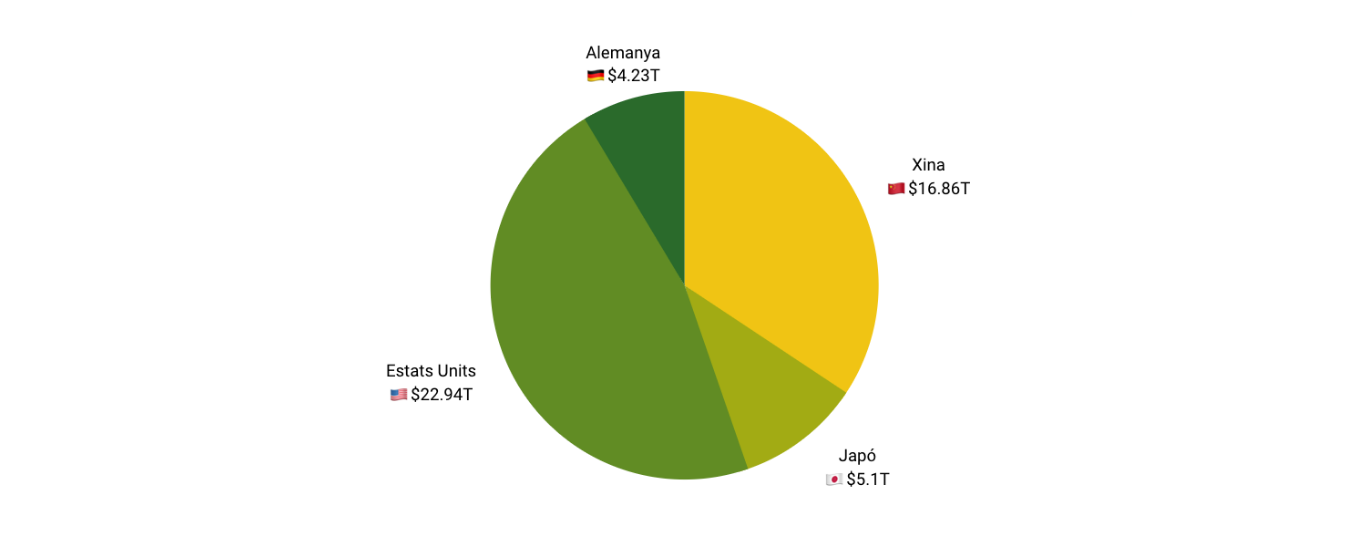
The world economy is worth 94 trillion dollars. For ordinary mortals, the figure can be staggering, if we have only just grasped its magnitude. Especially when we realise that just four countries, the United States, China, Japan and Germany, account for more than half of the world’s economic output in terms of gross domestic product. In 11Onze we take a look at how the global map of power is distributed.
To compare the various economies of the world, experts usually use the gross domestic product (GDP) of each country, with estimates made by the International Monetary Fund (IMF). This is what we have done, based on data produced by ‘Visual Capitalist’, to analyse the distribution of the world’s wealth in 2021.
GDP is a general indicator that measures all the country’s production, i.e. all the goods and services produced in a given period of time, quarterly or annually. Although GDP does not reflect the well-being of citizens, experts do believe that if a country’s GDP increases, it means that there is more economic activity, and that this benefits workers and businesses as a whole.
Although the figure of 94 trillion dollars may seem like a beastly figure, it should be borne in mind that in 1970 the world’s GDP was only three trillion dollars. Moreover, the figure is expected to double in the next 30 years. By 2050, according to experts, global GDP could reach $180 trillion. And by 2022 it is expected to exceed 100 trillion.
The countries that rule the planet
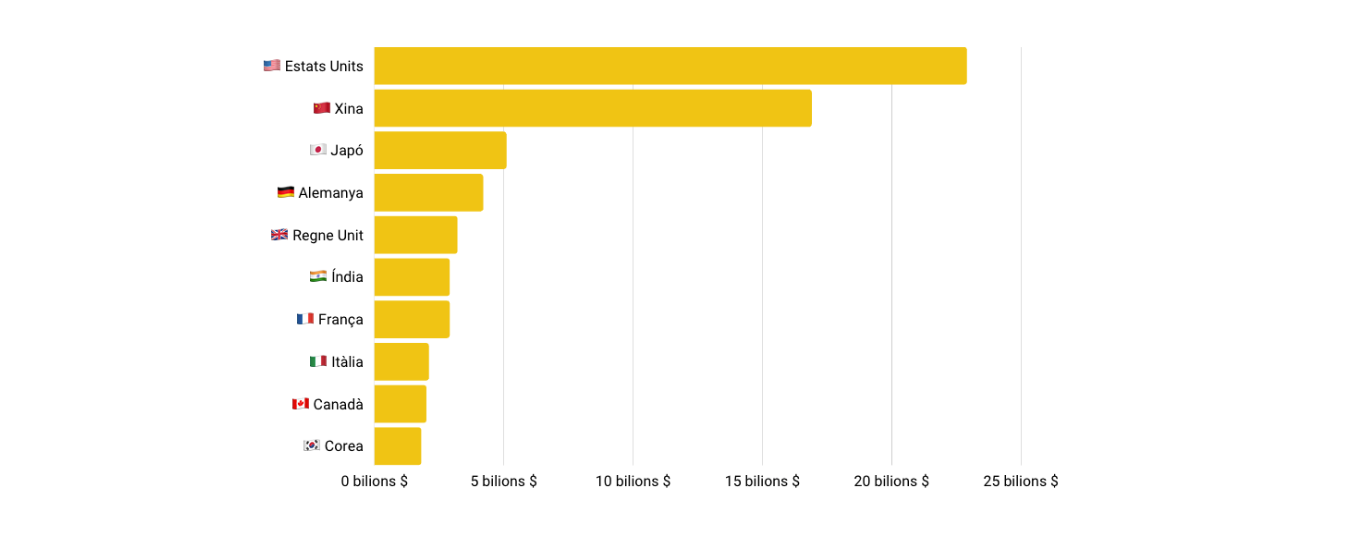
At $22.9 trillion, the GDP of the United States represents 24.4% of the world economy, although it is fair to say that this percentage is the lowest in its history, as 11Onze’s chairman James Sène explained. Finance and insurance are the biggest contributors to its economy, followed by services and public administration.
Below the United States, and at an increasingly smaller distance, is China, with $16.9 trillion, which accounts for 17.9% of the world economy. The country achieves most of its wealth because it is the world’s largest manufacturer of steel, coal, electronics and robotics. At a considerable distance behind it are Japan and Germany, which is Europe’s largest economy, thanks mainly to motor vehicle exports. In total, it exports around 20% of its production.
Thus a map of power is configured, the axes of which are divided between the United States on the American continent, China on the Asian continent and Germany on the European continent. And where is Spain on this list, if it does not appear among the first ten countries? Well, with a GDP of 1.4 trillion dollars, i.e. 1.5% of the world economy, it is in 14th place, just below Russia, Brazil and Australia, and just above Mexico, Indonesia and Iran.
The fastest growing economies
But there are countries that, although not in the best positions, are expected to grow a lot in the coming years. At the top of this list is Libya, as the IMF forecasts that it could grow by up to 123%, thanks mainly to oil exports and a depressed currency.
Also high on this list in Europe is Ireland, with a growth forecast of 13%. The key, according to experts, is that it is hosting large global technology companies, such as Facebook, Tik Tok, Google, Apple and Pfizer, because it has a very low corporate tax rate compared to other countries in the world. A rate that, unfortunately, will have to rise due to the agreements signed with the OECD. Macao is another growing economy and political tensions are becoming more and more evident. Macao is considered to be within China’s sphere of influence.
On the other side of the scale is Tuvalu, which has the world’s smallest economy at only $70 million. The business that brings the most wealth to this country located between Hawaii and Australia is very curious: as Tuvalu is allocated the .tv web domain, it receives huge revenues from audiovisual companies, such as Twitch.tv. The list of countries with the smallest economies includes many small islands in Oceania, such as Nauru, Palau and Kiribati, many of which are dependent on tourism.
11Onze is the fintech community of Catalonia. Open an account by downloading the super app El Canut on Android and Apple and join the revolution!