Banks earn more while their customers earn less
Despite the fact that the ECB has continued to raise interest rates, Spanish banks have kept the average remuneration on new deposits far below the rates offered by other European countries, taking advantage of the rise to earn more money from their customers.
The Spanish banking sector has shown itself to be one of the slowest in the whole of the European Union to reflect the European Central Bank’s rise in interest rates with a better return on deposits. In fact, according to data published by the ECB, banks in Spain and Cyprus were the only ones in the eurozone to start the year by reducing the remuneration they pay on deposits to their customers.
Spanish banks went from paying 0.64% in December 2022 to 0.59% in January this year, while in the eurozone as a whole banks raised rates on new deposits to an average of 1.65%. This happened at the same time as the interest differential between mortgages and deposits increased by 0.66 points since 2019, thanks to the fact that banks have made lending more expensive much faster than increased deposit remuneration.
All this has happened in a context where the big banks – CaixaBank, Banco Santander, BBVA, Banco Sabadell, Bankinter and Unicaja – have earned 5,696 million, 14% more, in the first quarter of the year compared to the previous period, despite the new tax on banking. The CEO of CaixaBank, Gonzalo Gortázar, argued that, “there is no extraordinary profit” and that it was a “modest” result, despite the fact that the financial sector recognises that interest rate rises have played a significant role.
A watered-down justification
The banks justify themselves by saying that, despite the ECB’s rate hikes, they are not paying more interest on deposits because they have plenty of liquidity. And it is true that many of these financial institutions enjoy ample liquidity thanks to bond purchases and long-term capital injections due to governments’ expansive monetary policies, which is why they no longer depend on depositors to finance their business.
However, this explanation seems poorly founded when we consider that Italian banks are the most liquid in Europe – far more so than Spanish banks – and, even so, pay more for deposits, in some cases up to 5% interest. Moreover, Spanish banks in Italy do offer a better return on their customer’s money than they do in Spain.
Given this situation of indifference of the financial sector towards the interests of its customers, it is not surprising that, although Spanish banks have begun to improve the remuneration of savings, during the first two months of the year Spanish families withdrew 18,000 million euros in deposits from Spanish banks in search of a better return on their money.
Fund lawsuits against banks. Do justice and get returns on your savings above inflation thanks to the compensation the banks will have to pay. All the information about Litigation Funding can be found at 11Onze Recommends.

The Fed, as the central bank of the United States, is responsible for stabilising the US economy, managing monetary policy and overseeing all economic activities in the country. Its decisions not only affect the US but also have an impact on the global economy.
Stock markets are watching the Federal Reserve’s meeting taking place between today and tomorrow. The rate-setting panel will announce its decision on 20 March. Many investors do not expect any surprises regarding the decision and give a 99% probability that it will leave rates unchanged at 5.25% to 5.5%.
On Thursday 7, Jerome Powell, chairman of the Federal Reserve, indicated that interest rate cuts may not be far off if there is “cooperation” by the inflation, but declined to give a specific timetable for when he expects them to occur, which could be delayed until the summer.
Holding higher rates for a little longer could keep pressure on the economy, protecting it against the risk of inflation picking up again. The latest inflation data indicates that the pace of price increases continues to moderate, although the CPI shocked markets when it was higher than expected in January.
On the other hand, the US is in an election year and Democrats want a rate cut to further boost the economy. At the same time, Donald Trump sees it as interference from the White House and threatens to change the Fed chairman when he regains the presidency if it “helps” his rival.
In any case, investors’ attention remains focused on whether the central bank will guide the expected timing of what would be the first-rate cut since March 2020, when the economy was in free fall because of the pandemic, which led the Fed to slash borrowing costs.
The ECB keeps an eye on the Fed
The inflation experienced in recent years has been a widespread problem affecting the world’s major economies, both in the US and Europe, and central banks raised interest rates precisely to control this price increase.
That said, other institutions, such as the European Central Bank, are awaiting the Fed’s decision before making a move. The ECB admitted that it made the mistake of taking too long to raise interest rates when inflation spiked in 2022, while the Fed reacted much earlier. Therefore, the president of the European Central Bank, Christine Lagarde, has all eyes on the Fed to avoid making the same mistake.
Global consequences
The Fed’s decisions directly impact global financial markets, affecting international trade, capital flows, emerging economies and shaping the global economic landscape. This is mainly due to the dominance of the dollar as the most important reserve currency today, because of the legacy of the Bretton Woods monetary system.
The dominance of the dollar in world trade means that its strength or weakness can have a significant impact on commodity prices around the world. This has a direct effect on global value chains, through which companies from different countries coordinate the production and distribution of goods around the world.
A strong dollar can hurt emerging countries that are in a delicate financial situation since the devaluation of their currency against the dollar makes imports more expensive and increases external debt. Moreover, these countries need more local currency to obtain dollars with which to repay debt or to buy energy, food and raw materials from abroad.
Even so, when the dollar is weak, oil prices tend to rise, as it takes more dollars to buy a barrel of oil. This can have consequences for other industries, such as transportation and manufacturing, which are heavily dependent on hydrocarbons.
Similarly, a weaker dollar can mean a decrease in the competitiveness of other economies that use their currencies, such as the European Union, especially the eurozone, and therefore a reduction in their exports.
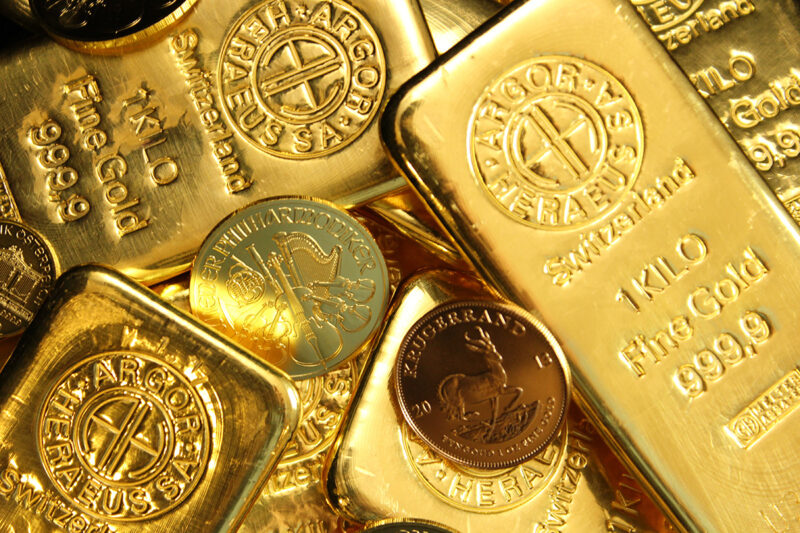
If you want to discover the best option to protect your savings, enter Preciosos 11Onze. We will help you buy at the best price the safe-haven asset par excellence: physical gold.


Unemployment rises slightly in Catalonia in July, despite the fact that the employment record has been maintained. But can we trust the reliability of the official data? Are there inactive workers who should be counted as unemployed?
Catalonia has registered an upturn in unemployment after five consecutive months of a downward trend. According to data published by the Ministry of Labour, during July, the Catalan labour market added 1,612 more unemployed people (+0.49%) than in June. Despite this slight increase in unemployment, it remains the lowest unemployment figure since the 2008 crisis.
Currently, there are a total of 331,356 unemployed people, but in the last year, the total number of unemployed has been reduced by 10,035 people, 2.94% less. Compared to 2022, there are 103,185 more contracts, which is equivalent to a 2.8% increase. In total, there are 3.75 million workers in Catalonia and an unemployment rate of 8.44%.
The unemployment figures for Spain as a whole also reflect the best figures for 15 years. The Spanish economy continues to create jobs and reduce unemployment for the fifth consecutive month, although the pace slowed in July to below the historical average. The active population increases to 23.8 million people and the number of employed exceeds 21 million, another record high.
Unemployment stood at 11.6%, a fall of 11.7 points, after 365,300 people found work in the second quarter of the year, adding 595,614 people to Social Security since January. On the other hand, the number of unemployed registered at the offices of the public employment services fell by 10,968 people in July, -0.41% compared with the previous month, to a total of 2.68 million.
Inactive workers who are not registered as unemployed
In March 2022, the latest labour reform came into force, one of the main objectives of which was to change the production model, moving from temporary to permanent contracts in order to reduce temporary employment and precariousness. Therefore, work and service contracts disappeared, while the possibility of temporary contracts was restricted to very specific situations that cannot exceed 90 days worked per year.
In exchange, it was proposed that companies should use fixed-term contracts so that people doing seasonal work would not have to worry about whether their contract would be renewed after a period of inactivity and would have the same rights as workers with a permanent contract.
Despite the benefits for employees that this type of contract brings, it has the counterpart that workers who were previously considered unemployed are no longer counted as unemployed. In other words, when an employee with a fixed-term contract enters a period of inactivity, he or she receives unemployment benefits, but is not counted as unemployed, but is considered a “jobseeker with an employment relationship”.
This is a significant number of people who, in Catalonia alone, last year accounted for 5.7% of all workers affiliated with Social Security in Catalonia under this type of contract. If we take figures for the whole of Spain in December 2022 and January of this year, they were equivalent to 443,078 and 660,000 unaccounted jobseekers.
Obviously, the official data do not include the people who are looking for work but who are not registered with the SOC or the SEPE, either because they are self-employed, because they do not make any profit, or because they are part of the underground economy. Nor is it specified how many people work part-time, not because they want to, but because they cannot find another full-time job.
And it is true that these figures are difficult to account for, but more transparency in the data related to discontinuous permanent workers does not require any effort, but the simple will to reduce the divergence between the reality of the labour market and the official rhetoric, an unavoidable necessity if we really want to evaluate the effectiveness of employment policies.
Do you want to be the first to receive the latest news about 11Onze? Click here to subscribe to our Telegram channel



The news that Saudi Arabia has decided not to renew a supposed agreement with the United States that compelled it to sell its oil in dollars has gone viral online and in the alternative press, sparking debates about the possible decline of the dollar as the world’s reserve currency, while pundits in the mainstream media dismissed it as fake news.
The information that went viral online and was repeated by some media outlets last week stated that on 9 June 2024, Saudi Arabia had not renewed its 50-year petrodollar agreement with the United States, according to which it had to sell its oil exclusively in US dollars and invest its surplus in US Treasury bonds.
The debate has focused on the fact that this development may accelerate the de-dollarisation trend, whereby countries seek to reduce their dependence on the US dollar. Thus, further weakening the dollar’s hegemony as the world’s reserve currency and accelerating its decline.
The mainstream media simply ignored the story or dismissed it as “fake news“, citing experts such as Paul Donovan, chief economist at UBS Global Wealth Management, who claims there was never a formal agreement requiring Saudi Arabia to price its crude oil in dollars. Furthermore, Donovan explained, that after the 1974 joint economic cooperation agreement was signed, Saudi Arabia continued to accept other currencies, such as the pound sterling, and it was not until later that year that the Kingdom stopped accepting the pound as payment currency.
Yet, other commentators have also come out lending credibility to the alleged deal: “Since the 1970s, the US has been pressuring Saudi Arabia to sell its crude oil in dollars to protect the dollar’s status and demanding that Saudi Arabia buy US bonds and weapons,” said Shigeto Kondo, senior researcher at the JIME Center of the Japan Institute for Energy Economics.
Let’s review a bit of history
The dollar’s status as the world’s reserve currency predates the creation of the petro-currency known as the petrodollar, essentially, oil export revenues denominated in US dollars. That said, we must acknowledge the financial flows, known as petrodollar recycling, whereby the money that Western countries spend buying oil ends up flowing largely back into the US economy through financial investments or the purchase of debt by energy producers.
It is true that this currency pattern established in 1973 was not born out of a contract or a treaty, but out of an agreement, let us call it implicit, initially between the United States and Saudi Arabia and later extended to other OPEC countries, according to which the oil-producing countries agreed to sell their oil in dollars in exchange for protection from the American partner and to reinvest the surplus from oil exports in buying US weapons and debt through Treasury Bonds.
In other words, after an oil crisis called into question the future of the dollar as a reserve currency, especially after France, Germany and other countries cashed in their dollar reserves, the US military became a mercenary military force for theocratic regimes in the Persian Gulf in exchange for ensuring that the dollar remained the currency of choice for oil purchases around the world, perpetuating its demand and value.
This recycling of petrodollars creates an almost unlimited demand for the issuing country’s debt, which allows the US to print large amounts of money (debt) without consequences. Moreover, any leader from this region who has opposed selling his oil in US currency – as Saddam Hussein and Muammar al-Ghadafi did – has been considered a direct threat to the petrodollar, i.e. to US hegemony. These countries were then subjected to a military intervention, which “coincidentally” led to the resumption of selling their oil in dollars.
The reality of a multipolar world
Ultimately, it is irrelevant whether there was a formal agreement between the two countries to use the dollar as the oil trading currency. The global geopolitical and economic context in the 1970s was much different than it is today. The dollar had emerged as the “de facto” reserve currency before any agreement was signed and there was no real alternative.
Today, however, we find ourselves in the context of a multipolar world that is spurring a necessary and inevitable rebalancing of the world order and does not require the expiry of a 50-year-old agreement. At the 2023 Davos Forum, Saudi Arabia’s finance minister, Mohammed Al-Jadaan, announced that the kingdom was open to accepting local currencies for oil trading and reaffirmed his decision on a visit to India last September. Oil sales in other currencies are no longer a novelty.
Over the past two decades, the dollar has gone from accounting for more than 70 per cent of global official reserves to 58 per cent today, according to IMF data. This is not to say that it is in any imminent danger of losing its status as a global currency, far from it, but it is undeniable that its days are numbered. Its supremacy as a trading currency and the hegemony it gives to the United States are being eroded year by year.
If you want to discover the best option to protect your savings, enter Preciosos 11Onze. We will help you buy at the best price the safe-haven asset par excellence: physical gold.

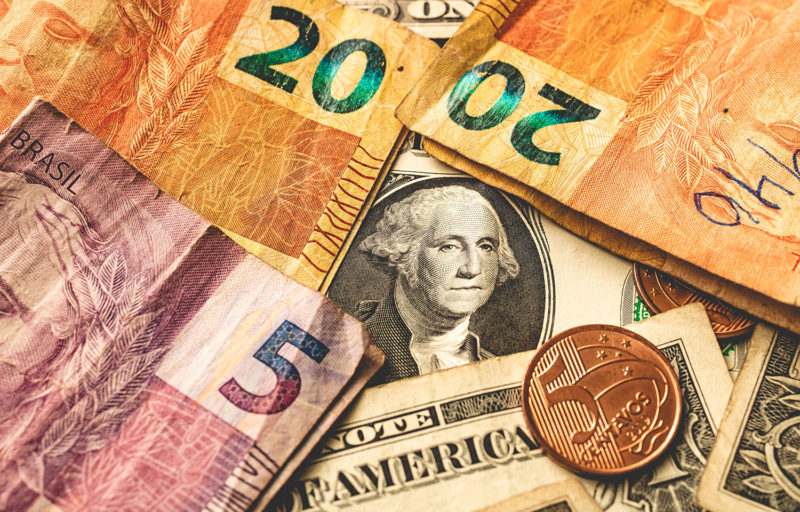
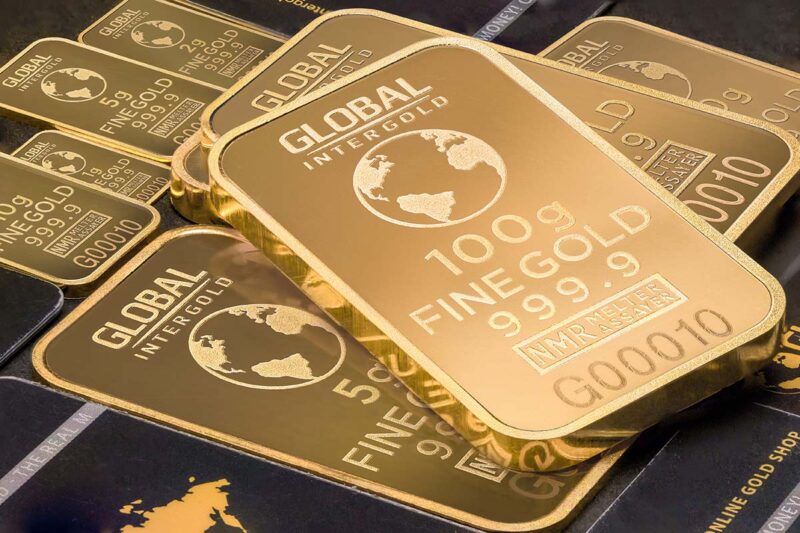
Although the US dollar is nowhere near losing its reserve status, the growing trend towards de-dollarisation is gradually eroding its place at the top of the global financial pyramid. What would be the consequences of ending the dollar’s supremacy as a trading currency?
Since the end of World War II, the US dollar has held the privilege of being the world’s main reserve currency. Even so, in recent years, several countries have redoubled their efforts to move away from the ties that come with relying on the greenback for all trade and financial exchanges.
According to IMF data, the dollar has gone from representing more than 70 per cent of global official reserves in the last two decades to 58 per cent today. This decline has accelerated dramatically over the last year as a result of the growing trend towards de-dollarisation as a defence mechanism against the abuse of economic sanctions by the United States.
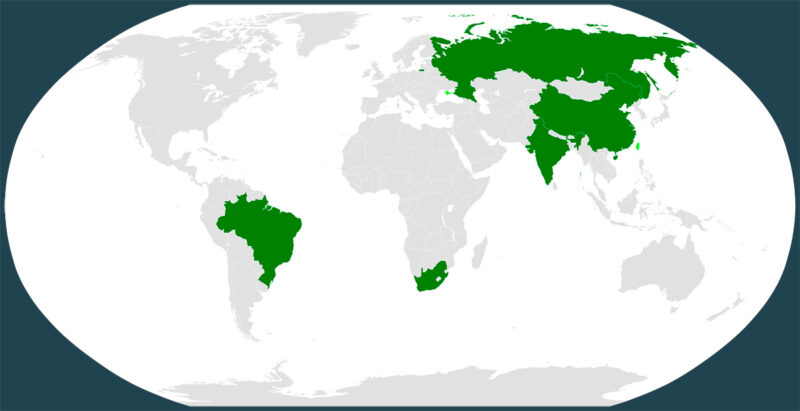
This has translated into other global actors encouraging the use of their currencies in bilateral trade and exponentially increasing their gold reserves. In this context, the group of emerging countries that form part of the BRICS economic bloc have not only promoted their own financial institutions with the aim of becoming an alternative to those of the West but are also working on the creation of a new single currency as a counterpart to the dollar for international transactions.
The importance of the petrodollar
The dollar’s status as the world’s reserve currency predates the creation of the petrocurrency known as the petrodollar, essentially, oil export revenues denominated in US dollars.
This currency standard was born in 1973 through an agreement, initially between the United States and Saudi Arabia, later extended to other OPEC countries, whereby oil-producing countries agreed to sell their oil in dollars in exchange for protection from the US and to reinvest their surplus in oil exports by purchasing US weapons and debt through Treasury Bonds. This is what is known as petrodollar recycling.
Put another way, after an oil crisis called into question the future of the dollar as a reserve currency, the US military became a de facto mercenary military force for theocratic regimes in the Persian Gulf in exchange for ensuring the dollar became the currency of choice for oil trading around the world, perpetuating its demand and value.
The cost of breaking off the monetary cartel
President Richard Nixon and Secretary of State Henry Kissinger had devised a perfect plan to keep the United States as the world’s only hegemonic power, but this arrangement depended on the loyalty of the producing countries to sell their oil exclusively in dollars and on the willingness of the United States to deal with these countries’ enemies in the region.
This explains many of the conflicts and wars that have taken place in the Middle East over the past 50 years. Any leader of the region who opposes selling his oil in the American currency – as Saddam Hussein and Muammar al-Ghadafi did – poses a direct threat to the petrodollar, i.e. to US hegemony, therefore these countries have to be “liberated or democratised” by military intervention.
The same interventionist foreign policy that years ago both the UK and US secret services had used against Iran. With the 1953 coup d’état, they overthrew the government by Prime Minister Mohammad Mosaddegh when the Iranian parliament voted to nationalise oil exploitation after the Anglo-Persian Oil Company (APOC) – now British Petroleum (BP) – refused to participate in an audit to verify it paid the contracted royalties and limiting its control over Iran’s oil reserves.
Saudi Arabia turns its back on the dollar
After nearly five decades of an exclusive relationship with the dollar, Saudi Arabia’s finance minister, Mohammed Al-Jadaan, announced at the 2023 Davos Forum that the kingdom is open to accepting local currencies for oil trading and reaffirmed his decision on his visit to India last September.
The fact that the petrodollar’s main supporter is joining BRICS countries that are already trading oil in local currencies, at a time when US imports of Saudi oil are at historic lows and Chinese purchases of the same crude continue to grow, suggests that the kingdom may be preparing for a paradigm shift in the international order.
To be clear, even if oil-producing countries accept other currencies, the dollar will not lose its relevance and international appeal overnight, but if the dominance of the US currency is diluted towards multipolarity, the current geopolitical and economic order could change considerably. Especially when we consider that Russia, Iran and Venezuela, which are under strict US sanctions, hold 40 per cent of the proven oil reserves of OPEC+ members.
Losing the unlimited credit card
Having the world’s reserve currency has allowed the US to run large deficits, both in international trade and public spending, without consequences. Losing the dollar’s hegemony would mean higher financing costs, reduced access to capital, a shock to the stock markets and a devaluation of the currency caused by a decline in demand for Treasury bonds. In other words, the United States, for the first time in many decades, would have to tighten its belt to avoid the collapse of a highly indebted economy.
On the other hand, the impact of a dollar devaluation would likely increase exports and decrease imports, thereby reducing the US trade deficit. In addition, other currencies and safe-haven assets such as gold would likely increase substantially in value in a context in which global capital rushes out of the greenback.
This de-dollarisation could help rebalance the world order and economies not aligned to the West. However, with the threat of the dollar’s possible demise as the world’s reserve currency, it is more than likely that the US and its client states will continue to use their military power to prevent, or at least prolong, the inevitable collapse of the empire.
If you want to discover the best option to protect your savings, enter Preciosos 11Onze. We will help you buy at the best price the safe-haven asset par excellence: physical gold.
Amid the escalation of tension with Iran, a new variable has come into play in global markets: Donald Trump’s tweets —or posts—. Each message shakes the price of oil, stock markets and investors’ expectations. Coincidence or strategy? The line between information and informational advantage is increasingly blurred.
The relationship between war and the economy is not new. Historically, conflicts have affected energy prices, currencies and financial markets. But the current moment introduces a new layer: the immediacy of information, which accelerates any reaction to unprecedented levels.
Political statements, leaks or simple messages on social media can trigger instant movements. In a matter of minutes, oil can move by several percentage points after a political statement. The facts do not need to materialise for the market to react. Perception is enough, expectation is enough. The market no longer waits. It reacts. In recent weeks, a disturbing synchrony has become evident: relevant political communications, immediate oil movements and chain reactions in stock markets.
This correlation is observable with data, but what really raises questions is not the subsequent reaction, but what happens before. When certain movements occur minutes or hours before the information becomes public, the debate ceases to be about volatility and becomes about informational advantage.
The invisible risk: who plays with an advantage
Financial markets are based on a fundamental premise: all participants should have access to the same information. When this does not happen, a structural distortion appears that calls the functioning of the system into question. In the United States, this problem is not new. The approval of the STOCK Act in 2012 already highlighted the risk that public officials could use non-public information to trade in the markets.
In this context, the synchronisation between certain political communications and financial movements reopens an uncomfortable debate: to what extent do markets reflect public information… or informational advantage? It is not about pointing to specific culpabilities, but about understanding the incentives and patterns that repeat over time and that can generate imbalances.
As set out in The current state of the extractive system, the great structures of power have evolved towards more subtle forms of control. Direct intervention is no longer necessary; influencing information is enough. The management of the narrative —political, media or financial— thus becomes a tool capable of generating value, volatility and opportunities. In this scenario, whoever has early access to information does not only interpret the market… they can anticipate it.
Basel III: the system seeks refuge
Faced with this environment, the financial system has begun to react. With the implementation of Basel III, international regulators have strengthened the quality requirements for bank assets. This is a profound change that seeks to restore confidence in a system increasingly strained by volatility and uncertainty.
There is, however, one particularly revealing element: physical gold comes to be considered an asset of the highest quality —Tier 1—. This move is not accidental. It implies recognising that not all financial assets have the same solidity and that not everything can be based solely on trust or on the information available.
When the system demands more real assets, it is implicitly admitting that trust in “paper” is not enough. It is a silent but significant shift, pointing towards a growing need for stability in an environment dominated by volatility and informational asymmetries.
In this context, gold regains prominence not because of tradition, but out of pure logic, because this metal has historically been the refuge when monetary or financial systems become destabilised. It does not depend on any issuer, it cannot be created arbitrarily and it cannot be anticipated with privileged information. “It is, in essence, an asset that exists outside the narrative… and outside the game of information.
Two speeds: speculation vs. value
The current market seems to move in two very different dimensions. In the short term, speed dominates: information, immediate reaction and growing volatility that responds more to expectations than to fundamentals. It is a space where time is measured in seconds and where any stimulus can trigger abrupt movements.
By contrast, in the long term, the logic is different. Here the focus shifts towards the preservation of value and security. When the perception grows that prices may be influenced by early information, investors look for assets less exposed to this dynamic. It is not an ideological question, but a rational response to a system that raises doubts about its own fairness.
A fair market… or only an apparent one?
While some actors can take advantage of these asymmetries, the real impact is distributed across the rest of society. The increase in the price of energy, persistent inflation, the loss of purchasing power and insecurity for savings are its most visible consequences. It is a familiar pattern: the benefits are concentrated among a few actors, while the risks are spread among the majority.
Financial markets are built on an apparently simple idea: equality of informational opportunities. But when this equality is called into question, so is their legitimacy. There is no need to manipulate the market when one can trade before everyone else. It is at this point that trust begins to erode and the foundations of the system are exposed.
In a world where information can move markets in seconds, understanding who has access to what —and when— becomes essential to protect wealth. Because when doubt sets in, capital does not seek explanations: it seeks refuge in what does not depend on time, nor on the narrative, nor on early information. It seeks, simply, what is real. And that, in today’s markets, is increasingly scarce. At La Plaça by 11Onze, we continue to analyse these dynamics to help you make informed decisions in an increasingly complex system.
Protecting savings with physical gold has been one of 11Onze’s main contributions to its community and, now, the range of products is being expanded. That is why, in the face of volatility, still-high inflation and the growing crisis of confidence in the banking system, gold is once again strengthening as a safe-haven asset. Discover Gold Seed at Preciosos 11Onze.
If you would like to learn more about this topic, we recommend:
 Economy
Basel III and the myth of “paper gold”
6 min readWhile media attention swings with the price of gold and...


Since the start of the pandemic, Spain’s top 23 billionaires have seen their wealth grow by 29%. At the same time, in the first year of the pandemic alone, more than one million citizens found themselves in a situation of severe material deprivation in the state. This is demonstrated by Oxfam Intermón in a report on growing inequalities in the world.
According to the NGO, the wealth of the ten richest men in the world has doubled. During the first two years of the pandemic, the wealth of these richest men has risen from $700 billion to $1.5 trillion, or $1.3 billion a day. All this while the incomes of the remaining 99% of the population have deteriorated unchecked.
In fact, Oxfam Intermón also points out that every 26 hours a new billionaire is born in the world, while inequality causes the death of at least one person every four seconds. The director of the NGO, Franc Cortada, said that, currently, the richest of the rich accumulate six times more wealth than the 3.1 billion poorest people in the world. And they have also been responsible for more than twice as much carbon emissions as these millions of poorest people. “If these ten richest men were to lose 99.99% of their wealth tomorrow, they would still be the richest people on the planet,” he said.
According to ‘Forbes’ magazine, the richest men in the world are: Jeff Bezos of Amazon; Elon Musk of Tesla; Bernard Arnault, CEO of Louis Vuitton, and his family; Bill Gates, founder of Microsoft; Mark Zuckerberg, founder of Facebook, now Meta; Warren Buffet, chairman of Berkshire Hathaway; Larry Ellison, co-founder of Oracle; Larry Page and Sergey Brin, co-founders of Google; Mukesh Ambani of Reliance Industries; and Amancio Ortega of Zara. Not a single woman on the list.
Inequalities kill
Thus, as the NGO states in the report, fighting inequalities could prevent the deaths of 21,000 people a day. Oxfam Intermón also recalls in the study that, on a global scale, “billionaires have increased their fortune by five trillion dollars, more than in the last 14 years accumulated.” It is, according to the NGO, the largest increase since records have been kept.
The result, says Oxfam Intermón, is “more wealth for a few and more public debt for all.” In addition, it is estimated that inequality between countries will grow for the first time in just one generation. The inequalities caused by the pandemic, according to the report, are particularly severe for women and girls, as well as for all those who are migrants or in situations of exclusion.
In Spain, more of the same
Oxfam Intermón also notes that, in Spain, the austerity policies implemented during the crisis have been a scourge for the health system, which has withstood the blow of the pandemic in an extreme situation. “We cannot afford to see the public health system collapse,” Cortada said. Meanwhile, the richest people in Spain have seen their wealth increase.
For this reason, the NGO calls on governments, among other measures, to apply more taxes on large fortunes, reorient policies with public funds, combat the gender gap and tackle the climate crisis once and for all. In particular, it reminds Spain that it must seize the opportunity of tax reform, ensure that European funds for the pandemic are “a real and effective opportunity”, reinforce social protection policies and invest in health and education.
11Onze is the fintech community of Catalonia. Open an account by downloading the super app El Canut on Android and Apple and join the revolution!


You’ve probably heard a lot about tokens lately, especially in connection with cryptocurrencies, the blockchain, and the metaverse. But what exactly are they? What are they for? We are already surrounded by tokens in our daily lives, although we are not sufficiently aware of it. Núria Rambla, executive assistant at 11Onze, gives us all the clues.
‘A token is a token, a symbol, a code. Tokens are objects similar to a currency, but not legal tender,’ Rambla explains. This means that they only have value within the market where it has been established that they will be used and only for the purpose for which they have been created. Tokens have been around for many years and the clearest example is casino or fairground tokens, those plastic coins that can only be used to play slot machines or poker or to ride the witch train or bumper cars.
And what characterises tokens? ‘They have no value, they are issued by institutions or private companies, they are made of low-value materials, they have a control system, and they are secure and cannot be counterfeited,’ says the executive assistant. In the digital world, tokens use the infrastructure of cryptocurrencies, the so-called blockchain, to circulate. We could say, in fact, that a cryptocurrency is a token, although a token is not exactly a cryptocurrency.
‘While a cryptocurrency has its own blockchain, a token always takes advantage of an existing blockchain, so it is cheaper for digital platforms’, argues Rambla.
In the virtual world, tokens have infinite applications: they can serve as security codes that are validated when we enter a website, as redeemable points in video games, as miles flown by airlines… In the world of finance, they are also used in the so-called ‘tokenisations’, that is, to protect our data when we make online payments, through a code that validates the transaction with total security. And in terms of investments, there are ‘security tokens’, i.e. investment securities in ‘tokens’. Want to know more? Just watch the video below!

Tokens



Central banks buy record amounts of gold while drastically reducing their dollar reserves. The banking crisis, market volatility and geopolitical tension are shaking the global monetary system and threatening the dollar’s hegemony.
It is no secret that the rising value of gold is fuelled by bad news and economic uncertainty. The risk of contagion from the US banking crisis and market volatility in the face of a possible recession have caused the price of this precious metal to rise by 10% since January.
So far nothing new, the demand and price of gold are approaching historic highs whenever money seeks refuge in safe-haven assets such as precious metals. According to a report by the World Gold Council (WGC), central banks have maintained a steady pace of gold purchases during the first quarter of 2023, adding almost 230 tonnes of gold to their national reserves, an increase of 176% over purchases made in the same period last year.
In this case, however, the gold rush is partly due to an occurrence that could signify a paradigm shift in the world order. We are talking about de-dollarisation, a process that implies a reduction in dependence on the dollar as a currency for international trade transactions and as a reserve currency. The consensus among geopolitical and economic analysts is that the end of the dollar’s reign as an international reserve currency is not a question of if, but of when it will happen.
Growing demand for tangible assets
It would be unfair to attribute the rise in gold purchases to a single factor, but there is no denying that a return to fiat currencies underpinned by tangible assets such as precious metals is the order of the day. From digital currencies issued by some central banks to a future quantum financial system, gold is establishing itself as the ultimate safe-haven asset and an antidote to the loss of confidence in today’s fiat currencies.
According to the IMF, the US dollar’s market share as the world’s reserve currency has fallen from 66% in 2003 to 58.4% at the end of the fourth quarter of this year. A downward trend that is accelerating thanks to economic sanctions and which contrasts with an exponential increase in central banks’ gold reserves.
In this context, and unlike other occasions, it is important to bear in mind that this increase in demand for gold is not only driven by small and large investors who want to protect themselves against inflation and falling interest rates but is also led by central banks, which now account for 33% of the global market.
This diversification into gold, especially spurred by large emerging economies that are part of the BRICS group, seems to confirm that the international financial system is undergoing a radical transformation process which, although it is too early to know whether it will mean a return to the gold standard, suggests a continued demand for this precious metal and other tangible assets.
If you want to discover the best option to protect your savings, enter Preciosos 11Onze. We will help you buy at the best price the safe-haven asset par excellence: physical gold.

Starting in May, a whole series of calls for applications for direct aid from the Generalitat to boost the competitiveness of Catalan companies in seven different areas will be open. These grants, which are awarded in chronological order of application, can reach up to 20,000 euros in areas such as digitisation and Industry 4.0.
Part of the €200 million annual budget of Acció, the Generalitat’s agency dedicated to promoting the competitiveness of Catalan businesses, will be available in the form of “coupons” from May. These coupons offer a direct economic discount that companies can exchange for an expert service in internationalisation, innovation, sustainability or new technologies through the advice of Acció’s accredited suppliers.
The windfall of millions is distributed in seven different calls for proposals. In addition to accompanying companies in their digitalisation or international expansion, this year’s grants will also help them to access European research and innovation programmes or to reformulate their strategy.
Once the calls for proposals have been opened, it should be noted that grants are awarded in chronological order of application and are usually sold out in a short time. Projects can be implemented between 1 January 2023 and 30 September 2024.
The best endowed vouchers
The calls for proposals with the highest grants are those aimed at digital transformation and towards Industry 4.0, with amounts of up to 20,000 euros per project.
The one for advanced digital technologies will allow the contracting of consultancy services to test technologies that contribute to the digital transformation of the company. It will be possible to do this through the technological facilities of the Digital Innovation Hub of Catalunya. Projects may include, for example, technological feasibility studies, analysis of new disruptive business models or the development of proofs of concept or new prototypes.
Industry 4.0 aims to facilitate the first steps to implement technologies such as 3D printing, ‘big data’, the internet of things or robotics, among others, with the aim of improving products, services or company processes.
The necessary internationalisation
Another important area for businesses today is internationalisation. In this area, there are two calls for proposals: one for initiation to exporting and another dedicated to increasing sales around the world through digital channels.
The first includes the possibility of making an international promotion plan, with a maximum grant of 2,500 euros, or subcontracting an export manager, for which a subsidy of up to 8,000 euros is envisaged.
The second allows access to a consultancy service to define the international digital strategy, carry out a complete analysis of the company’s online presence or design an action plan for digital channels. The maximum grant for each project is 6,000 euros.
Strategy, innovation and sustainability
Two new calls for proposals this year are for strategy and European R&D programmes. In the first, with grants of up to 8,000 euros, an advisor accompanies the company in the analysis of changes in the environment, to see the effect they may have on the business model and identify new opportunities and challenges. The second aims to help companies access European research and innovation grants in a collaborative way. The grants, of up to 12,000 euros, provide advice on how to prepare proposals and create a consortium, as well as support in the application of the regulations.
The last call for proposals, with grants of up to 8,000 euros, is aimed at moving towards climate neutrality. Actions can be related to the use of technologies to develop sustainable materials, move towards renewable energies, work to improve efficiency in the use of water, energy or biodiversity, among others.
An ambitious objective
More than 3,800 Catalan companies have already benefited from this type of Acció aid in previous calls for proposals, which have helped them to make their first exports, implement or develop new technologies or adapt their business model to changes in the environment.
With more than 35 years of history, Acció has set itself the goal of making Catalonia the most competitive economy in Southern Europe by 2030. Its grants and services aim to create a more sustainable, digitised and innovative business ecosystem, increase the number of internationalised companies and continue to make Catalonia a pole of attraction for foreign multinationals.