Maria Aurèlia Capmany: the right to emancipation
The sun set. A long, cold, and decadent night spread across Spain for almost forty years. Finally, the guns had imposed “me over you”. But the conviction and tenacity of many women made it possible to change the situation as the century progressed. We continue with the historical exercise on the history of contemporary women.
The drama increased when some 500,000 people crossed the border into France between the end of 1938 and January 1939, fleeing the horror. In fact, it had been suspected for months that this would happen. The victory of fascism in Spain became a reality in April 1939, when the hopes and illusions of a social majority that had worked to create a fairer and more egalitarian society were finally dashed. From then on, peace would be imposed under the constant threat of imprisonment for dissidents against the new order.
The regime imposed by force of arms was based on national trade unionism, but after the Second World War it was forced to move towards a different conception of power in order to ensure its survival. The world that emerged after 1945 would no longer be the same as at the end of the Spanish Civil War, since historical reality would be constructed on the basis of the confrontation between the capitalist and communist countries.
It was then that Francoism decidedly opted for National Catholicism as a social articulation. Catholic rhetoric would be more acceptable to the Western allies, the winners of the world war. And the most visible manifestation of this conception of power would be the return of hegemony to the Church, which would control all aspects of public and private life in society. The state would put the clergy on the payroll and provide the Church with a broad tax exemption and, most importantly, it would once again be given absolute freedom in the management of education.
Involution of the role of women
Franco’s dictatorship would destroy all the achievements of the Republic. The Church would legitimise the redefinition of the role of women in society. Thus, Franco’s regime would put the brakes on all the female achievements of the previous period by arguing an anti-feminist discourse, in which women would be perceived as inferior to men, both spiritually and intellectually.
Under this pretext, the new regime would relegate women to household chores, as mothers and wives. Many women were repressed by the regime, especially in the period 1939-1945. Feeding, helping or curing Republican combatants was considered a crime, for which many women were imprisoned, sent to concentration camps or even shot. Others, conditioned by fear, silenced their participation in the battlefields, making it a purely private memory.
Even so, the regime legitimised two youth organisations, the Women’s Section and the Youth Front, which were set up to indoctrinate all young people in the principles of the ‘movement’. In this way, the aim was to build a new society that was obligatorily articulated by the new values that underpinned Francoism.
A new political turn
Towards the end of the 1950s, something began to change. The failure of the autarchy and the tense international situation, with the Cold War in the background, led the regime to a forced reorganisation of forces in the power families. The Falangists, who had dominated the political scene until then and were the guarantors of fascist symbolism and rhetoric, were replaced by young technocratic politicians linked to Opus Dei.
This change allowed the regime to generate a new ideological discourse and project a more modern social image to the outside world. In this way, ‘developmentalism’ would favour the growth of a Spanish middle class that would sustain the regime for a few more decades, but would also cause its annihilation. This controlled openness, for example, would tolerate the publication of works in Catalan, but it would also allow demands for social gender equality to be rescued from the attics of memory.
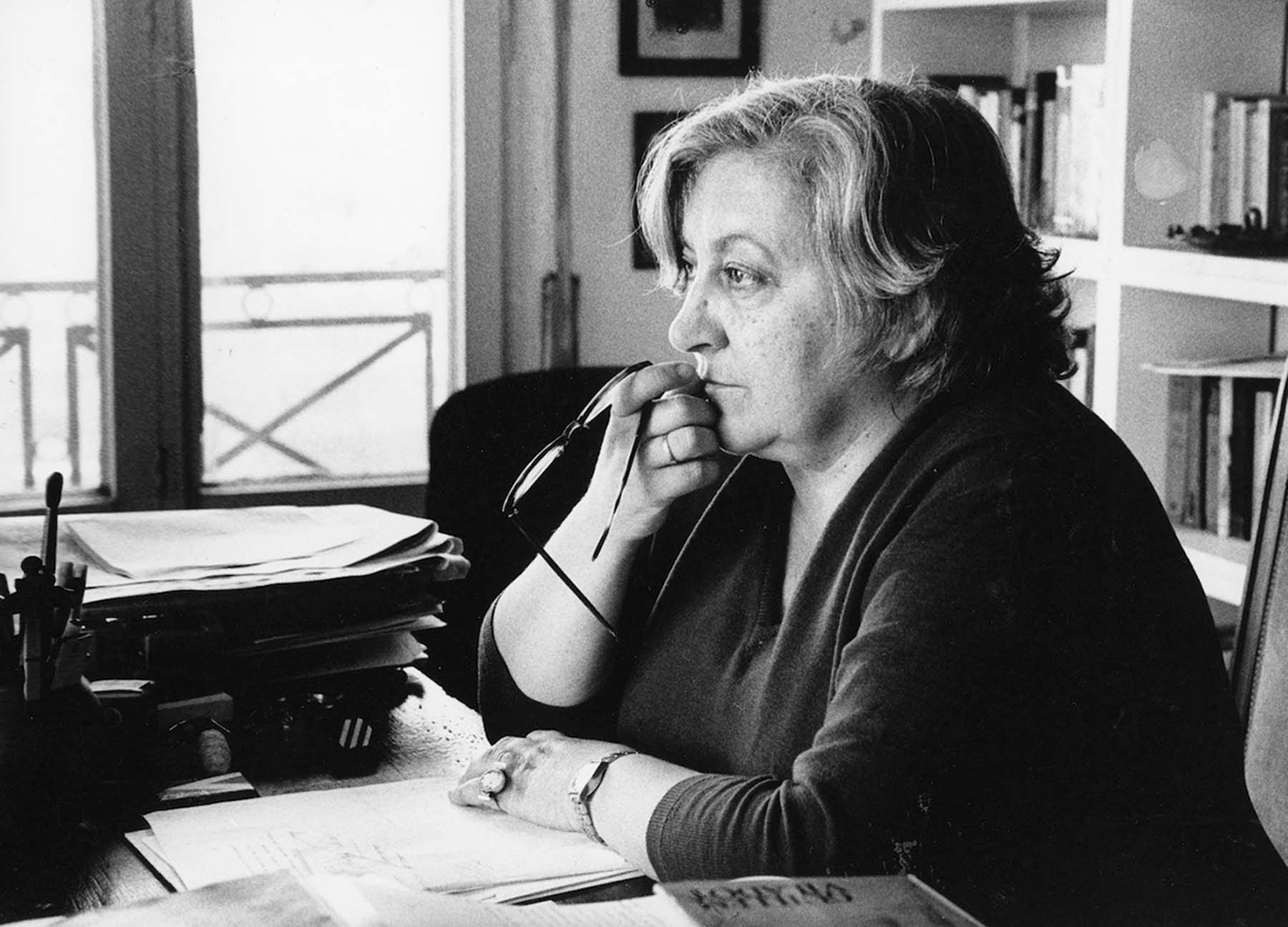
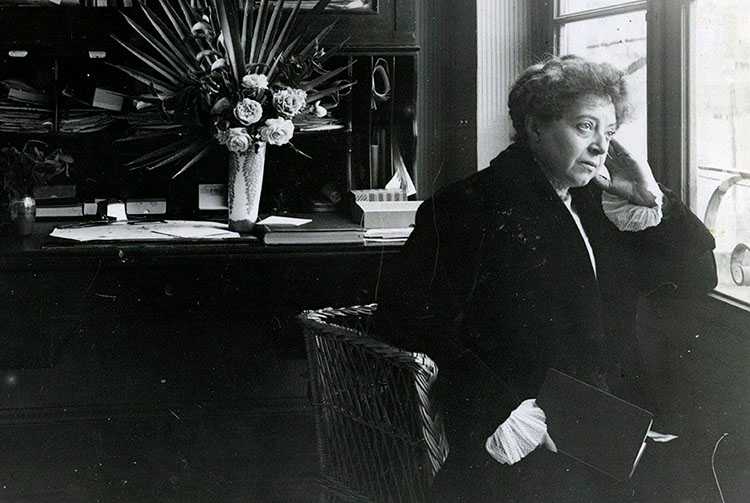
Source: Maria Aurèlia Capmany, 1974. Pilar Aymerich, Meteora.
Women in Catalonia
It was in this context that Maria Aurèlia Capmany i Farnés (1918-1991) published her famous essay ‘Women in Catalonia’ (1966), one of the key works for the recovery of feminist demands in Catalonia. She was the daughter of the folklorist Aureli Capmany and Maria Farnés, and granddaughter of the journalist and Catalanist politician Sebastià Farnés. From an early age, Maria Aurèlia Capmany showed an innate ability for writing and literary activities in general. The impact of her essay allowed her to give up teaching to devote herself entirely to literary activities and theatre.
The main thesis put forward by Maria Aurèlia Capmany in ‘Women in Catalonia’ hinges on the idea that no progress can be made on the problem of gender if the social and political problems of Catalonia are not solved first. And this is written by someone who was a woman, a Catalan and a socialist. In other words, the devil for the Regime!
A palpable problem
For Capmany, the gender problem exists and is palpable within society. Her essay reveals two major problems: on the one hand, the definition of women as otherness and dependence; and, on the other, social inequalities and women’s access to the public world. In this sense, the conclusion reached by Maria Aurèlia Capmany is very clear: women have the same social status as men, but only in appearance, because the reality is that they are all aware of their lack of integration, their state of evolution and the instability of their insertion in the society in which they live.
A working woman can easily discover the objective conditions of her marginalisation, since she works the same as a man, studies the same subjects, obtains the same qualifications as a man. Still, with these qualifications, she will do a second-rate job. Therefore, if a woman wants to dedicate herself to something beyond the walls of her home, she will have to do it discreetly and without giving it any importance.
As a result, Capmany would once again put forward the thesis of the 1930s, which fiercely defends the “me just like you”. Even so, throughout her long career, first as a writer and then as a politician, she worked tirelessly for the equality and integration of women in society. Through her prolific work, she fought against the stale ultra-conservatism of the Franco regime, coming to the conclusion that the key word for women’s liberation is emancipation. As her song ‘Teatro de cabaret’ says, she was an emancipated woman who had to think and decide, solemn and sensible, and she did it from freedom and dialogue.
11Onze is the community fintech of Catalonia. Open an account by downloading the super app El Canut for Android or iOS and join the revolution!
If you liked this article, we recommend you read:

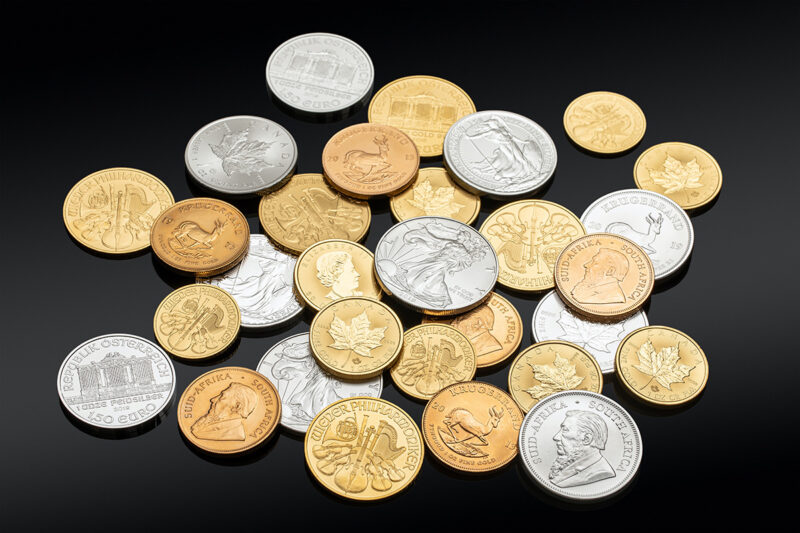
There is a golden thread that runs through the entire history of humanity. It is not found in books, nor in the borders of ancient empires, but it is as real as the stones of temples or the blood of conquests. That thread is gold. Not as a simple metal, but as a symbol laden with meaning: divinity, power, beauty, wealth, and control.
From the moment humans discovered the ability to work with precious metals, these metals became a mirror in which each civilisation projected its dreams and fears. For the Egyptians, gold was the flesh of the gods; for the Romans, the key to world domination; for the medieval Church, the materialisation of divine glory; and for modern states, the basis for controlling the global economy.
Over the centuries, gold has changed form, but not function. It has been idolised and plundered, buried and unearthed, turned into currency, reliquary or state jewel. It has built palaces, but it has also destroyed empires. Not only that, but it has symbolised both eternity and decadence.
Gold in Egypt, a reflection of Pharaonic eternity
In Ancient Egypt, gold was not just a valuable resource. It was, literally, the flesh of the gods. This symbolic conception is reflected in many sacred texts, such as the “Book of the Dead”, which describes the relationship between the god Ra—the supreme solar deity—and the precious metal. Gold, impervious to corrosion and the passage of time, became the perfect symbol of divine eternity.
The pharaohs, conceived as living incarnations of Horus and sons of Ra, used gold to legitimise and perpetuate their power. Not only did they decorate tombs and temples with this metal, but many ritual objects, sarcophagi, masks and liturgical jewellery were also crafted from pure gold, such as the famous funeral mask of Tutankhamen (14th century BC), which in itself is an exaltation of gold as a symbol of immortality.
Gold in Rome, currency of conquest and imperial rule
If for the Egyptians gold was divine flesh, for the Romans it became the driving force of an empire. With Rome, the noble metal was de-divinised and transformed into a tool of earthly power: the foundation of a monetary system, the reward of a legionary, the key to bribery and the symbol of imperial greatness.
The first major step was taken by Julius Caesar, who between 46 and 44 BC minted large quantities of aureus to finance his ambitious military expansion. The aureus, a gold coin of the highest purity, was equivalent to 25 silver denarii and symbolised not only wealth but also authority.
Gold in the Carolingian world and the renewal of the Empire
With the fall of Rome, the Western world entered a long period of transition. But gold did not disappear: it changed hands and meaning. It was Charlemagne, King of the Franks and first Emperor of the Holy Roman Empire, who reformulated the role of gold as a tool of political and religious legitimacy.
His reign, which lasted from 742 to 814, marked a turning point. In Aachen, the symbolic capital of his power, a monumental palatine chapel was built, inspired by the Byzantine model of San Vitale in Ravenna. Domes, mosaics, and relics framed in gold show that the new Rome will not be a city, but an idea: the Renovatio Imperii Romanorum. Charlemagne himself was crowned by surprise by Pope Leo III in 800, in a ceremony full of golden liturgy that sought to consolidate the alliance between the throne and the altar.
The Renovatio Imperii Romanorum is thus based on a return to order, law and faith. Gold, in this context, is not a currency in regular circulation — since the Frankish economy is essentially rural — but a symbol of hierarchy, the sacred and mission. It is the halo of power incarnate.
Al-Andalus gold: splendour, refinement and wisdom
At the same time, another vision of gold flourished on the Iberian Peninsula. Under Abd al-Rahman III, the Caliphate of Córdoba reached its peak, becoming one of the most brilliant cultural centres of the Middle Age. Here, gold was not just power: it was refinement, science, and beauty.
The Mosque of Córdoba, enlarged and embellished during his reign, makes masterful use of gold in its interior decoration. Byzantine mosaics, imported directly from Constantinople, cover the mihrab with subtle gilding that captures the light and elevates the space. Unlike Christian monumentality, here gold does not impose: it seduces.
The Caliphate mints the dinar, a gold coin with Koranic inscriptions, which circulates throughout al-Andalus and the Maghreb, demonstrating the commercial and political dynamism of Islam on the peninsula. But it is not just an economic issue: the dinar also acts as a calling card for Muslim power, at a time when calligraphy replaces iconography as an expression of faith.
The court of Córdoba also became a centre for translation, astronomy, medicine, and philosophy. Gold financed libraries, schools, and gardens. In fact, the people of Córdoba understood wealth differently: not as accumulation, but as cultural fertility. Thus, while the Carolingians reinforced the sacralisation of power with liturgical gold, the Umayyads of Córdoba saw it as a way to project sophistication and intellectual leadership. Two ways of shining in the same era.

The Renovatio Imperii Romanorum is thus based on a return to order, law and faith. Gold, in this context, is not a currency in regular circulation — since the Frankish economy is essentially rural — but a symbol of hierarchy, the sacred and mission.
Feudal gold: financing churches, castles, and crusades
The European Middle Ages were a fragmented, rural and theocratic world. In this context, gold—scarcer than in previous eras—took on a heightened value: it was not only wealth, but also a means of accessing divine grace or projecting feudal authority.
With the start of the Crusades in the 11th century, this metal began to move on a large scale once again. The expedition of the European monarchies to Jerusalem cannot be understood without the financial support of the feudal lords, who mortgaged lands, sold titles and even ceded castles to obtain gold. Under the religious pretext, the real objective was the possession of territories in the Holy Land, as spoils of war and control of the trade routes between East and West.
Thus, medieval gold was not everyday currency—silver dominated minor transactions—but it was a privileged instrument for connecting land, faith, and sword. Its presence in relics, altarpieces and processional crosses testifies to a value that transcends economics: gold as a visual language of transcendence.
The gold of Mali: African splendour and global impact
While Europe ploughed fields and built cathedrals, an empire of bewildering wealth flourished in the heart of Africa: the Mali Empire. And its most emblematic ruler, Mansa Musa I, has gone down in history—not only for his devotion—but for being the richest person humanity has ever known.
His journey to Mecca in 1324 is legendary. According to the Arab historian Ibn Fadlallah al-Umari, Musa distributed so many kilos of gold in the markets of Cairo that the price of the metal plummeted for a decade. He brought thousands of slaves, horses, and camels laden with pure gold from the mines of Bambouk and Bure, in present-day Mali. This episode is not a romantic exaggeration: it is documented by various sources and even appears in the famous Catalan Atlas (1375), where Mansa Musa is depicted holding a golden sphere in his hand.
His reign marked a cultural and architectural explosion: the great mosque of Djenné was founded, and the city of Timbuktu became a centre of learning, where manuscripts were copied and Greco-Arabic knowledge was preserved. Mali’s gold was not used to conquer: it was used to educate, trade and establish relations with the Islamic and Mediterranean worlds.
Mexico’s gold: sacred symbol and sweat of the sun
When the Spanish conquistadors set foot in Tenochtitlan in 1519, they were so impressed by the order, symmetry, and monumentality of the city that Cortés himself compared it to Venice. But there was one element that eclipsed all others: gold.
In the Aztec religious universe, gold was not currency or an accumulable asset. It was, literally, the sweat of the sun —teocuitlatl—, a sacred material that could only be worked by specialised craftsmen, the Toltecs. It was used to make masks, ceremonial discs, ornaments for the gods and ritual objects. Its function was symbolic and spiritual, not commercial. Unlike in Europe, there were no gold coins or banking systems here, but rather an economy based on tribute and barter, with cocoa as the most common means of payment.
Moctezuma II, emperor of the Aztecs, maintained a refined court where gold was part of divine worship and state ceremonies. Sources such as Cortés’s Letters of Relation and Bernal Díaz del Castillo’s True History of the Conquest of New Spain describe the riches of the imperial palace with fascination and greed: ‘They had so many pieces of gold, so beautiful and mysterious, that no Christian king possessed any like them.’
But that same gold, which was sacred in Aztec logic, was capital to the Europeans. The misunderstanding between the two visions was absolute. The Aztecs offered gold to Cortés as a sign of respect and hospitality. He interpreted it as submission. From then on, the plundering began.
Gold in Castile: from greed to imperial decline
With the conquest of America, the Spanish monarchy—first under the Catholic Monarchs, and later under Charles I and Philip II—gained access to quantities of gold and silver that had been unthinkable until then. Between 1503 and 1660 alone, it is estimated that more than 180 tonnes of gold and 16,000 tonnes of silver arrived in Seville from the colonies, especially Peru and Mexico. This flow, known as the “gold of the Indies”, became the backbone of Castilian imperial power.
But this treasure, far from consolidating a stable empire, poisoned the peninsular economy. Gold made it possible to wage continuous wars in Flanders and Italy, but it was not reinvested in productive structures. Unlike England or Holland, Castile opted for military spending and imports, causing rampant inflation and foreign dependence. The metaphor is clear: a rich empire… but a poor one.
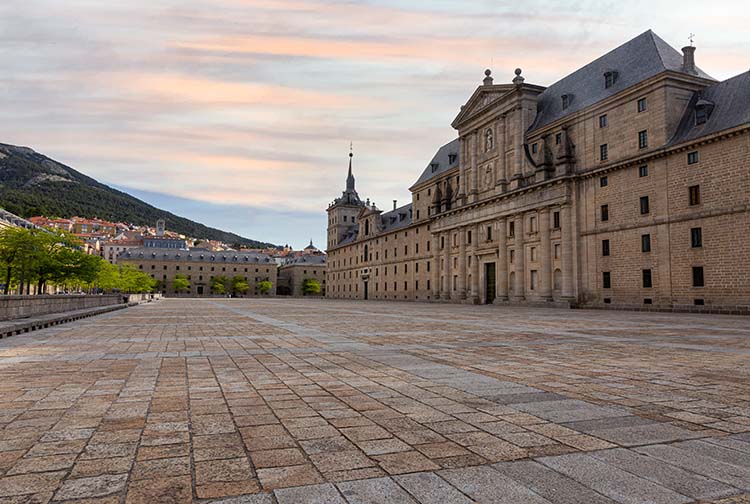
Philip II symbolises this paradox. Under his reign, El Escorial was built, a palace-monastery-fortress that was intended to be both the religious and administrative centre of the empire. Its architecture is severe, hieratic, almost otherworldly, but laden with symbols of power. The gold does not shine as it does at Versailles: it weighs heavily. It is the material reminder of an empire that aspires to dominate the world from a stone desert.
Papal gold: from luxury to eternal art
In Rome, however, gold takes on another function. With the Renaissance, the Catholic Church promotes artistic and spiritual renewal… and gold becomes God’s favourite pigment. Pope Julius II, known as “the warrior pope”, understood that in order to reaffirm Rome’s spiritual power, it was necessary to master the language of beauty. And gold was the perfect medium.
During his pontificate, he hired the best artists of the time: Michelangelo, Raphael, Bramante… and promoted the construction of the new St. Peter’s Basilica, with a dome that still defines the Roman skyline today. Gold covers altars, domes, frescoes, liturgical objects and altarpieces. But here it is not just belief: it is a visual catechesis. The message is clear: the glory of God must be tangible. In a Europe divided by the first Protestant criticisms, Rome speaks through art. And gold becomes the language of faith.
Gold in France: the backdrop for absolute power
If in Rome gold is sacred art, in France it becomes the theatre of absolute power. With Louis XIV —the Sun King— Versailles is transformed into a monumental backdrop where every cornice, every mirror and every golden ornament communicates a single idea: everything revolves around the king.
The gold of Versailles is not used to pay for wars—of which there will be many, as it is the basis of mercantilism—nor to convince the people—who are starving—but to project the myth of the omnipotent monarch. In the words of Louis XIV himself: ‘I am the State.’
This means that gold is not distributed: it is concentrated. In the Hall of Mirrors, with more than 350 mirrors facing 17 gilded windows, the multiple reflections of the king create an illusion of infinity. It is the theatricalisation of power made palace.
Between 1503 and 1660 alone, it is estimated that more than 180 tonnes of gold and 16,000 tonnes of silver arrived in Seville from the colonies, especially Peru and Mexico. This flow, known as the “gold of the Indies”, became the backbone of Castilian imperial power.
Gold in England: regulation, trust and an invisible empire
With the advent of the Industrial Revolution and the development of the modern banking system, gold no longer circulates in sacks or carriages. Now, it is stored in security vaults and underpins the value of currency. It is the era of the gold standard.
England, a pioneer in centralised banking, established the gold standard in 1717 with the reform of the monetary system led by Isaac Newton, then director of the Royal Mint. Newton officially set the value of the pound sterling based on a specific amount of gold. This established a new relationship: gold = trust.
The Goldsmiths’ Company of London, founded in 1327, became one of the key institutions in the development of this system. Initially a guild of goldsmiths, it eventually evolved into a regulatory body and guarantor of the weight and purity of gold, creating standards that still govern the market today (Good Delivery List).
With the gold standard, the major industrial powers stabilised their currencies and generated international confidence. Gold does not need to be seen, it is enough to know that it is there. And so an invisible empire was built, with central banks holding tons of gold — such as the Bank of England or the Federal Reserve Bank of New York — making the metal a silent pillar of the world order.
Gold became the dollar. And the world became dollarised
After two world wars, European states are ruined, but the United States retains massive gold reserves. Thus, in July 1944, in Bretton Woods (New Hampshire), a new international monetary system is decided: all currencies will be linked to the dollar, and the dollar in turn to gold: £35 per ounce of gold.
Thus, the dollar becomes the new gold, and the United States its manager. This decision transforms the world: international trade, finance, diplomatic relations… everything begins to revolve around the dollar. It is a monetary hegemony with a gold base.
But at the same time, the great contradiction began: the US printed more dollars than it could back with gold. Europe and Japan grew, the Vietnam War became extremely expensive, and confidence faltered. Suddenly, gold weighed too much… or too little.
The dollar abandons the gold standard. The world is thrown off balance
On 15 August 1971, Richard Nixon unilaterally announces the suspension of the dollar’s convertibility into gold. The Bretton Woods system collapses. For the first time, money no longer has an objective physical reference. Now, its value is based solely on trust and the management of central banks.
This marks the beginning of the era of fiat money, in which banknotes and digital zeros have value because… we decide they do. This opens the door to debt expansion, financial liberalisation and speculative bubbles.
Meanwhile, gold — expelled from the system — once again grows as a safe-haven asset. The oil crises (1973 and 1979), rampant inflation in the 1980s, the fall of the Berlin Wall and the financial crises of the 21st century (2008, 2020…) mean that gold is once again considered insurance against uncertainty.

Gold, the eternal reflection of civilisations.
When all else fails, gold remains
Today, in the 21st century, when cryptocurrencies are fluctuating wildly, public debt is reaching astronomical levels, and mistrust of institutions is becoming chronic, gold remains a silent but powerful benchmark.
Central banks in countries such as China, Russia, Turkey, and India are buying tonnes of gold to de-dollarise their reserves. Institutional investors see it as insurance against inflation and volatility. And more and more citizens see it as a form of personal sovereignty, outside the banking system.
Gold does not pay interest. It does not promise returns. But it does not lie. It is tangible, finite, universally recognised. When everything else falters — when stock markets fall, when governments falter, when currencies fluctuate — gold remains. And that is why, after millennia, it remains the eternal reflection of civilisations.
If you want to discover the best option to protect your savings, enter Preciosos 11Onze. We will help you buy at the best price the safe-haven asset par excellence: physical gold.



Evolutionary theory is much more complex than a reduction to simple individual competencies. The thing is that Charles Darwin’s theory of the evolution of the species led to the conclusion that the existing social hierarchies within contemporary societies were the result of “natural selection” or “survival of the fittest”. Even so, the selective application of biological concepts in a social and anthropological framework can be harmful to humanity.
At the end of the 19th century, the English naturalist and philosopher Herbert Spencer pushed for the application of the biological concepts of “natural selection” and “survival of the fittest” in the field of social science. Spencer thus invented the concept of “social Darwinism”, which was a deliberate misrepresentation of Darwin’s evolutionary theory.
The concept became very popular in academic circles, for example in the neoclassical or marginalist school of economics, represented by the economists Jevons, Menger, Walras, Pareto and Marshall. This school of economic thought focused mainly on explaining individual behaviour and the exchange of goods and services, abandoning the great classical themes of wealth generation and distribution, which had occupied economic analysis since the mid-17th century.
However, it is not by chance that this concept gained wide acceptance – especially among the European high society – since it appeared just at the time when the old European monarchies were transforming into today’s modern states, adopting capitalism as the only socio-economic system and abandoning mercantilism for good.
Therefore, Western states – including the emerging United States – began to attach great importance to competition between individuals – here also between companies, territories or countries – within the always-defended free market and to justify why there are strong actors who see their wealth and power increase, as opposed to those considered weak actors who see their wealth and power diminish, if they ever had any!
Thus, “social Darwinism” would only mean the ideal expression of dominant material relations. Since then, the concept has become very popular among Western societies and has been widely disseminated in academic and social circles, since it has provided Western societies with a pseudo-scientific justification of their privileged positions worldwide. Moreover, it has allowed them to continue to rationally justify their past colonisation of the Americas, Africa and Asia. It has even allowed them to justify misogyny.
“Western states – including the emerging United States – justify why there are strong actors who see their wealth and power increase, as opposed to those considered weak actors who see their wealth and power decrease”.
Of course, there are other options!
At the antipodes of Spencer, we find the Russian geographer and zoologist Piotr Kropotkin who, at the end of the 19th century, would provide an opposite view to “social Darwinism”. For Kropotkin, cooperation is the key factor in human evolution, while competition is a parallel issue.
Throughout his book “Mutual Aid: A Factor of Evolution”, Kropotkin unpacks how cooperation and mutual aid are common and essential practices in nature. If we humans renounce solidarity and replace it with greed, social stratification will appear, absolutism will be justified and fascism will be sweetened. The latter state could not be observed by Piotr Kropotkin, but it was magnificently described by George Orwell in his well-known fable “The Revolt of the Animals”.
Thus, only a morality based on freedom, solidarity, and justice can overcome our destructive instincts, which are also part of human nature. It will therefore be of vital importance that science be the foundation of ethics, forcing it to shy away from any principle that sacralises power. It will also be important to constantly study social structures, which will enable us to produce the knowledge necessary to meet human needs, the basis for the development of a free society.
Those who think that “freedom is doing whatever you want” are fools! Hegel said that “freedom is consciousness of necessity” and Montesquieu, very beautifully, said that “freedom is being able to do whatever we want, when we want”. Then there are the phonies who say “Freedom is to have no limits”. And where do you find this? Perhaps in geometry, where there is only the point and the straight line or regular curves. No, life is pure exigency with limits. Freedom without responsibility is a fraud,” says the Spanish philosopher Antonio Escohotado in his work “The Enemies of Commerce. A moral history of property”.
Mutual support is therefore the term that describes cooperation, reciprocity and teamwork, which gates or implies a mutual benefit for the people cooperating or involved. There are countless examples of mutualism within the animal and plant kingdom, such as the collaborative work of ants in gathering food for the winter, or the highly effective strategy of plants, which take advantage of the interaction with insects and birds to pollinate. More than 170,000 species end up contributing to 35% of global food crop production.
Certainly, nature is full of examples and Kropotkin provides plenty of arguments to show that humans are interdependent. Indeed, this is the key to our success as a species in human evolution, to the extent that early human societies practised this strategy when it was a matter of survival.
The idea of the socially independent individual is a myth that has been widely promoted by Western states – especially in the Anglo-Saxon world – and by large multinational corporations, which have projected countless triumphant models of self-made men and women. The clear visualisation of their triumphs has allowed the system to model us on Spencer’s concept. Somehow, it has managed to turn us into atomised and easily controllable consumers, given that from the time we are small we are educated to become individual, self-sufficient, independent, property-owning, smartphone-carrying people who, although they make it easier for us to connect, paradoxically lead us into isolation. Without knowing it, social Darwinism is embedded in our brains.
“The idea of the socially independent individual is a myth that has been widely promoted by Western states – especially in the Anglo-Saxon world – and by large multinational corporations, which have projected countless triumphant models of self-made men and women.”
New ways for old strategies
Voltaire famously said that “civilisation does not abolish barbarism, but perfects it”. Strange as it may seem, the phrase is still relevant today. Slavery has always existed and will always exist, it is just that the contemporary world has softened the methods. What are the two things a human being would defend with his life? His children and a place to stay.
And nowadays, what are the two mechanisms that subjugate us to the system? Well, raising a family and acquiring a home. The skill of the system lies in the fact that it has been able to create profitable businesses around these two principles. This is why the desire for private property and the formation of the ideal family as a consumer entity has been fostered, while at the same time, wages are frozen, house prices rise and the cost of living has increased. This has resulted in a population of dependents and convinced people for a large part of their lives. These are the ones who will go into debt and submit to precarious work or an unjust law to maintain these standards imposed by the system. That is why it is up to us to declare ¡enough is enough!
Mutuality in Catalonia
In Catalonia, there are countless examples of mutualism, which can be traced back to the guilds and brotherhoods of the Middle Ages. Since the end of the 19th century, mutual societies, cooperatives and associations have been one of the distinctive features of Catalan society – just look at the amount of money raised by the TV3 Marathon year after year! The richness of its associative fabric shows a great diversity of entities that form the backbone of our country, ranging from leisure and sports associations, mutual or health insurance companies, social welfare, agricultural cooperatives, cultural or neighbourhood associations to political organisations, savings banks or community banking.
Community banking is based on the principle of mutualism, which is based on the associative tendencies of human beings to satisfy their needs through voluntary and peaceful cooperation, mutual aid and solidarity in a model where producers freely exchange products and services.
From the very beginning, we explained that 11Onze is a fincom. A fintech platform where the community can educate itself financially, get access to diverse content and access a growing range of financial products: from the El Canut account you can do your banking, buy gold and cryptos, and soon get access to credit.
Do you want to know what the great secret of the Catalans is?

El gran secret dels catalans



As with the resolution of past conflicts, the meeting of the victors at the end of the Second World War in the German city of Potsdam in the summer of 1945 once again divided the world into two blocs. The great Western powers implemented a new economic model allowing them to impose their pre-eminence over other countries.
Two political, social and economic models – in principle antagonistic – that would clash several times over the decades in small, low-intensity armed conflicts that would become the great lever of economic growth for the Western world.
However, the Potsdam Conference also confirmed that industrial capitalism – initiated at the end of the 18th century – was an exhausted economic model. The more than sixty million deaths resulting from the Second World War forced the old European monarchies – now evolved into Western democracies – to adopt much more subtle ways of achieving their economic goals. The new extractive strategy therefore had to be less catastrophic and more effective. Therefore, the new economic model that will be progressively deployed will no longer involve having to physically occupy territory but will be sufficient to control local elites.
With this new strategy, the United States, as the big winner and supported by a powerful military-industrial complex, will be able to displace the world’s economic centre – from Europe to North America – through the imposition of its currency, the financial pressure exerted by its banks, and the creation of technological dependence on a global scale. Thus, the establishment of their well-known multinationals – Amazon, Nike, Coca-Cola, Pepsi, Apple, McDonald’s, Disney, HP and others – will allow it to directly or indirectly conquer almost the entire world. Entertainment, mainly cinema and major sporting events such as the Olympic Games, the Super Bowl or the World Cup, will be the real weapons of mental and material subjugation that would make it possible to extend the American dream to the whole world.
The United States will be able to displace the world’s economic centre – from Europe to North America – through the imposition of its currency, the financial pressure exerted by its banks, and the creation of technological dependence on a global scale
Social peace, the basis of the new economic efficiency
It all began in the spring of 1951 in Montreal, when representatives of various Western intelligence agencies met secretly with university psychiatry professors at the Ritz-Carlton Hotel. As a result of that meeting, we know from declassified documents that the US military invested a large amount of money in McGill University in Montreal to research sensory isolation.
This research was initiated by Dr Donald Olding Hebb, who would eventually abandon the project when he realised the magnitude of the tragedy and completed by Dr Donald Ewen Cameron, who would take it to a higher level. Cameron went on to experiment with many patients who were subjected to a multitude of electroshock sessions, combined with sleep cures and constant repetition of recorded messages to the point of mental exhaustion.
The study found that sensory isolation is a way of generating extreme monotony that leads to a reduction in critical thinking capacity through the confusion of the individual’s mind. Therefore, when a person is not able to reason… we are in trouble!
The results of all these experiments will allow Western intelligence agencies to design mechanisms of control over their population to guarantee social stability within democracies. Consequently, the idea of freedom of speech, freedom of the press and the right to private property, the fundamental basis of the free market, will be repeated ad nauseam. To ensure economic efficiency, competition will be made an instrument to drive economic growth, based on the premise that “if the company next door has better products and more sales than me, I will consequently have to develop better ideas to be better than my competition”.
Not least, the studies on sensory deprivation will enable Western intelligence agencies to develop interrogation manuals – such as the famous KUBARK manual of the US military and the CIA – to be used against internal and external dissidents of the system the West’s postulates.
The management of fear
The technological breakthrough of World War II would take humanity into outer space – to the Moon and beyond – but it also led to the development of the atomic bomb as a weapon of global destruction. It will be used as an instrument of political pressure that persists to this day.
The five main arms manufacturing countries in the world – the United States, Britain, France, Russia and China – are the ones who are in charge of our peace. They make a business out of war, but they sell peace, above all, through the propagandist MSM serving Western hegemonic powers that test the ‘democracy’ of each country. They are big media that confuse freedom of expression with freedom of pressure and decide who is a dictator or a coup leader, which incidentally has the “bad habit” of making people vote to find out what they think about that policy or any other issue that may affect them. And those media outlets that don’t follow these guidelines are shut down or taken to the confines of the system. The news shows a reality that often doesn’t exist to suggest, isolate and pit us against each other!
Countries like the United States, England, France, Russia and China – they are the ones who are in charge of our peace. They make a business out of war, but they sell peace, above all, through the propagandist MSM serving Western hegemonic powers that test the ‘democracy’ of each country.
Economic shock therapy
As everyone knows, the Wall Street crash of 1929 triggered the Great Depression of the 1930s. By 1932, some 5,096 banks went into receivership. Their collapse drove many companies into bankruptcy, which saw stocks of goods accumulate, and led to a significant fall in prices, especially in the agricultural sector. Finally, the decline in economic activity led to a runaway rise in unemployment.
Influenced by the economist John M. Keynes, the newly proclaimed President of the United States, F. D. Roosevelt, launched a major public employment programme to get people back to work: the policy known as the New Deal. But it was not until after the Second World War that the Depression ended, thanks in large part to the implementation of the famous Marshall Plan, which generalised Keynes’s regulatory and interventionist model to most of the Western world.
Contrary to Keynes’ postulates, we find already in the late 1940s a small group of intellectuals – known as the Mont Pelerin Society and led by the Austrian economist Friedrich August von Hayek – who were convinced that if governments stopped providing services and regulating markets, the problems of the world economy would solve themselves. One of its leading representatives and professor of economics at the University of Chicago, Milton Friedman, believed that through economic shock therapy, he would push societies to accept a purer, deregulated capitalism.
Indeed, the theses of the shock doctrine have been imposed all over the world in different processes. These radical measures have triumphed not so much from the hand of freedom and democracy but from their imposition through shocks, crises and states of emergency. Thus, far from sugar-coating the role of the US in becoming a global hegemon, its ability to control the world is due to sanctions, restrictions, blockades, freezes, confiscations or military action.
Above all, the role played by the creation of a specific international bureaucracy, generated strictly because it does not depend on the United Nations and is therefore exempt from any direct control that might upset the international community, has been essential. These supranational bodies – World Bank, World Trade Organisation and International Monetary Fund – have executed all these economic shock therapies by the book all over the world, combining political pressure with extortion. And there is no shortage of examples!
Milton Friedman believed that through economic shock therapy, he would push societies to accept a purer deregulated capitalism.
A system in need of a financial mafia
In 2004, the American John Perkins – a former employee of the American consulting firm CHA Consulting, Inc. – published an interesting book entitled Confessions of an Economic Hit Man”, in which he explains in detail how he participated in different processes of economic colonisation of Third World countries, especially on the South American continent, during the 1980s.
Perkins, as chief economist at CHA Consulting, had the task of identifying countries with natural resources of interest to the clients – mostly corporations – represented by his consultancy.
Once identified, the next stage was to send a “small army of jackals” to the country in question to promise that, with the sale of its resources, the country would achieve Western standards of social welfare and economic stability. Finally, the country was forced to take out a large loan – through the World Bank or other related organisations – justified to the public as part of the deal and because it had neither the technology nor the infrastructure to extract, produce or manufacture the natural resource.
But this amount of money never reached the country in question, since it left the World Bank – based in Washington – and was diverted to an account in Houston, Texas or San Francisco, where, funnily enough, the owner was a company that worked for the consultancy, and which specialised in the construction of the infrastructure necessary to extract, produce or manufacture the natural resource.
Thus, the money was used to pay for the cost of the construction – power stations, roads, industrial parks, ports – which in the end only generated large profits for the companies awarded the contracts. It is true that, to a lesser degree, they also ended up enriching a local minority who owned the basic industries or commercial establishments, but to the detriment of the majority. Thus, at the end of the process, all the country’s economic resources earmarked for health, education or other public services were used to repay those loans. As John Perkins explains, knowing upfront the country’s inability to repay the loans was an important part of executing the plan.
Thus, this system has allowed Western corporations or supranational bodies – the World Bank, the World Trade Organisation and the International Monetary Fund – to create a parallel empire that controls large parts of the planet: the so-called “areas of influence”. It is for this reason that Western democracies can tell one of these “voluntarily influenced” countries that if it cannot repay its loans, it can always sell its resources to be exploited… without the obligation of a social or environmental commitment; or that it has to allow the construction of a military base on its territory, or that it has to vote against certain countries considered “enemies” at the next United Nations meeting.
When the president of one of these countries does not accept, the government is often intervened or overthrown. The process starts with a strong national and international smear campaign, false news of all kinds is created to condition public opinion and, in the end – in favour of democracy – the coup d’état is carried out with full justification. And if it did not go well, he would end up being assassinated. Contemporary history is full of examples: Mossadeq in Iran (1953), Ngô Đình Diệm in Vietnam (1955), Lumumba in the Congo (1960) Allende in Chile (1973). More recently, the pressures of all kinds that Lula da Silva has had to endure to stop the deforestation of the Brazilian Amazon, and Maduro to nationalise Venezuelan oil or Petro for the decarbonisation of the Colombian economy.
The economy of death
In 2009, amid the global recession, the English psychologist Oliver James published the book “The Selfish Capitalist”, which concludes that behind the mental illnesses of today’s Western society lies the capitalism that has been practised for the last fifty years. Simplifying a lot, the thesis of the book exposes how the Anglo-Saxon neoliberal economy has pushed individuals to want to have more and more cars, mobile phones, clothes, and money… and all this has led to permanent dissatisfaction of the individual. Based on a study published by the World Health Organisation in 2004, concludes that mental illness affects almost 23% of the population in the Anglo-Saxon world and 11.5% in the rest of the European countries, given that they entered the neoliberal wheel later.
For example, in the United States, the number of young students with huge debt is increasing, just as there is a huge number of people in debt for healthcare, credit cards or mortgages. So this system, designed to exploit the so-called “developing” countries, has now turned against the West.
On the other hand, neoliberal economics has sought to maximise short-term profits without taking into account the social cost and environmental impact. And here, neoliberals like Friedman got it wrong: beyond the short term, we need to increase profits in the long term, so that everyone wins. If we are guided by the goal of paying a decent rate of return to investors who invest, we can begin to change the model.
According to the latest report by the Stockholm International Peace Research Institute (SIPRI), global military spending increased by 3.7% in real terms in 2022, to a new all-time high of $2.24 trillion. If much of this money went to pay the same companies that get these million-dollar contracts, but instead of paying to make missiles, it would go to collecting all the plastics in the oceans, restoring destroyed natural environments, cleaning up the waste dumped in the oceans… the planet would be a much better place. And in this process, new technologies can help us to make it possible.
This system, designed to exploit the so-called “developing” countries, has now turned against the West.
Multipolarity
This system has worked as long as the winners have been the United States, since it allowed their allies to take a piece of the pie on the condition that they supported its international policy or facilitated access to their markets for its companies. The United States has shared the pie with aligned countries, but not with those who were willing to dispute its economic interests.
At this point, we are entering a new era where the distribution of political, military and financial power will no longer rest with a single country. In short, the world will no longer dance to a single tune. We have already begun to dance to the tune of oriental music, to the rhythms of the balalaika, combined with a little samba, a touch of Indi-pop and a dash of mbaqanga.
11Onze is the community fintech of Catalonia. Open an account by downloading the super app El Canut for Android or iOS and join the revolution!


The adoption of a new economic logic at the beginning of the 19th century allowed the English and Dutch to acquire a dominant position over the rest of the European economies, and by extension, over the rest of the world’s economies. This prompted the old European monarchies – Castile, Portugal, France, Austria, Prussia and Russia – to seek ways of embracing this modern socio-economic vision in order to eradicate their endemic poverty, but unlike the former, it forced them to undergo tumultuous processes of adaptability to the new economic system.
Oriol Garcia Farré, historian and 11Onze agent
At the beginning of the 17th century, the first colonial empires with deeply Catholic roots – such as Castile and Portugal – were structurally bleeding to death as a result of decades of fierce fighting against the Protestant and Turkish world, which was causing them significant losses of economic resources and a growing territorial delegitimisation. The repression exercised by the Catholic Castilian fundamentalists – led by their king – against the Dutch Calvinist world, far from definitively subjugating those territories, had the opposite effect, as it brought to the surface a survival instinct that has been widely studied by the Social Sciences.
At the root of the conflict was the Dutch refusal to contribute financially to the Hispanic imperial cause, which sought to universalise Catholic culture. For more than eighty years, imperial encounters sought to break the Dutch protective ring that had been built up to counter the pressure exerted by the famous Flanders “tercios”. This line of defence consisted of forty-three towns and fifty-five fortifications. Forced to live within this territorial microcosm, Dutch survival – as people – required rationalisation and systematisation of public and private initiatives.
First and foremost, Amsterdam was to become the epicentre of power for the seventeen United Provinces. From there, they would promote the creation of a free and open market that would be able to satisfy the needs – in that context of permanent war – of all the cities of the Dutch territory. Thus, it would encourage the diversification of agriculture as a basis for future specialisation and division of labour, foster technological innovation to improve agricultural production, promote fairs and markets to encourage the exchange of goods and services, expand internal trade networks and seek external trade routes through the development of a powerful shipbuilding industry, and guarantee the right to private ownership of the means of production. But above all, the government of the federation of the United Provinces would enforce all commercial contracts and ensure full freedom of movement of both people and goods through the creation of a Dutch standing army.
Therefore, this whole level of organisation resulting from the conjunction of the public and private spheres would be designed to meet the needs of the population in the face of Catholic pressure, which would lead to a significant increase in public spending. To reduce it, a financing mechanism would be developed consisting of issuing long-term public debt securities, which would be traded on the recently created Amsterdam stock exchange.

Forced to live within that territorial microcosm, Dutch survival – as people – demanded rationalisation and systematisation of public and private initiatives.
And Descartes came to the rescue!
A transcendental event was the contribution of the philosopher René Descartes to the mentality of Northern European society. Through his treatise “Man” he will argue that humans are divided into two distinct components: an immaterial mind and a material body, the latter understood as a perfect machine. In this way, he will succeed in separating the mind from the body and establish a hierarchical relationship between the two. Therefore, as the seigniorial classes dominate nature and seek to control it for productive purposes, the mind will have to dominate the body for the same purpose.
This view will be exploited by Calvinists to model the “good Christian” as one who controls his body, his passions and his desires and thus ends up self-imposing a regular and productive order. Therefore, any inclination towards joy, play, spontaneity or the pleasures of bodily experience will be considered potentially immoral.
All these ideas will be fused into a new explicit value system: idleness is a sin and productivity is a virtue. Within Calvinist theology, profit will become a symbol of moral success. It will be the test of salvation. To maximise profit, people will be encouraged to organise their lives around productivity and those who fall behind – during the race for productivity or fall into poverty – will be branded with the stigma of sin. This new ethic of discipline and self-mastery will become central to the culture of capitalism.
The creation of new monopolies
Until then, commercial expeditions had operated on the basis of small fleets created and controlled expressly by the monarchies. Most of the time, the company was set up for a single commercial voyage and, on its return, the small fleet was liquidated so as not to bear the costs of maintenance. Investment in such ventures was therefore extremely costly and high risk, not only because of the usual dangers of piracy, disease and shipwrecks but also because of the conditions of the spice market, where inelastic demand – insensitive to price changes – and relatively elastic supply – price changes increasing supply – could cause prices to fall at just the wrong time and ruin the venture’s prospects of profitability.
Thus, if the commercial expedition was successful, it has been calculated that the return was close to 400% of the initial investment, allowing the Crown to boost its economy. On the other hand, if it was a failure, it was the Crown itself who assumed the losses and, consequently, it was the population who ended up paying the debt through higher taxes and lower salaries, since the Monarchy managed the violence.
But in the early 17th century, through the formalisation of stable agreements – known as cartels – the respective governments of England and Holland obtained charters granted to private initiatives in the spice sector to trade with the East Indies. With the creation of the British East India Company and the Dutch East India Company, entrepreneurial mechanisms were put in place to control supply and minimise risk in the global spice trade.
The novelty arose in the founding process of both companies when they came up against the problem of financing. Given the size and high costs involved, the founders of the companies were unable to finance the entire cost of the project, which made it necessary to obtain financing by selling part of their securities to merchants and small savers, to whom they granted them a share of the companies’ future profits in exchange.
The stock exchange becomes the key to the new system
Thus, both the British East India Company and the Dutch East India Company would be the first shareholder-owned companies to be listed on the London and Amsterdam stock exchanges respectively. From then on, any English company seeking finance would be able to trade in its own securities. In less than a hundred years, more than a hundred English companies will be trading their own securities on the London Stock Exchange. For their part, any resident within the United Provinces would have the possibility to register in writing – in any of the 17 Dutch Chambers – the amount of money they wanted to invest on the stock exchange. At the beginning of the 19th century, both companies will distribute annual dividends of 40% to all shareholders and will be the first companies to publish their profits annually.
Supported by the methodical rationality of the Protestant world, both the English and the Dutch managed to give commercial continuity to those companies, which eventually became true multinationals for almost three hundred years, thanks to the use of the stock exchange as a mechanism to finance future commercial expansions. Therefore, the new economic system will be more dynamically and efficiently self-regulating, unlike the old centralised system, which still remains today. Within a few years, the new financial mechanisms and continuous private initiatives will break up the old commercial monopolies controlled by the first colonial empires, which had been self-legitimised by the right of conquest through the Treaties of Tordesillas, Zaragoza and Cateau-Cambrésis.
The two companies will be structured as a modern vertically integrated global supply chain corporation divided by a conglomerate of companies that will allow them to diversify into multiple commercial and industrial activities, such as international trade, shipbuilding and the production and marketing of spices. The companies would become so large in the early 19th century that they would gain quasi-governmental powers over their colonies, such as the ability to wage war, imprison and execute convicts, negotiate treaties, issue currency, have their own flag and conquer new territories. The most extreme case was the British East India Company, which ruled India until its dissolution in the late 19th century when it passed directly into the hands of the British Crown.
Therefore, we would never be able to understand the English industrial revolution of the late 18th century if we untied it from the financial revolution that began in the early 17th century. As England was able to obtain more raw materials and more markets, it would be forced to mechanise all its production processes in order to satisfy the growing world demand. By the middle of the 19th century, it would control 30% of world markets, although this would change at the end of the century when new competitors appeared.
We would never be able to understand the English industrial revolution at the end of the 18th century if we untied it from the financial revolution that began at the beginning of the 17th century.
A system to satisfy social welfare
Unlike mercantilism, capitalism will decide not to consume all its goods, since it will organise itself rationally and methodically for the sole purpose of producing, accumulating and investing its goods in order to produce more and more. In this sense, capital investment decisions will be determined by profit expectations, whereby the profitability of invested capital will play a fundamental role in any economic activity.
The enlightened scholars defended capitalism as the only economic system capable of generating sufficient wealth to satisfy social welfare, which could only be maintained on the condition that it generated continuous economic growth in the production of goods and services. Thus, meeting this crucial social need will only be possible if there is a progressive specialisation in work or if new skills are acquired by individuals, companies, territories or countries. But it will also be necessary to maintain unchanged and without interference, the existence of free competition – based on the law of supply and demand – which will require a willingness to do so without coercion or fraud on the part of the participants in commercial transactions.
This innovative economic system will imply a new way of doing things based on the existence of three key axioms: the accumulation of capital as a source of economic development, strong privatisation of the means of production and the obligation to make constant profits. Therefore, the theoreticians of capitalism will be aware that the maintenance of the new economic system will force the systematic search for new markets and the creation of new and increasingly aggressive consumer dependencies between individuals, companies, territories or countries all over the world.
The maintenance of the new economic system will force the systematic search for new markets and the creation of new and increasingly aggressive consumer dependencies between individuals, companies, territories or countries all over the world.
The perversity of the system
Within the system itself lies a hidden self-destruction trigger that is activated when goods start rising in price, driven by the idea that their value can never fall. There are few areas of human activity where historical memory counts for as little as in the field of finance.
Financial crises and bubbles have been repeating themselves – in a more or less cyclical fashion – since 6 February 1637, when investment in tulip bulbs in Holland inflated prices to the point where a bulb could be worth as much as a house, or when in 1720 the English state fraudulently altered the real value of the South Sea Company’s shares in order to place debt, which would end up triggering a crisis of biblical proportions in its economy.
It may be tulips, shares in public companies, the debt of a growing country, investments in railways, dot-com stocks or complex financial assets, but in the end, there will always be a trigger: a war, a bankruptcy, a rumour or simply someone smarter who will cause a few to go ahead and sell the securities, and behind them the rest will try and fail to do so. This is what we now call “financial bubble bursts”. In credit contracts, the flow of money comes to a standstill, and what was once worth a lot is now worth nothing. The crisis begins. Bigger and bigger, more expansive and much more contagious.
11Onze is the community fintech of Catalonia. Open an account by downloading the super app El Canut for Android or iOS and join the revolution!

L’exuberància econòmica de finals del segle XVII farà creure a les monarquies europees que la riquesa del món és estàtica i que només cal repartir-la. La constant entrada d’or i de plata dins l’economia els permetrà universalitzar la seva idea de civilització, i s’aprofitaran de la meravella causada en aquelles cultures amb pràctiques i creences ancestrals. Dels 700 milions de persones que habitaran el món, quasi 120 milions viuran a Europa, atès que la mundialització —iniciada dos segles abans— els possibilitarà una varietat alimentària que els permetrà allargar la seva esperança de vida.
En finalitzar el segle, els europeus hauran verificat empíricament tota la terra, la qual cosa els permetrà generar una cartografia basada en l’observació de la realitat. Lluny quedarà aquella geografia imaginària fonamentada en les supersticions dogmàtiques. D’aquesta manera, apareixeran infinitud de descripcions sobre civilitzacions exòtiques dins l’imaginari europeu, el qual dibuixarà un canvi en els gustos —més orientalitzats— i suscitarà una progressiva actitud crítica davant les creences que els europeus tenen sobre el món. Aquest sentiment d’universalitat cultural s’anirà diluint a mesura que l’europeu entengui que el món també està habitat per una multitud de cultures i civilitzacions, les quals són diferents de les descripcions contingudes a la Bíblia.
Per tant, l’adopció del pensament crític comportarà la codificació enciclopèdica de la natura a través del revolucionari mètode científic, el qual es basarà en l’observació, l’experimentació i l’especulació empírica. La física —escrita amb llenguatge matemàtic— descriurà les formes i les mides dels cossos celestes, mitjançant l’ús de la recentment creada geometria analítica. I a partir d’aquest moment, la ciència esdevindrà un corpus de coneixement diferenciat de la filosofia i la religió. Tot plegat desembocarà en una percepció de la realitat que provocarà que les elits intel·lectuals europees es qüestionin conceptes tan bàsics com la propietat, la justícia, el poder i, per damunt de tot, la religió.
“L’adopció del pensament crític comportarà la codificació enciclopèdica de la natura a través del revolucionari mètode científic, el qual es basarà en l’observació, l’experimentació i l’especulació empírica.”
El qüestionament de la divinització del poder
De forma clara, l’Església — tant la catòlica com la protestant— haurà de fer front a multitud de veus discordants que dubtaran sobre l’origen diví dels textos sagrats, atès que es qüestionarà l’autoria divina de les Sagrades Escriptures. Aleshores, la religió esdevindrà un assumpte individual i privat entre l’home o la dona amb Déu. I en virtut d’aquesta privatització, els europeus progressivament s’alliberaran de dependre obligatòriament de les disciplines dogmàtiques imposades per l’Església des del segle X.
El fet de qüestionar el fonament sagrat que justificava l’existència dels Estats cristians, esquerdarà la legitimitat confessional de l’autoritat política representada pel monarca. Amb la presa de consciència del propi jo —a través del principi racional “cogito ergo sum”— s’inaugurarà la filosofia moderna que portarà als savis il·lustrats a qüestionar obertament la divinització del poder reial.
Aquest innovador pensament racional provocarà un xoc frontal entre els partidaris del poder absolut —en mans d’una sola persona i defensat aferrissadament per totes les monarquies europees— contra els defensors de l’estat natural de l’ésser humà, els quals argumentaran que “cap home no pot ser sotmès a la voluntat arbitrària d’un altre home, ni pot ser obligat a obeir lleis que un altre home no seguiria com ell.” Aquest pensament provocarà una profunda crisi de la consciència europea, la qual obrirà el camí cap a la invenció de la llibertat i la reclamació de la igualtat social.
El poder absolut i el mercantilisme
Els teòrics del poder monàrquic —com Jean Bodin o Thomas Hobbes— justificaran l’absolutisme com la forma més perfecta de govern i l’única capaç de gestionar la gran acumulació de riqueses que s’extreuen de les colònies. L’alt funcionariat —designat pel mateix rei— desenvoluparà mecanismes cada vegada més eficaços per organitzar meticulosament les finances de l’Estat, atès que els seus guanys no només s’aconseguiran per mitjà de la introducció de gran quantitat d’or i de plata dins del sistema econòmic, sinó que també es maximitzaran les exportacions i minimitzaran les importacions amb l’ajuda d’estratègics aranzels.
Convençuts que la riquesa del món era estàtica perquè només calia agafar-la, intercanviar-la o robar-la, les monarquies absolutistes perseguiran qualsevol intromissió o iniciativa privada que desestabilitzi el sistema del comerç internacional, com per exemple la persecució sistemàtica de la pirateria. En canvi, la multitud de conflictes bèl·lics entre les diferents monarquies europees —al llarg del XVII i XVIII— seran vistos com un intercanvi necessari de riqueses, territoris o persones en què totes hi sortiran guanyant o perdent, i d’aquesta manera es mantindrà el sistema econòmic viu, el qual sempre haurà de sumar zero.
Les monarquies europees —aclaparades per l’abundància— s’oblidaran completament de la vida dels seus súbdits. Meravellades per la situació, seran incapaces d’aplicar millores socials i econòmiques i aviat toparan amb el greu problema de la pobresa col·lectiva dins les seves societats. I en un context d’un incipient conflicte social —com serà el de principis del segle XVIII—, els economistes de l’època, Colbert, Mun, Serra o Misselden, defensaran l’aplicació d’una política de salaris baixos com única via per aconseguir la competitivitat en el comerç internacional, seguit del pervers argument que “si la població disposa de salaris superiors al nivell de subsistència, aquests esdevindran els causants de la reducció en l’esforç laboral.”
La riquesa extreta de les colònies, no només s’acumularà o es transformarà en els recursos productius que l’economia requereix, sinó que sobretot s’utilitzarà per ser exhibida a través de les arts —arquitectura, pintura i escultura—, les ciències i la cultura. I tot plegat desembocarà en una paradoxa quan les principals monarquies absolutistes —francesa, austríaca, russa o castellana— seran capaces de viure dins dels seus fastuosos palaus, en la més exquisida i refinada opulència, sense importar-los l’escassetat de recursos amb els quals vivien la majoria dels seus súbdits. Tanmateix, aquesta dinàmica estructural s’esmicolarà amb la irrupció del racionalisme il·lustrat dins del pensament europeu, que contribuirà al trencament definitiu de l’statu quo de segles d’excessos monàrquics. El despotisme il·lustrat li atribuirà al monarca la missió de portar el progrés econòmic i el benestar social a tots els seus súbdits, cosa que produirà infinitud de conflictes socials. I en aquest punt, no totes les monarquies europees abordaran el problema de redistribuir la riquesa de la mateixa manera.
“Les principals monarquies absolutistes seran capaces de viure dins dels seus fastuosos palaus, en la més exquisida i refinada opulència, sense importar-los l’escassetat de recursos amb els quals vivien la majoria dels seus súbdits.”
Dues solucions per a un mateix problema
Una de les respostes la donarà la Corona de Castella a través de les seves polítiques econòmiques, les quals encara li permetran ostentar una relativa predominança internacional. Malgrat tot, l’extracció massiva de metalls preciosos del “Nou Món” —que li havia permès obcecar-se amb la seva particular idea d’universalització cultural— li havia provocat una miopia i una nul·la adaptabilitat als moviments canviants de l’economia. Per tant, davant el repte de redistribuir la prosperitat entre els seus súbdits, es trobarà atrapada entre un deute gegantí i una societat poc dinàmica que dependrà majoritàriament de les decisions reials i dels recursos que arriben de les colònies. Tot plegat posarà de manifest l’existència d’una piràmide social parasitària que provocarà que un sol camperol —condicionat pel sistema de censos i de furs— estigui obligat a alimentar a trenta no-productors.
Per tant, l’estratègia que seguirà la Corona de Castella —a través dels ‘validos’ del rei, els famosos duc de Lerma, el comte-duc d’Olivares o el pare Nithard— serà la d’exercir una forta pressió fiscal mitjançant l’increment o creació de nous impostos sobre les fràgils economies camperoles, o sobre les classes urbanes per mitjà de constants pujades de preus i baixades de salaris. Aquest programa econòmic buscarà obtenir els màxims recursos per a continuar sustentant la idea d’Imperi, atès que fins aleshores els havia permès gaudir d’una balança comercial positiva. En contraposició, se situaran la noblesa i el clergat, els quals quedaran totalment exemptes de totes aquestes càrregues fiscals, a part de permetre’ls incrementar el cobrament de les seves rentes. Al capdavall, tot desembocarà en un important empobriment de la societat castellana, amb conseqüències tan desastroses sobre la natalitat i el despoblament de grans territoris de la Meseta, i que no es recuperarà totalment fins a principis del segle XX. I per reblar el clau, la societat serà segrestada pel Tribunal del Santo Oficio de la Inquisición, la qual vetllarà —a través de la censura, la crema de llibres “prohibits” i un integrisme misogin— perquè no germini cap pensament crític que defugi de la línia oficialista.
Per altra banda, trobem la resposta dels territoris del nord d’Europa —com són la Corona anglesa i les disset Províncies Unides— la qual suposarà introduir amb fermesa les idees il·lustrades dins la societat, la política i l’economia. Mentre Anglaterra acabarà constituint-se en una monarquia parlamentària, a través d’un procés polític que limitarà el poder del monarca i la separació de poders, la unió militar d’Utrecht —constituïda per les disset Províncies Unides— combatrà enèrgicament fins a la Pau de Münster l’ocupació de la Corona de Castella per esdevenir la república de les Províncies Unides del Nord. Ambdós territoris adoptaran una nova mirada sobre el comerç que provocarà la mutació del sistema econòmic i adoptarà una lògica de lliure mercat sense restriccions ni proteccions estatals. La generació de riquesa ja no es farà a través de la sang, sinó que serà per mitjà de l’habilitat que tingui l’individu en l’acumulació de capitals cosa que farà aparèixer la plusvàlua, origen de la nova conflictivitat. I en aquest nou paradigma econòmic, l’Estat ja no hi tindrà cabuda atès que els elements bàsics i irreductibles que impulsaran aquesta nova mentalitat serà —tant per empreses com per individus— sota l’imperatiu econòmic de maximitzar els guanys i minimitzar les pèrdues.
“En contraposició, se situaran la noblesa i el clergat, els quals quedaran totalment exemptes de totes aquestes càrregues fiscals, a part de permetre’ls incrementar el cobrament de les seves rentes.”
Canvi de paradigma econòmic
La universalitat cultural que havia imperat fins aleshores serà substituïda per nous raonaments basats en “si es pot demostrar que el rendiment econòmic que tota la producció industrial del món ha d’estar concentrada a Madagascar o a les illes Fiji o que tota la població d’Àfrica negra s’ha de traslladar al Nou Món per a treballar en les plantacions de cotó o de la canya de sucre, no existeix cap argument econòmic que pugui aturar aquestes iniciatives.” I d’aquesta manera, el capitalisme imposarà una globalització cada vegada més extensa i arribarà a regions cada vegada més remotes, les quals seran transformades de manera més profunda.
El món es dividirà en parcel·les productives seguint criteris globals com “no té cap sentit produir plàtans a Noruega perquè la seva producció és molt més barata a Hondures”. Per tant, quan els terratinents argentins només produeixin carn o els grangers australians només esdevinguin experts productors de llana, serà el moment en què hauran abandonat la seva pròpia producció agrícola, ja que els resultarà més beneficiós comprar les produccions cereals per l’autoconsum a l’exterior. D’aquesta manera, aquestes transaccions els permetrà especular i treure més rendiment econòmic a les seves inversions.
I en aquest sentit, tant Anglaterra com Holanda esdevindran els únics exportadors de capitals i serveis financers a les colònies americanes o asiàtiques amb la finalitat de desestabilitzar els antics imperis —Castella i Portugal— i d’aquesta manera assegurar-se les matèries primeres per a la incipient revolució industrial. Les borses de Londres o Anvers —fundades a finals del XVII— esdevindran les capitals comercials de la nova economia que es basarà sobre les expectatives d’un dinamisme especulatiu, les quals seran participades principalment pels descendents d’aquells jueus sefardites expulsats per la Monarquia Hispànica a finals dels XV.
Des del principi, tant Anglaterra com Holanda van tenir la certesa que per desenvolupar el nou paradigma econòmic calia engegar un procés de concentració de l’activitat econòmica per mitjà de la urbanització de les zones costaneres, cosa que els possibilità l’impuls de la construcció naval i el desenvolupament de manufactures properes als ports. Això els va permetre convertir els seus litorals en espais econòmicament molt dinàmics i potents. Un fet similar succeirà a la costa peninsular mediterrània, la qual passarà a ser un dels territoris amb un creixement econòmic similar al dels territoris del nord d’Europa. Serà aleshores quan Catalunya adquirirà la cohesió territorial sobre les bases d’un sistema urbà estretament entrellaçat amb Barcelona —com a centre comercial i polític— alhora que es desenvoluparà la indústria pels pobles propers —Sants i Sant Martí de Provençals— i l’activitat mercantil es reorientarà cap a l’Atlàntic i l’interior peninsular.
11Onze és la fintech comunitària de Catalunya. Obre un compte descarregant la super app El Canut per Android o iOS. Uneix-te a la revolució!
The chronological arc from the Treaty of Tordesillas to the declaration of independence of the United States of America represents the first process – on a global scale – of the distribution and exploitation of the whole world by the European monarchies. During this period, the succulent income produced by the spoils of war or by the indiscriminate plundering of the native populations was transformed into an unprecedented binge of gold and silver, which was introduced into the European economy. For this reason, the construction of the first colonial empires was based on a mercantile economy that enabled them to live up to expectations.
From the outset, the European monarchies were convinced that all the territories of the world belonged to them by right of conquest. In this way, cartography allowed them to gradually extend and possess ownership of land, over which they legitimised themselves as possessors in order to impose – not always by force – their model of civilisation on the native societies.
This process of cultural supremacy was based on the religious certainty of questioning the true human nature of the natives. And the firm belief in this reasoning will motivate the European monarchies to project a geography of large spaces to be Christianised. The greed of the newcomers led to numerous abuses and genocides, but also to an unprecedented demographic catastrophe, as the territories of the new world were reduced to 80% of their native population.
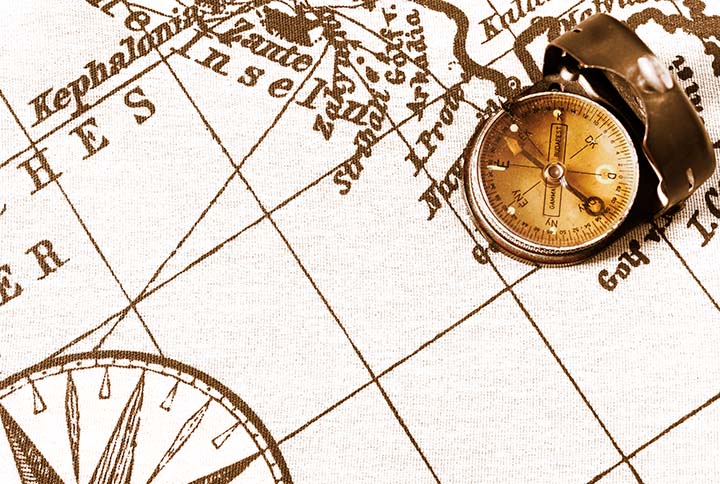
The progressive development of maritime techniques – such as the improvement of the compass, the construction of caravels or the updating of world maps – will allow Europeans to be able to navigate all the seas and oceans that make up the planet in just a few years. This feat will result in the division of the world into two halves, two geographical lines which, drawn between the two poles, will give them the power, signed by the papal authority, to divide the world into zones for navigation, fishing and conquest. The first line will be 370 leagues west of the Cape Verde Islands, while the second will be set at 297.5 leagues east of the Molucca’s.
The discovery of important deposits of precious metals in America – between Mexico and Peru – or the arrival on the islands of Southeast Asian species, led to the foundation or re-foundation of important American, African or Asian cities, which acquired a different territorial role in order to ensure a regular flow of wealth to Europe. The European monarchies thus began to control all trade passing through their territories in order to protect their economic gains.
From the beginning of the 16th century until the mid-18th century, the first colonial empires would maintain a strict mercantile monopoly with their colonies, and trade with people or companies that were not subjects of or related to the Crown would be prohibited. Castile, for example, regarded the English, Dutch and French, not as competitors but as enemies and the cause of corsair practices.
The colonial mercantilist system
Trade with the colonies was based on the premise that the colonists had to sell their raw materials – at a low price and with high taxes – exclusively to companies designated by the Crown. At the same time, the colonists would only be able to buy consumer goods manufactured by this select group of entrepreneurs. Therefore, monarchies will favour the unlimited enrichment of companies and individuals close to the state, since they will be denied competition. This mercantilist system will create useless needs for the natives and will seek to perpetually maintain the colonie’s underdeveloped – whether American, African, or Asian – in order to nullify possible direct competition with the metropolis.
And to make matters worse, the senior civil servants close to the king’s council will also play a very important role in this innovative economic system, since they had the ability to speed up or delay bureaucratic procedures in order to favour one or the other. The emergence of illicit and parallel trade between colonies was therefore inevitable and led many entrepreneurs, both large and small, to seek ways of circumventing the bureaucratic controls imposed by the Crown itself.
Acting as nouveau riche, the first colonial empires – mainly Castile – will spend an indecent amount of economic resources to build their concept of civilisation. This obsession – sometimes uncontrolled – will lead them to embark on countless conflicts of all kinds, such as theological disputes, family conflicts, commercial affairs or lavish megalomaniac constructions.
“This mercantilist system will create useless needs for the natives and will seek to perpetually maintain colonies underdeveloped – both American, African and Asian – in order to nullify possible direct competitors with the metropolis”.
Financing the empire with precious metals
Coinciding with the time of greatest economic extraction from the American colonies – between the late 16th and early 17th centuries – Castile spent more than 7 million ducats to maintain its fleet in the Mediterranean during the famous Battle of Lepanto. In approximately seven years, a staggering 11.7 million ducats would be spent to finance the countless campaigns in Flanders.
To commemorate the victory in the battle of Saint-Quentin against the French troops, more than 6.5 million ducats will be spent to build the magnificent Royal Monastery of San Lorenzo de El Escorial. Thanks to the construction and launching of the famous Invincible Armada, 9 million ducats were sent directly to the bottom of the sea. And of course, this Catholic and universal civilisation will need to build a new capital on the banks of the Manzanares River. For the reader who is curious about the conversion, the ducat of the 16th and early 17th century would currently be equivalent to around 167.1 euros. True, the figures are… shocking!
Therefore, between 1500 and 1650, the Castilian monarchy – and by proximity, the rest of the European monarchies – lived in a veritable economic bubble generated by the massive influx of precious metals. The latest studies estimate that the Castilian Crown extracted some 17,000 tonnes of silver and 70 tonnes of gold from the American colonies. This metal binge led the state to have a distorted view of the real economy.
The paradox occurred when, despite the huge inflow of gold and silver and the collection of high taxes, they did not cover all the expenses incurred by the state. We should bear in mind that the Castilian Crown would only use this extraordinary wealth to finance all the delusions of grandeur of the Castilian elites, which in most cases would come into direct conflict with the real needs of the population. For this reason, when the oligarchies of a country were more interested in working for lavishness than for the real possibilities offered by the reinvestment of capital, all this leads to the destruction of the productive fabric itself.
Indebtedness of the Castilian Crown
By the mid-17th century, the Castilian Crown was in debt to the tune of more than 100 million ducats. This gigantic debt forced them to declare successive suspensions of payments. To plug this hole, the Crown was forced to issue a large amount of public debt, which would end up in the hands of the main European banks, such as the German banks – the Fuggers and the Welsers – and the Genoese banks. The Crown will pay the Welsers by granting them the exploitation of the mines in Mexico and the right of conquest over extensive territories in what are now Venezuela and Colombia. For their part, the Fuggers will obtain all the commercial concessions over the territories of Chile and Peru. Today, they are one of the most powerful families on the continent.
Faced with the successive financial crises that the Castilian Crown began to suffer, many European businessmen living in the American colonies preferred not to ship their precious metals to Castilian ports – a monopoly granted in Cádiz and Seville – for fear of the massive confiscations decreed by the Crown. They, therefore, sought to invest their assets in other emerging sectors of the colonial economy at the end of the 17th century, such as agriculture, livestock and manufacturing production.
The Castilian Crown was therefore forced to look for new and regular sources of income. For this reason, it set in motion the ambitious plan of the king’s minister, the Count-Duke of Olivares, known as the Unión de Armas, which would require each kingdom that formed part of the Hispanic Monarchy – that is, mainly Portugal and the Crown of Aragon – to contribute a certain amount of money and soldiers.
“By the middle of the 17th century, the Castilian Crown would have an economic debt of more than 100 million ducats. This gigantic debt forced them to declare successive suspensions of payments”.
Relaxing the trade monopoly
Portugal, which had been part of the Hispanic Monarchy since the end of the 16th century, refused to grant any further economic contribution, given that Castile exploited its colonies, which led to a war that lasted more than 28 years. Finally, with the economic support of England and Holland, Portugal managed to free itself from the control of the Habsburgs, but the price it had to pay involved the cession of important territories in Brazil and the change of ownership of the colonies of Ceylon (now Sri Lanka), Cape Town, Goa, Bombay, Macao and Nagasaki, among others.
As for the Crown of Aragon, the Castilian oligarchy did not gauge the situation correctly when it accepted that King Philip IV would swear the Catalan constitutions, a sine qua non condition for obtaining the desired funds. Ignorance of the laws regulating the king’s functions within the Catalan territories would be the focus of important institutional discussions, given that the king – within the Principality – was obliged by law to explain the use of the resources granted. For their part, the Catalans were more interested in having their proposals for new Catalan constitutions approved and grievances addressed than in engaging in absurd wars.
But at the genesis of the institutional debate – between Castile and the Principality – we find a much deeper problem. If, since the end of the 16th century, Castile had moved towards a political system of an absolutist nature, where power resided in a single person, who decided without being accountable to any parliament, the opposite was true in the Principality, where the General Courts of Catalonia were the legislative body representing all strata of society, including the king.
The constant inflow of precious metals into the Castilian economy would remain stable until the mid-18th century, but only a very small percentage would remain within the Castilian economic system since the rest would continue to be used to pay off the monstrous debt of the State. Historiography estimates that it was not until 1820 that the Spanish state recovered from this huge expenditure, largely due to the fact that it had annexed the productive economy of the whole of the peninsular Mediterranean strip at the beginning of the 18th century.
The system of privileges and monopolies developed by the Bourbon trade policy continued to fail, and new agents had to be introduced to guarantee the viability of trade with America. Therefore, with the Royal Decree of Free Trade of 2 February 1778, the monopoly of Cádiz and Seville was definitively broken and Catalonia’s direct trade with America was favoured, which provided a new way of doing business. Funnily enough, today, 34% of Spain’s GDP continues to be contributed by the productive economy of the entire Mediterranean peninsular strip. Therefore, nothing happens by chance…
11Onze is the community fintech of Catalonia. Open an account by downloading the app El Canut for Android or iOS and join the revolution!

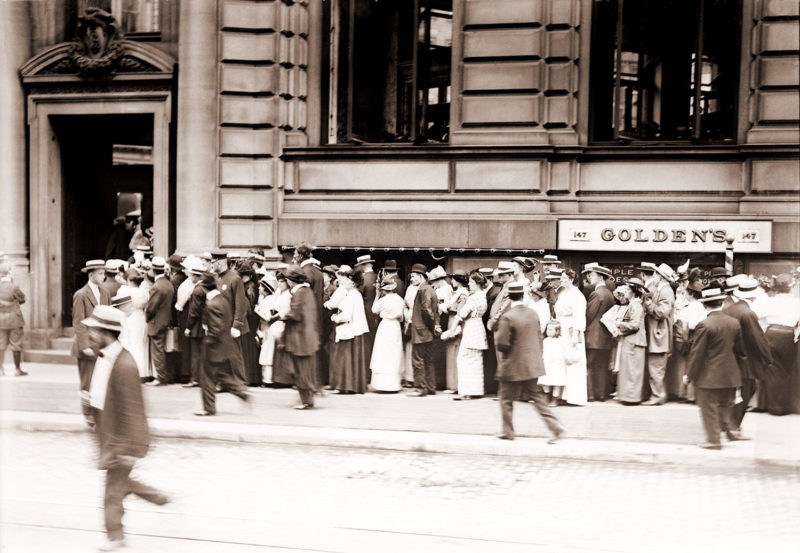
The political map of Europe at the end of the 15th century was shaped after the many conflictive social, political and economic events of the previous century and with a population reduced to less than 50% due to the Black Death. The new political landscape that emerged from this process showed a great variety of institutional forms of power. Alongside the two legacies of the Christian Lower Empire – the Holy Roman Empire and the Papacy – the feudal monarchies that emerged from this structural impasse greatly strengthened, which legitimised them to govern differently and led them to construct a new concept of the State.
In order to sustain this new conception of the State, the European monarchies sought the basic mechanisms that would enable them to consolidate new state structures with a markedly centralising and unipersonal character. For this reason, they first fought energetically against all those powerful families – the Armagnacs, Lancastrians, Braganzas, Mèdicis and Palomas – who had the capacity to dispute their decisions. The fight would not always be through the use of violence, but plots were created to delegitimise them or a tight matrimonial policy of territorial anthropophagy would be applied to them in order to extend state property permanently, without the need for bloodshed.
The new political conception would lead to a clear cornering of the most representative organs of the citizenry – such as the Cortes, the Estados Generales or the Dietas – which would be replaced by a powerful and much more specialised council of the king. In this way, the State would multiply its presence in the territory through the creation of a powerful administrative network linked to the different activities of the new management system. Soon, the civil service would appear, with a life tenure at the end of the century, which would allow a segment of the population to become rich beyond limits simply by working in proximity to power.
Up to this point, the monarchies had been financed by their own resources through ordinary rents linked to manorial rights or the profits produced by their possessions, whether from the exploitation of forests, the stamping of coins or the slave trade. But this was no longer enough.
“The new political conception would lead to a clear cornering of the most representative organs of the citizenry – such as the Cortes, the Estados Generales or the Dietas – which would be replaced by a powerful and much more specialised council of the king.”
An economic paradigm shift
The European monarchies would assuage their ambition by imposing a three-pronged strategy: firstly, they made the supplies of the feudal system regular and plentiful, which lead to the appearance of an infinite number of extraordinary financing funds for people and goods, such as taxes on trade, the famous tax on salt, or taxes on houses, fires, and so on; Secondly, they created the need for consumption, such as new eating habits or the introduction of fashion in the need to dress; and thirdly, they freed themselves from the usual need to ask for the consent of their subjects, who – were still represented in institutional bodies – coming up against the argument that “in peacetime, this request was completely unnecessary”. But the key and fundamental element that would allow all this new machinery to work perfectly would be the creation of a standing army, aimed at domestic control – between threats and persuasion – and projecting the monarch’s power outwards.
Gold would continue to be the main problem for the European economy, since it would still be absolutely necessary for trade. Since ancient times, the East-West relationship had gone through an infinite number of ups and downs, but its balance of trade had always been in deficit – with respect to gold – as the Asian continent was poor in deposits of precious metal. The only gold that reached Europe with any regularity – since the 10th century – was Sudanese gold, but this would never satisfy the needs of the feudal economy.
“The key and fundamental element that would allow all this new machinery to work perfectly would be the creation of a standing army, aimed at domestic control – between threats and persuasion – and projecting the monarch’s power outwards.”
The study and appreciation of the Greco-Latin classics
The atmosphere of strong economic dynamism pervaded the whole of this period, forcing the European monarchies to seek new fields of action and new sources of profit to maintain the new and very costly state structures. Europe was too small a space to satisfy the ‘grandeur’ of the nascent modern states, but above all, it showed a shortage of raw materials. It was then that the real desire to get closer to the sources of African gold or oriental spices would appear.
The worldview of medieval society was conditioned by religion, imaginary legends and geographical ignorance, but this changed radically from the Quattrocento onwards with the recovery of Greek manuscripts ignored by the Church – which controlled culture – as they were considered pagan texts. With the introduction of the basic rules of correct Latin translation – promoted by Petrarch and Boccaccio – these manuscripts were correctly transcribed and took on a new meaning. The rereading of numerous classical texts – such as Euclid, Pythagoras, Ptolemy, Eratosthenes and many others – made it possible to construct new critical thinking that would lead humanist scholars to want to verify how much wisdom the ancient texts contained about the world.
This humanism would favour a definitive break with medieval tradition and would exalt the qualities proper to human nature. It would allow the discovery of the human self and give a rational meaning to its existence. This anthropocentrism would free the human being from metaphysical wonder and place him before the gates of empirical curiosity. The dissemination of this innovative thinking was made possible by the invention of the movable type printing press. But this mental change would also enable a small group of people – settled in both Sagres and Nuremberg – to begin to experiment and apply modern scientific methods based on mathematics and astronomy, which would alter the universal worldview.
“The worldview of medieval society was conditioned by religion, imaginary legends and geographical ignorance, but this changed radically from the Quattrocento onwards with the recovery of Greek manuscripts ignored by the Church – which controlled culture – as they were considered pagan texts.”
Colonial conquest and exploitation
Ambitious businessmen set out in search of maritime routes that would lead them to new territories where they could find abundant products to satisfy the growing demand of European markets. And in this context, the State would favour this expansive economy by participating – indirectly – in the commercial adventures of these daring entrepreneurs, who would boast a great deal of audacity but little Atlantic experience.
Chance and the trade winds led the first navigators to the most populated area of the American continent. The territory of the “New World” – both north and south combined – is 42.5 million km². Before the arrival of Europeans, an estimated 100 million people lived on the entire continent, as opposed to the 1 billion who live there today. Of these, some 80 million people lived in the strip between Mexico and Peru. On the other hand, in the gradual southward descent of the African continent, Europeans discovered that the Muslim world had penetrated much further than they thought. Beyond the equator, they entered a totally unknown world and discovered black Africa. With an area of 32 million km², current estimates speak of some 60 million people who could be living on the entire African continent by the end of the 15th century.
From the very beginning of the westward voyages, the first navigators were certain and aware that where they had arrived was not the East Indies, but a completely different territory. And in embellishing this fact, the state deployed all its modern legal and administrative machinery to possess it legitimately. Without entrusting themselves to anyone and by the right of conquest, the European monarchies began to claim ownership of those territories while ignoring the indigenous population. At this point, religion played a key role in justifying the destruction, annihilation and extermination of the ancestral cultures that lived harmoniously. A similar path would be followed on the African continent, although this process would begin some one hundred years later.
As the newcomers – already in the name of the Crown – moved into these new territories, they would discover that precious metals were not the only source of wealth. In less than fifty years, European markets would be supplied, in quantities unthinkable until then, with countless tropical products such as pepper, sugar, cotton and tobacco. The Atlantic coast would see the growth of a major port network stretching from Cádiz to Antwerp and would form the backbone of a new economic area. And then, the Crown would define itself as an Empire, always, with a shining sun!
11Onze is the community fintech of Catalonia. Open an account by downloading the super app El Canut for Android or iOS and join the revolution!
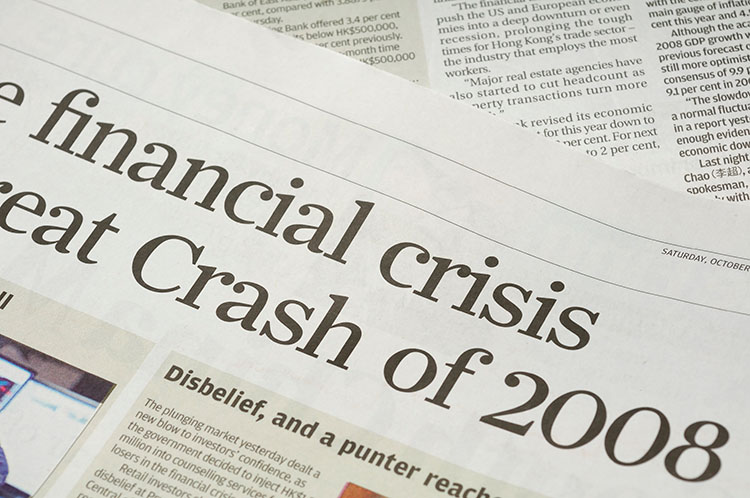
For the first time, we are entering a rocky path where many plans are mixed up. Historical objectivity – based on documentary rigour – has been abducted by a clearly intentional narrative that has sought to justify anything that would serve to construct universality. Doubting the official narrative surrounding the “Discovery of America” – where the Hispanic matrix is based – has forced countless historians to work outside the academy, with no other resource than their wit and intelligence.
The raw material on which history is based is documentary sources. Chronicles, cartularies, wills, contracts, dispositions, novels, chants, archaeological remains or ‘Lebenswelt’, are a specific type of documentary that each historian uses to understand and explain the past, which – filtered through his or her mental framework – will end up shaping a specific perception of that reality.
It is for this reason that, during the creation of knowledge, one will engage in passionate, constructive and sterile debates. Discrediting one’s adversary with personal attacks is a symptom of dialectical incapacity. Therefore, anything outside empirical rigour evokes us into the world of fiction or coffee shop talk. But what happens when a documentary source is shown to have been altered, tampered with or burned?
The capitulations of Santa Fe
Established in the camp of Santa Fe of Granada, the recent victors of the war of Granada, better-known as Catholic Monarchs – a title granted by Pope Alexander VI in 1496 – signed capitulations or agreements with Christopher Columbus on 30 April 1492 to carry out a major ultra-oceanic venture.
The agreements signed – known as the Capitulations of Santa Fe – would set the legal framework that would underpin the entire discovery of America, but they would also be the origin of future disputes between the Crown and the Columbus family. They will also clarify the granting of the titles of admiral, viceroy and governor-general of all the territories discovered and all the benefits derived from this enterprise.
The capitulations will acquire capital legal importance for Columbus and his descendants, and for this reason, he will never part with them during his lifetime. There is no record of the existence of this original until 1526 when it appears for the last time among the documents kept in the Columbus Archive in the Carthusian monastery of Santa María de las Cuevas (Seville). Unfortunately, this original has never reached us.
At the same time that the original of the capitulations was released to Columbus, a copy of the original was entered in the corresponding Book-Register of legal dispositions of the Royal Catalan-Aragonese Chancery in Barcelona. This entry is recorded in book 3,569, folios 135 and 136, in the ‘Diversorum sigilli secreti’ section, dated the same day of its issue, i.e. 17 April 1492. But just as the Catalan register is patented, no similar record has been found to date in any Castilian register. And it is well known that the systematic investigations carried out for centuries in the main Castilian archives -Simancas, Indias or Duque de Veragua- have so far been unsuccessful.
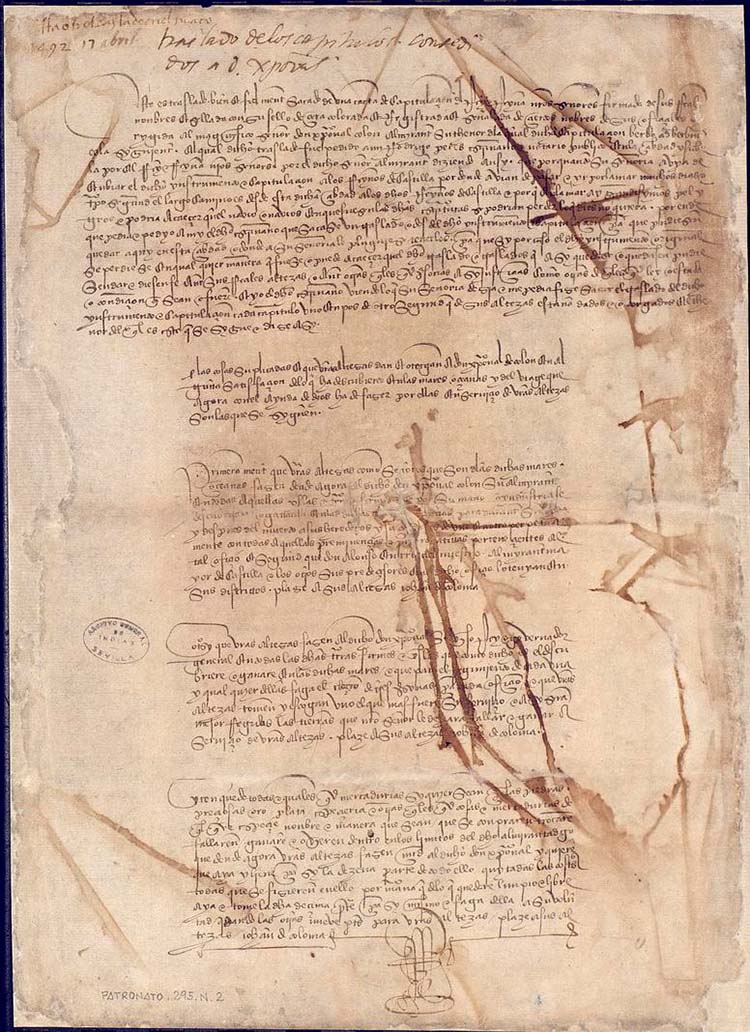
Original document of The capitulations of Santa Fe (ACA)
The legal construction of the maritime enterprise
Legislative power in the Crown of Aragon did not belong exclusively to the monarch but had to be developed together with the three estates: nobility, clergy and cities and towns. If the initiative came from the monarch, the constitution was born, while if it came from the estates of the courts, the court chapter was born.
From 1363, there is evidence of this legal practice when it came to the pairing of armies by the king with the deputies of the different estates of the Catalan-Aragonese Crown. It is for this reason that King Ferdinand signed the capitulations with Columbus, which is why one of the agreements states “perquè sia feta Armada en la Senyora del Senyor Rey, de Galées”. Therefore, neither in the legal sources of contemporary Castilian law nor in those of Indian law itself, will we find norms through which the legal concepts that appear in detail in the capitulations can be established.
The capitulations were negotiated and prepared in Barcelona by a committee formed by Joan de Coloma – representative of the Catalan Chancellery and the king’s personal secretary – and Joan Peres – Columbus’ representative – who was a prominent doctor of medicine and renowned cosmographer and owner of the castle of Sant Miquel, on the outskirts of Pals d’Empordà. And it was from the old port of this Empordà town, which no longer exists, that the ultra-oceanic expedition set sail.
When the two parties reached the agreement – on 17 April 1492 – the capitulations were immediately sent to the camp at Santa Fe de Granada – where the Catholic monarchs were staying – for official ratification (on 30 April 1492) and were subsequently handed over to Christopher Columbus. Finally, at the beginning of 1493, the Cortes Generales held in Barcelona ratified the agreement. All this justifies why these ‘Capitulations’ were kept only in the Archive of the Crown of Aragon: because that is where the documents of the magistracy concerned were recorded and archived.
“Neither in the legal sources of contemporary Castilian law nor in those of Indian law itself, will we find norms by means of which the legal concepts that appear in detail in the capitulations can be established”.
The financing of the maritime enterprise
All the surviving texts show very clearly that the money for the ultra-oceanic venture was advanced – to a large extent – by a Valencian settled in Barcelona, Lluís de Santàngel, who was the scribe of rations for the Catalan Chancellery, which often performed fiscal functions. The company was also financed by other illustrious figures such as Gabriel Sanxis – general treasurer of the Crown of Aragon -, Joan Cabrero – King Ferdinand’s waiter – and Alfons de la Cavalleria, royal adviser. It so happens that all these illustrious figures had had commercial links with the Columbus family in Barcelona for decades.
All the documents referring to the royal payments for the ultra-oceanic enterprise, count the figures in ducats, which was the Catalan currency. However, this currency was not used in Castile until 1497, when, after strong opposition from the Castilian municipalities for considering it a foreign currency, it was imposed by the monarchs.
It should be borne in mind that the structures of the two states, Aragon and Castile, always remained separate, despite the creation of bodies common to both crowns, such as the Inquisition. Therefore, each crown had its treasury, with its treasurer, its scribes and its royal archives. Consequently, if we apply the scientific method to find out who paid for the enterprise of discovery, we only have to go through the account books of both treasuries. Unfortunately, it is impossible to review the account book of the Catalan treasury, as it has disappeared. On the other hand, other contemporary Catalan sources say that thousands of ducats were being allocated to pay for ships and crews throughout that period.
But what happens when we look at the account book of the Castilian general treasury? By the way, it is public and in a modern edition! Well, there is no record of any money being spent on any maritime expedition during the nineties of the 15th century. There is no document that speaks of money referring to ships, pilots, crews or expeditions of any kind.
“Unfortunately, it is impossible to review the account book of the Catalan treasury, as it has disappeared. On the other hand, other contemporary Catalan sources speak of thousands of ducats being allocated to pay for ships and crews throughout that period.”
The triumph of the maritime enterprise
Christopher Columbus was received with full honours by the Catholic monarchs at the Royal Palace in Barcelona on 3 April 1493, after completing the first transoceanic voyage. Contemporary chronicles explain that the audience was very well received, and attracted many curious onlookers from all over the world.
Columbus had succeeded in finding the lost continent spoken of in countless ancient texts: the lands on the other side of the Atlantic “which since the sinking of Atlantis had been cut off”. And as proof of this discovery – of this “New World” – he presented the indigenous people, animals, metals and plants that they had brought back to the kings and to the highest authorities of the kingdom. Reliable proof that they came from lands hitherto unknown.
In fact, in the Capitulations of Santa Fe, it is written that the company undertook to discover territories “which are in the direction of the Indies”. Since at that time there was no geographical reference to illustrate an expedition that aimed to go to the other side of the Atlantic, the geographical reference of the Indies and China of the Great Khan was used. Both cases are extensively described in Marco Polo’s Travels at the end of the 13th century.
As the official documents of the first Columbus voyages state, the toponyms used to designate the “new places” were: Florida, l’illa Montserrat, the region of Valençuela, l’illa Margalida and la Jamaïca. It was after the expulsion of Columbus from all his American possessions and the change in the Crown’s policy in the mid-16th century that Castilian place names began to appear.
Disputes following the discovery of the maritime enterprise
When Columbus returned from his first voyage, the kings confirmed all the powers stipulated in the Capitulations de Santa Fe. But on returning from the second expedition, the monarchy realised that the lands discovered were not four lost islands, but were actually the mainland. This perception caused the monarchy to reconsider the powers granted to Columbus.
The legal problem the monarchy encountered was serious: they were aware that they had accepted and signed capitulations, which allowed the birth of a new dynasty installed in a New World and where Columbus would become viceroy for life, as well as being a hereditary title!
Aware of this problem and in the absence of the person concerned – since he was on an expedition – King Ferdinand changed the rules of the game. The viceregal reform of 1493 led to a limitation of the viceroy’s power, which would be subjugated to the power of the king and the possibility of removing him from office whenever treason against the Crown was proven. In 1500, Francisco de Bobadilla accused Columbus of betraying the Crown.
All documentation on the trial against Columbus has disappeared. From indirect sources, it is known that the Crown seized all the documentation that Columbus had to provide in his own defence. And it is also known that the reports on which the accusations were based were drawn up by Pere Bertran Margarit and Bernat Boïl.
And after all this setup, Columbus was released but deprived of all the titles signed in the capitulations. In other words, he became an inoffensive character for the powers that be. From the 16th century onwards, a long period of litigation began – first against Columbus and then against his descendants – to restore the agreements. For more than eighty years, the Columbus family would sue the monarchy, but it would prove to be a fruitless affair.
BASIC BIBLIOGRAPHY
David Bassa i Jordi Bilbeny: Totes les preguntes sobre Cristòfor Colom. Col·lecció Descoberta, Llibres de l’Índex, 2015.
Jordi Vila: Les Capitulacions colombines de 1492: un document català. 1r Simposi sobre la Descoberta Catalana d’Amèrica, Arenys de Munt, 2001.
Jordi Bilbeny: Cristòfor Colom, príncep de Catalunya, Proa, Col. Perfils, Barcelona, 2006.
Jordi Bilbeny: Inquisició i Decadència: Orígens del genocidi lingüístic i cultural a la Catalunya del segle XVI, Librooks, Barcelona, 2018.
11Onze is the community fintech of Catalonia. Open an account by downloading the super app El Canut for Android or iOS and join the revolution!
Until the mid-20th century, the official version of the transoceanic expedition that led to the discovery of the “New World” was somewhere between myth and romantic argument. But nothing of what had been recounted until then has turned out to be entirely true, not even the places of departure and return. For decades, a small group of historians – rejected by the academy and ignored by the media – have persisted in their work of dismantling a web of falsehoods surrounding the true facts.
If we shy away from fantasy and focus on making a true analysis of historical reality, which is based on the objective and scientific study of documentary sources – be they direct or indirect, primary or secondary – we will quickly realise that the usurpation of the historical identity of the transoceanic expedition carried out against the Catalan admiral Christopher Columbus is a fact.
Without any economic or institutional baggage to condition their research, a small group of historians have been able to find the true version of the discovery of America and the real identity of its protagonists that was silenced by Castilian censorship. Comparative studies of popular manuals, general histories and planispheres, whether in Castilian, Portuguese or French editions, have revealed how the Crown of Castile – through pervasive censorship supported by specific laws – came to control most of the narrative about the American expedition. Fortunately, curiosity has unmasked the manipulation and revealed the crudeness with which the Crown of Castile worked to manipulate the facts in order to confuse public opinion about the true authorship of the discovery.
Therefore, we should not be surprised that the Castilian epic appears at the beginning of the 16th century, just when Columbus was stripped of all the titles signed in the “Capitulaciones de Santa Fe” which, let us remember, was the legal framework that supported the whole discovery of America. With that trial, the Crown succeeded in making the Columbus family a harmless family in the eyes of the authorities. Indeed, a long period of litigation began thereafter – first against Christopher Columbus and then against his descendants – to nullify the agreements. For more than eighty years, the Columbus family would sue the monarchy, but it would prove to be a fruitless affair.
Manipulated documentation
The task set in motion – first by the Crown of Castile and later by Spain – has promoted over the centuries a series of official and singular versions, with an infinite amount of mixed-up data, unlikely places, real characters mixed with fictitious ones, changes of identity or disparity in the natural origins of the main characters. This has made it possible to configure a novelistic story, mutable to the tastes of the audience and handy for covering the needs of Spanish politics at any given moment. Therefore, it should come as no surprise that the epic has been based on a premeditated false narrative. But this confusion has begun to dissipate with the emergence of prominent scholars from outside Spanish circles, who have managed to reverse the tendency to repeat the official narrative as a set mantra.
An example of this changing trend has been the research of the American historian Alícia Gould, which has made it possible to trace all the surnames of the expedition members that appear in the supposed official records of Columbus’ different voyages, and has led to the following conclusion: nothing is true, everything is smoke and mirrors! Her research has gone far beyond the texts that list the names of the crew members. The investigation found that most of the crew members’ surnames do not have any documentary continuation that certifies that the sailor or individual – who appears in the lists – had a real and effective existence. But it is also very surprising that in these notorious lists, no Catalan surname appears among the crew. So, if we think that all these surnames have been manipulated, and we look for their equivalents in Catalan – Garay for Garau or Fernández for Ferrandis or Cases for Casaus – it turns out that they all fit in with very well-documented surnames, not only as real Catalan characters in flesh and blood but also as sailors, cosmographers or military men.
In conclusion, the Columbus chronicles that have come down to us denote a clear manipulation, given that they are full of anachronisms and significant temporal inconsistencies, something that seems inexplicable when the main source was supposedly a bibliophile, cultured and with a great memory, like Columbus’ son. Textual examination has shown that all these supposed originals have been retouched. For this reason, to trust the sources without applying any kind of documentary criticism, or suspecting the political intentions of the book’s arrangers, leads us, rather than to value rigour and historiographical academicism, to rely on faith.
The task set in motion – first by the Crown of Castile and later by Spain – has made it possible to configure a novelistic story, mutable to the tastes of the audience and handy for covering the needs of Spanish politics at any given moment.
The departure point of the expedition
Today we know from outstanding research work done by historians – both the pioneering Núria Coll and Eva Sans – that the town of Pals d’Empordà had an important natural port. We know this because these studies have made it possible to document countless witnesses that speak of commercial transactions that were carried out and, therefore, we know it had become an important commercial port since the beginning of the 13th century. In addition, toponymy and landscape archaeology have made it possible to identify both the remains of buildings and geographical features documented on ancient maps. All this, combined with palaeo-hydrographic studies of the area around Pals, confirm what the documents testify to.
Bearing in mind that the surface of the planet is exposed to constant change that causes regular movements, and we understand that the seas move away from the beaches or the other way around, we will understand that the surroundings of Pals at the end of the 15th century have nothing to do with the landscape of Pals that we see today. Obviously.
Therefore, what is most surprising about the official version – as far as the departure point of Columbus’ transoceanic expedition is concerned – is the name: Palos de Moguer. This is undoubtedly the same case as Sant Esteve de les Roures, two places that do not exist, nor have they ever existed. Certainly, in the province of Huelva, there are two villages, separated by 16 km, which correspond to the place names Palos de la Frontera and Moguer. Both are located more than 40 km from the Atlantic coast. And as if this were not enough, it is even more surprising when we find out that neither of the two places has ever been surrounded by walls or had a 21.28 metre-high Catalan Gothic bell tower.
Let us keep in mind that in the 15th century, Catalonia had become an important European nautical power. In fact, it is where the most outstanding pilot schools, cosmography centres, navigation instrumentation workshops and a host of specialists in the production of nautical charts were to be found. Moreover, since the mid-13th century, the Principality had pursued a very active insular policy that consolidated more than a hundred consulates of the sea scattered throughout the Mediterranean.
By contrast, at the same time, in Castile, there were no nautical schools, no pilot schools, no cosmography centres, nor any kind of nautical infrastructure capable of carrying out a transoceanic expedition such as the one undertaken by the Catalan admiral Christopher Columbus. Many historians point out the profound contradiction of the American expedition in itself, given that it was undertaken in a context where Castile was still waging war within its own territory against the Arab world, and had no developed commercial infrastructure or even a sufficiently powerful naval fleet to carry it out. In the context of a deep economic crisis – which would end with the revolt of the Castilian Communities – it is questionable that Castile had sufficient military and, above all, nautical capacity to launch a transatlantic expedition. Significantly, the first Castilian consulate – that of Seville – was created in 1543.
But the definitive proof of the point of departure of Columbus’ expedition is provided by Antonio de Herrera on the title page of his work “Historia General de los Hechos de los Castellanos en las Islas y Tierra Firme del Mar Oceano”, where in both editions of 1601 and 1726 there is an engraving that theoretically aims to illustrate “the town of Palos” in Andalusia when in reality it is meticulously representing the silhouette of the town of Pals d’Empordà. You only have to look at the engraving to quickly recognise its characteristic bell tower. Even so, the three caravels are depicted, which curiously carry the Catalan flag, something that is repeated successively in the engravings that illustrate the interior of the work. And as if all this were not enough, the quotation that accompanies the engraving reads: “The Admiral left Palos, villa of the Count of Miranda, to discover”. For, as Spanish historiography has pointed out, the Andalusian Palos belonged to the Count of Niebla. On the other hand, the Lord of Miranda was the Count of Empúries. Let’s continue!
Palos de Moguer is undoubtedly the same case as Sant Esteve de les Roures, two places that do not exist, nor have they ever existed!
The point of return and reception of the expedition
Today we know for certain that the Catalan admiral Christopher Columbus was received with full honours by the Catholic monarchs at the Royal Palace in Barcelona on 3 April 1493, after completing the first transoceanic voyage. And this event – accepted by all historiography – was totally silenced by the official version until not so long ago.
For centuries, both Portugal and Andalusia held this narrative, until the emergence of the study by the historian Antoni Rumeu de Armas, who, in his extensive work “Colón en Barcelona” – published in the midst of Franco’s dictatorship (1944) – had the courage to document the arrival of the Discoverer of America in the Catalan capital. Rumeu de Armas’s study was a key work for the future of Columbus studies, and contributed with an innovative investigation – in terms of the detail and precision of the research – in testifying how the city of Barcelona played a fundamental role in the discovery of the “New World”. Since then, documents of all kinds have continued to appear that prove that the discoverer was received in Barcelona.
Rumeu de Armas was able to demonstrate that the official version was built on a falsehood when it spoke of Palos de Moguer as the place of departure and return of the expedition. The analysis of the documentation – especially the ship’s log – made it possible to prove that the Pals de Empordà-Barcelona pair were the expedition’s true departure, return and reception points. It is also clear from the ship’s logbook that the expedition was planned as a reconnaissance voyage. Therefore, of a short duration and with a more or less fixed return.
On this first voyage, Columbus had managed to find the lost continent spoken of in countless ancient texts: the lands on the other side of the Atlantic “which had been cut off since the sinking of Atlantis”. And as proof of this discovery, of this “New World”, he presented to the royals and high authorities of the kingdom, the natives, animals, precious metals and plants that they had brought back. Reliable proof that they had come from lands hitherto unknown.
Even so, the Catholic Monarchs – from the summer of 1492 – stayed between Barcelona, Girona and Figueres, as the Principality was involved in a territorial conflict with the French, who had invaded Cerdanya and Roussillon in order to exchange them for the kingdom of Naples. King Ferdinand the Catholic – who was looking after the interests of his states – began to organise the military defence of the territory. It was for this reason that both monarchs, being in Catalonia and knowing that the expedition was only a reconnaissance expedition and, therefore, of short duration, waited for Columbus to return to Barcelona. It was there that a Portuguese delegation arrived to negotiate the distribution of the newly discovered lands, a process that would end with the Treaty of Tordesillas. And it was also there that the papal donation documentation arrived – from Pope Borja, “il papa catalano” – which would be made public by Bishop Pedro Garcia of Barcelona. Moreover, contemporary chronicles explain that the audience in Barcelona had a great echo and that the reception was a really popular and spontaneous celebration, with all the people of Barcelona celebrating in the street, a fact that is not recorded in any of the Castilian chronicles.
As Father Casaus’ chronicle explains, the gold that arrived from Columbus’ second voyage was confiscated in its entirety by the kingdom’s officials and customs officers, which made it possible to pay for the campaign to recover the Cerdanya and Roussillon, and to finance the construction of the fortress of Salses. But the most worrying event occurred during the course of the third voyage, when Francisco de Bobadilla – with broad powers to judge the admiral – confiscated all his merchandise, arguing that not all the promised wealth had been sent to the Crown. Thus began a veritable campaign of public discredit that would end with Columbus’ arrest.
All documentation on the trial against Columbus has disappeared. From indirect sources, it is known that the Crown seized all the documentation that Columbus had to provide in his own defence. It is also known that the reports on which the accusations were based were drawn up by Pere Bertran Margarit and Bernat Boïl, representatives of the Crown. Therefore, we should not be surprised at the somewhat farcical trial – something to which the Crown of Castile has become accustomed – in which Christopher Columbus and later his family became involved. In an act of extraordinary audacity, the Crown overstepped its bounds when, by means of falsehoods, it dispossessed the most famous navigator of the time of all his deservedly acquired titles.
At this point, the history of the discovery of America is an immoral issue for the Catalans. Since the 15th century, Catalanophobia has marked relations between Castile and Catalonia. We cannot continue to accept the Genoese origin of the Discoverer, we cannot continue to believe that the configuration of the crew of the three caravels was Castilian and – above all – we cannot continue to legitimise Castile as the promoter of the transoceanic expedition that led to the discovery of the “New World”, according to the official version, with the invaluable help of Queen Isabella of Castile who – with the pawning of her personal jewels – helped to defray all the expenses of the voyage. The whole thing makes no sense at all!
BASIC BIBLIOGRAPHY
- Antonio Rumeu de Armas: En Colom a Barcelona, Editorial Llibres de l’Índex, 2012.
- Eva Sans i Narcís Subirana: El Port de Pals. ANNALS de l’Institut d’Estudis Gironins, Volum LIV, Girona, 2013.
- David Bassa i Jordi Bilbeny: Totes les preguntes sobre Cristòfor Colom. Col·lecció Descoberta, Editorial Llibres de l’Índex, 2015.
- Jordi Vila: Les Capitulacions colombines de 1492: un document català. 1r Simposi sobre la Descoberta Catalana d’Amèrica, Arenys de Munt, 2001.
- Jordi Bilbeny: Cristòfor Colom, príncep de Catalunya, Proa, Col. Perfils, Barcelona, 2006.
- Jordi Bilbeny: Inquisició i Decadència: Orígens del genocidi lingüístic i cultural a la Catalunya del segle XVI, Librooks, Barcelona, 2018.
11Onze is the community fintech of Catalonia. Open an account by downloading the super app El Canut for Android or iOS and join the revolution!