The contentious handling of Next Generation funds
The European Union’s Next Generation funds should provide 140 billion euros in aid and loans to the Spanish economy. While the Spanish government boasts of exemplary management, autonomous communities and business organisations criticise bottlenecks that slow down their arrival in the real economy.
The Spanish government’s 2022-2025 Stability Programme foresees that, together with the impact of the war and the recovery of tourist activity, “the third factor that will determine growth in 2022 will be the Recovery Plan, whose first effects were already felt in 2021 and which will reach its cruising speed this year”. However, this third factor seems to be moving forward with the handbrake on.
The PERTEs (Strategic Plans for Economic Recovery and Transformation) were created with the aim of organising the distribution of a large part of the 140 billion euros in aid and loans that the EU has granted Spain to alleviate the economic ravages of the pandemic. So far, eleven PERTEs have been approved, three of which have open calls for applications and one, for electric vehicles, is already closed.
According to the Spanish government’s Recovery, Transformation and Resilience Plan, the largest allocations are expected to go to the modernisation and digitisation of industry and services (23%), the urban and rural agenda (21%) and infrastructure (15%). And to a lesser extent, to education (10 %), energy transition (9%), employment policies and the care economy (7%), modernisation of public administration (6 %) and the National Health System (6%), with residual percentages for culture and sport.
Contrasting visions
The Spanish government boasts of being the one that has mobilised the most Next Generation funds from the European Union, and the one that has done so most quickly. And the truth is that the President of the European Commission, Ursula von der Leyen, recently stated that Spain had been the first country to apply for the second payment of European recovery funds.
However, business organisations have a very different view: they estimate that only 13% of the nearly 33 billion of the eleven approved EERP funds have been mobilised and that barely 2% of the total has reached the real economy.
It is estimated that 8 of the 19 billion for 2021 have yet to be mobilised, to which at least another 26 billion should be added this year. But there is also the problem that part of the money mobilised was destined for public bodies such as ADIF or is still stuck between the central government and the autonomous communities, which aspire to allocate of half of the aid.
Various business organisations have criticised the Spanish government for the lack of agility, the lack of time for the presentation of applications in some solicitations, the bureaucratic complexity and, in short, the low percentage of Next Generation funds that have reached companies.
Both the president of the CEOE, Antonio Garamendi, and the president of the Galician Confederation of Entrepreneurs, Juan Manuel Vieites, have agreed in recent months that only one in four euros has reached companies.
For their part, organisations such as the Independent Authority for Fiscal Responsibility (Airef) have also criticised the government for the delays in implementation and the lack of official information.
The multiplier effect of European aid
In the calls for proposals planned by the central government and the autonomous communities for the second half of this year, suburban railways, digitalisation, health and the agri-food industry should be the areas with the highest concentration of funds.
The pull effect of public aid is evident, as highlighted in a recent report by the Bank of Spain, which calculates that “a 1% increase in public investment would be associated with an increase of the same magnitude in private investment in the short term”.
Hence, the importance of speeding up the execution of European funds. Also, there is concern about another piece of data from a survey by the Bank of Spain: the proportion of companies interested in applying to calls for proposals related to projects financed with European funds fell to 16.6% in the first quarter of 2022, some 7 percentage points lower than in the previous quarter.
The Bank of Spain expects the Next Generation funds to contribute 1.4% to Spanish GDP in 2022, but this percentage could be reduced if the aid does not arrive to the extent and at the speed expected.
11Onze is the community fintech of Catalonia. Open an account by downloading the super app El Canut for Android or iOS and join the revolution!


The world’s economic elite gathered this week in the Swiss town of Davos. Fears of a possible recession have marked the annual meeting of the World Economic Forum, which continues to be weighed down by the lack of women.
“A family reunion for the people who broke the modern world.” This is how Anand Giridharadas, former columnist for ‘The New York Times’ and editor of ‘The Ink’, described the World Economic Forum Annual Meeting. “A unique collaborative environment in which to reconnect, share ideas, gain fresh perspectives, and build problem-solving communities and initiatives.” This is how the World Economic Forum describes it on its website.
This World Economic Forum event, cancelled in 2021 due to the pandemic, brings politicians, business people, academics, social leaders and celebrities to Davos each year to address the global agenda. Although it is normally held in January, amidst snow-capped mountains, the Omicron variant of Covid-19 forced it to be delayed, and it finally took place between 22 and 26 May.
Some see it as a place for the world’s elite to pat each other on the back and exchange favours. Others see it as a platform for seeking solutions to major global problems and conflicts. Both are probably partly right.
An elitist event
What is clear is that participation in this event is not open to everyone. To do so, you have to be one of the approximately 1,000 members of the World Economic Forum, which can cost more than half a million euros, or you have to be invited. One way or the other, a presence at the event is an opportunity to influence the global agenda.
This year’s list of participants included some 1,250 business leaders, more than 300 politicians from around the world and some 200 NGO representatives, as well as entrepreneurs, academics and other members of civil society.
The World Economic Forum was founded in 1971 by Klaus M. Schwab, a professor at the University of Geneva, who invited about half a thousand European executives to a meeting on business management. In 1987, the non-profit organisation adopted its current name and took on a broader focus to address the major issues affecting the future of humanity.
From polarisation to the war in Ukraine
The 2020 edition, which was attended by more than 3,000 people, highlighted the polarisation in the world, with two major antagonistic protagonists. On the one hand, the then President of the United States, Donald Trump, and on the other, the activist Greta Thunberg, who criticised the world’s major leaders for their inaction on climate change.
This year, Davos has been visited by the executive director of the International Monetary Fund (IMF), Kristalina Georgieva; the president of the European Commission, Ursula von der Leyen, as well as business figures such as Bill Gates and George Soros. Ukraine’s President Volodymir Zelensky, who called for stronger sanctions against Russia, spoke by videoconference at the opening of the conference. In any case, the overwhelming majority of men shows that the power elites are still far from achieving gender parity.
This year’s more than 150 sessions were organised around eight thematic areas, including climate and nature, fairer economies, tech and innovation, jobs and skills, better business, health and healthcare, global cooperation and society and equity. The war in Ukraine, the energy and food crisis, as well as their impact on the already complex economic situation, took centre stage.
Recession fears
Bad news is not good news for business, and Davos tends to offer a somewhat sugar-coated view of the future. This year, however, it was hard to ignore the risk of a recession.
The head of the IMF reservedly acknowledged that an economic contraction cannot be ruled out and warned that 2022 will be a “tough year.” For his part, José Viñals, president of Standard Chartered, acknowledged that the threats looming over the global economy could turn into “a perfect storm.”
Even if a new recession were to occur, it would not prevent the list of nouveau riche aspiring to attend the World Economic Forum Annual Meeting from continuing to grow. An Oxfam report indicates that, despite the global economic meltdown, a new billionaire emerged every 30 hours during the pandemic.
If you want to discover the best option to protect your savings, enter Preciosos 11Onze. We will help you buy at the best price the safe-haven asset par excellence: physical gold.


Nearly 100 billion euros of loans granted by Spanish banks are on the verge of default, according to the Bank of Spain. And everything indicates that the situation will worsen in the second half of the year, so difficult times lie ahead for the banking sector.
At the end of 2021, Spanish banks accumulated loans at risk of default amounting to 94 billion euros, with an increase of 14% in the last quarter of the year, according to a report by the Bank of Spain. These are loans that the Spanish banking supervisor places in the “special watch” category because they have not yet defaulted, but are at risk of becoming non-performing. Overall, they represent 8% of total corporate and household debt, 2.2 percentage points higher than before the pandemic.
Business loans that are on the verge of default are the most worrying, having risen by almost 26%, and account for almost two thirds of the total under “special surveillance”. Even so, we should not lose sight of the fact that the likely rise in short-term interest rates could complicate the repayment of mortgage loans taken out by many families.
The situation of loans considered doubtful by the Bank of Spain is not good either. Although the total has fallen by 5.5%, it is still close to 50 billion euros. Of the total, 27 billion correspond to companies and 22 billion to households.
The impact of the pandemic
The business sectors most affected by Covid-19, which account for 24% of total doubtful loans and under special surveillance, show the greatest signs of deterioration. For example, 35.5% of the credit granted to hotel and catering companies is under special surveillance and 6.5% are doubtful loans, so that problematic credit is close to half of the total. In the case of transport, problematic loans account for 27.5 % of the total. And it should be borne in mind that these sectors are particularly sensitive to the rise in energy and food prices.
The Bank of Spain also notes a deterioration in loans to businesses guaranteed by the ICO in the second half of 2021. Total ICO credit under special surveillance increased by almost four percentage points in the last six months of the year to 20%, while that considered doubtful accounts for 3.5%, an increase of 1.4 percentage points compared with June last year.
The end of the grace period for repayment of the principal that many companies with ICO loans will have to face in the coming months increases the risk of credit deterioration. It should be borne in mind that, according to the Bank of Spain’s report, more than a third of these loans are still in the grace period for repayment of the principal.
Not an encouraging picture
The Bank of Spain notes in its report that the Spanish banking sector as a whole shows an “adequate” aggregate resilience to face a possible deterioration of the economic situation. However, it recognises that “the combination in the short term of higher inflation, which erodes the real incomes of households and companies, and an increase in interest rates, could reduce the payment capacity of these agents”.
The fact is that the combination of several circumstances could cause a perfect storm in the second half of the year for Spanish banks. The economy has already shown signs of slowing down in the first quarter of the year, inflation is still soaring, household consumption is contracting, and many companies will soon have to start repaying the principal on ICO loans.
If we add to all this the likely rise in interest rates by the European Central Bank, which would complicate the repayment of all variable-rate loans, the risk of default will skyrocket in the second half of the year.
Is the Spanish banking sector as a whole really prepared to face this scenario? The “adequate” resilience pointed out by the Bank of Spain might not be enough. And we all know what happened to the banking sector when the real estate bubble burst.
If you want to discover the best option to protect your savings, enter Preciosos 11Onze. We will help you buy at the best price the safe-haven asset par excellence: physical gold.

Gold is in fashion. The upward trend in the precious metal has been spurred by the health crisis, runaway inflation, and global geopolitical conflicts. Even so, it seems that central banks have seized the opportunity to release a whole series of special edition gold coins. Here is the latest coin to be released by the Bank of Spain.
The coin collecting hobby, known as numismatics, is in luck. In December 2021 the first gold bullion coin issued by the Royal Spanish Mint (FNMT) was put into circulation. Although it has a face value of 1.5 euros, its real value is determined by the price of gold at the time of sale, plus a 10% production cost.
The coin weighs one ounce of gold (31.10 grams) and is dedicated to the Iberian lynx, of which only 12,000 will be issued. It is intended for investors and collectors, so it is not legal tender.
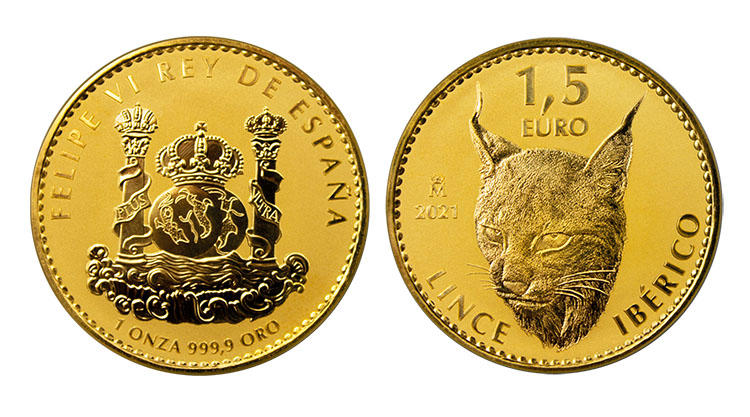
The new 1.5 EURO coin from the FNMT.
This special edition coin is the first of a series of coins that the FNMT announced it would be introducing in the coming months, with the aim of minting more investment coins for numismatic enthusiasts.
Thus, last month the FNMT revealed that during the second quarter of 2022 it will also be possible to buy a new gold coin with a face value of 15 cents.
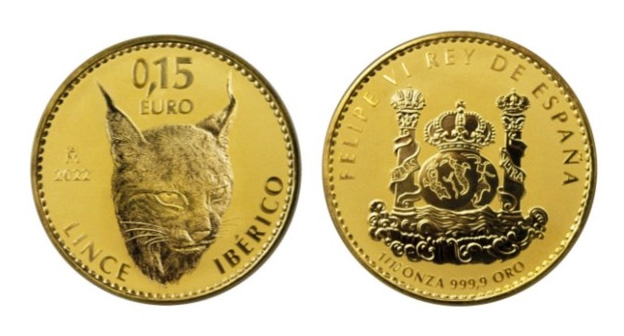
The new 15 cent coin from the FNMT.
The Iberian lynx as the protagonist
The Iberian lynx has once again been chosen for the new gold coin, which has certain differences from the initial 1.5 euro coin. In this case, it will have a grooved edge instead of a smooth one and is made up of one-tenth of an ounce of gold, i.e. weighing 3.1 grams. This means that it is a much more affordable coin.
As for its price, it is still unknown. The FNMT website states that it will be determined at the time of the transaction by the price of physical gold transactions at that time plus a margin of 22% (as opposed to 10% in the previous case).
Therefore, although the retail price of the coin will be established at the time of the transaction, if we take into account the current price of gold and add 22%, the price of the coin would be around 212 euros. This is much less than the almost 2,000 euros we would pay for a 1.5 euro coin.
If you want to discover the best option to protect your savings, enter Preciosos 11Onze. We will help you buy at the best price the safe-haven asset par excellence: physical gold.

Public debt in Europe is at record highs, and the interest that governments have to pay to finance themselves has in some cases reached levels that have not been seen for years. All the signs are that interest rates will eventually rise in the near future, thus credit for households and businesses will become more expensive.
The interest rate on German ten-year bonds rose to over 1% this week and Spanish bonds to 2%. Neither had been the case since 2015. The yield on the Spanish ten-year bond closed 2021 at 0.595%, after having reached negative levels in December 2020. As for the German bond, the increase has been considerable in the last two months, as it was negative at the beginning of March. On the other side of the Atlantic, the interest paid by the United States on ten-year bonds also exceeded 3% this week, something that has not happened since the end of 2018.
Interest rates on the debt of other European countries such as France, Portugal, Italy and Greece have experienced a similar trend to Germany’s in March and April, with increases in most cases of around one percentage point. Thus, the interest rate on French ten-year bonds is already close to 1.5%; Portuguese bonds are around 2%; Italian bonds have reached 2.8%, and Greek bonds are above 3%.
It should be noted that the European Central Bank (ECB), the Eurozone’s largest customer of government bonds, announced in March that its debt purchases would be drastically reduced this year. Its forecast is to go from the 80,000 euros per month it bought until recently to 20,000 million from June onwards.
New investors are being sought
This sharp decline in debt purchases means that supply and demand have to be readjusted, and the way to attract new investors is to increase yields. As a result, governments will have to pay more for their debt and their ability to invest will be reduced, which has an obvious negative effect on the economy.
Moreover, higher interest rates on public debt will make it more attractive to investors, with the result that some of the money that was previously used to finance the productive economy will now be used to buy public debt.
The end of an era
The reality is that the era of negative interest rates for European debt thanks to the ECB’s ultra-loose monetary policy is over. And the most fragile European economies in particular are suffering as a result of the risk of recession. They are seeing their risk premium, which is the extra cost they pay with respect to the ten-year German bond, increase.
The risk premium attached to Spanish bonds, for example, remains slightly above 100 basis points, with peaks at the end of the daily sessions that have not been reached in the last two years. Like Italian and Portuguese yields, Spanish yields have risen by around 40% since January. And Greece’s is already above 230 basis points, having risen by more than 65% since the beginning of the year.
Each basis point of the risk premium is equivalent to 0.01% more interest than the yield on the German ten-year bond. Thus, 100 basis points means paying 1% more interest than Germany and 200 points is equivalent to 2% more.
The rise in interest rates is also affecting short-term debt. In the case of Spain, only bonds with maturity of less than one year are trading with negative interest rates, since in the last few days twelve-month bills have once again registered positive interest rates. And the trend is similar in other Eurozone countries.
Debt out of control
This increase in the cost of financing will particularly affect the Eurozone’s most indebted economies. It should be borne in mind that the public debt of many countries has risen sharply in recent years. For example, in the case of Spain, its debt in February reached an all-time high of 1.442 trillion euros, according to the Bank of Spain. This represents 119% of GDP, whereas in 2008, before the onset of the economic crisis, the percentage was less than 40%.
In addition to this increase in debt and the interest rates that countries pay on it, there has been a change in the monetary policy of the major international players, who have raised or are considering raising the price of money to combat inflation. One example is the United States, which has just raised its interest rate by 50 basis points, and all forecasts suggest that the ECB will also end up raising rates in the near future to curb inflation. In short, everything points to a tightening of credit for SMEs, the self-employed and households.
If you want to discover the best option to protect your savings, enter Preciosos 11Onze. We will help you buy at the best price the safe-haven asset par excellence: physical gold.


In recent weeks, there has been speculation that Russia could be forced into default due to its inability to meet its debt payments in dollars. Cases such as Argentina’s give clues as to what the consequences of such a move might be.
Rumours in financial circles had Russia on the brink of default in mid-March. The reason for this was difficulties in meeting its US dollar debt repayment commitments on schedule.
The fact is that so far the country has managed to meet its scheduled payments. However, doubts remain, as the amount that Russia must repay in April, more than 2 billion dollars, is much higher than in March. The blocking of Russian assets by the EU and the US is a serious obstacle to making payments in dollars.
International debt rating agencies have downgraded Russia’s debt to pre-default levels. And Kristalina Georgieva, managing director of the International Monetary Fund (IMF), acknowledged a few weeks ago that a Russian default “is no longer an unlikely event“.
Russia would not be the first country to declare a default. Indeed, the Spanish state did so seven times in the 19th century. And the case of Argentina in this century offers many lessons on the consequences of such a move.
One month grace period
When such a situation arises, countries have a period of 30 days to renegotiate the debt with creditors, which are mostly banks. The aim may be to refinance the debt, have a part of it written off, or agree on a temporary moratorium on payments.
Another option is to seek alternative financing, either by raising interest rates on the debt to attract new investors, as Iceland did in 2008, or by resorting to international organisations such as the IMF, the solution applied by Greece in the past decade. In any case, Russia would find the latter route complicated by the majority of nations’ rejection of the invasion of Ukraine.
If after 30 days, the country does not achieve any of the above, the only option is to declare insolvency or default. This is what Argentina did between late 2001 and early 2002, in what was the largest state default in history. The state owed almost $200 billion and had only $10 billion in foreign exchange reserves.
Cascading consequences
Obviously, the suspension of a country’s payments implies the loss of investor confidence in that economy. This translates into the impossibility for the state to continue borrowing to finance itself and a massive exodus of capital, especially foreign investment.
The drastic contraction of private investment leads to a recession in the economy, which leads to a vicious circle of more unemployment and shrinking state revenues. It should be borne in mind that in the case of Argentina, unemployment doubled in five years and the need to cut public spending hit pensioners and civil servants particularly hard, as their incomes were considerably reduced.
Moreover, following a default, a devaluation of the local currency is common in the face of a loss of external confidence, which leads to higher prices.
The population’s fear of devaluation and hyperinflation often leads to a massive withdrawal of funds from banks in order to move them abroad. This phenomenon forced the Argentine government to freeze bank accounts and limit the amount of money that could be withdrawn daily, which became known as the “corralito”.
The perfect storm
This inflationary environment, coupled with a sharp decline in incomes and limited access to savings, is the ideal breeding ground for social unrest, rising crime, and the flight of human capital.
Six months after the default, almost a quarter of Argentines were considered destitute and another quarter below the poverty line. These are hard figures to swallow considering that this is a country rich in natural resources and with one of the largest livestock herds in the world.
The loss of confidence in paper money even led to the proliferation of up to 8,000 barter clubs in Argentina, some of which went so far as to issue their own “coins”.
Risk of international contagion
A country’s suspension of payments can also have negative consequences beyond its borders. It should be borne in mind that the first effect of this measure is that creditors cease to be paid. This can put a strain on international creditors who are heavily exposed to that debt or on insurers who have decided to hedge those investments. In certain cases, the banking and insurance system may be affected by the domino effect.
It now remains to be seen what Russia’s ability to meet its commitments will be in the coming weeks, and whether the IMF managing director’s warning takes shape as the cost of the war in Ukraine and international sanctions put the Russian economy on the ropes.
If you want to discover the best option to protect your savings, enter Preciosos 11Onze. We will help you buy at the best price the safe-haven asset par excellence: physical gold.



With the announced reduction in the funds earmarked for debt purchases and a rise in interest rates on the horizon, the European Central Bank is putting the recovery of the most indebted countries at risk. They may be the collateral victims of the war on inflation.
Growth or price stability? This is the dilemma facing the European Central Bank (ECB) through its policy of buying debt and interest rates. And the bet today is clear: its president, Christine Lagarde, wants to avoid runaway inflation at all costs despite the economic uncertainty caused by the war in Ukraine.
The ECB’s forecast is that price rises in the European Union will reach 5.1% on average this year, almost two points higher than they predicted in December. This is why Lagarde recently announced a tightening of monetary policy to contain inflation: the ECB’s monthly debt purchases will fall from 40 billion euros in April to 30 billion in May and 20 billion from June onwards.
Bond purchases during the pandemic
Until now, the ECB has been purchasing around 80 billion euros of debt per month, three-quarters of it under a special programme set up to deal with the Covid-19 crisis.
The ECB is even considering ending net debt purchases if the measures are not sufficient to curb inflation. It should be borne in mind that during the pandemic, the ECB has bought nearly two trillion euros in debt. From January 2020 to mid-2021, the eurozone’s debt stock went from 86% to 100% of GDP.
Rising interest rates
In addition, the ECB announced that there will be a “gradual” rate hike after some time. Analysts estimate that this policy shift could begin in the latter part of this year or early 2023. However, inflation developments will dictate the timing and intensity.
These decisions will particularly affect the Spanish, Italian, Portuguese, and Greek economies, as the ECB is buying a large part of the debt issued by these countries. Debt in Spain is already 125% of GDP, in Portugal 140%, in Italy 160%, and in Greece 210%.
In the case of Spain, the net borrowing requirement for 2022 is estimated at around 75 billion euros. The economic uncertainty and the energy crisis caused by the war in Ukraine are now added to the convalescence of the pandemic in their economies.
Less room to maneuver for the most heavily indebted
The ECB’s announcement to reduce debt purchases will considerably reduce the capacity of the most indebted countries, including Spain, to finance fiscal policy measures to stimulate recovery, either through subsidies or a reduction in the tax burden on individuals or companies. Another undesired consequence could be that the risk premiums on the debt of these countries could start to rise.
All of this is taking place in an environment of great uncertainty due to the international situation and the evolution of energy prices, which have a direct impact on the price of most products.
11Onze is the fintech community of Catalonia. Open an account by downloading the super app El Canut on Android and Apple and join the revolution!
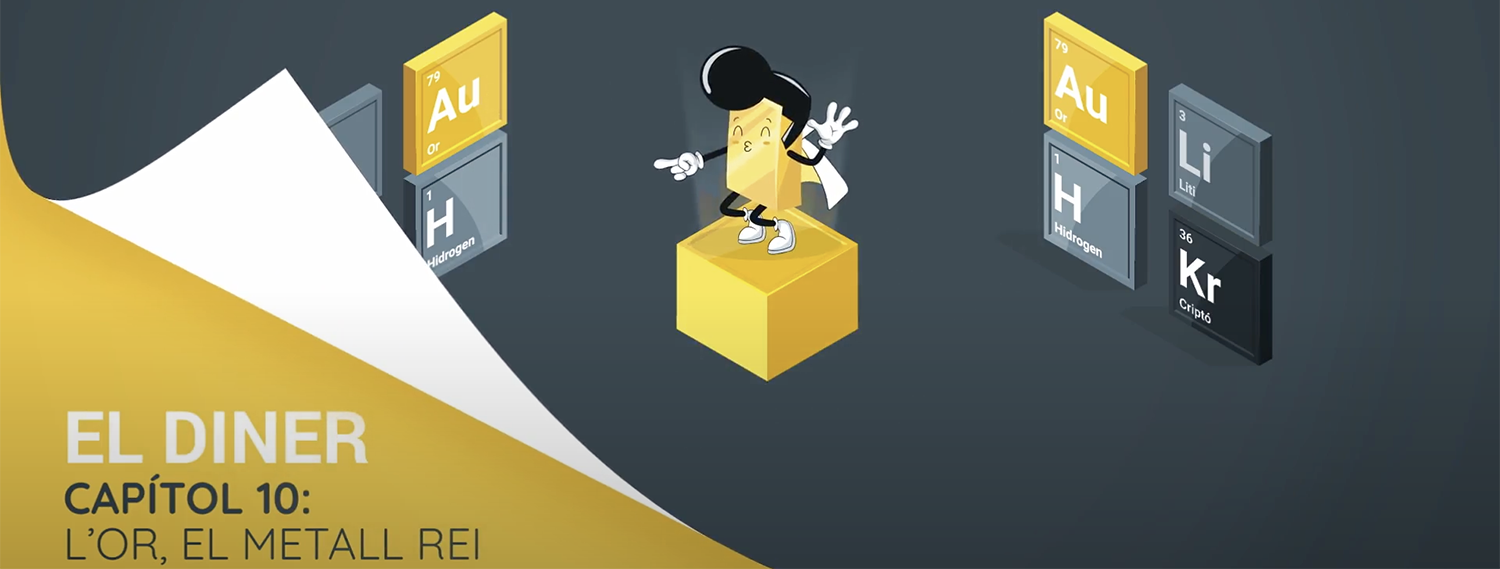
11Onze’s animated series dedicates an episode to gold. We explain mankind’s relationship with this precious metal since its origins in a special episode.
If you thought we had already explained everything about gold, you were wrong. What makes gold so safe and so prestigious? Well, the human history with gold goes back a long, long way. That is probably why there is this atavistic behaviour: when things go wrong, we go back to gold. When there is a crisis, when currencies can no longer be trusted… we always look to the king metal. It’s normal, it’s thousands of years of relationship. Already in prehistoric times, around 4600 BC, humans were making gold jewellery. And we haven’t stopped since then. Gold has always been a symbol of wealth and stability.
In this episode of El Diner we take a look at this history and the role of gold in the global economic system. From the Gold Standard to the Dollar Standard and the present day. We say it is a special episode for several reasons. Because it is longer than usual, because it incorporates a new main character and because, for the first time, 3D had to be incorporated into the animation. An effort by 11Onze and Luee studio for a protagonist who is not just anyone: he is the metal king. That’s why our ingot is akin to Elvis.
At the end of the chapter, as always, you will be able to test your acquired knowledge with a quiz. Are you already an expert in gold? That’s exactly what we wanted: if you decide to protect your savings with Preciosos 11Onze, you will have all the training you can get.
Gold, the king metal
You can see the full chapter here.
If you want to discover the best option to protect your savings, enter Preciosos 11Onze. We will help you buy at the best price the safe-haven asset par excellence: physical gold.

The snake in the tunnel broke early, during the 1970s, but it allowed Europe to create the European monetary system as we know it. Why was it created and what did it become? Agent 11Onze Eve Doña explains it.
“The agreement to create the snake in the tunnel was established between 1972 and 1974 as the European exchange rate system,” Eve Doña explains. From the consequences of the Bretton Woods Agreements, which fixed fluctuation margins for the different currencies of the planet with respect to the US dollar, the system was born after the Basel Agreement.
The countries belonging to the European Economic Community (EEC) realised the problems of having flexible exchange rates for the common market and created the snake in the tunnel. In this way, they tried cross rates for their currencies. But what was the result?
“The results of the snake in the tunnel were not encouraging. The imbalances between the European economies led to greater difficulties, which made the snake in the tunnel a failed policy,” the agent argues. Thus, devaluations and revaluations, taking into account the different exits and entrances of the exchange rate stability mechanism, made the snake in the tunnel a system that could not correct this issue.
For this reason, in 1979 the snake in the tunnel was discarded in order to implement what we know today as the European monetary system. Watch the video below and find out more about the snake in the tunnel.

Snake in the tunnel

The recovery in demand and consumption in 2021 has pushed up the price of oil, metals and gas, among others. But this is not the only reason that brings us closer to the next crisis. We have to add speculative interests and a tense geopolitical situation. All these temporary factors had to be corrected in the short term, but the inflation that is gripping us is still very much alive. What is happening with the oil price?
For a start, the price of oil has risen so high and so fast that it is already close to 100 dollars per barrel. Experts have not seen a similar figure since 2014. This rise now threatens post-pandemic economic growth, but also fuels the inflationary crisis that has been brewing for some time. And this, it is clear, can weigh on business production, but also seriously affect the purchasing power of citizens.
According to ‘Bloomberg’, the rise from 70 dollars per barrel at the end of 2021 to around 100 dollars per barrel at the end of February could raise inflation by around half a percentage point in the United States and Europe in the second half of the year. And this is of great concern to the US Federal Reserve, but also to other central banks. To try to combat this crisis, the G20 finance chiefs will meet for the first time since the start of 2022.
Although energy exports will benefit from the oil boom, a large part of businesses and the population will be affected by this increase. And it is well known that oil price rises tend to herald periods of recession.
As recently as last week, Deutsche Bank’s head of economic research, Peter Hooper, said that “the oil shock is fuelling what is already a much broader inflation problem.” JP Morgan has also warned that, if the price per barrel rises to $150, it will “almost stall the global expansion” and could push inflation above 7%, more than three times the rate forecast by most financial institutions.
Keep in mind that fossil fuels, such as oil, coal and natural gas, provide 80 per cent of the world economy’s energy. These fossil fuels have experienced increases of more than 50% over the previous year. And this, of course, also affects supply chains and delays and raises the costs of raw materials.
Geopolitical tensions in Russia, the world’s largest oil producer, are not helping to contain prices either. And a supply constrained by OPEC cuts does not facilitate faster distribution from these countries either —today, 400,000 barrels per month are exported. Analysts believe that curbing the rise would only be possible if there were an increase in investment in a highly polluting sector, and in a context in which the West prefers to bet on green energy; or if Iran were to rejoin the international oil market. But it does not seem that either of these two options is viable.
In order to control inflation, the Federal Reserve and the Bank of England have already announced possible interest rate hikes, but this will have an impact on sovereign debt, especially that of emerging economies. As a result, China may suffer, because it is one of the world’s largest borrowers. China is also a major exporter of oil and other fossil fuels, and until now has enjoyed very benign inflation, but its economy remains vulnerable and producers are beginning to see the energy crisis looming.
Who benefits?
But not all countries are being hurt by rising oil prices. Alternative energy offers a small buffer. For example, since the emergence of the shale oil industry in the United States, its economy is less vulnerable than it was during the 1970s. Thus, even though domestic consumers have to pay more for energy, domestic producers earn more money.
Russia could also benefit, increasing its revenues by $65 billion for the year, which could protect Moscow from possible sanctions over the conflict with Ukraine. And this increase could also benefit other emerging economies in the sector, such as Canada or Middle Eastern countries.
The recession is coming
For the general population, and for most economies, however, there is nothing to celebrate. AXA IM’s head of systems and information services, Chris Iggo, has warned that inflation “could remain around 7% for the rest of the year, which would mean more aggressive hikes by the Federal Reserve and bring us closer to the next recession.”
Analysts at Bank of America Merrill Lynch have also warned that the economy is reaching an “end of cycle.” The Covid-19 crisis, the millions mobilised by governments to respond to it that have further indebted the world’s economies and, now, central bank stimulus to combat inflation may have accelerated everything. The rise in oil prices is a further symptom to be taken into account. And it does not seem to have a good solution in the long run.
11Onze is the fintech community of Catalonia. Open an account by downloading the super app El Canut on Android and Apple and join the revolution!