The hurricane of calamities
The energy crisis, runaway inflation, record public debt and the International Monetary Fund’s warning that the outlook for the global economy is worsening in the face of an impending recession, have sent the global economic climate index plummeting to its lowest level in 20 years.
There is no merit in announcing that the world economy is in a crisis, when it is nothing new for a population suffering from the growing economic turbulence that has been accompanying us for three years. A bleak outlook that may leave our current account, but also our emotional well-being, in the red.
The question on everyone’s mind is: when will we get out of the crisis? But at the moment, none of the economic research bodies or managers of financial institutions seem to know. The analysts and politicians who were forecasting sluggish and one-off inflation that would last a few months, but which has shot up and seems endless, are either backtracking or continuing to move the dates of recovery to match those of the most pessimistic forecasts that were considered implausible only a year ago.
In the face of unchecked price increases that continue to reduce the purchasing power of the population, controlling inflation should be the first priority of policymakers. The tightening of monetary policy will inevitably come with real economic and social costs, but delaying it will only exacerbate them, as it has done in the past.
On the brink of the abyss
Not only do the major European economies have to cope with higher than expected inflation, but they also face a possible total disruption of Russian gas imports, either because of Washington’s pressure on Europe or because of Russian retaliation to economic sanctions, which would result in measures to reduce price rises proving wholly insufficient.
On the other hand, the United States has recorded negative growth for two consecutive quarters and is technically in recession, despite a strong labour market and inflation that has come down slightly thanks to lower petrol prices. Still, anaemic growth at the start of the year, coupled with declining household purchasing power and tightening monetary policy, continue to drive downward revisions to the future of the US economy.
Growth forecasts for the Asian bloc, especially India and China, are more optimistic. Even so, the crisis in the Chinese real estate sector, together with the zero covid policy that paralyses consumption and perpetuates the slowdown in production and logistics chains, threaten the Asian giant’s growth.
This economic context suggests that the world may soon be on the brink of a global recession, which would increase the risk of geo-economic fragmentation to the detriment of the poorest countries, which cannot afford to provide specific financial support to help cushion the impact of the crisis on their populations.
If you want to discover the best option to protect your savings, enter Preciosos 11Onze. We will help you buy at the best price the safe-haven asset par excellence: physical gold.



On 21 of June 2020, the European Council approved an economic stimulus package known as the European recovery fund or Next Generation EU (NGEU), with the aim of reviving the economies of member states affected by the Covid-19 pandemic. Banks are complaining that they will not play the same role as they did with the ICO during the pandemic, but are their complaints sufficiently substantiated? We cross-checked the information.
Six months ago, the Spanish government and the banks initiated formal contacts to explore ways of collaboration and to specify the role that financial institutions will play in the distribution of the European fund. Negotiations are still ongoing, but it is becoming clear that the role of the banks in channelling this fund will be different from the one they developed with the ICO credits during the pandemic, since in this case, the state has the money at its disposal. The ICO is a public bank with the function of distributing credit to stimulate the economy and depends on funds provided by the Spanish government. During the pandemic it had no liquidity, and it was the private banks that provided the money for the ICO loans, making it a business for the sector. Now, it seems that the Spanish government does not need private banks because it has the 140 billion coming directly from Europe.
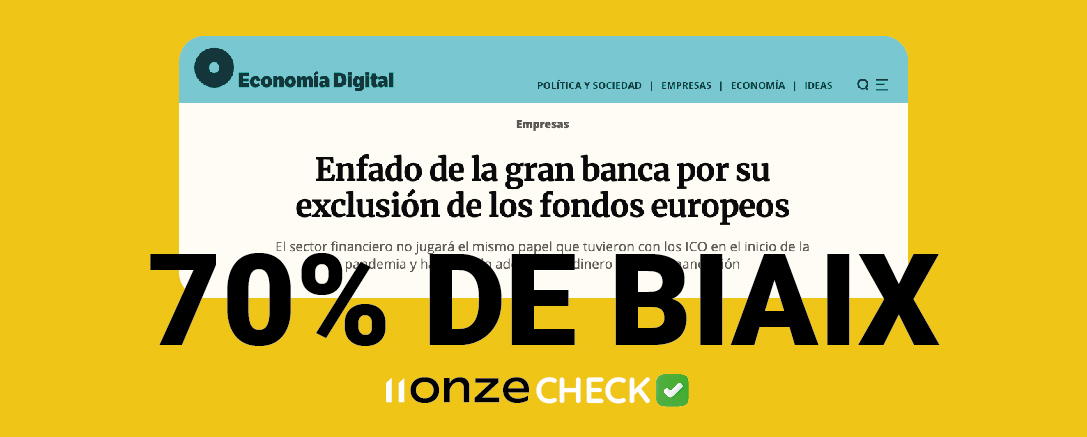
The banks’ outcry did not take long, and it seems that they have all agreed to publicise their grievances. An extensive media offensive that we analyse today by looking at an article published by Economía Digital, “Enfado de la gran banca por su exclusión de los fondos europeos”, but which serves as an example of how other media has dealt with the issue. Is this information biased? Yes, according to the 11Onze Check Bias Method, it has a bias of 70%. We analysed it.
SOURCES
We only hear the voice of the banks. There is only one unidentified source from the Spanish government. There is no reference for all the data provided. It is not possible to trace where this data comes from.
ENDOGAMY
There is no representative of the ICO, nor of the Ministry of Economy, nor any alternative voice to the view of the traditional banks. We only read the opinion of the banks’ representatives. Moreover, unverified statements from the banks are taken for granted. For example: “The president of Banco Santander, Ana Botín, recalled this week that banks have played an important role in the pandemic by protecting businesses, and now they need to strengthen public-private collaboration to do the same with the recovery funds”. If we know that, according to the INE, in nine months of the pandemic 207,000 businesses closed… Are we sure that, as Botín says, the banks have protected companies?
FOG
The information is foggy because the bankers seem angry, but, at the same time, they assure that the arrival of the funds will increase their turnover by 10%. The mechanisms that the banks are proposing to participate in the Next Generation Fund are also unclear and seem to be focused on accompanying the client. In reality, however, it could be a manoeuvre to make sure the public funds go to their clients’ accounts (and not to other entities) in order to be able to count on these funds.
INTENTION
We are not talking about a single news item but about a compilation of articles in the same media outlet, some of them linked to each other, which contain the same rhetoric clearly aimed at discrediting the government’s management and spreading the bank’s vision: 1, 2, 3. Therefore, we can deduce that there is an intention to establish the narrative according to which the banks have to participate, no matter what, in the allocation of public funds.
CONTEXT
The information is simplified, and key elements are missing. For example, it is not explained that the ICO’s function is specifically to provide credit to stimulate the economy. It seems that it cannot function without private banks, and this is not true. Nor is it explained how this aid has been channelled in other countries. And finally, there is a crucial piece of context that is omitted: banking has already recovered pre-pandemic profit levels thanks to the closure of branches and massive lay-offs. Nine billion net since the start of the pandemic. This, coupled with the fact that the price of money is at historic lows, removes any impediment for banks to lend and stimulate the economy. What is stopping them? What do they need Next Generation Funds for?
COMMERCIAL MOTIVES
The article talks about the good role played by banks in channelling the ICO funds and the role they can play in the Next Generation fund, but makes no mention of the benefits obtained by the financial sector through the management of the ICO, nor of the abusive practices that were uncovered during its management. Nor is there any mention of the commercial interests behind this desire to play a key role in the distribution of these new resources. The basic idea is to play the role of intermediary. The money comes from Europe (and therefore does not have to be mobilised by the banks), but it is still channelled through private banks. Why should it be this way? What is the point?
VOLUNTEER SERVICE
The public interest is not represented at all. While it talks extensively about how private banks and investment funds are key in advising companies and distributing this fund, no public alternatives, which are there, are given when it comes to channelling this aid. The article does not take into account the consumer’s point of view: is it in the interest of the ordinary citizen that ICO loans are managed by large Spanish private banks?
Therefore, we conclude that this information is 70% biased and shows a partial view of the management of the Next Generation Funds. If you want to know the Bias Method, which we have followed to contrast this information, you will find it here. If you would like to send us economic information to verify, you can do so by writing to us at [email protected]
11Onze is the community fintech of Catalonia. Open an account by downloading the super app El Canut for Android or iOS and join the revolution!


A report based on data compiled by Bloomberg analyses the global economic situation and lists the countries most at risk of bankruptcy. Spain is not on the list, but it exhibits some markers of an economy close to collapse, artificially propped up by the ECB bailout.
As with companies, states can declare bankruptcy or default when they are unable to meet their financial obligations due to a lack of liquidity. Runaway public debt, together with high external debt and fiscal deficits, are the main indicators that anticipate a country’s bankruptcy.
The study by Bloomberg Economics warns that a “historic cascade of defaults from emerging markets” is coming. In other words, there is a group of countries that are currently at high risk of default or bankruptcy. In addition, he notes that the number of developing countries that are close to economic collapse has doubled.
El Salvador, Argentina, Ghana, Egypt, Tunisia and Pakistan top the list of 50 countries accumulating a quarter of a trillion dollars of debt that could lead them to the same situation of economic bankruptcy in which Sri Lanka finds itself. The first country to default on its sovereign debt this year.
Spain’s public debt is at an all-time high
Each Spaniard owes more than 31,000 euros. This is the figure that corresponds to each citizen of the 1.45 trillion euros of accumulated public debt. A debt that is growing at a rate of 270 million euros per day, and which from 2020 to 2021 increased the fiscal hole by 200,000 million euros.
An economic situation of extremely high uncertainty, with inflation running rampant and GDP shrinking as all the institutions make downward forecasts every few months, point to the precariousness of the vital constants of a country incapable of meeting its public debt without the help of the ECB. A covert bailout that, as we have seen in other crises, has a cost and threatens our quality of life.
Europe is already calling for a halt to stimulus and a return to “fiscal discipline“, a well-known euphemism that in practice amounts to more cuts and tax burdens for citizens who can barely cope with the magnitude of the current economic tragedy. No wonder that, with a popular revolt looming, they are urging a balance between this “fiscal discipline” and “social peace”.
If you want to discover the best option to protect your savings, enter Preciosos 11Onze. We will help you buy at the best price the safe-haven asset par excellence: physical gold.
Is a new housing bubble forming? If house prices seem too expensive, you are probably right. Both the Bank of Spain and the European Central Bank have already detected signs of “overvaluation” in the housing market.
The Bank of Spain has acknowledged that house prices show “incipient signs of overvaluation”, according to the ‘Financial Stability Report,’ published at the end of April. Although this body believes that the overvaluation is “limited”, it recommends closely monitoring the market’s evolution.
According to this report, indicators of imbalances in the real estate market have been showing some slight signs of overvaluation since the beginning of 2020, which increased slightly in 2021 despite the pandemic.
Luis de Guindos, vice-president of the European Central Bank, was already concerned in January about the overvaluation of the residential housing market and the situation of the mortgage market in some Eurozone countries.
A market immune to the pandemic
The truth is that at the end of 2021 buying a flat was 6.4% more expensive than twelve months earlier, according to INE. And the fact is that the real estate market has been one of the few that has shown itself to be immune to the coronavirus. Supply has not grown at the same rate as demand, so prices have continued to rise.
In fact, the price of housing in Catalonia increased by 1.3% in April, according to the real estate portal Idealista, bringing the price per square metre to an average of 2,340 euros. In the case of Barcelona, the increase was 0.7%, meaning that the price per square metre is now close to 4,000 euros. And if we take a look at the evolution of the last twelve months, Tinsa puts the price increase in Spain as a whole at 7.7%.
In 2021, more than 89,000 homes were sold in Catalonia, with an average price per square metre of 2,293 euros, and 2022 began with more sales transactions than 2008, according to the Association of Registrars.
A risk for the banking sector?
The Bank of Spain considers that there are no signs that financial institutions are being lax in granting mortgage loans, but real estate imbalances within the euro area represent a “significant source of risk” for the banking sector. It should be borne in mind that the foreseeable rise in interest rates by the European Central Bank would increase the monthly instalment on variable-rate mortgages, so the default ratio could rise.
According to the Bank of Spain’s report, the growth of credit for new mortgages was particularly significant in 2021, with year-on-year rates of over 40% in the final part of the year. In any case, banking is now less sensitive to the real estate market than in the last housing bubble, as the volume of credit to this sector does not currently reach 40% of the total, whereas in 2007 it accounted for 70%.
Since the start of the pandemic, most Eurozone countries have seen slight increases in the ratio of the total balance of mortgage credit to GDP. However, in the case of Spain, this increase is due more to the decline in GDP generated by the pandemic than to the accumulation of debt.
Renting, mission impossible?
If buying a flat is expensive, renting is not at all economical either. The study ‘Relación de salarios y vivienda en alquiler en 2021’, carried out by Infojobs and Fotocasa, indicates that renting a flat on your own is almost an impossible mission. To live in an 80 m² flat, Catalans had to spend an average of 54% of their gross salary on rent last year.
The average rental price per square metre last year was 14.06 euros, 0.4% more than the previous year. If we compare the data with those of other Spanish regions, Catalonia is where the highest percentage of salary is spent on renting housing, followed by the Basque Country (50%), the Balearic Islands (49%) and Madrid (49%).
Unfortunately, this percentage is much higher than the percentage recommended by European supervisory bodies and makes it almost impossible for young people to become independent.
11Onze is the community fintech of Catalonia. Open an account by downloading the super app El Canut for Android or iOS and join the revolution!



What will the European Central Bank’s bailout of Spain cost? Over the past decade, the European Union has been very tolerant in demanding that Spain meet its commitments. But the debt burden is becoming increasingly unsustainable, so cuts and reforms seem inevitable in the near future.
The European Central Bank (ECB) announced in mid-June its intervention to prevent the risk premiums of Greece, Italy, Spain and Portugal from soaring. Basically, these are new bailouts in the face of the markets’ distrust of economies with soaring debt and a clear imbalance in their accounts.
The aid is not a blank cheque, as none of the previous bailouts was. All indications are that the latitude Spain has been given over the past decade to meet its reform commitments could come to an end in 2024. For the time being, fiscal rules limiting the public deficit to 3 per cent per year and debt to 60 per cent of GDP will remain frozen in 2023.
A European Commission report published in May stressed that Spain’s indebtedness exceeds “prudent levels” and could destabilise the EU as a whole because of “macroeconomic imbalances”. EU experts have already called for the introduction of measures to mitigate the long-term risk to fiscal sustainability, which should be adopted this year.
Pensions and the labour market
In this situation, pensioners could be the main victims. Pensions account for almost a third of the Spanish state budget, making them the item with the greatest scope for cuts. In fact, the government is already considering extending the reference period for calculating pensions.
The European Commission’s other great hobbyhorse is to make the labour market more flexible in order to reduce the percentage of unemployed, which is twice as high in Spain as in the EU as a whole. Obviously, this reduction in unemployment in order to improve the state’s accounts will entail a certain amount of precariousness.
Brussels’ objective is for Spanish debt to be below 114 per cent of GDP next year. And the demands it will make of the Spanish government in terms of the scope of cuts and reforms have yet to be specified. In any case, what is clear is that the level of demands in terms of fulfilling commitments will increase. The huge growth in debt over the last decade leaves no other option.
Third in a row
This is Spain’s third “bailout”, after the one granted in 2012 to Mariano Rajoy’s government to save the banks and the one granted two years ago to Pedro Sánchez’s government to tackle the ravages of the pandemic.
The first involved the injection of 100 billion euros in exchange for the signing of a “memorandum of understanding”. Although this document focused mainly on financial sector reform, it also addressed macroeconomic aspects. The agreement called for a reduction in the annual deficit from 6.3 % in 2012 to 2.8 % in 2014, with the consequent cuts and tax hikes that this implied. In addition, the document stated that progress in deficit reduction and the implementation of structural reforms to “correct macroeconomic imbalances” would be monitored “closely and regularly”.
Also the 140 billion euros the EU promised Spain two years ago in grants and loans involved conditions very similar to those of a full bailout. The aid is being delivered in tranches and disbursement is conditional on the implementation of the reforms promised by the Spanish government. Again, these will eventually affect the pension system and the labour market in particular.
Every year, the Spanish government must submit a stability plan to the European Commission, which is closely scrutinised in Brussels. And although there are no “men in black” in Madrid, any European government can stop payments from the Next Generation funds if it considers that Spain is not delivering what it has promised.
The Greek and Italian experiences
How far could the EU’s adjustment plan for Spain go? The cases of Greece and Italy show that European technocrats do not hesitate to take measures to balance the books.
Between 2010 and 2018, Greece experienced a “corralito”, implemented multiple cuts, sold public companies and reduced pensions by more than a third, in addition to going through multiple political crises. It is estimated that more than 400,000 Greeks had to leave the country during this period. And, in the case of Italy, in 2011 it even forced a change of prime minister and the appointment of a technical government almost designed by Brussels.
11Onze is the community fintech of Catalonia. Open an account by downloading the super app El Canut for Android or iOS and join the revolution!
Digital Banking is a term that refers to the digitisation of all traditional activities and services of analogue banking, which in the past were only accessible to customers when they moved to a branch. A process of change that has been going on for years, but which has accelerated enormously in recent years, mainly due to the generational change that the market is undergoing.
Every year the millennial generation is achieving higher levels of consumption of financial products, and today they are already the generation that consumes the most. Therefore, the market has had to adapt progressively to the differentiated needs and preferences of millennials, who demand agility, speed and accessibility. The achievement of this digitalization process is creating new opportunities for financial institutions and, above all, for society, allowing to directly reach people living in all kinds of different realities and situations.
Digital banking and online banking: are they the same?
As a starting point, there is a fundamental difference between the terms digital banking and online banking that should be distinguished. Online banking refers to the evolution that many traditional financial institutions have made towards the online world: it is a digitisation process that focuses on offering online certain basic services and products from their catalogue, such as money transfers or the basic management of current accounts. For other matters, however, it is still necessary to go to the branch.
Digital banking, on the other hand, refers to the intention of offering all the activities and services of traditional banking, but transferring them to the digital environment in order to reach the consumer directly, reducing intermediaries to a minimum and streamlining the entire process. Thus, apart from being able to make transfers or control the movements of our account, we can also apply for a loan or apply for a mortgage without having to go to the bank offices.

Customer experience in digital transformation.
The transition from analogue to digital banking
In the beginning, banking was entirely analogue. It offered such basic services as transfers, management of current accounts, checks and promissory notes, credit or debit cards, cash withdrawals and deposits, loans and mortgages. It was, however, necessary to go to the branch to carry out most of the transactions.
Later, especially from the 2000s onwards, new ways of managing financial transactions without having to go to a bank branch in person began to appear: online banking was born. This gradually allowed greater use of online commerce, although at that time it was still somewhat rudimentary, and had not yet become fully popular among the general population. It was at this time that payment methods such as PayPal were born, in response to a new consumer need that had not existed until then: being able to securely pay an unknown trader for an online product.
In 2010, however, the unexpected success of the first iPhone and smartphone models pushed society towards a new innovation: mobile banking. The currently well-known applications or apps began to be designed by traditional banks, with the aim of being able to have access to the banking services of our lifelong bank from the palm of the hand. This new technological revolution also allowed the appearance of contactless payments, making life easier for millions of people.
Finally, the massive use and popularization in broad segments of society, not only in millennials and young people but in the vast majority of adults and older people, has recently led to the creation and popularization of digital banking, with the most visible face being neobanks. Thus, with these new Fintech and applications that have nothing to do with those of the past, you can navigate and request any of the traditional financial services quickly and intuitively, reducing information barriers for consumers.
The rise of neobanks
In recent years, neobanks have led the digitization of financial services, taking full advantage of their digital capabilities: leveraging online platforms and data analytics to generate social interaction, providing cards instantly, offering personalized information and assistance to customers, etc.
At the beginning, they were aimed primarily at a digital native audience, such as generation Z and millennials, but little by little they have been attracting many other more diverse segments of the population and from different fields. This has been thanks to two main factors. Firstly, the cost reduction they have been able to offer in their services thanks to the lack of offices, as opposed to traditional banking, which has to pay very high rents and usually suffers from many cost overruns.
On the other hand, it is also due to the effect that the Covid-19 pandemic has had on many older consumers, as they have wanted to find a way to be able to continue carrying out their usual financial activities without having to leave home, and it is precisely in this area where neobanks have a comparative advantage over other financial institutions, since they move like fish in water in the digital area and have much more experience.
Direct banking: reaching the whole society
The popularization of these digital services has led to the emergence of the concept of direct banking: the possibility and the will to reach all customers, wherever they are and whatever their segment. New products and services can be offered to specific customer segments without suffering from geographical limitations. It is possible to reach consumers of different educational levels, of different economic incomes, personalized attention can be given to millions of people who otherwise would have no one to turn to, or to whom the traditional entities might not serve in the desired way due to physical limitations.
It is, in short, in an increasingly fast and interconnected world where the combination of current technology with new preferences for agility and accessibility allows neobanks and digital banking to put customers at the center.
11Onze is the community fintech of Catalonia. Open an account by downloading the super app El Canut for Android or iOS and join the revolution!



The tourism sector is beginning to pick up after two years of gloom due to the restrictions caused by the pandemic. However, the search for “maximum savings” on holidays has become a priority for many people and 12% of the population will continue to stay at home for one more summer, in many cases for economic reasons.
Despite the improvement in the sanitary crisis and the relaxation of measures to avoid contagion, 12% of the population still do not plan to travel this year for holidays, according to a study by the National Observatory of Outbound Tourism. This is a significant percentage, although the situation has improved considerably for the tourism sector compared to last year, when almost a third of those surveyed were planning to stay at home.
In half of the cases, respondents who will not travel this year cite economic reasons, with price increases (25%) and a drop in income (20%) being the most common causes. The percentage of those who have given up travelling because of pandemic-related fears has fallen from 23% a year ago to just 12%.
One of the major trends highlighted by the study for this summer is “the key role of travel flexibility and cancellation policy” in holiday booking. In this regard, 41% of respondents are considering taking out cancellation insurance, 27% are considering taking out accident insurance and 24% are considering taking out medical insurance.
Thirty-seven percent of travellers had already booked a summer holiday in May, when the survey was conducted, but almost one in three (31%) said they would wait and book “as late as possible to be on the safe side”.
Low-cost holidays
Another big trend the report notes for travel this year is “the search for maximum savings”. The average amount that each person expects to spend on holidays is still below pre-pandemic figures, although this year interrupts the downward trend that had been in place since 2018. Thus, the budget is €610 per person, €44 more than in 2021. The main expenses are expected to be accommodation (34%), catering (25%) and transport (20%).
In terms of type of holiday, sun and beach tourism is overwhelmingly in the majority (41%), followed by family (15%), relaxation (15%) and culture (14%). With respect to the summer of 2021, the proportion of people who will travel within the Spanish State drops to 60% and the proportion of those who opt for an international destination (18%) or combine both geographical options (22%) increases.
Despite the slight recovery in travel to international destinations, it is still below pre-pandemic levels and interest in the different geographical areas is very uneven. In this sense, Europe is the destination that attracts the most interest, while the attractiveness of other continents remains in the minority. In line with this, air travel is experiencing a clear recovery, close to pre-pandemic levels, although private car is still the most popular means of transport, as it is chosen by two out of three respondents.
The majority of travellers (56%) will enjoy a summer holiday of at least 8 days, and 14% will spend more than 15 days. August is the main month of the summer holidays for 42% of the respondents, while July is the month of choice for 29% of the respondents.
In 2022, the hotel is consolidating its position as the most popular type of accommodation (36%), up 9 points compared to 2021, followed by the holiday flat (22%). In contrast, self-catering (21%) is down 11 points compared to last year and 18 points compared to 2020, a year in which it increased sharply due to the pandemic.
A recovering sector
According to the study, the data seems to show that the tourism sector is beginning to recover, as some figures are approaching pre-pandemic levels. A key role in this progress is said to be played by “the improvement in the sanitary situation and the opening up (or relaxation) of measures adopted in the different countries regarding the mobility and security of travellers”.
Even so, the report warns that the positive data should not overshadow the major challenges and uncertainties: “rising inflation, slowing GDP growth rate and loss of purchasing power of citizens”.
According to data from the Residents’ Tourism Survey compiled by the National Statistics Institute (INE), residents in Spain made 143 million trips in 2021, 41% more than in the previous year. Catalonia was the second most popular destination, chosen by 14% of Spanish tourists. Moreover, Catalans accumulated the highest percentage of trips during 2021 (18% of the total) and their average daily expenditure was 56 euros.
11Onze is the community fintech of Catalonia. Open an account by downloading the super app El Canut for Android or iOS and join the revolution!
If you liked this article, we recommend you read:
 Community
Holiday ideas for singles
6 min readThe term “single” refers to all single, separated, divorced or widowed people, regardless of


Spain has gone from a public debt of 384.6 billion euros in 2007 to more than 1.445 trillion euros in April 2022, almost four times more. In just one year the debt has increased by 55,760 million euros, more than 150 million euros a day. The liabilities of each of us now exceed 30,000 euros.
Although Spain’s public debt fell by 8,427 million euros in April, according to data from the Bank of Spain, this figure can be misleading as the level of indebtedness is still rampant and is expected to continue to grow in the medium and long term.
Despite the slight decrease, debt remained above 1.445 trillion euros in April, or 117.06% of GDP. This is a level not reached in Spain since the end of the 19th century. The only developed economies that currently exceed this percentage are Japan (259 %), Greece (193 %), Italy (150 %) and the United States (134 %).
Spain, along with Greece, Italy, Portugal, Cyprus, France and Belgium, is one of the Eurozone countries whose public debt exceeds 100 % of GDP, although the Maastricht Treaty set a target that debt should not exceed 60 % of GDP. These are not irrelevant economies, as the seven countries together account for more than half of the Eurozone’s GDP.
A burden on the economy
Put in perspective, the growth of Spain’s public debt has been shocking. In just 15 years the volume of debt will almost quadruple, since in 2007 it stood at 384,662 million, or 35.8% of GDP. And if we look at the most recent developments, between April 2021 and April 2022, the debt has increased by 55.76 billion euros, a growth of more than 150 million euros per day.
What does all this mean for our individual pockets? Each of us owes more than 30,000 euros, a figure we will have to pay at some point. Given that the average salary in Spain in 2021 was 26,832 euros, not even working a whole year for free would pay off the debt. Moreover, this debt has increased in the last year by around 1,200 euros per person.
Paying off Spain’s current public debt is simply utopian. A report by Allianz last year calculated that it will take Spain 89 years to return to pre-covid-19 debt levels, so that would be in the 22nd century, while Germany would return to pre-pandemic levels by the end of this decade.
Higher interest rates
The current level of debt forces us to pay more than 30,000 million euros a year in interest alone, which is equivalent to more than 600 euros per person, and everything indicates that this amount will grow due to the tightening of financing conditions.
The rating agency Moody’s warned at the beginning of June of the deterioration in the sustainability of Spanish public debt and estimated the increase in interest payments due to the rise in the CPI at more than 4 billion euros, given that 5.7% of Spanish debt is linked to inflation. Each percentage point increase in prices is equivalent to 600 million euros more in interest, according to Moody’s.
The president of the Independent Authority for Fiscal Responsibility (Airef), Cristina Herrero, stated a few days ago that the changes in the European Central Bank’s monetary policy will make it more expensive to finance Spanish public debt by 12 billion euros, which could rise to 14 billion euros by 2025.
According to the Airef, the difficulties in reducing the State’s primary deficit could cause public debt to reach 140% of GDP in 2040. In fact, a report by this body warned in May that debt will start to rise from 2025 onwards if the structural deficit of 4 % is not reduced.
11Onze is the community fintech of Catalonia. Open an account by downloading the super app El Canut for Android or iOS and join the revolution!

After the escalation in the risk premium paid by Greece, Italy, Spain and Portugal for their debt, the intervention of the European Central Bank has restored some stability to the market. But the interest paid by these countries on their debt continues to rise, and the situation is becoming increasingly unsustainable.
On 14 June, Greece’s risk premium was dangerously close to 300 basis points, Italy’s was close to 250, Spain’s reached 140 and Portugal’s closed the session at 138. The interest rates payable by the countries of southern Europe on their debt had soared in recent days compared to Germany’s.
Because that is what the risk premium measures: each basis point of the risk premium is equivalent to 0.01 % more interest than the yield on the German ten-year bond. Therefore, 100 basis points means paying 1 % more interest than Germany and 200 points is equivalent to 2 % more.
In the first half of June, the market has been showing growing distrust in the debt payment of the PIGS, a pejorative acronym for Portugal, Italy, Greece and Spain by their initials. So the interest differential that these countries were forced to pay to place their debt bonds versus Germany had been rising.
Much ado about nothing
The European Central Bank (ECB) decided to take matters into its own hands and, after an emergency meeting, announced on 15 June that it would reinvest part of the portfolio of the Pandemic Emergency Purchase Programme (PEPP) to prevent the risk premiums of these countries from soaring. Everyone has inevitably interpreted this as a new bailout for these countries, as happened during the last crisis. Spain looks set to be rescued from bankruptcy once again by the ECB.
Since then, the situation has calmed down. The risk premium on Greek debt has fallen by 70 basis points in one week, Italian risk premium is now back below 200 points and Spanish and Portuguese risk premium is below 110 points.
In reality, the ECB’s announcement is nothing very new. As we explained in the article “ECB’s check on the most fragile economies”, in recent years the banking regulator has bought nearly two trillion euros in debt and announced in March that purchases would be drastically reduced as of June. But it also warned that it would reinvest the returned principal of securities purchased under debt purchase programmes “for as long as necessary to maintain favourable liquidity conditions”. Now it only goes a little further by adding the possibility of reinvesting the returned interest as well.
Good news?
The fact that the risk premium of the PIGS has fallen in recent days is good news in the sense that their financing has not soared relative to that of Germany. But this does not mean that the interest on their debt costs the same as before, because the interest paid by Germany on its ten-year bonds has risen by 1.78 percentage points in just four months.
German bond yields, which were at negative levels at the beginning of March, have risen steadily since then, even after the ECB’s emergency meeting, and now stand at 1.69 %. In short, both Germany and the PIGS are paying considerably more for their debt today than at the beginning of March.
More clouds than clear skies on the horizon
Complicated times lie ahead for everyone, although the PIGS’ cushion is obviously much thinner than that of countries such as Germany. The ECB’s future rate hikes in an attempt to control inflation should result in a generalised rise in the cost of debt. And, moreover, when the effects of the banking regulator’s recent announcement on debt purchases wear off, it cannot be ruled out that the spread between the southern European countries and Germany will increase again.
The ECB is running out of tools to maintain the stability of an economy that is caught between stagnation and inflation. And, with debt running out of control, the PIGS would be the main victims of any possible adjustment measures or cuts that Europe might demand in the future.
Some warn that, if recession hits, the solidarity of Europe’s partners could crack, as it almost did a decade ago. From then on, the future of the Eurozone is unpredictable, as is the future of pensions and public health care.
11Onze is the community fintech of Catalonia. Open an account by downloading the super app El Canut for Android or iOS and join the revolution!
On 31 December 2020, the transitional period provided for in the Brexit Withdrawal Agreement came to an end, with the United Kingdom leaving the European Union. This exit from the EU bloc had economic consequences in both the commercial and financial spheres, but its impact was not the same in all sectors of the economy.
Attempts were made to minimise the economic damage with the Trade and Cooperation Agreement of 24 December, but even with the new deal, the UK’s exit from the EU had a significant impact on the European economy and, in particular, on ours, which has a higher trade and financial exposure to the UK than other EU economies.
The UK is Spain’s fifth-largest trading partner, behind Germany, France, Italy, and Portugal. In 2019, it received 6.8% of total Spanish exports, equivalent to 19.666 billion, an amount that could be reduced depending on tariffs and other barriers placed on Spanish products.
As 11Onze agent Aitor Canudas explains, “Catalonia and Madrid are the two communities that sell the most goods to the UK, followed by Andalusia, Valencia, Galicia, the Basque Country, and Aragon. Cars, fruit, pulses, and vegetables are the best-selling goods, but also precious metals, motors, electrical appliances and medicines, among others”.
Brexit and its economic consequences
Since 1 January, the flow of goods between Spain and the United Kingdom ceased to be considered as intra-Community operations and became subject to customs formalities and VAT liquidation in the case of imports (exports are exempt), which represent an annual volume of 11.808 billion with data from 2019.
Selling or buying goods in the UK will involve having a UK ID number, filing a customs declaration, providing security and safety data, obtaining a special licence for certain goods, or completing additional formalities for trade-in excisable goods (alcohol, tobacco, or fuel).
Complexities and prospects of an evolving process
The compensatory measures that may be put in place to help the sectors and regions most affected by Brexit will be key to minimising the impact of this paradigm shift. As will the bilateral agreements that are eventually established between the European Union and the United Kingdom to mitigate the effects derived from the changes in the linkage that has existed up to now.
The evolution of the exchange rate of the pound against the euro, especially in relation to the depreciation of the pound against the euro, implies a rise in the price of Spanish products sold in the United Kingdom and a loss of purchasing power for the British, which could affect the national tourism sector.
Even so, there is also a possible positive impact, since Brexit may generate opportunities for Spain, which could gain weight in EU decision-making in the face of the departure of one of its main economies. On the other hand, companies based in the UK, as well as highly qualified professionals, could opt to settle in other EU countries, and Spain could be particularly attractive in this respect.
Moreover, Spanish companies, particularly the larger, more productive, and geographically diversified ones, could increase their export capacity, substituting part of the sales of British companies in the EU, or even replacing Spanish exports to the UK.
If you want to know more about superior options to make your money profitable, go to Guaranteed Funds. From 11Onze Recomana we propose you the best options in the market.