
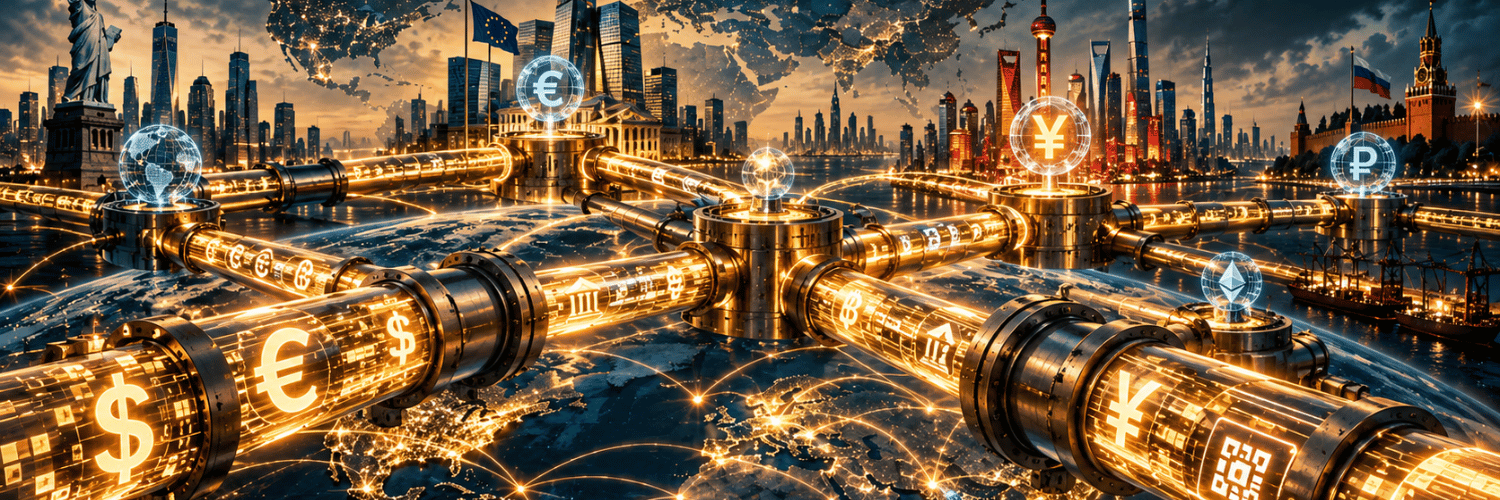
In the first two chapters of The war for money we have seen how stablecoins can give the dollar a new digital life and how de-dollarisation is transforming, but not yet replacing, the global monetary order. Now one final piece is missing. Perhaps the most important one. Who controls the pipes through which money flows?
Because having your own currency is of little use if, in order to move it, you depend on networks, banks, companies or infrastructure controlled from outside. In the financial system of the 21st century, whoever controls the pipes through which money flows also controls part of the power that this money represents.
When paying stops being a neutral act
When we pay for a coffee with a card or send money abroad, the gesture seems almost instantaneous. We press a button, bring our mobile phone close to the terminal and the transaction is complete. But behind those few seconds there is a huge financial architecture. Banks, payment processors, card networks, clearing and settlement systems and financial messaging platforms make it possible for money to get from one point to another. It is an infrastructure that is almost invisible to the citizen, but essential to the functioning of the economy. And this infrastructure is not neutral.
One of the best-known examples is SWIFT, the financial messaging network that connects thousands of institutions around the world. SWIFT is not a bank and does not physically move money: it allows financial institutions to send each other payment instructions in a standardised and secure way. Put very simply, it is a kind of messaging system for the international banking system.
For decades, this architecture was seen mainly as a technical infrastructure. Geopolitics has shown that it can also become a tool of pressure. After the invasion of Ukraine, several Russian banks were expelled from SWIFT as part of the Western sanctions package. Subsequently, the European Union has continued to expand restrictions on Russian financial institutions and on the mechanisms used to circumvent them.
The message for any power rival to the West is clear: being able to participate in the global financial system and being able to use it without interference are not necessarily the same thing.
Infrastructure is also sovereignty
This problem does not only affect Russia or China. Europe is also beginning to ask itself to what extent it truly controls its own financial infrastructure. The European Central Bank has expressed this with unusual clarity. Approximately two thirds of card transactions in the euro area are subject to the rules of non-European companies and a majority of euro-area countries depend heavily on international systems for everyday payments.
This means that we can pay in euros, but an important part of the infrastructure that makes the payment possible is not under European control. It is a fundamental difference.
Imagine a city that has all the water it needs, but the pipes that distribute it belong to a company based in another country. Formally, the water is still its own. In practice, however, the ability to use it also depends on who controls the pipes. Something similar happens with money.
That is why the ECB already speaks of payment systems as critical infrastructure, comparable to energy, telecommunications or transport. It is not only about paying more or less in fees. It is about ensuring that an economy can continue to function even in a context of conflict, sanctions or political rupture with an ally.
The battle to build their own networks
The rest of the world has understood this too. China has been developing its own cross-border payment system, CIPS, for years, while Russia has promoted alternatives following Western sanctions. At the same time, several countries are seeking to connect their instant payment systems in order to reduce intermediaries and facilitate direct transactions between currencies.
This does not mean that SWIFT is about to disappear. Its scale, the trust it has accumulated and the enormous number of connected institutions remain extraordinary advantages. But the movement is significant because it points towards the same process we observed in the previous chapter: the global financial system is becoming fragmented.
Not necessarily into two perfectly separate blocs, but into a network of systems that compete, cooperate and attempt to reduce dependencies.
Viewed from this perspective, de-dollarisation ceases to be simply a question of currencies. A country can reduce the use of the dollar in its foreign trade while continuing to depend on financial infrastructure that it does not control. True monetary autonomy requires both things: the ability to decide which money is used for payment and the ability to decide where it flows.
Programmable money changes the rules
Digitalisation makes this issue even more important. Stablecoins, central bank digital currencies, tokenised bank deposits and new networks based on distributed ledger technologies can reduce intermediaries and speed up payments. The Bank for International Settlements believes that tokenisation could profoundly transform cross-border payments and financial markets by integrating central bank money, commercial bank deposits and financial assets within new digital infrastructures.
But every technological advance opens up a political question. Who sets the rules of these networks? Who can take part? Who stores the data? Which jurisdiction applies? And, above all, who has the ability to stop a transaction?
These questions explain much of Europe’s interest in the digital euro. The ECB does not present it only as an electronic version of banknotes, but also as a way of reducing Europe’s dependence on foreign infrastructure. The objective is for Europe to have a public digital means of payment that works throughout the euro area under its own standards and rules.
This also involves a paradox. The same technologies that can increase the sovereignty of states can also increase their capacity for supervision. A digital infrastructure can be faster, cheaper and more resilient, but it can also generate much more information about the movement of money than traditional cash. Therefore, the debate about the monetary future is not only about efficiency and technology. It is also about sovereignty, privacy and control.
The war for money has already begun
For much of the 20th century, controlling money mainly meant controlling its issuance. Central banks printed currency, states guaranteed the system and the dollar acted as the main international reference. The 21st century is adding a new layer of power. Now it also matters who controls the code, the standards, the payment networks, the settlement systems and the digital infrastructures that connect one economy to another.
This explains why the United States wants to preserve the centrality of the dollar, why China is building alternative financial routes and why Europe is talking increasingly about sovereignty in payments. They have all understood that leaving monetary infrastructure in the hands of others means accepting a strategic dependency. And in this way, the circle that began with an apparently simple question about stablecoins is closed.
Perhaps the future will not be a world in which the dollar disappears and another currency takes its place. It may be much more complex: digital dollars circulating through blockchain, yuan moving through alternative networks, digital euros building their own infrastructures, gold accumulating in central bank reserves and different monetary systems competing to attract countries, companies and citizens.
The monetary battle of the 21st century, therefore, will not simply be a war between currencies. It will be a war to decide the rules of the system that moves them. Because whoever issues the money has power. Whoever gets others to use it has even more. But whoever controls the infrastructure through which it must circulate has a decisive capacity: they can determine the conditions under which that money exists, moves and reaches its destination. This is, ultimately, the war for money.
Protecting savings with physical gold has been one of 11Onze’s greatest contributions to its community, and its range of products continues to expand. In today’s environment of market volatility, persistently high inflation and growing distrust in the banking system, gold is once again strengthening its role as a safe-haven asset. Discover Or Llavor at Preciosos 11Onze.

 Equip Editorial

