
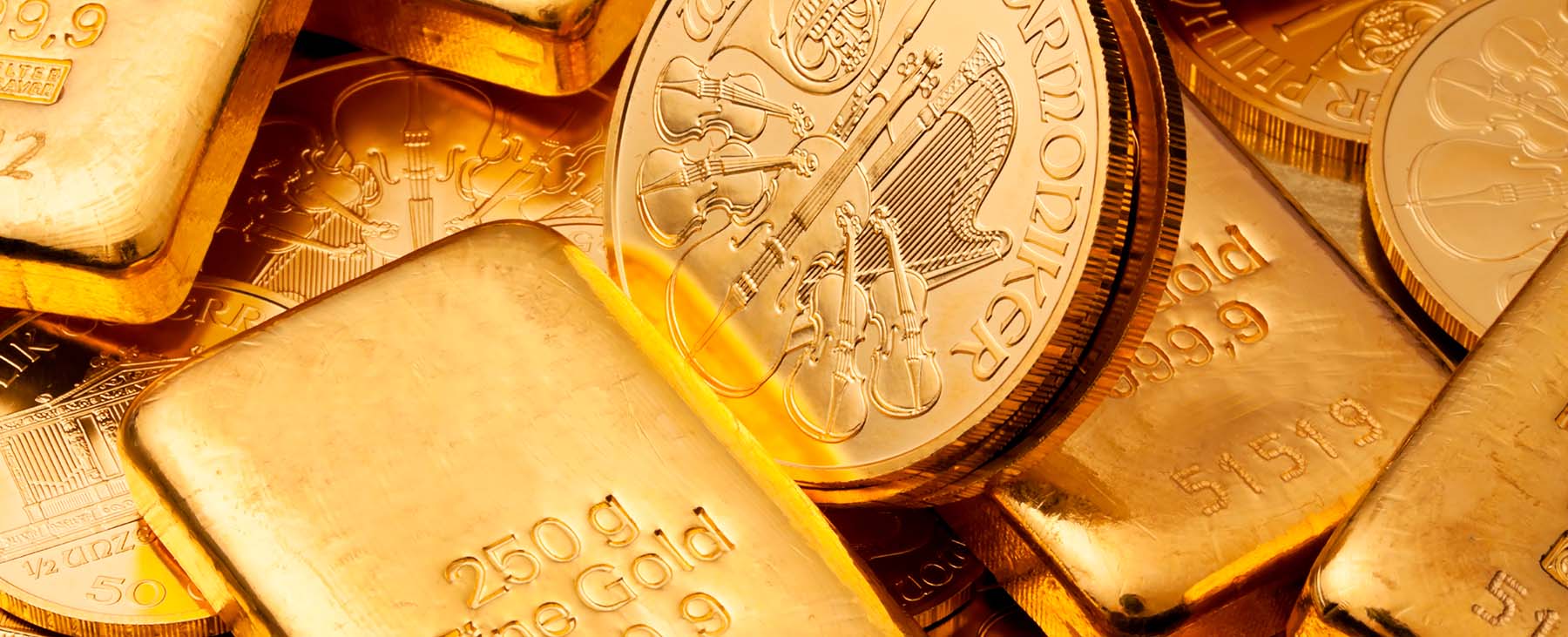

When we talk about gold, we talk about value. But not all gold is the same: what really determines its price and use is its degree of purity. And this is where two ways of measuring it come into play: carats (K) and thousandths (‰).
Although in jewellery shops we hear about 18 or 24-carat gold, in the world of investment and international trade, the most common system is that of thousandths, a much more precise measure.
What does gold purity mean?
Gold purity indicates the proportion of pure gold present in a piece of jewellery in relation to its total weight. Pure gold — that is, unmixed with other metals — is chemically known as Au and belongs to the family of noble metals. This means that it does not oxidise or degrade over time, does not react easily with other elements, and has exceptional resistance to acids.
These properties make gold a particularly valuable, rare and durable metal, but also too soft for some practical uses, such as the manufacture of jewellery or coins. For this reason, it is often combined with other metals such as copper, silver, or palladium to increase its strength or alter its colour.
Carats: the traditional measure in jewellery
The carat system divides purity into 24 parts. Thus:
- 24 carats (24 k): pure gold (100%)
- 22 carats (22 k): 91.6% gold + 8.4% other metals
- 18 carats (18 k): 75% gold + 25% other metals
- 14 carats (14 k): 58.5% gold
- 9 carats (9 k): 37.5% gold
18-carat gold is the most common in jewellery in Europe, as it offers a good balance between quality, durability, and cost. In contrast, in countries such as India and the United Arab Emirates, 22-carat gold is more common, especially for traditional pieces.
Thousandths: the standard measure in gold investment
In the field of investment and industry, a much more accurate decimal system is used: thousandths, which express the amount of pure gold per 1,000 parts.
- 999.9‰ (or “four nines”): extremely high-purity gold, used in investment bars and coins. It is the closest to real pure gold.
- 995‰: minimum standard for a bar to be considered “investment grade” according to international guidelines.
- 916‰: approximately equivalent to 22-carat gold.
- 750‰: equivalent to 18 carats.
- 585‰: equivalent to 14 carats.
At 999.9‰, it is considered pure gold on international markets. This is what we find in bars, bullion coins and other recognised investment products.
How is investment gold presented?
Investment gold is mainly traded in bars and coins. Ingots can weigh from 1 gram to 1 kg or more, although the most common formats in the retail sector are 2.5 g, 5 g, 10 g, 20 g, 50 g and 100 g.
Bullion coins are issued by central banks or official mints and combine market value with a certain collectability. Well-known examples:
- Krugerrand (South Africa): 1 ounce (ca. 38 g) of 22 k gold
- Maple Leaf (Canada): 999.9‰ pure gold
- Philharmoniker (Austria): 999.9‰
- American Eagle (USA): 22 k with a total weight of one ounce
- Britannia (United Kingdom): 999.9‰ since 2013
All these coins must be engraved with their exact weight and purity, which guarantees their acceptance on the global market.
And how is pure gold obtained?
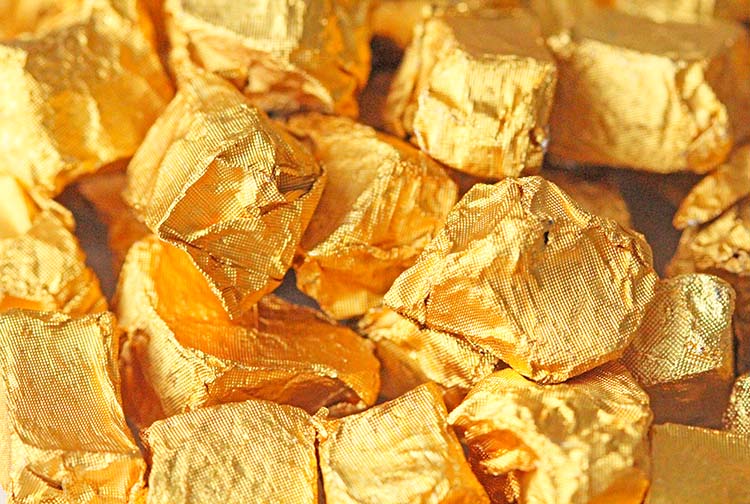
Gold is not found in nature in its pure state, but in the form of grains, veins, or mixtures with other materials. To convert it into investment or high-quality gold, it must undergo refining processes that may include smelting at high temperatures, chemical processes with acids and subsequent purification.
This pure gold is used to make high-value ingots and coins. But in jewellery, as we have already mentioned, the purity is often deliberately reduced for technical or aesthetic reasons.
Why is it important to know the purity of gold?
Knowing whether we are dealing with 18k, 22k or 999.9‰ gold is not just a technical issue, but a guarantee of value, transparency, and security. Whether we are buying it as an investment, or whether it is a piece of jewellery or a family heirloom, correctly identifying its purity helps us to make informed decisions.
Furthermore, in a world where gold is once again gaining prominence as a safe haven in the face of economic uncertainty, knowing its real value is more relevant than ever.
If you want to discover the best option to protect your savings, enter Preciosos 11Onze. We will help you buy at the best price the safe-haven asset par excellence: physical gold.



Molt interessant!
Moltes gràcies pel teu comentari, Marc!!!
Ara sí m’ha quedat clar!!!!
Ens alegrem que hagi estat així, qualsevol dubte, pots posar-te directament en contacte amb nosaltres!
Molt interessant 👍
Celebrem que ho hagis trobat interessant, Jordi!!!
Sóc nou a la placa, amb il·lusió de forma part d’aquest projecte i poder fer una comunitat important i forta.
Benvingut, Felip! Aquí ens trobaràs sempre, informant i formant de tot i de tota l’actualitat. Ens veiem a La Plaça!😉
Molt bona explicació.
Encantats que t’hagi servit Pere!
👍
Gràcies, Manel!!!