
When we hear an economist talking about taxes, inflation, wages or housing, we tend to think that their conclusions are purely technical. But reality is different. Behind every economic proposal lies a particular way of understanding how society works. Economics is a social science. And, like all social sciences, it is made up of different schools of thought that interpret reality from different perspectives.
For more than three hundred years, these schools have attempted to answer the same questions: what creates wealth, what role the State should play, why crises occur, and how they should be addressed.
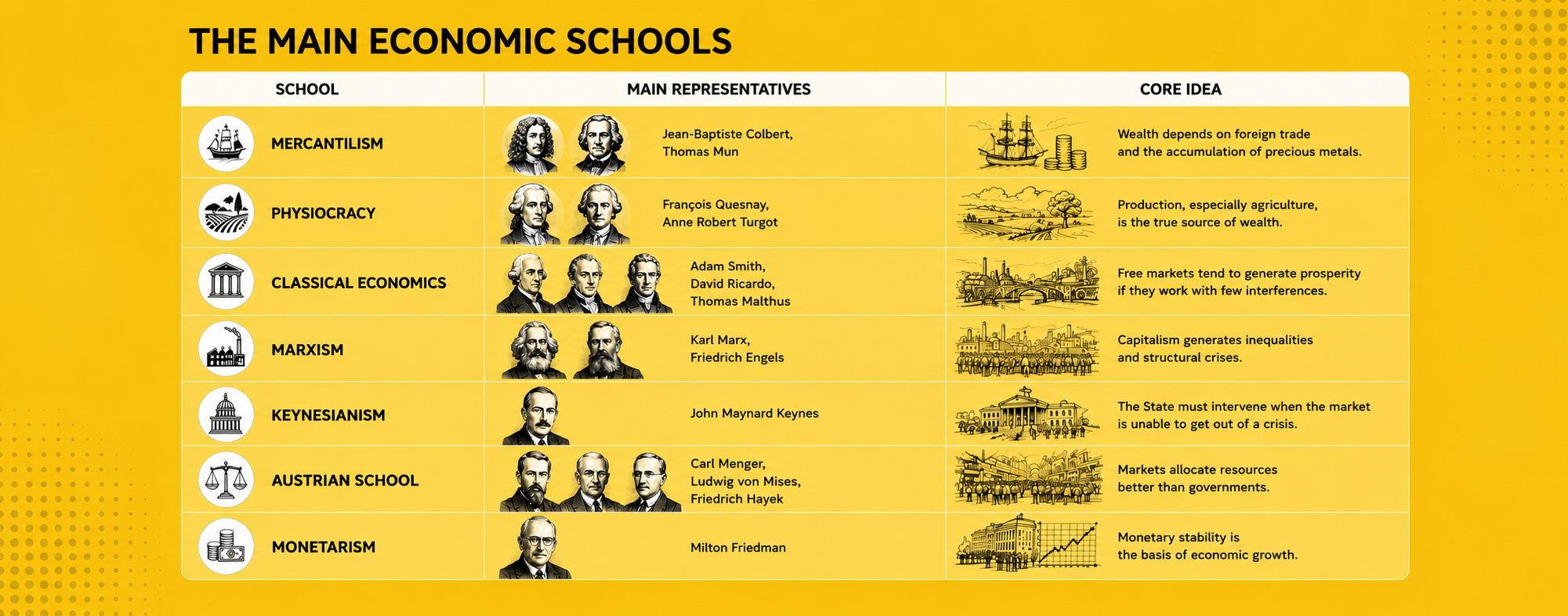
Each school is a product of its time. Mercantilism emerged when the European monarchies competed for world trade; Adam Smith wrote during the Industrial Revolution; Karl Marx observed the harsh conditions of nineteenth-century workers; John Maynard Keynes sought to explain the Great Depression; Friedrich Hayek and Milton Friedman reacted to the inflation of the 1970s. What is most remarkable is that none of these schools has disappeared. All of them continue to influence, to a greater or lesser extent, the economic policies of governments, central banks and international institutions.
The major schools of economic thought at a glance
Schools also have a history
Each economic school emerged in an attempt to respond to the major challenges of its time.
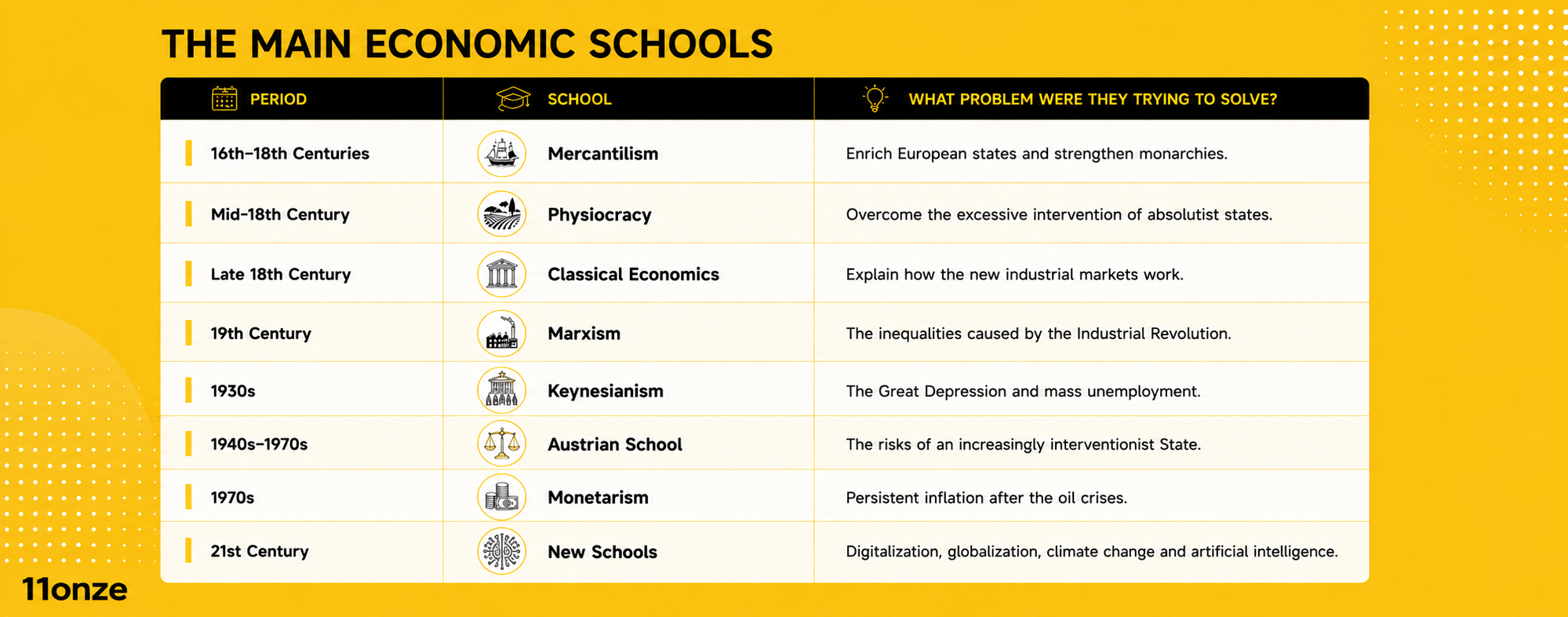
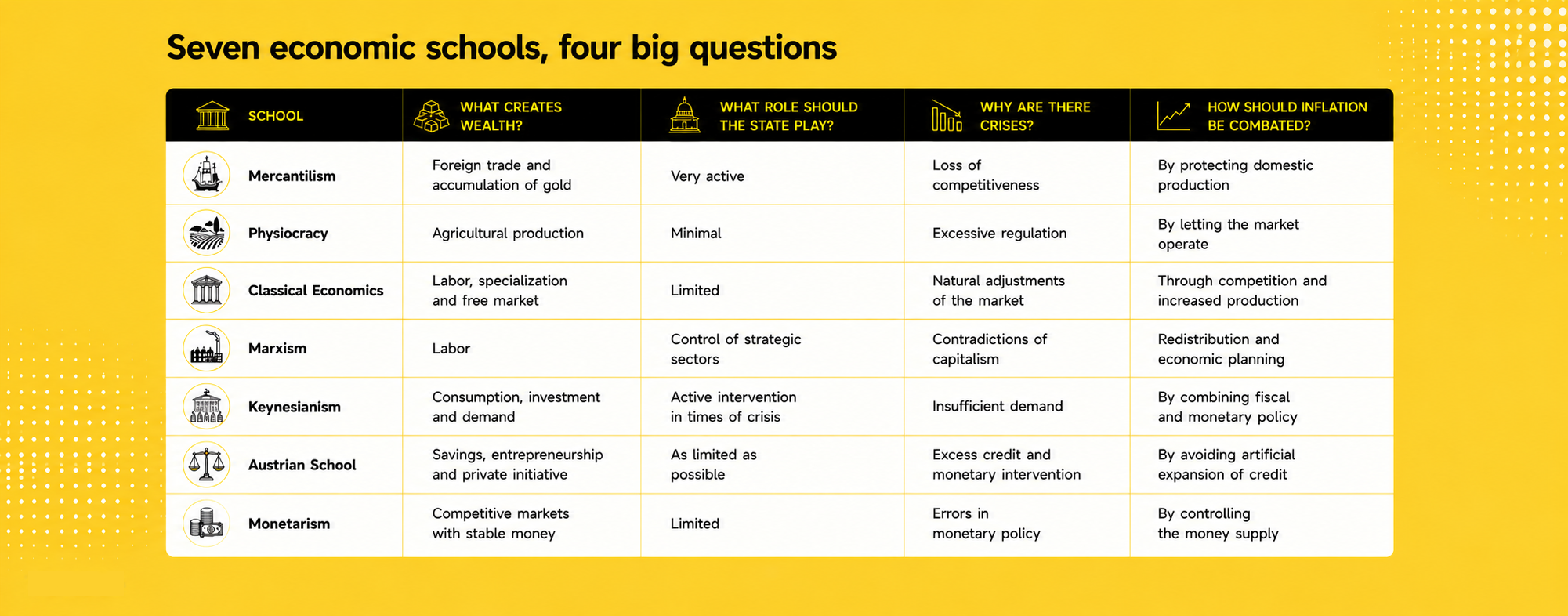
This summary highlights one essential idea: the schools of economic thought do not disagree only about the solutions. They often disagree about what the real problem actually is.
What creates wealth?
This is the first great question that has divided economists for centuries.
Mercantilists believed that prosperity depended on accumulating gold and maintaining a positive trade balance.
The Physiocrats overturned this idea by arguing that wealth originated from production.
Adam Smith expanded this concept: prosperity is the result of labour, specialisation, innovation and the freedom to exchange.
Karl Marx also placed labour at the centre, but argued that the capitalist system allows part of the value created by workers to be appropriated by the owners of capital.
Keynes shifted the focus towards demand. An economy may produce a great deal, but if households and businesses stop consuming, factories come to a halt.
For Austrian and Monetarist economists, sustainable growth requires saving, productive investment, entrepreneurial initiative and a stable currency.
What role should the state play?
This is where the best-known differences emerge.
Mercantilists advocated strong governments that directed trade.
Classical economists preferred to limit the State to basic functions such as justice, security and infrastructure.
Marx envisioned an economy in which the principal means of production were collectively owned.
Keynes believed that, during recessions, the State should stimulate demand and prevent economic activity from collapsing.
By contrast, Hayek warned that excessive intervention could reduce economic freedom and generate new inefficiencies.
Milton Friedman shared this caution, although he accepted a limited role for the State in ensuring stable rules and a consistent monetary policy.
Why do crises occur?
The same recession can generate completely different diagnoses.
For Marx, crises are part of the very functioning of capitalism.
For Keynes, they are the result of a decline in consumption and investment.
Austrian economists attribute them to excessive credit expansion and artificially low interest rates.
Monetarists emphasise mistakes in monetary policy.
Classical economists tend to interpret them as adjustment processes that markets eventually correct.
How should inflation be fought?
Few issues generate as much controversy as this one.
Keynesians accept that moderate inflation may be acceptable if it prevents a deep recession.
Milton Friedman argued that “inflation is always and everywhere a monetary phenomenon,” that is, the consequence of an excessive amount of money in circulation.
The Austrian School shares much of this diagnosis, but places the main responsibility on the artificial expansion of credit driven by central banks.
Classical economists trust that competition and market adjustments will eventually moderate prices.
Marxists, by contrast, tend to interpret inflation within the framework of distributional conflicts between wages, profits and economic power.
The new schools: Economics continues to evolve
The classical schools remain essential for understanding economics, but the new challenges of the twenty-first century have given rise to schools of thought that incorporate factors which previously played only a secondary role.
Behavioural economics: we do not always make rational decisions
For decades, it was assumed that people made rational decisions. Daniel Kahneman and Richard Thaler demonstrated that cognitive biases, emotions and habits influence many economic decisions.
This discipline has influenced the design of savings plans, pension systems, taxation and public policies based on the so-called nudges—small incentives that guide behaviour without imposing it.
Institutional economics: Institutions matter
Why do some countries prosper while others remain stagnant despite possessing abundant natural resources?
Economists such as Douglass North, Daron Acemoglu and James Robinson argue that the answer lies in the quality of institutions. Legal certainty, the protection of property rights, judicial independence and the fight against corruption are factors that are just as important as capital and labour.
Modern monetary theory (MMT): A new debate on public debt
Modern Monetary Theory argues that a State which issues its own currency has far greater room for manoeuvre than has traditionally been assumed. According to this school, the main constraint on public spending is not the budget deficit, but inflation.
Its supporters argue that this approach makes it possible to deal more effectively with major public investments or economic crises. Its critics warn that it could encourage the excessive creation of money and fuel inflationary pressures.
The debate remains open and is one of the most active in contemporary economics.
An ongoing conversation
Economics is not a collection of infallible recipes. It is a conversation that has lasted for more than three centuries and continues to evolve with every social, technological and political transformation.
No school has succeeded in explaining the whole of reality, but each has provided tools for understanding part of the world. For this reason, when we hear an economist defending a particular fiscal, monetary or social policy, it is worth asking not only what they are proposing, but also from which school of thought they are speaking.
Understanding these traditions does not guarantee that we will always find the correct answer, but it does allow us to interpret, with greater judgement, the debates that shape our savings, our investments and the future of the economy.
Protecting savings with physical gold has been one of 11Onze’s greatest contributions to its community, and its range of products continues to expand. In today’s environment of market volatility, persistently high inflation and growing distrust in the banking system, gold is once again strengthening its role as a safe-haven asset. Discover Or Llavor at Preciosos 11Onze.



 Equip Editorial