
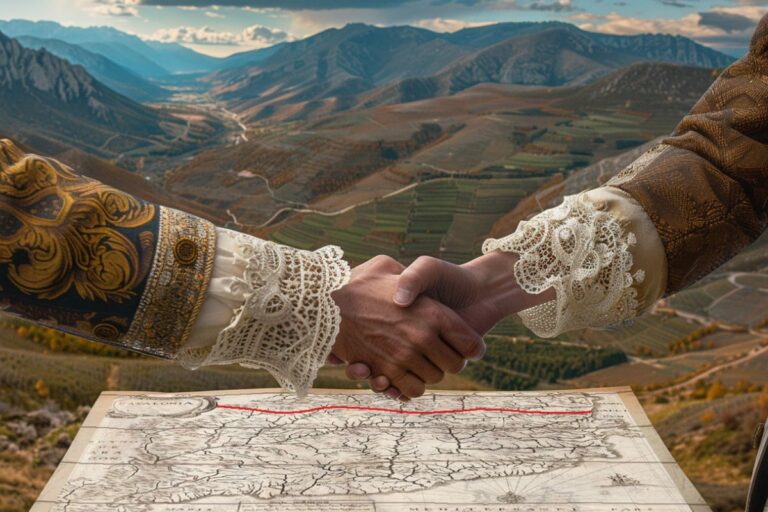
When Europe emerged from the chaos of the Thirty Years’ War in the mid-17th century, it decided to reorganize itself. With the Peace of Westphalia (1648) and, shortly afterward, the Treaty of the Pyrenees (1659), the continent consecrated a new political architecture: each king would rule within his own territory, and that territory would be enclosed by a legal border. From that territorial redesign, a new world was born —that of the nation-states— a legal invention that would turn geography into property and diversity into suspicion.
For centuries, this system functioned with brutal yet solid efficiency, giving rise to regular armies, stable currencies and bureaucracies capable of controlling the territory with the same coldness with which they drew maps. The border ceased to be a zone of exchange and became a line of separation. And with it, Europe believed itself immortal.
But time erodes all geometries. In the 21st century, the lines drawn at Westphalia have begun to melt, as if the borders of Europe’s political map were made of wax. This has allowed capital to circulate without an address, companies to operate without a homeland, and people to move more out of necessity than vocation. In this new landscape, the old nation-state looks increasingly like an empty fortress: perfect in form but hollow in substance. In fact, it feels as if we are once again inside Thomas Mann’s “The Magic Mountain” (1924), in which the author brilliantly portrayed the 1920s as a Europe enclosed, sick and fascinated by its own fever.
The inner fracture
Today’s Europe suffers a crisis that is not moral, but demographic and territorial. Its societies are ageing at a dizzying pace, which causes their interior spaces to fade progressively and the welfare system —built on the premise of an abundant active population— can only be sustained thanks to the massive entry of human capital.
Every year, hundreds of thousands of workers from diverse backgrounds arrive —who, like the barbarians of the 4th century, do not come to destroy but to sustain the system— preventing collapse. This new human capital provides the necessary workforce, contributes net tax revenue and ensures that social contributions continue to feed public services. Without them, the wheel of welfare would stop instantly, accelerating Europe’s decline.
But Europe has not yet understood that, like 5th-century Rome, it will only survive if it is capable of transforming its political structure to organically integrate all this human capital.
This population crisis overlaps with another of a geographical nature. The continent’s night map shows a brightly lit coastline and a vast dark interior. The great metropolises —London, Paris, Barcelona, Milan, Madrid, Berlin— concentrate wealth and power, while vast rural areas are emptied to the point of becoming human deserts. This is the new invisible frontier now taking shape, where divisions are no longer between states but between useful territories and abandoned ones.
Nation-states, born to defend their unity, now find themselves divided from within. The fiscal balance, redistribution and territorial cohesion that sustained the social pact have cracked. The south pays for the north’s demography; the west lives off the labour of the east; the centre concentrates what the peripheries produce. The result is an imbalanced system reminiscent of the Late Roman Empire: bureaucratic, indebted and dependent on human flows it can no longer control or understand.
In fact, this is the model of state that 18th-century colonialism —French, English, or Dutch— exported across the world. The same that, with supremacist arrogance, drew lines over empty maps and imposed by force of arms the principle of territorial sovereignty as a universal formula, stripped of any local grounding. In this way, European powers projected onto Africa, Asia, and the Americas their dream of rational order through the creation of straight borders, traced with a set square across deserts, jungles or unknown mountains, even if this meant separating peoples who shared language, culture and economy, or merging them with historical enemies under the same flag.
The result was an artificial geography built upon a state architecture with no social foundation. And when those colonies achieved independence, they did so under a poisoned inheritance: the nation-state had been an imposed model without a society to sustain it. The civil wars, genocides and absurd borders of the 20th century are the bill.
Because Europe, in trying to civilize the world, ended up universalizing its own mistakes. And perhaps now, faced with its own internal crisis, the Old Continent is beginning to understand that that model of rigid border and single identity was not a historical truth but an anomaly of its past.

Europe has not yet understood that, like 5th-century Rome, it will only survive if it is capable of transforming its political structure to organically integrate all this human capital.
The future lies in the limes
During the Late Empire, when Rome began to collapse under its own weight, the Germanic peoples crossed the limes not to destroy the Empire but to become part of it. They wanted to be Romans and, contrary to popular belief, their contribution —labour, soldiers, farmers, and taxes— was essential to keep the system alive. From that moment on, this new human capital allowed lands to continue being cultivated and kept the State functioning.
Today, history seems to be retracing the same steps. The Europe that invented the concept of the nation-state sees its model running out while new populations sustain its continuity. In essence, it is the same process the Old Continent experienced in the past, when it needed those “barbarians” to keep being what it was.
Perhaps this will lead us into a new Late Antiquity, a kind of transitional moment in which sovereignty will no longer be measured by control of territory but by the ability to manage the flows that cross it —capital, people, data, or ideas. And any State that fails to understand this and entrenches itself will likely be condemned to dissolve.
The Mediterranean once again —which was once the economic heart of the world— holds the key to the future. It is the place where the two halves of the old system meet: the ageing north and the growing south. If Europe wants to be reborn, it must look again towards its Mare Nostrum and understand that its survival depends on the permeability of what modernity sought to make impermeable.
When a civilization enters decline, history offers two options: raise walls or build bridges. Rome survived as long as it knew how to integrate, and disappeared precisely when it began to exclude. Even so, Europe is still in time to straighten its course. Perhaps the end of the nation-state will not be a collapse but a return: one in which geography acts as truth and history as a warning.
11Onze is the community fintech of Catalonia. Open an account by downloading the app El Canut for Android or iOS and join the revolution!


 Oriol Garcia Farré