Community-saving to get higher earnings
11Onze Recommends, at the request of the community, has managed to get the provider to further improve Litigation Funding: you can now access the product with family or friends to get higher returns on your savings. The returns are quadruple the average returns of Spanish banks.
Litigation Funding is one of 11Onze Recommend’s most requested products, a fact that gives us the strength to ask for improvements from our provider. In this regard, some users noted that the best yields are achieved for higher amounts, which is a barrier to entry for many people.
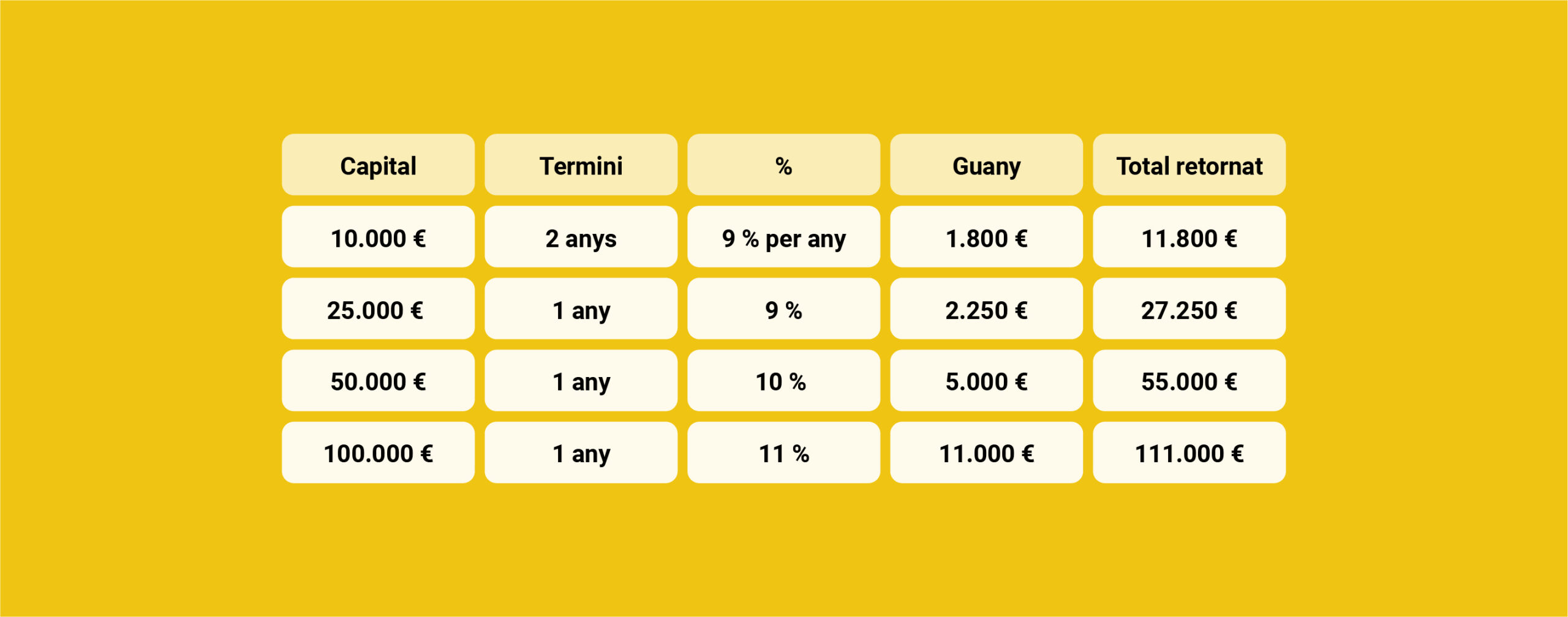
As 11Onze’s chief financial officer, Farhaan Mir, explains: “To access the 9% per annum you have to contribute 25,000 euros and many people don’t have these amounts, but they also deserve to be able to save. So we thought, what can we do? We can’t ask for the amount to be reduced, but we can ask for it to be contributed by several people, so that, several people in the same family, or a group of friends, can save together. Each one with their documentation, transferring their amount and receiving the corresponding earnings in their account. The only requirement is that the aggregate amount corresponds to the amounts set by the provider.
Quadrupling the returns offered by banks
This move by 11Onze Recommends gives its community access to a savings product unheard of in the country. In October 2023, Spanish banks increased the interest paid to their clients, but they remain the lowest-yielding banks in Europe, offering an average yield of 2.3%. Litigation Funding, therefore, almost quadruples what Spanish banks offer and does so with extra security, as the funds are insured to cover the principal.

“You no longer need to save alone and miss out on the best offers. This would be unfair. Everyone should be able to save.
Community-saving
11Onze is thus reinforcing its community vision by now offering community-saving. “You no longer have to save alone and miss out on the best offers because you don’t have enough money. This would be unfair. Everyone should be able to save”, says Farhaan Mir. The product offered by our UK provider has become one of the star savings products. To find out more about the product, you need to be a member of 11Onze and go to the Litigation Funding section on our website.
If you are already a member of La Plaça you can request more information from our provider.



Provincial Courts, such as those of Cádiz, Zaragoza and Asturias, have condemned the Unión de Créditos Inmobiliarios (UCI), a finance company owned by Banco Santander, for breaching the rules of information transparency or declaring its system of capital amortisation null and void, with unaffordable repayments that have caused serious problems to many families.
During the years when the real estate bubble burst and amid a period of credit restrictions by the banks that have traditionally monopolised the largest shares of the mortgage market in Spain, Banco Santander was deriving high-risk mortgage loans from Unión de Créditos Inmobiliarios (UCI), its finance company, also owned by BNP Paribas.
These were mortgage loans that were unviable for most financial institutions because of the precarious economic situation of the customers requesting the loan, but which were approved by UCI. Faced with the need to buy a home or move house, thousands of young couples and families who had difficulty accessing a traditional mortgage loan opted for this alternative, which was presented to them as an attractive and affordable product. It is estimated that between 2009 and 2012, more than half a million mortgages of this type were marketed.
In most cases, these mortgages were marketed through real estate agencies that offered the management, negotiation and processing of mortgage loans with their real estate sales and purchase service. They acted as intermediaries for the UCI. Even so, the consumer only had contact with the UCI on the day of signing the contract in front of a notary, which is when he was faced with all the paperwork and small print.
An amortisation system with unaffordable repayments
As a general rule, Spanish banks’ mortgages are based on the French amortisation system, according to which the instalments you pay are constant or fixed and serve to pay part of the interest and part of the capital. During the first years of the mortgage, you pay more interest than capital, while in the last years almost all you pay is capital and the interest rate goes down.
Unlike these conventional mortgages, the principal repayment system of UCI mortgages establishes a very low fixed instalment during the initial period of the mortgage payment (between 5 and 10 years), but at an unusually high-interest rate, and the amount of interest that is not covered by the instalment is added to the capital of the loan. Therefore, debt continues to increase, generating new interest even if we keep up with the repayments. This is known in legal terms as anatocism and, in many cases, has generated exorbitant and unaffordable monthly repayments in the last years of the mortgage.
Although this is not an abusive practice per se and is included in the Commercial Code as legal, it is illegal and abusive for the consumer not to be informed of the economic scope of the clause. This is what has happened with these UCI mortgage loans when the applicable amortisation system was not even correctly specified in some of the mortgage contracts and many consumers were not informed diligently.
@atilalegal UCI sabia lo que hacia y les dio igual llevar a miles de familias a la ruina con sus hipotecas. Ahora me enfrento a ellos y no pienso pararme en ningún punto del camino. Voy a llegar hasta el final y voy a pelear por TODO lo que les corresponde a mis clientes. Los bancos ya no salen impunes de esto. #uci #hipotecauci #hipoteca #psoe #pp #vox #prestamo #prestamohipotecario #usura #deuda #fondobuitre #bancos
The possibility of claiming IRPH
These mortgage loans used the Mortgage Loan Reference Index, better known as IRPH, as an alternative to EURIBOR for the calculation of interest on variable-rate mortgages. This value is obtained by calculating the average interest rate of the banks that grant mortgages on a monthly basis, which some courts consider may be abusive in its application.
After an in-depth analysis of users’ claims, on 13 July 2024, the European Court of Justice (CJEU) issued a ruling on the nullity of IRPH clauses, thus correcting the Supreme Court and establishing that customers have the possibility of claiming, but that the Spanish courts have to decide on each case individually, analysing whether certain standards of transparency were met when signing the mortgage contracts.
In other words, to be able to claim IRPH, judges have to check whether the clause in the contract has been drafted in a way that is understandable for the customer and whether it fits with the information the customer received from the bank before signing the contract. On the other hand, they assess whether the consumer was offered the possibility of contracting the loan referenced to EURIBOR, explaining the differences between one and the other.
@atilalegal Declaran NULO el sistema de amortización de Uci. Aqui te explico porque siempre pagas más. Estamos preparando un paquete de miles de demandas contra Uci para que os devulevan todo vuestro dinero. Basta ya de usura! #hipoteca #prestamohipotecario #uci #bancos #prestamo #usura #psoe #pp #vox #dinero
An avalanche of consumer lawsuits
Although in the face of the claims of thousands of consumers affected by these mortgages, some Provincial Courts, such as those of Cádiz, Zaragoza and Asturias, had already ratified previous judgments of courts of first instance that condemned UCI for not having sufficiently explained the characteristics of these mortgages and for skipping the rules of informative transparency, declaring their amortisation system as null and void, the CJEU ruling opens the door to many more claims by affected consumers.
Thanks to this ruling of the Supreme Court, there is no specific deadline for claiming this abusive clause, since the claim can be filed at any time, even after the mortgage loan has been fully paid off. For this reason, some law firms have specialised in analysing these loans and determining whether the claim for abusive clauses is justified.
Once again, the banks will pay for having deceived their clients. Abusive practices have resulted in copious fines and penalties for these entities, as well as damage to their reputation, but which are periodically repeated in the face of a regulation and a sanctioning regime that continue to prove insufficient to guarantee consumer protection.
If you want to find out how to get returns on your savings with a social justice product, 11Onze recommends Litigation Funding.
Durant la Diada els catalans ens deixem endur pel romanticisme i els ídols de la resistència que van intentar preservar les llibertats. Casanova, Villarroel, Moragues, Carrasclet… però les guerres són una qüestió de diners i cal mirar-les amb fredor i autocrítica. Hi ha una colla de catalans que van optar per fer negoci amb l’invasor, essent així decisius per a la seva victòria.
Toni Mata. Director de continguts i mitjans d’11Onze.
Que les guerres les guanyen els diners és una cosa que se sap des de fa més de 2.400 anys. Ja ho va deixar escrit Tucídides parlant de les guerres del Peloponès. Però quan s’acosta l’11 de setembre els catalans tendim a treure la llista de greuges en lloc de posar-nos a pensar on la vam cagar. El cap del general Moragues exposat durant dotze anys en una gàbia, la brutalitat de la repressió, la resistència de Villarroel, la persistència de Carrasclet, el poble enterrant els traïdors fora muralles perquè “al Fossar de les Moreres no s’hi enterra cap traïdor”… Tot això està molt bé. Però qualsevol país que pretengui ser-ho s’ha de prendre una mica més seriosament a si mateix i deixar-se de romanços. Si l’any 1714 Catalunya va caure va ser perquè es va perdre una guerra i, si es va perdre va ser per molts factors. Un dels que va ser clau és el col·laboracionisme.
Qui es va fer ric amb la victòria de Felip V?
L’avenç de Felip V per Catalunya no hauria estat possible sense que una sèrie de catalans hi contribuïssin prioritzant el benefici econòmic individual per davant del país. Potser aquells ciutadans no tenien consciència de país, però qui sí que la tenia era l’exèrcit borbònic que, tal com explica l’historiador d’11Onze Oriol Garcia en aquest article, va mantenir el 65% de les seves tropes als Països Catalans durant anys per consolidar la invasió.
Efectivament, hi ha catalans que van decidir fer negoci amb els Borbons mentre aquests destruïen el país i les llibertats de tots. I es van fer rics! Es van fer rics subministrant aliments o tota mena de necessitats que tenia l’exèrcit invasor a mesura que avançava. Què hauria passat si aquests subministraments bàsics haguessin quedat tallats a la rereguarda? Felip V hauria pogut mantenir la contesa bèl·lica? Fa de mal dir, però és ben sabut que la flota naval austriacista (que comptava amb el suport català) era capaç de mantenir el subministrament de les seves tropes, però la borbònica no. Depenien del que poguessin comprar a terra ferma.
Per això, a 11Onze hem volgut demanar al nostre historiador que se submergís en els estudis sobre aquesta idea: quins catalans hi van guanyar amb la victòria de Felip V? És a dir, qui el va ajudar i se’n va beneficiar? I el resultat és espaordidor. Prop d’una trentena de famílies catalanes es van fer riques traint el seu propi país. Famílies que van obrir les portes a l’invasor i van ser convenientment recompensades amb contractes públics a partir de 1714. La nova elit catalana es va configurar durant la guerra de Successió. El poble intentava resistir, però alguns apostaven per intentar fer fortuna a costa d’entregar el país a l’enemic. Hem llistat els casos més rellevants, amb noms i cognoms, perquè més de 300 anys després siguem més conscients que mai que alguns catalans van tenir un paper clau en la derrota de Catalunya.
Trencar la dependència
És el que en podríem anomenar, les paguetes de 1714, fent un símil amb la terminologia actual. La història és reiterativa i és imprescindible conèixer-la per detectar els errors que duen a les desgràcies. És possible defensar Catalunya i que el teu negoci o el de la teva família depengui directament dels ajuts espanyols de l’ICO? O el teu sou? La història diu que no. De la història sabem que és impossible parlar cara a cara o defensar-se d’algú de qui tens una dependència econòmica. I sabem que hi ha catalans capaços de vendre a Déu i a sa mare per un plat de llenties. La consciència nacional estava al segle XVIII (i potser ara?) en un segon terme, per a alguns.
En qualsevol cas, per començar a canviar les coses és ben clar que el primer que hem de fer és dir-nos la veritat. És un compromís que tenim a 11Onze. Per això hem volgut fer aquesta revisió històrica per poder-nos dir clarament: Catalunya no va ser derrotada el 1714 perquè fos abandonada pels anglesos. No tot és culpa d’algú altre. Catalunya va ser venuda per alguns catalans.

Qui hi va guanyar amb la victòria de Felip V?
Descobreix les famílies que es van enriquir amb la derrota de 1714 a 11Onze TV.
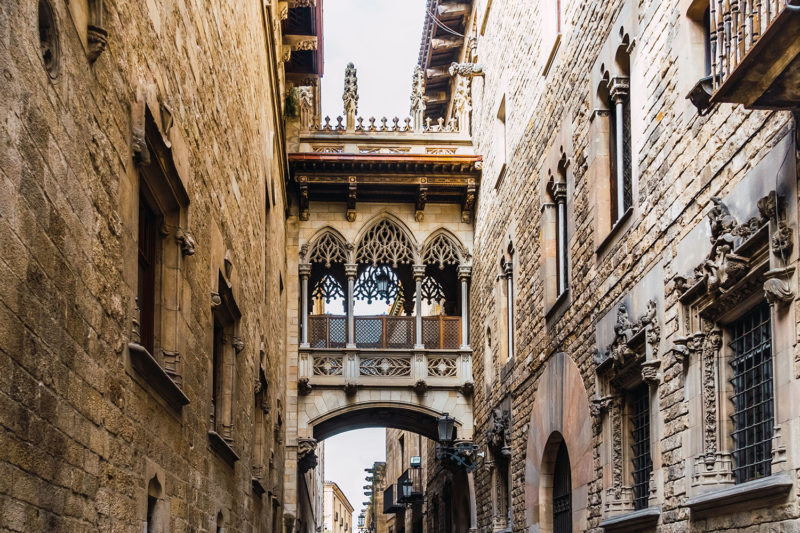


Summer is a time when we can do things with the family, share and enjoy a few days’ holiday. The pandemic that kept us cooped up at home last year is subsiding, and many families are thinking of going on holiday for a few days.
Planning a holiday is a job to be done, especially if you are travelling with children. Finding a place that is suitable for them and, at the same time, pleasant for adults, is not an easy task. Not all tourist destinations are designed for children. Therefore, it is necessary to look for destinations that are prepared to welcome families, with spaces and activities designed for young and old alike. In fact, the tourism sector is increasingly specialising according to the needs of the client.
Catalonia is a country full of opportunities. A tourist destination par excellence, it has managed to diversify its offer. Family tourism is one and, nowadays, there is a wide range of proposals to suit all types of families: large families, single-parent families, families with one or two children… That is why, when choosing a destination, one must take into account, among other aspects, the budget, the tastes, and ages of the different members of the family, the duration, the distance, etc.
Choosing a place adapted to the needs of both children and adults is key. Catalonia has quality destinations that meet a series of requirements considered suitable for family tourism, to which the Catalan Tourism Agency awards the Family Tourism mark. This mark accredits them as destinations that provide a diversified offer of accommodation, catering, and leisure and entertainment establishments aimed at children.
Iu Alemany gives us tips on how to live together as a family.
Sea or mountain?
Specifically, there are 27 destinations that have the Family Tourism brand. These are divided into two groups: sea destinations and mountain destinations.
The seaside destinations have the Family Beach label. Nineteen municipalities on the coast have it. We find Pineda de Mar, Castelldefels, Vilanova i la Geltrú, Salou and Cambrils, among others. Lifeguard services, restaurants with children’s menus, activities on the sand, in the water, and a long etcetera, designed for young and old, help to make the time easier for everyone.
As for families who prefer mountain activities, there are 8 municipalities with the Nature and Mountain in family brand. Nature lovers will find a wide range of leisure activities on offer: educational centres, adventure sports, ski resorts open in the summer, etc.
In addition, in both sea and mountain destinations you will find accommodation prepared for families: hotels, campsites or flats that even offer a pushchair, cot, and baby seat service so that you don’t have to carry your own luggage; a nursery service; complementary activities; monitors; etc.
Travelling as a family is an opportunity that presents itself when we can enjoy a few days’ holiday. Planning them well and choosing a suitable place according to the age and tastes of the youngest members of the family will guarantee a successful stay.
11Onze is the community fintech of Catalonia. Open an account by downloading the app El Canut for Android or iOS and join the revolution!



There are words that seemed like relics of the past. Stagflation is one of them. But today it is returning with force, not only in central bank reports, but in the everyday reality of millions of people. With expensive energy, global tensions, and a slowing economy, the world is dangerously approaching a scenario reminiscent of the 1970s. The question is no longer whether it can happen, but whether we are already there.
Stagflation is an unusual but devastating economic phenomenon because it combines three elements that theoretically should not coexist: high inflation, low or zero economic growth, and a stagnant labor market. Simply put, everything becomes more expensive, but the economy does not improve. It is a situation that erodes purchasing power and limits the ability of families and businesses to progress.
The problem is that this scenario breaks traditional economic policy tools. If interest rates are raised to curb inflation, the economy slows down even further. If growth is stimulated, there is a risk of driving prices even higher. In essence, it is a dead end that puts governments, central banks, and citizens to the test.
From the 1970s crisis to today’s situation
To understand the present, we must look back. In the 1970s, the Western world experienced severe stagflation following two key shocks: the 1973 oil embargo and the global energy crisis. Oil prices soared, production costs increased, and the entire economy entered a spiral of high prices and low growth. That episode marked an entire generation and reshaped global economic policy for decades.
Today, the specter returns in a new context. Tensions in Iran and risks around the Strait of Hormuz—through which a critical share of the world’s oil flows—have reopened the global energy issue. When energy prices rise, production costs increase, these are passed on to final prices, and consumption declines. It is exactly the same mechanism seen in the 1970s, but in a far more interconnected world.
This situation is compounded by a particularly fragile environment: strained supply chains, soaring public debt, and structural energy dependency that limits the ability to respond. The result is a system far more vulnerable to shocks, where any geopolitical tension can trigger immediate global effects.
The similarities with the 1970s are not only conceptual. If we compare both periods, the parallels are evident:
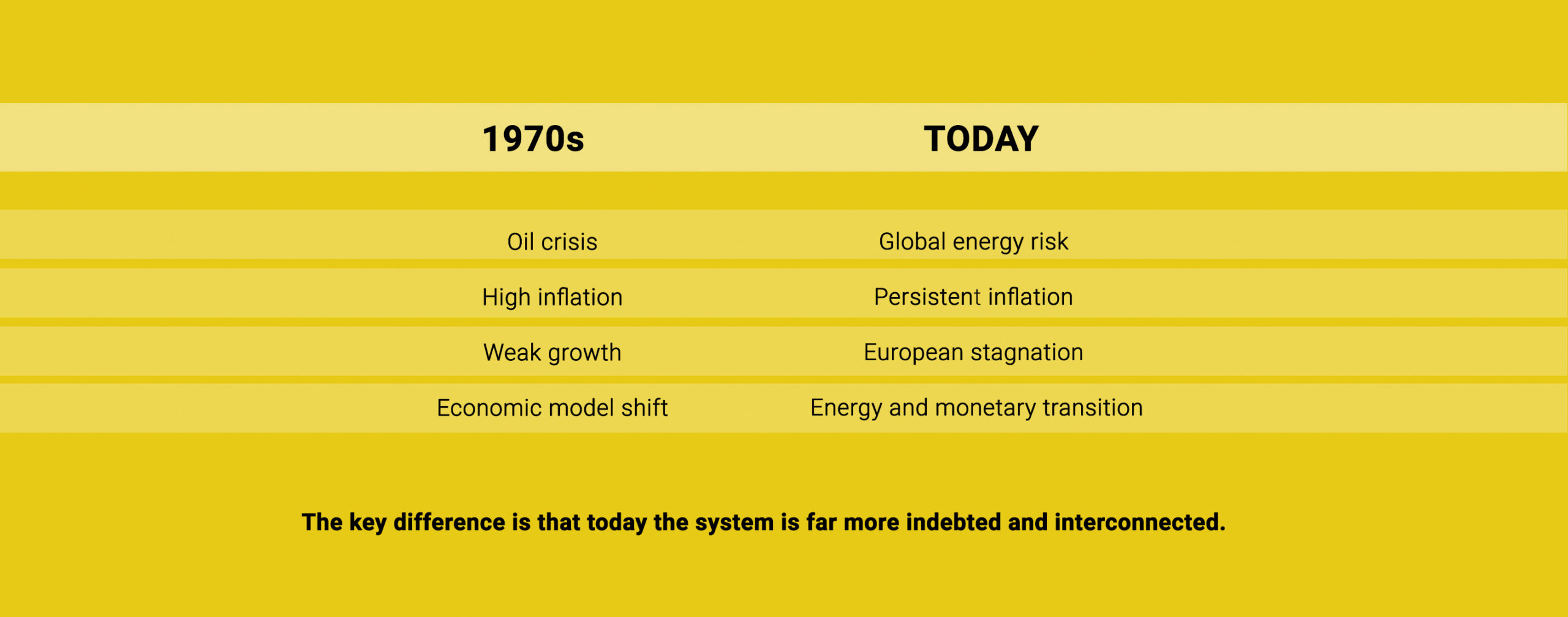
Main economic differences.
In fact, current data reinforces this diagnosis. According to Eurostat, inflation in the eurozone has remained above the 2% target of the European Central Bank in recent years, while the International Monetary Fund warns of weak and uneven growth in Europe. A scenario that aligns with classic stagflation patterns.
Recent data therefore paints a clear picture: persistent inflation, weak economic growth—especially in Europe—and stagnant productivity. But the issue is not only rising prices, but wages failing to keep pace. As analyzed in numerous publications by La Plaça, the cost of living has decoupled from real incomes, eroding households’ ability to save. And this is the key: without purchasing power, there is no consumption, and without consumption, there is no growth.
The real impact: your daily life
Stagflation is not an abstract or distant concept. It has very concrete consequences in your daily life, directly affecting your ability to save, the cost of debt, purchasing power, and even the taxes you pay without realizing it. It is a reality that seeps into every everyday economic decision.
- Savings lose value. When inflation is present, money loses value over time. If the economy is also not growing, investment opportunities shrink, creating the worst possible scenario for savers. It is no coincidence that, in times of uncertainty, assets such as gold regain prominence as a historical safe haven.
- Mortgages tighten. To combat inflation, central banks raise interest rates. The direct consequence is clear: more expensive mortgages, tighter credit, and less investment. All of this further cools the economy.
- Wages lose purchasing power. Even if salaries rise nominally, they often do not keep up with inflation. This creates an increasingly widespread feeling: you work the same or more, but you reach the end of the month worse off. This is especially harsh for the middle class.
- More “invisible” tax pressure. Inflation also increases public revenue indirectly. More VAT is paid because prices are higher, and more income tax due to bracket effects. This is what many economists consider a hidden tax increase.
A perfect storm for the economy
Stagflation is especially dangerous because it combines the worst of two crises: inflation, which silently impoverishes, and recession, which paralyzes economic activity. Unlike other scenarios, there are no easy solutions here. Traditional tools stop working and governments’ ability to respond becomes limited. In a world with high levels of debt, strong energy dependency, and growing global tensions, this scenario may be far more persistent than many would like to admit.
Faced with this context, the key question is inevitable: what can we do? When stagflation appears, the rules of the game change. It is no longer enough to follow traditional strategies. It is necessary to understand that inflation may not be temporary, to protect the value of money by avoiding excess liquidity, to diversify to reduce risk, and above all, to educate oneself. Financial education ceases to be optional and becomes an essential tool for making sound decisions.
This scenario points to a silent paradigm shift. Stagflation is not just a temporary problem, but a symptom of an economic model under pressure, based on debt, cheap energy, and constant growth. When these pillars weaken, the system falters. And it is at this point that society is forced to choose between ignoring the signals or adapting. The 1970s marked a turning point; today, all signs suggest we may be approaching another.
Understanding stagflation is not just economic knowledge—it is financial survival. Because the reality is clear: no one will protect your purchasing power for you. In a world where money loses value and the economy falters, waiting is not an option. The decisions you make today will shape your economic future.
Protecting savings with physical gold has been one of the main contributions of 11Onze to its community and, now, the range of products is expanding. Therefore, in the face of volatility, still high inflation and the growing crisis of confidence in the banking system, gold is once again strengthening as a safe-haven asset. Discover Seed Gold at Preciosos 11Onze.
If you would like to learn more about this topic, we recommend:
 Comunitat
Can the US continue to pay for its military?
6 min readSince the end of World War II, the United States has...