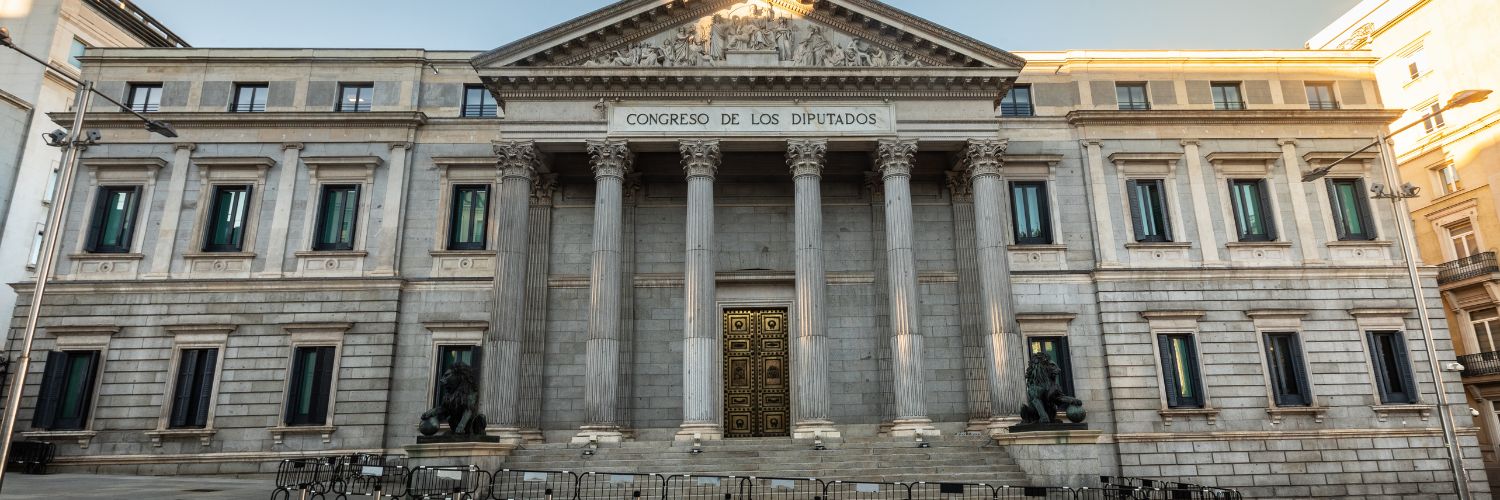
They say that the 1978 Constitution is the pillar of Spanish democracy. Perhaps it is, but it is also its chastity belt. Everything that tries to breathe outside the centre is repressed in the name of unity. What was drafted to guarantee autonomy has ended up becoming a mechanism of submission: a text that confuses loyalty with obedience, and coexistence with silence.
When the current president of Castilla-La Mancha, Emiliano García-Page, declared that “all the money of the Catalans is ours”, he was not making an electoral jest, but expressing, without filters, the deepest truth of a system designed to turn solidarity into appropriation. From the Bourbon centralisation of the 18th century to the constitutional regime of 1978, Spain has built a model that confuses unity with submission and finds in Madrid its gravitational centre. What was historically an administrative necessity has today become a form of economic and symbolic domination.
While the capital proclaims itself the engine of progress, the reality is far more prosaic: Madrid does not generate wealth; it absorbs it. Its so-called “Madrid miracle” is the result of a fiscal and legal architecture designed to concentrate power and income, suffocating the productive territories that sustain the country.
The Direct Link with the “Emptied Spain”
According to the Spanish Tax Agency, Madrid contributed 19.5% of the national GDP in 2023, but declared 24% of the country’s highest incomes. The difference is not productivity but absorption: wealth is born in the periphery —Catalonia, Valencia and the Balearic Islands— and declared in the centre. The State has built a radial model in which everything —companies, institutions, media and sport— orbits around a single nucleus while the rest of the territory empties out.
With a 100% exemption on wealth and inheritance taxes and a tax policy tailored to large fortunes, Madrid has created an internal tax haven within the State itself. More than 25,000 high-net-worth individuals have established residence there in the last decade. Capital takes refuge, the periphery is exhausted, and the State looks on contentedly, because this imbalance serves its interests.
This concentration of wealth in the centre not only impoverishes productive territories but also accelerates the depopulation of large parts of the country. Rural and industrial areas, deprived of investment and economic activity, suffer a constant exodus of young people and an increasing dependence on subsidies. The so-called “Emptied Spain” is not a natural or demographic phenomenon, but the direct consequence of a State that drains resources, talent, and opportunities toward Madrid.
This unfair competition is not corrected — it is encouraged. The supposed constitutional solidarity is, in fact, a mechanism of legalised plunder across the entire territory. And when any region denounces this abuse, it is immediately branded as selfish. The paradox is striking: those who sustain the State are accused of wanting to break it.

The ‘Madrid miracle’ is nothing more than the result of a fiscal and legal architecture designed to concentrate power and income, suffocating the productive territories that keep the country alive.
Density as a Strategy of Domination
Demography was its first visible consequence. From 1950 onwards, the Meseta began to empty gradually, pushed by the need to feed Madrid with large doses of human capital.
That internal population flow was not spontaneous: it responded to a state strategy aimed at reinforcing the political and administrative centre. Madrid did not grow to be the economic engine of the country, but to become its seat of power.
That massive concentration transformed the city into an ecosystem of civil servants, administrators, public employees and middlemen, rather than a space for producers or innovators. It was not a geographical accident but the result of a political project of population density — because where population accumulates, representation accumulates; and where there is representation, there is legitimacy.
The parliamentary majority that sustains this status quo is not a coincidence. Forty-five percent of the seats in Congress are distributed between Madrid and the two Mesetas, a configuration that turns demographic concentration into permanent political hegemony. The Electoral Law, designed to over-represent the province as the voting unit, guarantees that the centre governs even without a social majority.
Thus, the two-party system —PSOE and PP— acts as the two faces of the same regime, alternating in power without ever altering its foundations. Madrid has fortified itself not only with laws and votes but also with the morality of power, under the conviction that everything central is rational and everything peripheral is suspect.
Over time, this induced demography and over-representation became the material and symbolic basis of central power. When democracy arrived, Madrid already concentrated enough electoral weight to condition any majority. Territorial balance ceased to be an objective and became a statistical anomaly. Since then, concentration has been interpreted as “efficiency,” and the emptying of the periphery as a natural consequence of the market.
But even here, the logic remains the same: dependence as a method of cohesion. The centre grows at the expense of the periphery, and the periphery remains loyal because it depends on transfers, contracts or institutional presence. As in every historical structure of domination, corruption functions as a mechanism of social peace — compensating grievances, buying loyalties and preventing reforms that could dismantle the system.
Thus, demographic policy, radial economics and structural corruption form a single mechanism. Power is not only exercised from the centre but fabricated by it — with population, resources and narratives all serving the same purpose: to preserve unity through dependence.
Corruption as the Binding Agent
No structure can stand without cement — and in Spain, that cement is corruption. It is not a modern vice, but an organic inheritance. As early as the 11th-century León Courts, favour was the currency of power: bureaucracy existed to grant, not to administer. Under both the Habsburgs and the Bourbons, that courtly system was amplified and perfected until it became a method embedded in the State’s very core. When Spain was not yet Spain — merely a mosaic of kingdoms governed from the centre through the failed project of the Hispanic Monarchy — grace replaced law, and political loyalty was bought through economic obedience.
This pattern was never broken, only modernised. Where once there were royal favours, today there are public contracts; where there were viceroys, now there are government delegations; and where there were clienteles, now there are political parties. Corruption acts as the historical continuity of personalist power, the invisible glue binding the elites of the centre with the obedient peripheries.
And when obedience fails, the mechanism is debt. Creating debt is the modern way of subjugating territory. The autonomous communities, lacking fiscal sovereignty and forced to finance essential services with insufficient resources, are compelled to resort to the Autonomous Liquidity Fund (FLA) — an instrument created by the Ministry of Finance to provide liquidity… in exchange for structural dependence.
Through the FLA, what was once denied as financing —by imposing conditions and controls— is returned as conditional debt. Thus, need is transformed into political submission, and dependence into forced loyalty. Plunder and indebtedness are two sides of the same coin — one that always lands heads-up for the centre and tails for the periphery.

And when obedience fails, the mechanism is debt. Creating debt is the modern way to subjugate a territory.
Law as a Shield
The foundation of this architecture is not economic but legal. The 1978 Constitution, presented as a pact of coexistence, consecrated the unity of Spain as a dogmatic principle.
Article 2 defines it as “indissoluble”; Article 138 promises economic balance between territories, but without establishing effective mechanisms; and Article 156 recognises the financial autonomy of the regions… as long as it does not question unity. The result is a constitutional right to centralism, where every real decentralisation is perceived as a concession rather than a right.
The very legal structure reinforces this asymmetry. The State retains “basic” competences in almost every sphere —health, education, energy, taxation— under what the Constitutional Court calls “the basic equality of Spaniards.” This apparently neutral principle allows the central government to recentralise competences whenever it considers it necessary to “guarantee national cohesion” or “avoid territorial inequalities.” It is the legal mechanism that enables the State to decide on taxes, infrastructure or natural resources that, in other federal systems, would belong to the territories themselves.
The system of regional financing is a paradigmatic example: the regions collect only a limited portion of taxes but depend on annual transfers that the Ministry of Finance can adjust at its discretion. This generates a structural dependence that turns the principle of autonomy into an administrative fiction.
Within this legal and financial machinery, the banks play an essential role. Institutions such as La Caixa or Banco Sabadell —originally founded to channel Catalonia’s productive savings and credit— have ended up acting as structural pawns of the centralist system. Not out of ideology, but out of a need to survive within a regulatory, fiscal and political framework that rewards submission and punishes dissent.
The relocation of corporate headquarters after the 2017 referendum is the clearest proof: a legal operation presented as a “business decision,” but in reality the result of explicit political pressure from the State and the Bank of Spain, determined to use financial fear as an instrument of territorial control.
Thus, the very institutions that were created to support Catalonia’s productive economy have become guarantors of the status quo, ensuring that the flows of credit and investment continue to pass through the centre and that the structure of dependence remains intact.
In this way, Madrid can act as a fiscal paradise, applying bonuses and tax cuts that attract capital, while Catalonia or Valencia cannot fully manage their own resources without being accused of breaking Spain’s unity. The message is clear: the economic freedom of the centre is “efficiency”; that of others, “selfishness”.
Law thus becomes the shield of privilege, transforming inequality into a norm and dissent into a moral crime. In this way, centralism defends itself not with the army, but through legal codes, compliant banks and disciplined economic institutions that make power a matter of law, and law a tool of control.
When the Territory Questions the System
The Catalan independence movement was not —as it was portrayed— an identity delusion, but a political reaction to an unsustainable economic and institutional system. For decades, Catalonia had believed that self-government could coexist with constitutional loyalty, but the 2010 Constitutional Court ruling against the Statute of Autonomy shattered that illusion.
When the State declared unconstitutional several articles approved by referendum and ratified by Parliament, it made clear that autonomy had cardboard limits: self-government existed only as long as it did not question the centre. The demand for fair financing was not merely a budgetary issue; it was, in fact, a denunciation of the extractive model that feeds the heart of the State with resources from the entire eastern seaboard.
At the core of the economic debate appeared the fiscal balances, the investment deficit, and the radial infrastructures —all of which led to a political question of sovereignty, as they revealed that financial dependence is the true mechanism of submission.
In 2017, “el Procés” exposed that centralism is not a dysfunction of the system but its foundational essence. When part of the territory dared to question it, the State responded not with dialogue but with institutional reprisal and judicial mobilisation. In that response, the Bourbon monarchy played an especially active role, becoming the symbolic guarantor of the old order.
The application of Article 155, the intervention of the Catalan Government and the criminal prosecution of political and civil leaders revealed the stark reality: the Constitution is not a framework for coexistence, but a contract of submission that activates whenever someone tests its limits.
For this reason, the so-called “New Singular Financing” that the PSOE and its satellite parties now loudly offer to Catalonia is a complete contradiction in terms. Because if it were truly singular, it would break the fiscal uniformity that guarantees central power and would cause the constitutional edifice upon which the 1978 regime rests to implode.
The system cannot reform itself without destroying itself, because its strength lies in its rigidity. It was created to live off centralisation, and centralisation is incompatible with the economic freedom of the territories.
Madrid can act as a tax haven, applying bonuses and tax reductions that attract capital, while Catalonia or Valencia cannot fully manage their own resources without being accused of breaking Spain’s unity.
Behind the Mirage of ’78
As Montesquieu once warned, “when power is concentrated, freedom fades”. Spain has turned this maxim into a state doctrine. Madrid acts as an internal metropolis that governs through attraction and dependence — fiscal, media, political and sporting. Corruption fattens the machinery, law sanctifies its legitimacy, and demography guarantees its continuity.
That is why speaking today of “singular financing” is an oxymoron: no singularity is possible within a system designed to erase it. Madrid’s centralism is not a pathology — it is the very heart of the regime.
And as long as wealth continues to flow from the eastern seaboard to the centre, Spain will remain a state of dependencies with the appearance of a democracy. The true miracle is not Madrid: it is that the country still endures. Because —as always— power does not reside where work is done, but where the distribution of merit is decided. Perhaps the real question is not whether Spain can change, but whether it truly wants to.
11Onze is the community fintech of Catalonia. Open an account by downloading the app El Canut for Android or iOS and join the revolution!



 Oriol Garcia Farré