
There are words that seemed like relics of the past. Stagflation is one of them. But today it is returning with force, not only in central bank reports, but in the everyday reality of millions of people. With expensive energy, global tensions, and a slowing economy, the world is dangerously approaching a scenario reminiscent of the 1970s. The question is no longer whether it can happen, but whether we are already there.
Stagflation is an unusual but devastating economic phenomenon because it combines three elements that theoretically should not coexist: high inflation, low or zero economic growth, and a stagnant labor market. Simply put, everything becomes more expensive, but the economy does not improve. It is a situation that erodes purchasing power and limits the ability of families and businesses to progress.
The problem is that this scenario breaks traditional economic policy tools. If interest rates are raised to curb inflation, the economy slows down even further. If growth is stimulated, there is a risk of driving prices even higher. In essence, it is a dead end that puts governments, central banks, and citizens to the test.
From the 1970s crisis to today’s situation
To understand the present, we must look back. In the 1970s, the Western world experienced severe stagflation following two key shocks: the 1973 oil embargo and the global energy crisis. Oil prices soared, production costs increased, and the entire economy entered a spiral of high prices and low growth. That episode marked an entire generation and reshaped global economic policy for decades.
Today, the specter returns in a new context. Tensions in Iran and risks around the Strait of Hormuz—through which a critical share of the world’s oil flows—have reopened the global energy issue. When energy prices rise, production costs increase, these are passed on to final prices, and consumption declines. It is exactly the same mechanism seen in the 1970s, but in a far more interconnected world.
This situation is compounded by a particularly fragile environment: strained supply chains, soaring public debt, and structural energy dependency that limits the ability to respond. The result is a system far more vulnerable to shocks, where any geopolitical tension can trigger immediate global effects.
The similarities with the 1970s are not only conceptual. If we compare both periods, the parallels are evident:
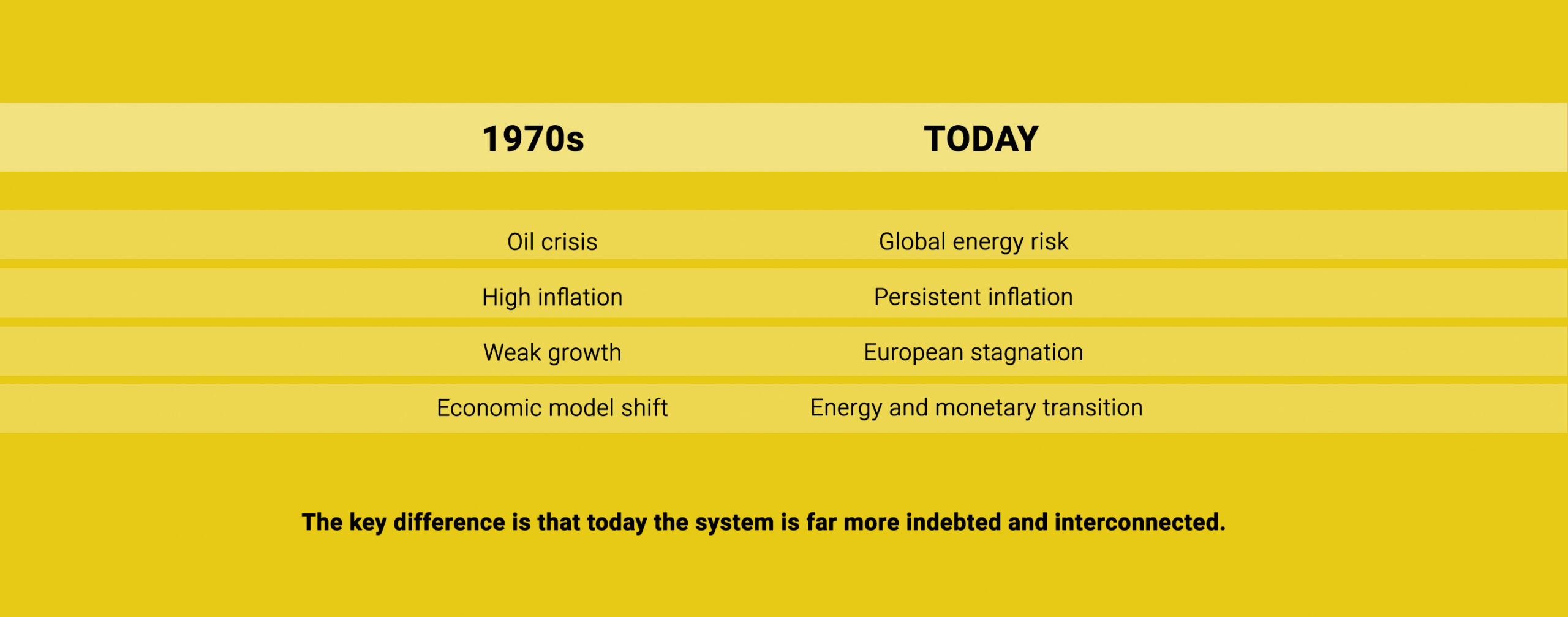
Main economic differences.
In fact, current data reinforces this diagnosis. According to Eurostat, inflation in the eurozone has remained above the 2% target of the European Central Bank in recent years, while the International Monetary Fund warns of weak and uneven growth in Europe. A scenario that aligns with classic stagflation patterns.
Recent data therefore paints a clear picture: persistent inflation, weak economic growth—especially in Europe—and stagnant productivity. But the issue is not only rising prices, but wages failing to keep pace. As analyzed in numerous publications by La Plaça, the cost of living has decoupled from real incomes, eroding households’ ability to save. And this is the key: without purchasing power, there is no consumption, and without consumption, there is no growth.
The real impact: your daily life
Stagflation is not an abstract or distant concept. It has very concrete consequences in your daily life, directly affecting your ability to save, the cost of debt, purchasing power, and even the taxes you pay without realizing it. It is a reality that seeps into every everyday economic decision.
- Savings lose value. When inflation is present, money loses value over time. If the economy is also not growing, investment opportunities shrink, creating the worst possible scenario for savers. It is no coincidence that, in times of uncertainty, assets such as gold regain prominence as a historical safe haven.
- Mortgages tighten. To combat inflation, central banks raise interest rates. The direct consequence is clear: more expensive mortgages, tighter credit, and less investment. All of this further cools the economy.
- Wages lose purchasing power. Even if salaries rise nominally, they often do not keep up with inflation. This creates an increasingly widespread feeling: you work the same or more, but you reach the end of the month worse off. This is especially harsh for the middle class.
- More “invisible” tax pressure. Inflation also increases public revenue indirectly. More VAT is paid because prices are higher, and more income tax due to bracket effects. This is what many economists consider a hidden tax increase.
A perfect storm for the economy
Stagflation is especially dangerous because it combines the worst of two crises: inflation, which silently impoverishes, and recession, which paralyzes economic activity. Unlike other scenarios, there are no easy solutions here. Traditional tools stop working and governments’ ability to respond becomes limited. In a world with high levels of debt, strong energy dependency, and growing global tensions, this scenario may be far more persistent than many would like to admit.
Faced with this context, the key question is inevitable: what can we do? When stagflation appears, the rules of the game change. It is no longer enough to follow traditional strategies. It is necessary to understand that inflation may not be temporary, to protect the value of money by avoiding excess liquidity, to diversify to reduce risk, and above all, to educate oneself. Financial education ceases to be optional and becomes an essential tool for making sound decisions.
This scenario points to a silent paradigm shift. Stagflation is not just a temporary problem, but a symptom of an economic model under pressure, based on debt, cheap energy, and constant growth. When these pillars weaken, the system falters. And it is at this point that society is forced to choose between ignoring the signals or adapting. The 1970s marked a turning point; today, all signs suggest we may be approaching another.
Understanding stagflation is not just economic knowledge—it is financial survival. Because the reality is clear: no one will protect your purchasing power for you. In a world where money loses value and the economy falters, waiting is not an option. The decisions you make today will shape your economic future.
Protecting savings with physical gold has been one of the main contributions of 11Onze to its community and, now, the range of products is expanding. Therefore, in the face of volatility, still high inflation and the growing crisis of confidence in the banking system, gold is once again strengthening as a safe-haven asset. Discover Seed Gold at Preciosos 11Onze.
If you would like to learn more about this topic, we recommend:
 Comunitat
Can the US continue to pay for its military?
6 min readSince the end of World War II, the United States has...
 Equip Editorial