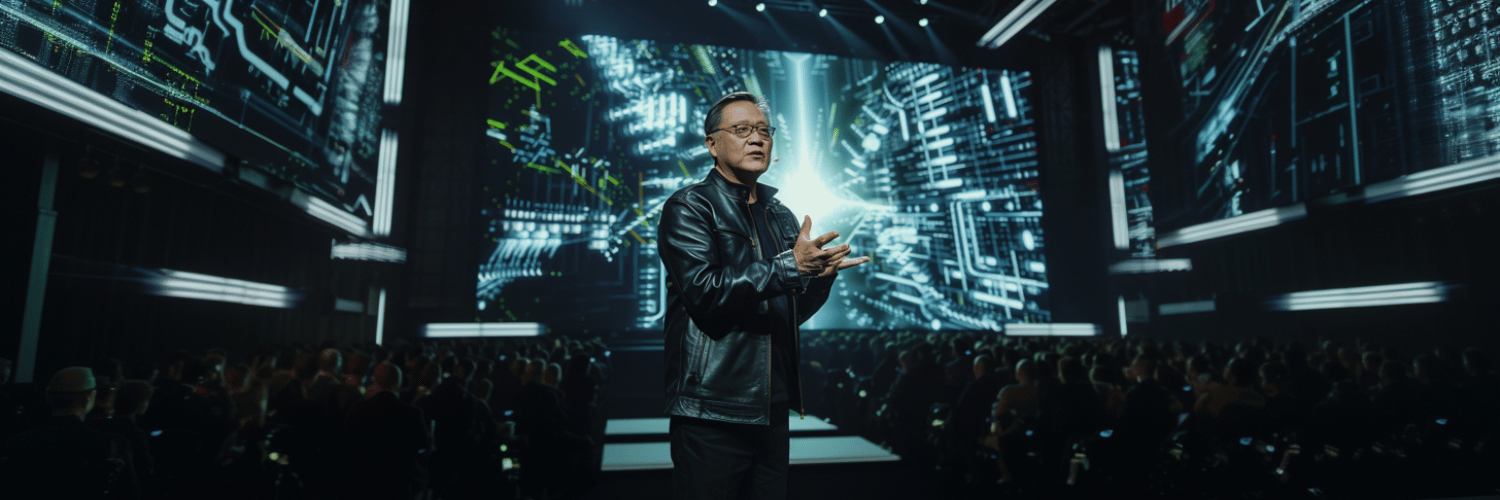
The lights go out and tens of thousands of people fix their eyes on a stage in San Jose, in the heart of Silicon Valley. When Jensen Huang appears, dressed in his inseparable black leather jacket, the audience welcomes him as if he were a rock star. This is no exaggeration. The announcements he will make over the following hours may alter the investment plans of the world’s most powerful companies, change market expectations and determine the speed at which artificial intelligence will advance.
Jensen Huang is the founder and chief executive officer of Nvidia, a company that, not so long ago, was known mainly among video game enthusiasts. Today, its annual GTC conference brings together more than 30,000 developers, researchers and executives, and has become a kind of global summit of the new digital economy. When Huang presents a processor architecture, he is not announcing a more powerful graphics card. He is showing the infrastructure on which Meta, Microsoft, Google, Amazon or OpenAI will try to build their businesses over the coming years.
This is the great paradox of artificial intelligence: the richest companies in history compete fiercely against one another, yet all of them depend, to a greater or lesser extent, on the same supplier. Nvidia has managed to place itself at the centre of a technological bottleneck that allows it to set the pace for the entire industry. Now, its best customers are trying to escape this dependence while continuing to buy billions of dollars worth of microchips from it.
Nvidia does not sell microchips: it sells time
Nvidia’s rise cannot be understood merely by looking at the performance of its processors. For years, the company sensed that graphics processing units, the well-known GPUs, could be used for far more than generating video game images. Their ability to perform thousands of calculations in parallel made them particularly useful for training neural networks and artificial intelligence models.
The company did not limit itself to manufacturing the hardware. It also created CUDA, a programming platform that allows developers to use GPUs for advanced computing tasks. Over the years, universities, laboratories and companies adopted this ecosystem until it became a de facto standard. This is why leaving Nvidia is not as simple as replacing one component with another: it involves adapting programs, libraries, teams and data centres that have been designed for years around its technology.
This combination of microchips, software, networks and complete systems has turned Nvidia into much more than a semiconductor manufacturer. When a company gains access to a new generation of accelerators before its competitors, it is not simply buying greater computing capacity. It is buying months of advantage.
In a sector where launching an artificial intelligence model six months earlier can mean attracting millions of users, this difference has extraordinary value. Nvidia, therefore, does not merely sell silicon. It sells speed, scale and time. And time is probably the most expensive commodity in Silicon Valley.
Zuckerberg’s dilemma
Mark Zuckerberg knows very well the risk of depending on third-party platforms. For years, Meta’s business has been shaped by Apple and Google’s operating systems, which control the phones used to access Facebook, Instagram or WhatsApp. When Apple changed its privacy rules, Meta saw how a decision made outside its own headquarters could profoundly affect its advertising model.
Artificial intelligence threatened to repeat the same story, but on an even larger scale.
Meta manages services used daily by billions of people. Every Instagram recommendation, every advertisement selected by Facebook and every future response generated by Meta AI require computing power. An individual query may seem insignificant, but when multiplied across a global community, the result is a colossal demand for electricity, data centres and processors.
If Meta wants to integrate intelligent assistants into WhatsApp, Instagram and Facebook, training a large model is not enough. It must then run it continuously for billions of users. This phase, known as inference, may end up accounting for an enormous share of the total cost of artificial intelligence.
This is where dependence on Nvidia becomes a strategic problem. If the supply of processors is insufficient, if deliveries are delayed or if the price of the infrastructure rises, Meta does not fully control the timetable of its own technological revolution.
Its response has been to develop the MTIA family of chips, standing for Meta Training and Inference Accelerator. This is not a new independent microchip company, but an in-house silicon programme integrated into Meta’s infrastructure strategy. The objective is to design accelerators tailored to specific tasks, such as ranking content, generating recommendations and running artificial intelligence services more efficiently. Meta plans to deploy several new generations of MTIA and has strengthened its collaboration with companies such as Broadcom and Arm to accelerate their development.
This does not mean that Zuckerberg is breaking with Nvidia. Meta insists that it will follow a portfolio strategy, combining its own chips with hardware from various suppliers. In fact, the company has also announced agreements to diversify its infrastructure with AMD. The aim is not to achieve absolute independence, but to prevent its entire future from depending on a single gateway.
Silicon valley’s war of independence
Meta is not the only company trying to reduce the toll imposed by Nvidia. Google has been using its TPUs for years to train and run models. Amazon has developed Trainium and Inferentia for its cloud customers. Microsoft is working on Maia accelerators, while Tesla has devoted resources to the Dojo platform. Apple had already demonstrated that designing its own processors could allow it to leave Intel behind and exercise greater control over the evolution of its products.
They have all reached a similar conclusion: when a technology becomes the core of the business, fully delegating control over it is dangerous.
This strategy does not necessarily involve building a direct competitor to Nvidia’s most advanced processors. GPUs are highly flexible tools, capable of handling a wide variety of models and applications. By contrast, a customised chip can be optimised to perform a few repetitive functions more cheaply and efficiently.
The comparison is similar to the difference between a Swiss Army knife and an industrial tool designed to perform the same movement repeatedly. The knife is useful in many situations; the specialised tool can be far superior when the same task must be repeated billions of times. This is why Nvidia may continue to dominate the training of the most demanding models while its customers gradually take certain workloads away from it. The risk for the company is not that Meta, Google or Amazon will stop buying its processors tomorrow, but that they will learn to reserve them only for the tasks in which they are truly indispensable.
TSMC, the factory that sustains the revolution
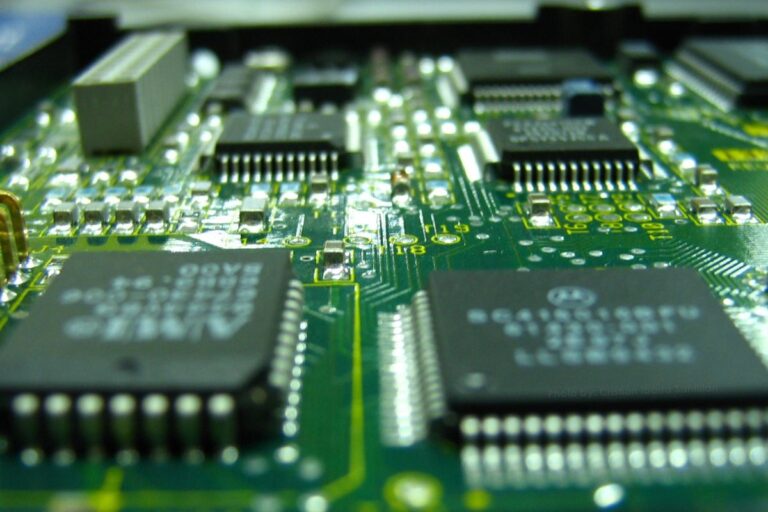
The story becomes even more complicated when we discover that Nvidia is not completely independent either. The company designs its processors, but it does not have the factories needed to produce them on a large scale. This responsibility falls mainly on TSMC, the Taiwanese giant that also manufactures microchips for Apple, AMD, Qualcomm and hundreds of other customers.
TSMC is the world’s leading specialist in contract manufacturing. Its advantage comes from decades of experience, enormous investment and an extraordinary ability to manufacture increasingly smaller structures without sacrificing performance or reliability. In 2025, advanced processes of seven nanometres or less already accounted for 74% of its wafer revenue, a figure that shows the extent to which the company has placed itself at the centre of the most sophisticated technology. That same year, it manufactured more than 12,000 different products for 534 customers.
This concentration explains why Taiwan has an importance that far exceeds its territorial size. A serious disruption to TSMC’s factories would not affect Nvidia alone. It would shake the production of phones, computers, cars, telecommunications equipment and data centres throughout the world.
People often speak of Taiwan’s “silicon shield”: the idea that TSMC’s importance offers the island a certain degree of geopolitical protection because no major power can afford to let its production disappear. But a shield can also be a vulnerability. The more the world depends on a small number of factories, the more devastating the consequences of a conflict or blockade may be.
ASML, the company that manufactures the impossible
There is yet another level of dependence. To produce the most advanced microchips, TSMC needs machines that can be supplied by only one Dutch company: ASML.
These machines use extreme ultraviolet lithography, known as EUV, to project microscopic patterns onto silicon wafers. They operate with light at a wavelength of 13.5 nanometres, close to that of X-rays, and make it possible to manufacture the circuits that power the most modern generations of processors. ASML’s new platforms are already designed to support the production of two-nanometre chips and, in some cases, even smaller ones.
The process is so complex that it seems to come straight out of science fiction. To generate the necessary light, the machine fires laser pulses at tiny droplets of tin until they are transformed into plasma. A system of extraordinarily precise mirrors then directs this light to print the shapes of the circuit.
ASML does not manufacture the digital brains of the 21st century. It manufactures the tool without which nobody could build them. This position has turned it into a central player in the technological rivalry between the United States and China, because controlling access to advanced lithography is, in part, equivalent to controlling who can manufacture the processors of the future.
The chain is thus laid bare with complete clarity: Meta needs accelerators to deploy its artificial intelligence; Nvidia designs many of the most powerful ones; TSMC manufactures them, and ASML provides the machines that make this manufacturing possible. The companies that appear to dominate the digital world are themselves dependent on a narrow, costly and geographically vulnerable industrial network.
Power no longer comes from beneath the ground
During the 20th century, the great powers competed for oil wells, mines, ports and maritime routes. The 21st century has not eliminated those struggles, but it has added a new strategic resource: computing capacity.
This power is not extracted directly from the earth. It is manufactured in cleanrooms where a microscopic particle can ruin a multimillion-dollar production run, inside machines that operate with a level of precision that is difficult to imagine and through a supply chain that crosses continents.
The battle between Meta and Nvidia is, therefore, only one part of a much deeper transformation. Zuckerberg does not intend to destroy Nvidia, but to regain enough autonomy to set his own pace. Google, Amazon, Microsoft and the other giants are pursuing the same objective.
Nvidia remains the great winner of the artificial intelligence boom. But its success also contains the seed of the main challenge it will have to face: the more power it accumulates, the more incentives it gives its customers to look for a way out. The microchip war will not merely decide who manufactures the fastest processor. It will decide who controls the cost, the speed and access to the infrastructure that is redefining the global economy. And none of the major technology companies seems willing to leave this power indefinitely in the hands of a single man wearing a black leather jacket.
11Onze is Catalonia’s fintech community. Open an account by downloading the El Canut app for Android or iOS. Join the revolution.


 Equip Editorial