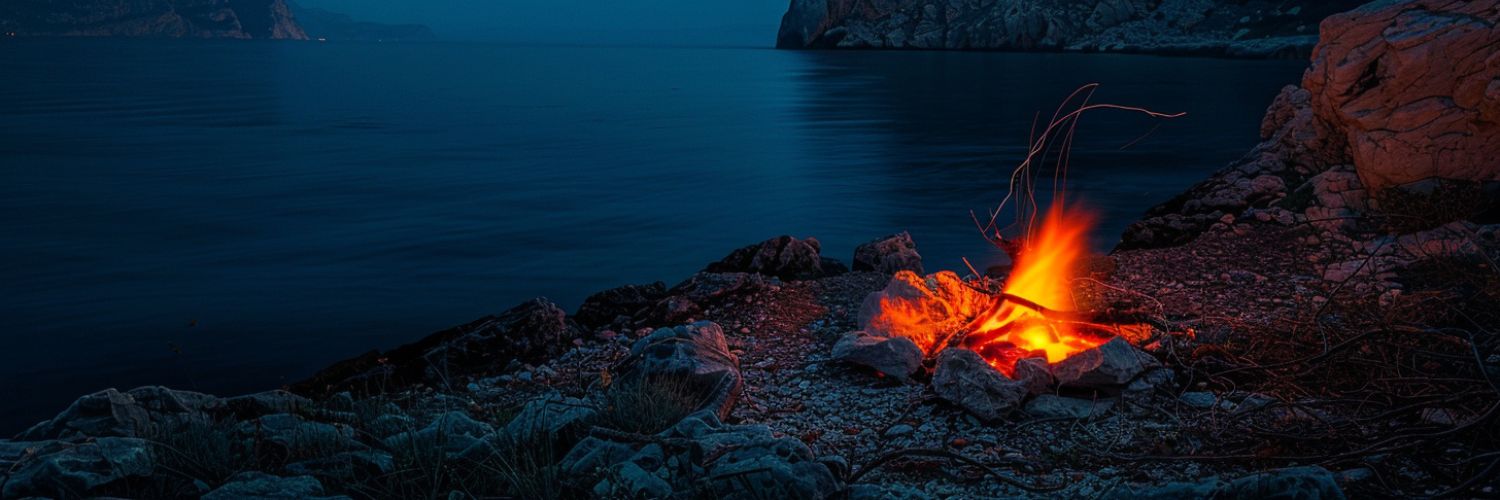
The sticky heat. The smell of gunpowder. The noise of firecrackers echoing through the streets. Bonfires lighting up the beaches. Coca on the table. People bathing in the sea at midnight, as if the water still preserved some ancient power. Year after year, when Saint John’s Eve arrives, the Mediterranean seems to remember something that we no longer know how to explain completely. But we repeat it. And that, in history, is never a minor thing.
Because Saint John’s Eve is not only a popular celebration. It is a survival. A collective memory disguised as a festive night. An ancestral ritual that has crossed empires, religions, calendar changes, industrial revolutions, massive urban developments and digital screens without completely losing its symbolic centre: fire, water, night, the body, community and the passage of time.
There are traditions that endure because they are beautiful. Others endure because they are useful. But there are a few that persist because they respond to a deep need. Saint John’s Eve belongs to this last category. In an accelerated, fragmented and increasingly artificial society, we continue to need rituals that return us —even if only for a few hours— to nature, to community and to an older way of understanding ourselves. Modernity has changed the tools, but it has not eliminated the needs.
When the sun governed time
Before clocks, work calendars and mobile phone notifications, time was marked by the sky. It was not an administrative abstraction, but a physical experience. It was seen, suffered and celebrated. Agricultural and livestock communities lived according to the solar cycles because their survival literally depended on them: sowing too early or harvesting too late could mean hunger.
The summer solstice was, in this sense, one of the great turning points of the year. The shortest night. The longest day. The moment when light seemed to impose itself definitively over darkness, even if only to begin, immediately afterwards, its slow retreat. This paradox —the triumph that already contains decline— explains much of its symbolic force.
Mediterranean peoples understood nature as a succession of cycles: birth, growth, fullness, harvest and disappearance. Nothing was linear. Everything returned, but never exactly the same. In this world, fire was not only heat or spectacle. It was purification, protection and fertility. It was a way of speaking with the invisible.
That is why bonfires were lit. To frighten away evil spirits, to protect the harvests, to burn the old and begin a new cycle. Jumping over the fire was not a simple test of youthful daring, but a gesture of passage: crossing the flames to leave behind an old skin. In the same way, bathing in the sea during that night had a purifying dimension. Water and fire, apparently opposed, shared the same function: to cleanse, renew, begin again. Today we do it almost by inertia, but inertia is often a memory that has forgotten its words.

Agricultural and livestock communities lived according to the solar cycles because their survival literally depended on them: sowing too early or harvesting too late could mean hunger.
The Mediterranean and the Atlantic: two ways of living together
Saint John’s Eve also explains a Mediterranean way of understanding life. Because the Mediterranean is not only a geography. It is a cultural form, a way of inhabiting time, space and others.
It is the street as an extension of the home. It is the square as the natural stage of public life. It is shared food, long conversation, the table that always admits one more chair, noise as proof that there is still life. It is also a certain resistance to turning existence into a succession of private, silent and functionally efficient spaces.
Opposite this view, there is another, more Atlantic one, which has historically ordered life in a different way. Not worse, but different. The Atlantic has often been the world of distance, of the port open outwards, of long navigation, of trade, of persistent rain and of the domestic interior as refuge. Where the Mediterranean tends to expose life in the street, the Atlantic has tended to protect it inside the house, the club, the institution or the rule.
It is not only a question of climate, although climate is never innocent. It is a way of looking. The Mediterranean celebrates proximity; the Atlantic manages distance. The Mediterranean improvises around a table; the Atlantic builds procedures. The Mediterranean understands community as a pact; the Atlantic, often, as an imposition. In one case, collective life is born from contact. In the other, from organisation.
The Iberian Peninsula is interesting precisely because it contains these two views. Although some insist on homogenising it —as if an administrative border could erase centuries of moral geography—, the peninsula is not a single way of living. It is a coexistence of landscapes, rhythms and cultures. There is a Mediterranean Iberia, open to the street, to fire, to the square and to the shared celebration. And there is an Atlantic Iberia, made of mists, ports, damp stone, long distances and a more restrained relationship with public space. The problem is not that they coexist. The problem is wanting to deny it.
Because a mature political community does not need to pretend uniformity. On the contrary: it should know how to read its differences without always turning them into conflict. Geography does not mechanically determine the character of peoples, but it does educate habits, schedules, forms of encounter and ways of celebrating. And, in this sense, Saint John’s Eve is a profoundly Mediterranean celebration because it brings life outside. It places it under the sky. It makes it visible, bodily and shared.
While many modern societies have gradually enclosed life inside increasingly individualised interiors —the house, the car, the office, the screen—, the Mediterranean preserves an ancient inclination towards the outside. Here, life still needs air, body and presence. Saint John’s Eve is a clear expression of this: people leave their homes, occupy streets and beaches, share a table, look at the fire, listen to firecrackers, eat coca, bathe, toast, laugh, embrace. It may seem a minor thing, but it is not.
Societies are not sustained only by laws, markets and infrastructures. They also need shared rituals. They need moments in which the community represents itself to itself, even if it does not formulate it that way. A people that only produces, consumes and communicates digitally may continue to function; but it may slowly cease to feel like a community.
Rituals create belonging because they turn time into narrative. They remind us that we are part of something larger than our immediate biography. That is why these celebrations survive even in the midst of the digital age, because there are human needs that no algorithm can replace: presence, contact, shared rhythm, the awareness that we do not live alone. Technology connects. Ritual binds. And it is not the same thing.
The Christianisation of an older celebration
Like so many other European traditions, the feast of Saint John was absorbed and reinterpreted by Christianity. The Church placed the celebration of the birth of Saint John the Baptist on 24 June, very close to the summer solstice, integrating into the Christian calendar rituals that were already deeply rooted among the population.
This operation was not exceptional. Christianity, like every great cultural architecture, did not only replace previous beliefs; often it translated them. It gave new names to ancient gestures. It gave doctrine to practices that came from much earlier. What could not be eliminated could be ordered. What could not be completely forbidden could be baptised. But beneath the Christian layer, many ancestral practices continued to breathe. The medicinal herbs gathered that night. The baths in the sea. The bonfires. The rituals linked to fertility, protection, luck and renewal. All of this forms part of an extremely ancient cultural substratum that crosses centuries and civilisations.
And this reminds us of an important idea: cultures rarely disappear all at once. They transform. They mix. They adapt. They change language, calendar and moral justification. But many times they continue living under new forms, like embers that persist beneath the ash. Saint John’s Eve is precisely that: an ancient ember beneath a modern celebration.
It is a way of looking. The Mediterranean celebrates proximity; the Atlantic manages distance. The Mediterranean improvises around a table; the Atlantic builds procedures. The Mediterranean understands community as a pact; the Atlantic, often, as an imposition.
We still need fire
It is curious. We live surrounded by technology, artificial intelligence, instant consumption and hyperconnectivity. We had never had so many tools to communicate. We had never been able to send so many messages, share so many images, accumulate so much data about ourselves. And yet, few periods have spoken so much about loneliness, anxiety and emotional disconnection. Perhaps that is why we continue to gather around the fire.
Fire forces us to stop. It has a silent authority. It hypnotises without demanding anything. It generates conversation and contemplation at the same time. In front of a bonfire, time ceases to be productive and becomes human again. Nobody looks at a flame in a hurry. Nobody calculates the performance of an instant when fire dances before the sea.
Modernity has made us more efficient, but not necessarily more whole. We have gained comfort, speed and immediate access to almost everything. But we have also lost pauses, thresholds, shared silences and symbolic ways of marking the passage of time. Contemporary life tends to dissolve cycles: everything is available, everything is simultaneous, everything is now. Saint John’s Eve, by contrast, reminds us that human life needs rhythm. That it is not enough to live days; we must know how to distinguish them.
That is why fire continues to speak to us, because it returns us to a very ancient part of ourselves. It reminds us that we are symbolic beings before we are users, consumers or digital profiles. That we need to celebrate. That we need to leave things behind and that we need to begin again. And that, even in a world dominated by screens, we still seek meaning by watching flames dance before the water.
When tradition becomes consumption
Naturally, Saint John’s Eve has not escaped commodification either. No popular celebration remains outside a time that turns almost everything into product, spectacle or excess. The consumer industry has a great ability to empty rituals of their meaning and preserve only their wrapping.
Industrial firecrackers, mass tourism, the alcoholisation of the festive night, dirt on the beaches, noise without measure and a progressive loss of the original symbolism coexist today with the ancestral sediment of the celebration. The risk is evident: that the ritual ceases to be an experience of community and renewal and becomes only intensive entertainment.
But even here it is advisable to avoid easy nostalgia. There has never been a completely pure tradition. Every popular celebration has always mixed spirituality and excess, order and disorder, community and transgression. The question is not to idealise a past that probably did not exist as we imagine it, but to ask ourselves what we want to preserve from the ritual.
Because a tradition does not die only when it ceases to be practised. It also dies when it continues to be practised without understanding anything of what it meant.
And Saint John’s Eve still has something to tell us. Beneath the noise, consumption and surface, that human need to find collective moments that give meaning to the passage of time continues to exist. We continue to light bonfires because, deep down, we continue to need what they represent: to purify, to gather, to remember, to begin again. The problem is not that the celebration changes, but that it changes until it becomes empty.
The fire that still unites us
Every year, during the night of Saint John, the Mediterranean lights up again with small and ephemeral fires. The flames last only a short time, but the gesture comes from very far away. Perhaps without knowing it, we repeat a millenary ritual that speaks of community, renewal and hope. And perhaps this is the real strength of traditions: they allow us to participate in a memory that does not need to be fully understood in order to be felt as alive.
In an age marked by uncertainty, speed and disconnection, Saint John’s Eve reminds us of something essential: human beings need to feel part of a shared narrative. It is not enough to exist individually. We must belong. We must celebrate. We must find moments in which time stops merely passing and acquires meaning.
Perhaps that is why Saint John’s Eve continues to move us, because for a few hours we recover an ancient memory: that of a world that understood that life had rhythms, cycles and sacred moments. A world that knew that light could not be taken for granted and that, precisely for that reason, it had to be celebrated. The night of Saint John does not return us to the past. It reminds us that the past still burns within us. And as long as we continue to look at the fire before the sea, perhaps we have not yet forgotten everything.
And perhaps this is the true function of celebrations that survive the centuries: to remind us that a community is not built only by sharing institutions, markets or infrastructures, but by sharing symbols, rituals and memories. During the night of Saint John, even if only for a few hours, we once again feel that we are part of something collective. Of a human chain much older than ourselves. Fire brings us together, the street reconnects us and the celebration reminds us that no society can sustain itself solely on individualism. Because, in the end, every community needs moments in which to look at itself and recognise itself as alive.
11Onze is the community fintech of Catalonia. Open an account by downloading the app El Canut for Android or iOS and join the revolution!
If you would like to learn more about this topic, we recommend:
 Culture
The Three Kings: archaeology of a useful mirage
12 min readIf today we speak of the Three Kings as one speaks of,...

 Oriol Garcia Farré