
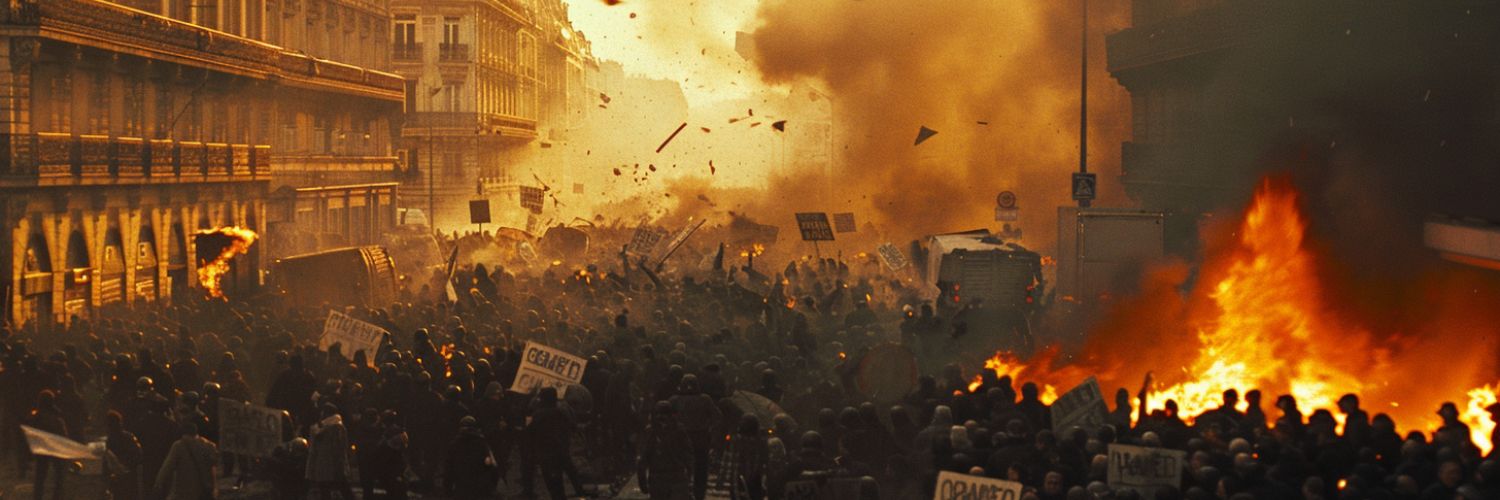
Europe is taking to the streets again. In France, student protests have ended up drawing in workers and trade unions. In Spain, thousands of people have mobilised over housing. In Portugal, banners are calling for wages that allow people to make ends meet. In Italy, discontent over the cost of living has filled the streets of Milan and other cities. And in Belgium, tens of thousands of workers have protested against pension reforms and in defence of purchasing power.
They are not protesting about exactly the same things. But it is difficult to ignore the common thread linking many of these mobilisations: the feeling that having a job no longer guarantees a good standard of living, while housing, food, energy and other basic necessities are taking an ever greater toll on people’s pockets. This is where inflation stops being a statistic. And enters the home.
In France, the protests that began among students over shortcomings in the education system have grown into a broader movement. Demands over the loss of purchasing power, wages, pensions and public services have also taken to the streets.
In Spain, the trigger is different, but the discontent feels familiar. Housing has become one of the main sources of economic anxiety. The case of Maricarmen, an 87-year-old woman evicted in Madrid after attempts were made to multiply her rent, became a symbol of a much wider problem and brought thousands of people onto the streets. Months earlier, Madrid and other cities had already seen large demonstrations demanding affordable housing.
In Portugal, thousands of people have protested in Lisbon, Porto and other cities against housing prices, low wages and the rising cost of living. One of the banners summed it up better than any economic report: “I want to leave my parents’ home before I turn 50.”
Italy and Belgium complete the picture. Italian cities have seen demonstrations linked to the cost of living and wages. Even around 6,000 members of the armed forces and security services demonstrated in Rome demanding improvements in pay and pensions. In Belgium, between 40,000 and 70,000 people took to the streets of Brussels in May against reforms affecting pensions, wages and purchasing power. The causes are different. The underlying feeling is very similar.
When the numbers reach the fridge
For years, we have talked about inflation as if it were an issue reserved for central banks. But inflation has a much simpler translation: going into the supermarket with the same amount of money and coming out with fewer things.
Even if inflation falls after a period of sharp increases, prices do not necessarily return to where they started. They simply rise more slowly. And this detail is important because it explains why many families continue to feel poorer even when governments announce that inflation is “under control”.
Between August 2021 and August 2026, the prices of food and non-alcoholic beverages in the European Union increased by approximately 34%, according to Eurostat data analysed by Euronews. The problem, therefore, is not only how much we earn. It is what we can buy with what we earn.
Governments are also feeling the squeeze
Here we find the other side of the problem. Citizens are demanding affordable housing, better pensions, decent wages, properly functioning schools, hospitals without long waiting times and efficient public transport. But many European governments have accumulated deficits and debt over the years, and now have to find the money to finance all these demands while at the same time paying the interest on past borrowing.
France is the clearest example. The country combines public debt close to 120% of GDP with strong pressure to reduce its deficit. When the Government proposes budget adjustments, but part of the population believes that public services are already deteriorating, conflict is almost inevitable.
And so a difficult squeeze is created: citizens need more protection precisely when governments have less room to provide it.
Paying more to live worse
This is probably the point that best connects the protests. You do not need to understand what a risk premium, a fiscal rule or a debt spread is to notice that something is not working. It is enough to pay the rent, go to the supermarket, fill up the car or wait months for a medical appointment.For decades, the European social contract has been built on an implicit promise: we pay high taxes, but in return we have healthcare, education, pensions, infrastructure and social protection.
When a family pays more for housing, food or energy and, at the same time, feels that public services are getting worse, a very basic question arises: If I am paying more and more, why do I feel that I am getting less? This question is no longer being asked only in parliaments. It is now also being shouted in the streets.
When people’s pockets finally speak
It would be too simplistic to claim that Europe is protesting only because of inflation. Each country has its own conflicts, political decisions and social divisions. But behind many banners, surprisingly similar words appear: rent, wages, pensions, schools, food, energy.
These are not abstract concepts. They are the things that determine how a family lives. And perhaps this is the warning that Europe should listen to. A society can accept sacrifices for a while. It can endure crises, high taxes and even a certain loss of purchasing power if it believes that the effort makes sense and is shared with a certain degree of fairness.
What is much harder to accept is something else: working, paying and doing what is expected, while feeling that every year it becomes a little harder to build a decent life. When this feeling spreads, discontent stops being an economic statistic. It becomes protest. And when protests appear simultaneously on the streets of Paris, Madrid, Lisbon, Milan or Brussels, perhaps Europe is no longer facing a temporary problem. Perhaps it is receiving a warning.
Protecting savings with physical gold has been one of 11Onze’s greatest contributions to its community, and its range of products continues to expand. In today’s environment of market volatility, persistently high inflation and growing distrust in the banking system, gold is once again strengthening its role as a safe-haven asset. Discover Or Llavor at Preciosos 11Onze.


 Equip Editorial

