
While interest rates remain high, central banks are accumulating gold at the fastest pace seen in decades. What are they seeing that the rest of us still do not?
For years, the relationship between interest rates and gold seemed to be one of the few unquestionable certainties of the financial markets. When central banks raised the price of money, assets that offered returns tended to become more attractive, while gold, which pays neither interest nor dividends, tended to lose prominence. It was one of the basic rules repeated by economists, wealth managers and investment textbooks.
However, something has changed. Since the pandemic, the U.S. Federal Reserve and the European Central Bank have led the most aggressive cycle of interest rate hikes seen in the last four decades. The cost of credit has soared, mortgages have become more expensive and money is no longer cheap. According to traditional theory, this scenario should have reduced interest in gold. Yet reality has been exactly the opposite.
The precious metal has not only resisted
It has continued climbing to reach new all-time highs. The contradiction is so evident that more and more analysts are asking the same question: if high interest rates are supposed to hurt gold, why does it keep rising? And above all, why are central banks themselves buying gold at the fastest pace seen in decades? Perhaps the right question is no longer what is happening to gold. Perhaps the question is what is happening to the global monetary system.
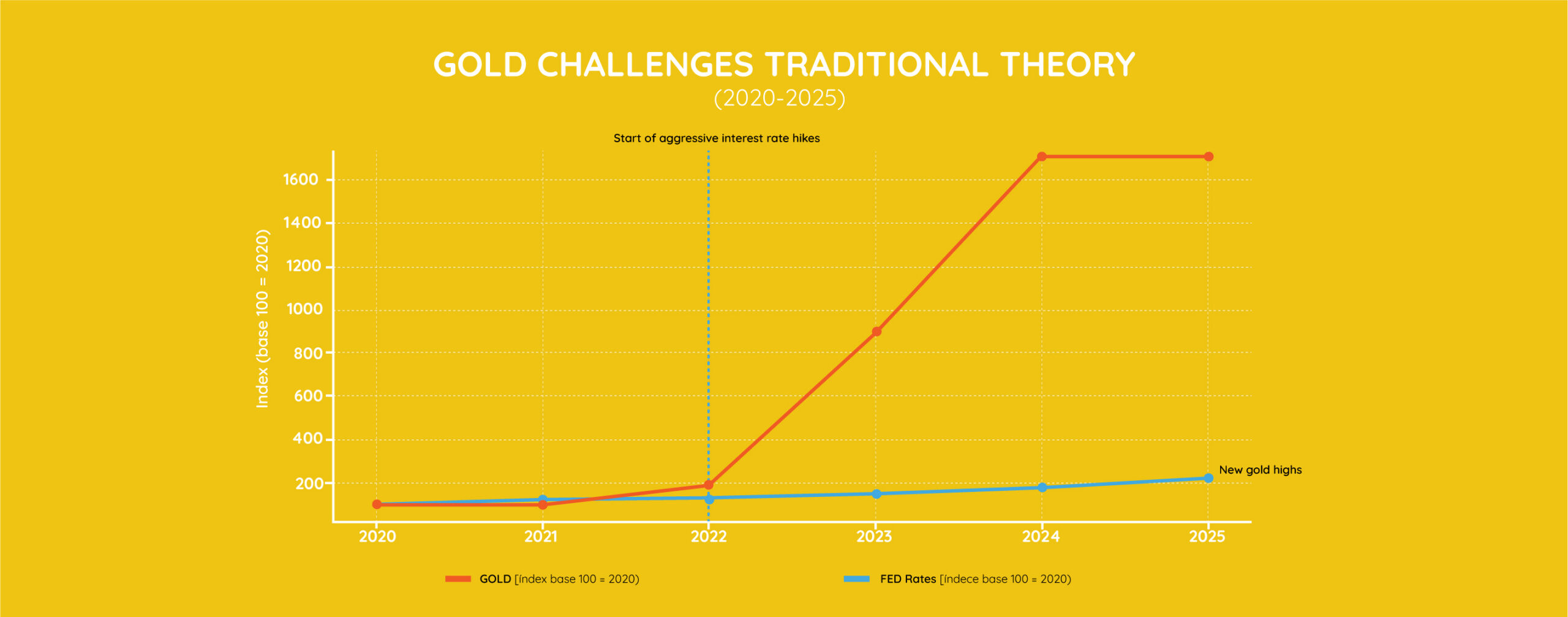
Sources. World Gold Council / Federal Reserve (FRED)
This divergence reflects a reality that goes far beyond interest rates. Investors do not only observe the yield on bonds or deposits. They also watch inflation, government debt levels, the health of the financial system and geopolitical stability. And it is precisely here that we find the reasons behind gold’s current strength.
Although inflation has moderated from the peaks reached in 2022, prices have accumulated several years of increases and have significantly eroded households’ purchasing power. Many savers have discovered that keeping money in a current account does not guarantee preserving its real value. In this context, gold regains one of the roles it has played for millennia: acting as a store of value when confidence in currency weakens.
But probably the most important factor is another one. The world has become accustomed to living in debt. According to the International Monetary Fund, global public debt remains at historically high levels after the pandemic. The United States has accumulated more than 36 trillion dollars in debt, while a large part of the developed world depends increasingly on the constant refinancing of its obligations. This reality raises an uncomfortable question. Is it possible to maintain high interest rates for many years in economies that have built their growth on debt?
More and more investors suspect that the answer is no
If central banks are eventually forced to cut interest rates in order to facilitate government financing, fiat currencies could once again lose value. And it is precisely in this type of scenario that gold tends to regain prominence.
Yet the most revealing data is probably not found in the financial markets or in economists’ reports. It is found in the decisions made by central banks themselves.
According to the World Gold Council, net gold purchases by central banks exceeded 1,000 tonnes in both 2022 and 2023, ranking among the highest levels recorded since modern statistics began. The most recent figures indicate that this trend remains well above the historical average.
This is an extraordinary figure
Central banks are the guardians of the monetary system. They manage strategic reserves and operate with time horizons measured in decades. When they steadily increase their gold reserves, they are sending a message that deserves to be heard.
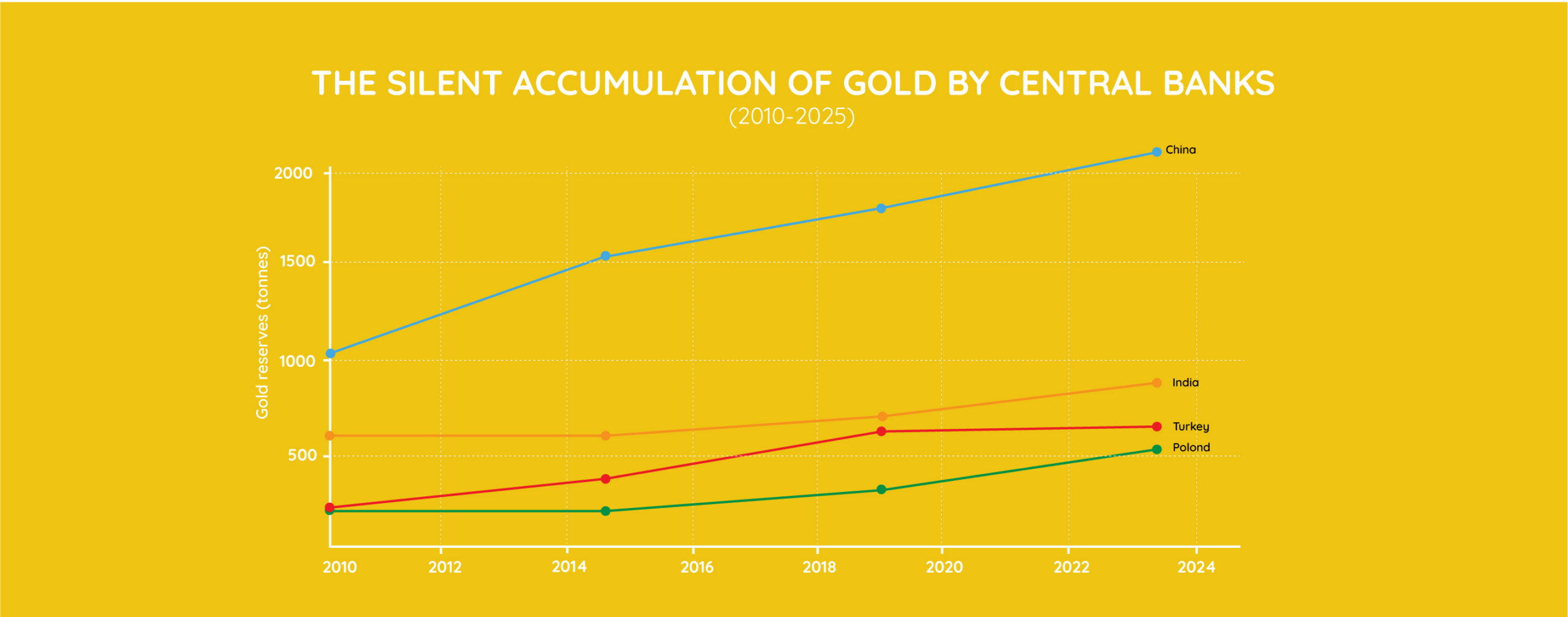
Source. World Gold Council
Among the most significant cases is China, which has gone from holding just over 1,000 tonnes to more than 2,290 tonnes today. India has gradually strengthened its reserves to exceed 880 tonnes, while Poland has carried out one of the most spectacular expansions, multiplying its holdings several times over to surpass 480 tonnes. Turkey, despite fluctuations in recent years, also maintains one of the largest reserves in the emerging world.
These purchases coincide with another trend of major significance: the gradual de-dollarisation of part of the global economy. Several emerging economies are seeking to reduce their dependence on the U.S. dollar both in international trade and in their official reserves. In this context, gold re-emerges as a neutral asset, independent of any government and recognised globally.
It is no coincidence that China is both one of the largest buyers of gold and one of the countries most actively promoting alternatives to the dollar-dominated monetary system.
Perhaps what we are witnessing is not simply an increase in the price of gold. Perhaps we are witnessing a gradual transformation in the way states understand financial security.
This is why gold remains relevant. Not because it is a speculative bet or because it guarantees future returns, but because for centuries it has acted as a form of wealth protection against inflation, monetary instability, financial crises and geopolitical uncertainty.
For more than five thousand years, empires, kingdoms, republics and central banks have changed their currencies. Gold, by contrast, is still here. Perhaps that is why, whenever uncertainty about the economic future increases, investors return to the same place.
Understanding why this happens is not merely a matter of investment. It is a way of understanding how the monetary system works and how it shapes our savings, our wealth and our future.
That is why more and more savers are once again considering gold not as a speculative investment, but as a tool for diversification and long-term wealth preservation. If central banks continue strengthening their reserves and gold maintains its historical role as a safe haven in times of uncertainty, understanding what place it can occupy within a savings strategy is becoming an increasingly relevant question.
Protecting savings with physical gold has been one of 11Onze’s main contributions to its community and, now, the range of products is expanding. Therefore, in the face of volatility, persistently high inflation and the growing crisis of confidence in the banking system, gold is once again strengthening its position as a safe-haven asset. Discover Gold Seed at 11Onze Precious Metals.



 Equip Editorial