In times of uncertainty, savers seek refuge. Traditionally, sovereign bonds were considered a safe asset, guaranteed by governments. But today, with wars threatening global stability, persistent inflation and very high levels of public debt, many are asking: are government bonds still the best option?
For decades, government bonds have been synonymous with security. When a government issued debt, the implicit message was clear: ‘we will always pay’. This perception made them the natural refuge for savers in times of uncertainty. But the world has changed. With public debt skyrocketing, persistent inflation and growing geopolitical tensions, many are wondering whether bonds are still the safe bet they once seemed to be.
The numbers speak for themselves. According to Eurostat, Spain has accumulated public debt of close to 102% of GDP, France already exceeds 110% and Italy is close to 137%. In the United States, federal debt has exceeded $34 trillion. These figures force governments to constantly refinance their liabilities, relying on financial markets to maintain their solvency.
The problem is that the cost of that debt has risen significantly. Following the rise in interest rates between 2022 and 2023, maintaining it has become a huge budgetary burden. Although the ECB and the Fed have begun to moderate monetary policy, real rates remain high and the fiscal pressure on citizens is not easing. In this context, bonds are no longer an absolute safe haven, but rather an asset exposed to budgetary tensions and austerity demands, such as those currently being experienced by France under the supervision of Brussels.
When bonds do not protect savings
The security of bonds is also relative when inflation is taken into account. A bond may offer 3% annual interest, but if inflation is 2.5%, the real gain is almost zero. And if inflation rises above the coupon rate, the investor loses purchasing power.
This scenario is not theoretical: we experienced it first-hand in 2022 and 2023. With inflation skyrocketing due to the war in Ukraine, the energy crisis and supply chain bottlenecks, bonds generated significant real losses. Today, inflation has moderated—it is around 2.4% in the eurozone and 2.8% in the United States—but it remains a latent threat.
Furthermore, governments have a perverse incentive: when prices rise, the real value of debt falls. Inflation provides relief for public coffers, but it erodes citizens’ savings.
Gold: millennia of stability
In this scenario, gold reaffirms its status as the ultimate safe haven. Unlike bonds, it does not depend on any government or central bank. No one can print more gold, and this natural scarcity makes it a tangible, universal and trusted asset.
Its historical track record is indisputable. When economic systems falter, gold regains prominence. This happened during the European debt crisis of 2012, the global financial crisis of 2008 and also during the pandemic of 2020. And it is happening again now, with open conflicts in Ukraine and the Middle East.
Data from the World Gold Council makes it clear: the price of gold has risen by nearly 85% in the last four years and more than 40% in the last decade. In 2024 and 2025, historic highs have been reached thanks to the purchase of more than 1,000 tonnes per year by central banks, especially China, which is seeking to reduce its dependence on the dollar.
Geopolitics and de-dollarisation
Global multipolarity also plays in favour of the yellow metal. China, India, and Russia are promoting initiatives to reduce the hegemony of the dollar and strengthen monetary alternatives. Although the dollar continues to dominate, this process has increased demand for gold as a neutral hedge. If even governments use gold to protect themselves from financial volatility, it makes sense for individual savers to consider doing the same.
The comparative analysis is clear. Over the last decade, many good sovereigns have offered negative real returns, while gold has maintained an upward trajectory. Bonds depend on the solvency of states and interest rate fluctuations; gold is independent and universally convertible in any market.
In high inflation, bonds lose value, while gold acts as a hedge. And in terms of confidence, while bonds are based on a state’s promise to pay, gold is based on its scarcity and millennia of recognition as a store of value.
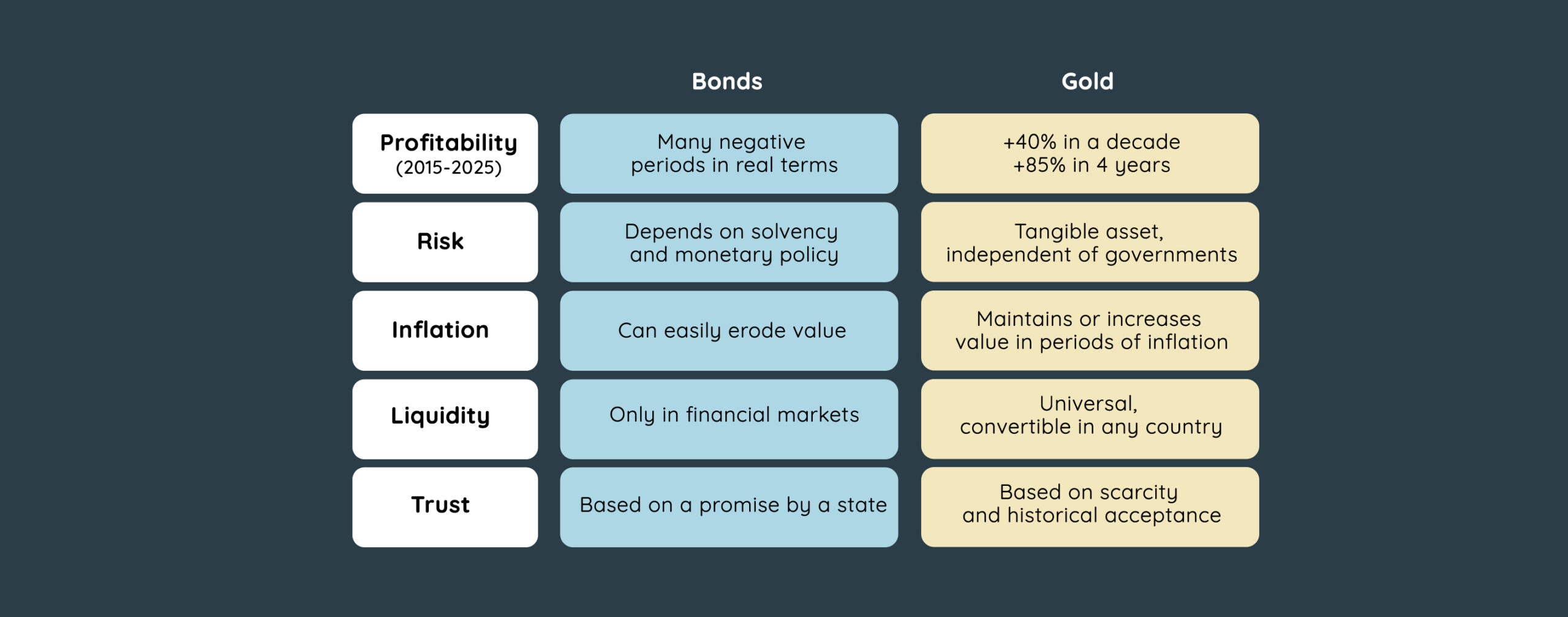
Source. Eurostat & World Gold Council
And for savers?
For small investors, the difference is decisive. Bonds may seem safe, but they carry risks of loss of purchasing power and losses if sold before maturity. Gold, on the other hand, does not offer spectacular short-term gains, but it does offer what many are looking for: stability and security.
In a world of recurring inflation, growing debt and geopolitical uncertainty, blindly trusting bonds is risky. Gold, on the other hand, has weathered every crisis known to man and continues to consolidate its position as the safe-haven asset par excellence.
If you want to discover the best option to protect your savings, enter Preciosos 11Onze. We will help you buy at the best price the safe-haven asset par excellence: physical gold.



 Equip Editorial