
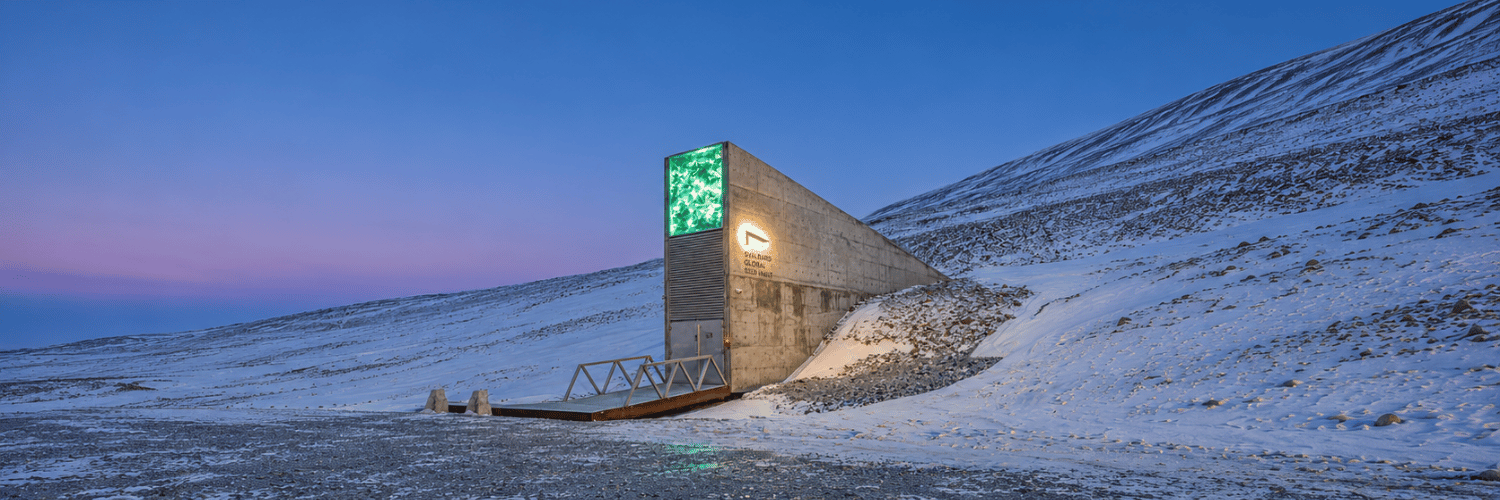
In a frozen mountain in the Arctic, there is a door that looks like the entrance to a secret shelter. Behind it, there are no gold bars, diamonds or confidential documents. The treasure it protects is much smaller: millions of seeds. And, although it may sound exaggerated, part of the future of our food supply could depend on this place.
In the Norwegian archipelago of Svalbard, about a thousand kilometres from the North Pole, there is a facility that looks as though it belongs in a science-fiction film. It is the Svalbard Global Seed Vault, an enormous vault built inside a mountain to preserve backup copies of seeds from gene banks around the world.
But why would anyone want to store seeds so far away from everything? The answer is simple: because a seed can become more valuable than gold. If a variety of wheat, rice or maize disappears, we may also lose the characteristics that made it particularly resistant to drought, disease or pests. And that is no small matter on a planet where climate change is transforming growing conditions.
A backup of our food supply
This vault works much like a computer backup. Gene banks preserve their seed collections and send duplicates to Svalbard. If they ever lose the originals, they can retrieve a copy. According to those responsible for the facility, it already protects more than 1.4 million seed samples.
The storage chambers are kept at around 18 degrees below zero Celsius, a temperature that allows many seeds to be preserved for very long periods. The Arctic’s natural cold helps, although the facility also has an artificial refrigeration system.
The idea stopped looking like an excessive precaution when the war in Syria affected a gene bank working with crops adapted to dry regions. Researchers were able to retrieve seeds deposited in Svalbard to rebuild part of their collections in other countries. Suddenly, that remote vault had demonstrated that it was not merely a project designed for some hypothetical future.
A treasure aspiring to the Nobel Peace Prize
When we think about national security, we usually imagine armies, energy supplies or oil reserves. But there is another strategic resource that often goes unnoticed: the diversity of the crops that feed us. A country may have enough money to import grain, but that does not guarantee there will always be sufficient production available. Wars, droughts and trade disruptions can turn an everyday food into a scarce commodity.
This connection between food security and international stability has brought Svalbard unexpected recognition. In March 2026, the seed vault was nominated for the Nobel Peace Prize. And in May of the same year, it received the Princess of Asturias Award for International Cooperation, which recognises collaboration between countries and institutions to preserve the world’s agricultural heritage.
The most significant gesture came in October: those responsible for Svalbard announced that they would allocate the award’s €50,000 prize money to helping other gene banks protect threatened collections. Instead of keeping the reward, they turned it into more protected seeds.
The paradox is fascinating. In a world obsessed with accumulating wealth, one of humanity’s most important treasures cannot easily be spent, displayed or sold. It must be preserved so that one day it can be planted.
The next time you eat a piece of bread, remember that part of its future history may be protected beneath a mountain of ice, we tell the stories that connect economics, geopolitics and everyday life to help you better understand the world around us.
Protecting savings with physical gold has been one of 11Onze’s greatest contributions to its community, and its range of products continues to expand. In today’s environment of market volatility, persistently high inflation and growing distrust in the banking system, gold is once again strengthening its role as a safe-haven asset. Discover Or Llavor at Preciosos 11Onze.
If you would like to learn more about this topic, we recommend:
 Sustainability
Does Catalonia give up food sovereignty?
4 min readThe demands of the peasants and farmers, which...
 Equip Editorial

