Businesspeople, wealthy individuals, family offices, hotel chains and even sports stars have set their sights on hotels. This is no passing trend. During the first six months of 2026, hotel investment in Spain reached the highest level ever recorded in a first half of the year.
But what does a hotel offer that other real estate assets do not? The answer goes far beyond tourism: behind this investment frenzy lies a new way of understanding wealth, profitability and the scarcity of quality assets.
From owning a hotel to investing in an asset
For decades, buying a hotel meant entering fully into the hospitality business. It involved managing staff, rooms, food and beverage services, and bookings. Today, a growing share of the capital entering the sector is not necessarily seeking to become a hotelier, but rather to acquire a real estate asset with a particular feature: in addition to deriving value from the building and its location, it contains a business capable of generating daily income.
This combination helps explain the scale the market has reached. According to major real estate consultancies, €2.46 billion was invested in hotels in Spain during the first half of 2026, 26.5% more than a year earlier and the best start to a year in the historical series. In just six months, 88 assets and more than 12,000 rooms changed hands.
Who is buying has also changed. Domestic capital accounts for 62% of the investment volume, while private investors, family offices and REITs jointly account for close to 30%. Transactions involving individual hotels now represent 82% of the market, while large portfolios have fallen to 18%, their lowest level in the past decade.
This largely explains the sense of an investment frenzy. Hotels are no longer solely the domain of large international funds and hotel chains. Increasing amounts of private capital are incorporating them as part of their wealth portfolios.
You don’t need many more tourists if you can charge more
Spain remains a tourism powerhouse, but focusing solely on visitor numbers does not provide a full understanding of the business. One of the keys is the sector’s ability to grow revenues faster than occupancy.
During the first six months of 2026, hotel overnight stays increased by 1.8% compared with the same period of the previous year. In June, by contrast, hotel prices were up 5.6% year-on-year, while average revenue per occupied room increased by 5.8%, reaching €137.1.
For an investor, this flexibility is highly valuable. A flat or an office usually has contracts that fix the rent for months or years. A hotel can adjust its prices every night according to demand, the season, a conference, a concert or any other event that fills the city.
This does not mean that it is immune to inflation. Wages, energy, food and maintenance costs also rise. But hotels have an ability to adapt their prices that other real estate assets do not.
Capital wants four and five stars
The second clue appears when we look at what is being bought. Capital is not flowing indiscriminately into every type of establishment. During the first half of 2026, five-star hotels absorbed 51% of investment and four-star hotels another 35%. Altogether, 86% of the money was concentrated in the highest categories.
This trend has pushed the average price paid per room to €213,300, more than double the figure of ten years ago.
This is where one of the most interesting strategies in today’s hotel business comes into play: repositioning. An investor can buy an older but well-located hotel, renovate it, upgrade its category, bring in an international brand and begin competing at much higher rates.
It is therefore not simply a matter of buying a building that is already operating. The business also consists of transforming it so that it can enter a segment with greater spending power.
Barcelona: when scarcity becomes a business
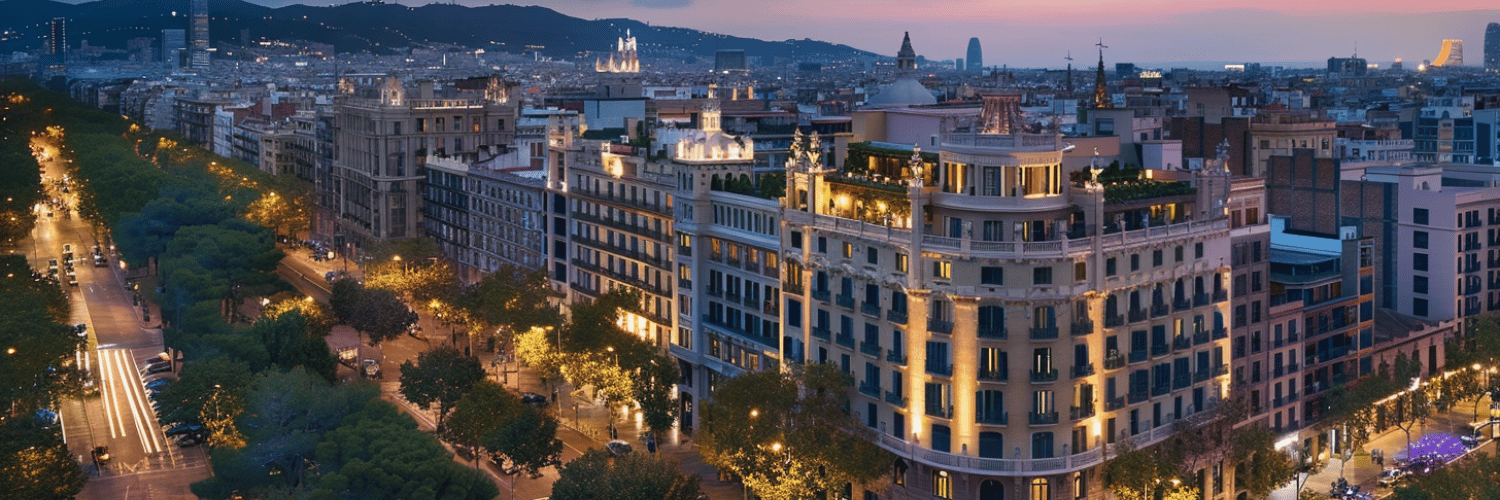
Barcelona allows us to understand this phenomenon on a much closer scale. In 2025, the city recorded 20 hotel transactions worth €712 million, close to 17% of all hotel investment in Spain and the second-best figure in its history. Barcelona and the Canary Islands jointly accounted for 41% of all the capital invested that year.
These figures are particularly significant because Barcelona is not a market where supply can grow indefinitely. Land is limited, the best locations are already occupied and urban planning regulations restrict the creation of new accommodation.
For investors, this limitation can become an advantage. If it is difficult to create new hotels in a city that maintains strong international demand, existing establishments in good locations become particularly coveted assets.
But this is also where the other side of the business emerges. The same mechanism that increases the value of hotels intensifies the debate over Barcelona’s tourism model, the pressure on urban space and the balance between economic activity and residents’ needs. What represents profitable scarcity for an investor can become a much more complex social and urban planning issue for the city.
Why are the wealthy getting involved now?
When wealth reaches a certain level, the objective is not simply to find the asset offering the highest return. There is also a desire to diversify and preserve wealth across different types of assets.
Hotels fit into this strategy because they combine real estate and business activity without necessarily requiring the owner to manage the business. Ownership of the building can be separated from its operation, which is left in the hands of a specialised chain through lease or management agreements.
In some cases, the power of a personal brand is added to this wealth-management logic. Cristiano Ronaldo, for example, is a partner of the Pestana Group in the Pestana CR7 Lifestyle Hotels chain, which has establishments in Madrid, New York, Lisbon, Madeira and Marrakech.
These types of transactions show the extent to which a hotel can be more than just a property: it can also become a platform for monetising a brand and projecting it internationally.
And all of this coincides with a particularly favourable moment. There is private liquidity looking for opportunities, the hotel sector retains a strong capacity to generate income, and capital is favouring premium assets in established destinations. Experts point out, in fact, that the greater presence of private investors and hotel chains is replacing some of the prominence previously held by large funds.
When everyone wants the same asset
The investment frenzy, however, has a paradox. The more capital competes for the best hotels, the higher their prices rise and the more difficult it becomes to achieve the expected return.
The fact that the average price per room already exceeds €213,000 demonstrates the strength of the market, but also the extent to which these assets have become more expensive. A good hotel is not necessarily a good investment at any price.
This is the great contradiction of the current moment: investors are seeking hotels because they are scarce assets capable of generating income, but this very demand is making them increasingly expensive to buy.
Stone remains stone. But every room can generate revenue again the next day.
Protecting savings with physical gold has been one of 11Onze’s greatest contributions to its community, and its range of products continues to expand. In today’s environment of market volatility, persistently high inflation and growing distrust in the banking system, gold is once again strengthening its role as a safe-haven asset. Discover Or Llavor at Preciosos 11Onze.



 Equip Editorial