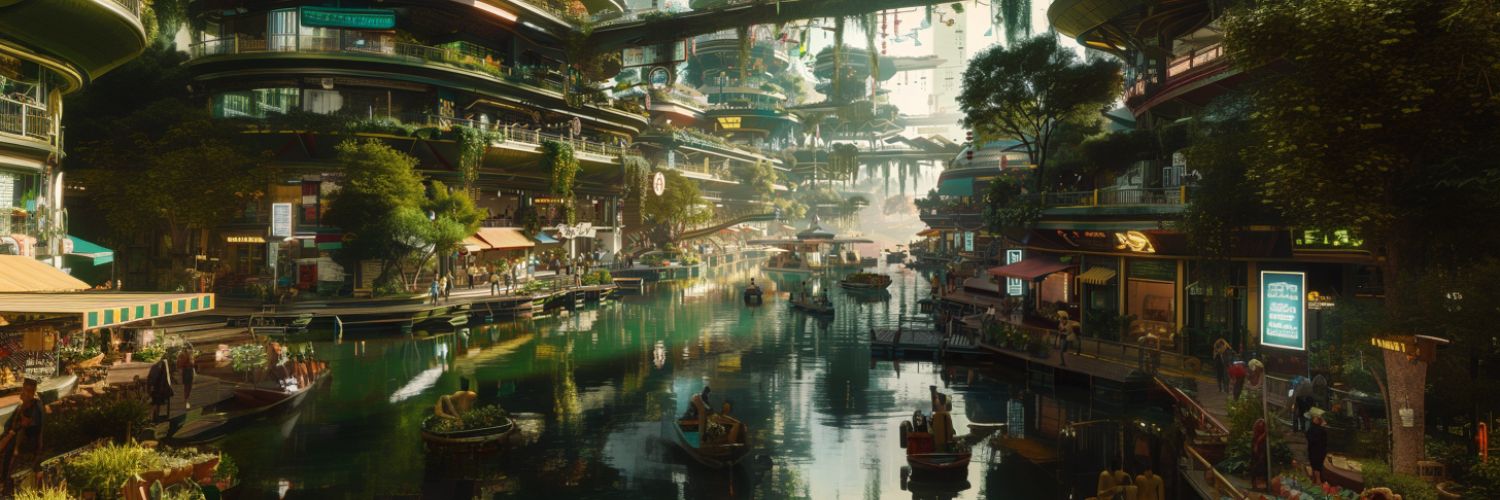
After discussing narrative and energy sovereignty, an uncomfortable —and perhaps inevitable— question emerges: what happens when we imagine a decentralized future within a system that, by nature, tends to concentrate power? This tension is not new. In fact, it runs throughout modern economic history: the struggle between the technical capacity to distribute and the systemic need to centralize.
Solar Punk is not just a visual trend or a pleasant aesthetic. It is, in essence, a silent but profound challenge to extractive capitalism. Not because it directly rejects it, but because it questions its guiding principle: that value must flow toward the center in order to be efficient.
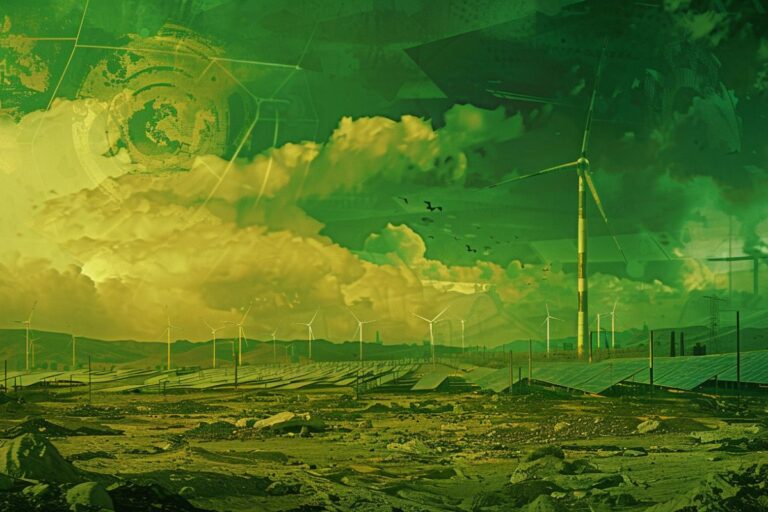
At first glance, Solar Punk presents itself as an optimistic reaction to the saturation of dystopian narratives: plants on façades, solar energy on rooftops, self-sufficient communities, and technology integrated with nature. But this seemingly innocent imagery hides a far-reaching economic proposal: distributed production, resilient communities, reduced dependencies, and a rebalancing of power. And it is precisely here that its strength —and its discomfort— lies.
Because contemporary capitalism is not the result of chance, but of a very specific historical evolution. As we have already analyzed in La Plaça, the system has moved from conquering territories to structuring dependencies. After the Second World War, the global economic center shifted to the United States, not only due to its productive capacity, but because of its financial architecture and the institutionalization of the dollar as a global axis. It was not just about producing more, but about defining the rules of the game.
This model is based on an extractive dynamic that has been refined over time. We are no longer talking only about natural resources, but about the extraction of financial rents, data, and value through debt. It is a system that concentrates wealth and power in central nodes, consolidating dependencies that often go unnoticed because they have become normalized. And it is precisely this normality that Solar Punk calls into question.
A new economy… or the limit of the system?
It is not just an environmental issue. It is structural. The global productive model is designed so that wealth flows toward centers of decision, and this dynamic is not accidental: it is the condition of its stability. Concentration is not a dysfunction of the system; it is its internal logic.
The data confirms it: according to the World Inequality Report, the richest 1% accumulates a growing share of global wealth, while strategic sectors —energy, technology, and finance— are consolidated in the hands of a few actors. As already analyzed in The scourge of crony capitalism, the proximity between political power and large corporations is not an anomaly, but a form of governance. When resources are concentrated, decision-making capacity is concentrated as well.
In this context, Solar Punk often appears as a misunderstood proposal. It does not speak of collapse, but of regeneration; not of scarcity, but of distributed efficiency; not of individualism, but of community. But this reading, if it remains superficial, misses the most important aspect: its transformative potential.
In economic terms, Solar Punk implies micro energy production, circular economy, local infrastructures, open technology, and the reduction of intermediaries. But above all, it implies something deeper: a redistribution of value flows. And that is what makes it difficult to assimilate within the current system.
When a community produces its own energy, it not only reduces costs: it alters the direction of income. When it finances local projects, it not only stimulates the economy: it redefines the relationship between capital and territory. When it embraces distributed production, it not only gains autonomy: it weakens structural dependencies. In fact, in Europe, local energy communities are growing driven by the regulatory framework of the European Union. It is not a declared revolution, but a gradual correction.
This approach conflicts with the foundations of the current system. Extractive capitalism requires energy, financial, and technological dependence to sustain itself. Solar Punk questions these three pillars simultaneously. And it does so without noise: it does not propose replacing the system, but reducing its capacity to absorb.
Therefore, the real debate is not aesthetic, but structural. The current model shows evident cracks —energy vulnerability, chronic debt, geopolitical tensions, and fragile supply chains— which are not anomalies, but consequences of an architecture designed to concentrate.
Solar Punk does not propose an immediate rupture, but an adaptation that, if successful, may end up transforming the system from within. Therefore, it is not a frontal revolution, but rather a deviation of course, without barricades and through everyday decisions that, accumulated, alter the structure.
Toward a more resilient and distributed economy
At 11Onze, we believe that understanding the system is the first step to avoid depending on it uncritically. Economic history teaches us that no model is immutable, but also that no transformation is spontaneous. There is always a prior tension, a consciousness that matures slowly before becoming visible.
In an increasingly volatile environment, energy and financial decentralization is not a trend, but a rational response to the vulnerabilities of an overly concentrated model. But this response is not only technical. It is, above all, cultural and moral.
The future will not be only a matter of technology, but of how we choose to organize power, resources, and dependencies. And this decision is not made in abstraction: it is built through every collective choice and every structure we accept or question.
Therefore, the fundamental question is not whether Solar Punk will succeed as an aesthetic, but whether we will be capable of assuming the cost —and the responsibility— of redistributing economic power before the tensions of the system intensify. Because history does not change when new ideas appear; it changes when those ideas become structure. And the future, as always, is not what we imagine, but what we choose to sustain.
11Onze is the community fintech of Catalonia. Open an account by downloading the app El Canut for Android or iOS and join the revolution!
If you would like to learn more about this topic, we recommend:
 Sustainability
Is there an alternative to the extractive system?
5 min readEvolutionary theory is much more complex than a reduction...

 Equip Editorial