
Imagine going to the market with a handful of shells in your pocket, paying off a debt with a cow or buying food with cocoa beans. Today, it would seem eccentric to us, but for centuries money took very different forms from those we know. And some were so surprising that they still help us understand what gives value to what we carry in our wallets.
When wealth came from the sea
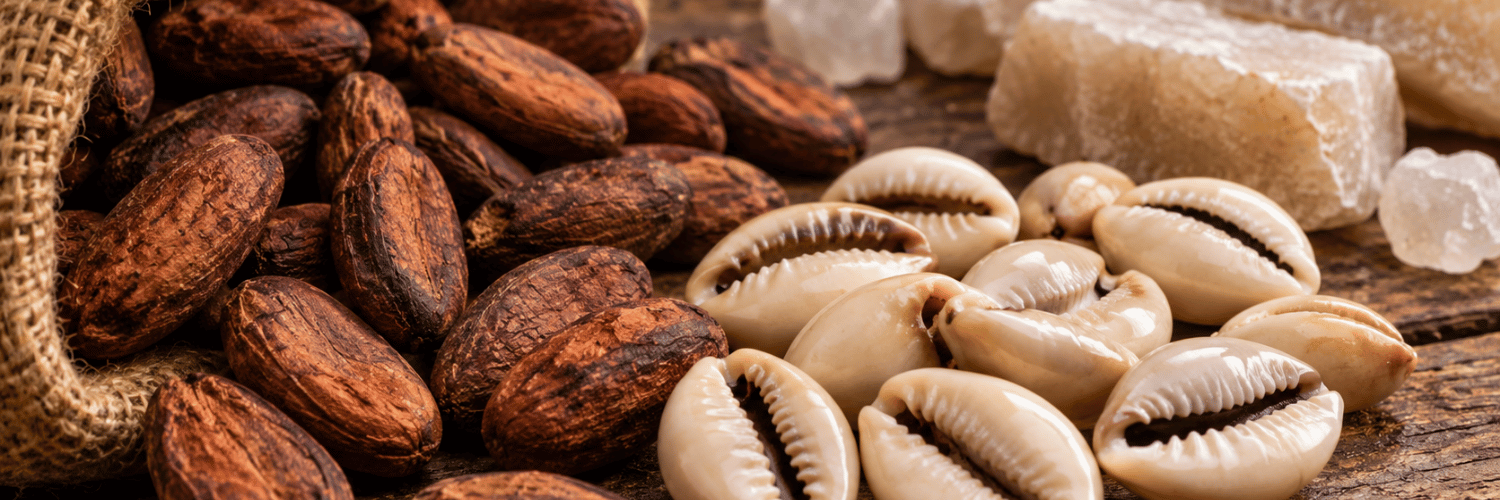
Long before cards and banknotes entered our lives, seashells were already circulating as money in different regions of Asia and Africa. The best known were cowries, small, shiny shells that had almost everything one could ask of a currency: they were durable, easy to transport and similar enough to one another to be counted.
They also had a special appeal. The farther they travelled from the sea, the harder they were to obtain. This made them desirable objects and, in many communities, an accepted form of payment. They were already being used in ancient China thousands of years ago, while in various parts of West Africa they continued to circulate for centuries, even when metal coins already existed.
However, shells also had their problems. When maritime trade made it easier for large quantities of cowries to reach certain African markets, their abundance could cause their value to fall. A surprisingly modern economic lesson: even money collected from the seabed can lose purchasing power.
Cows, salt and chocolate in your wallet
Shells were not the only way to avoid direct barter. In many livestock-raising societies, cattle represented an important part of family wealth and could be used to settle debts or other obligations. A cow had the advantage of providing milk and being able to produce offspring, but it was rather impractical if you only wanted to buy a little bread.
In other places, value could be stored in something much smaller: salt. Today it is an everyday product, but in societies where preserving food was a vital necessity, it could be valuable enough to be used in exchanges. In Ethiopia, for example, bars of salt were used as a form of money.
And if we travel to pre-Hispanic Mesoamerica, the story becomes even more appetising. Cocoa beans were not only used to prepare prized drinks, but also to pay for certain purchases. What we associate today with a bar of chocolate could function as a medium of exchange. Of course, eating your savings was a very literal temptation.
A fortune that never moved
Perhaps the most extraordinary case is that of Yap, an island in Micronesia where large limestone discs, known as rai stones, were traditionally used to represent wealth and carry out certain transfers.
Some were so large and heavy that moving them was extremely difficult. But this was not always necessary. If a stone changed owners, it could remain exactly where it was. What mattered was that the community recognised who it belonged to.
It seems like an extravagant idea, but it has a parallel with modern banking. When we make a bank transfer, we do not physically see money moving from one account to another either. What changes is the record of who holds that value.
The secret of money is not the material
A shell, a handful of cocoa beans, a bar of salt or a giant stone have very little in common. Nevertheless, all these objects tell us the same story: money works when people recognise a shared value and trust that others will accept it too.
Of course, the euro is based on very different institutions, rules and mechanisms. But trust remains essential. Without this collective acceptance, even the most sophisticated banknote would be little more than a piece of paper.
The next time you find a shell on the beach, perhaps you will look at it differently. Who knows whether, in another era and another place, you might have held a small fortune in your hands.
At La Plaça by 11Onze, we explain the most curious stories from the world of economics to help you better understand how money works today.
 Equip Editorial

