

Nvidia is worth more than five trillion dollars on the stock market. Apple is approaching five. Alphabet exceeds four. But what does it really mean for a company to be “worth” this amount?
The answer takes us to one of the most widely used concepts in financial markets: market capitalisation. Understanding it allows us to compare companies, interpret indices and discover where a large part of the world’s capital is concentrated today.
A share price does not tell us how large a company is
Imagine two companies. The shares of the first are trading at 500 dollars and those of the second at 50. We might think that the first is ten times more valuable. That would be a mistake.
To know what value the market assigns to a company, we also need to know how many shares it has in circulation. The formula is simple:
Market capitalisation = price of one share × number of shares outstanding
This is also the definition used by the United States Securities and Exchange Commission.
If a company has 1 billion shares and each one trades at 100 dollars, its market capitalisation is 100 billion dollars. This does not mean that the company has this money in the bank. Nor is it its turnover, profits or the value of its assets. It is the value that the market assigns to all of its shares at a given moment.
This value also incorporates the future anticipated by investors. Growth, profits, technology, brand or competition can change it. This helps to explain Nvidia’s rise: the market does not only value the chips it sells today, but also the role it could play if demand for artificial intelligence infrastructure continues to increase.
Why is it so important?
Market capitalisation makes it possible to compare the stock market size of companies and commonly classify them as small-, mid- and large-cap companies.
It also determines the weight of many companies within indices. The calculation is often adjusted for free float, that is, the shares actually available on the market. S&P Dow Jones Indices uses this methodology in several of its indices.
This has an important consequence: a few giant companies can influence the performance of an entire index. Therefore, the fact that “the stock market is rising” does not necessarily mean that most of the companies that make it up are doing so.
It can also create a false sense of diversification. A fund may invest in dozens or hundreds of companies, but if the largest ones account for a large share of the index, much of the result will continue to depend on a small group.
When market capitalisation becomes power
A high stock market valuation can also provide competitive advantages. The shares of a large company can function as a powerful currency. They can be used to buy other companies, compensate employees or raise new capital. These corporations also tend to have more resources to invest in research, infrastructure and international expansion.
Being large can make it easier to keep growing. This is especially relevant when capital is concentrated in the same sector. Large technology companies have enormous resources to hire talent, acquire competitors and accelerate the development of new technologies.
But being large does not mean being invulnerable. Market capitalisation depends directly on the share price. It can take decades to build a company and only a few trading sessions to lose a considerable part of its value.
The stock market also tells us which sectors dominate
Thirty or forty years ago, among the world’s most valuable companies we found oil companies, banks, industrial conglomerates, telecommunications companies and major manufacturers. Today, semiconductors, artificial intelligence, software, cloud computing, digital platforms and electronics dominate.
However, an important distinction must be made. The market capitalisation of a sector is not equivalent to its weight in the real economy. To measure that weight, we must also look at employment, turnover, investment, exports or added value.
Agriculture, construction or industry may be essential to the functioning of a country without having a comparable presence in financial markets. Market capitalisation therefore gives us a different picture: it shows us where the value of listed companies is concentrated.
The 11 most valuable listed companies in the world
As of 2 October 2026, the global ranking allows us to see this transformation at a glance. Since share prices change every day, the figures are a snapshot of the market on that date.
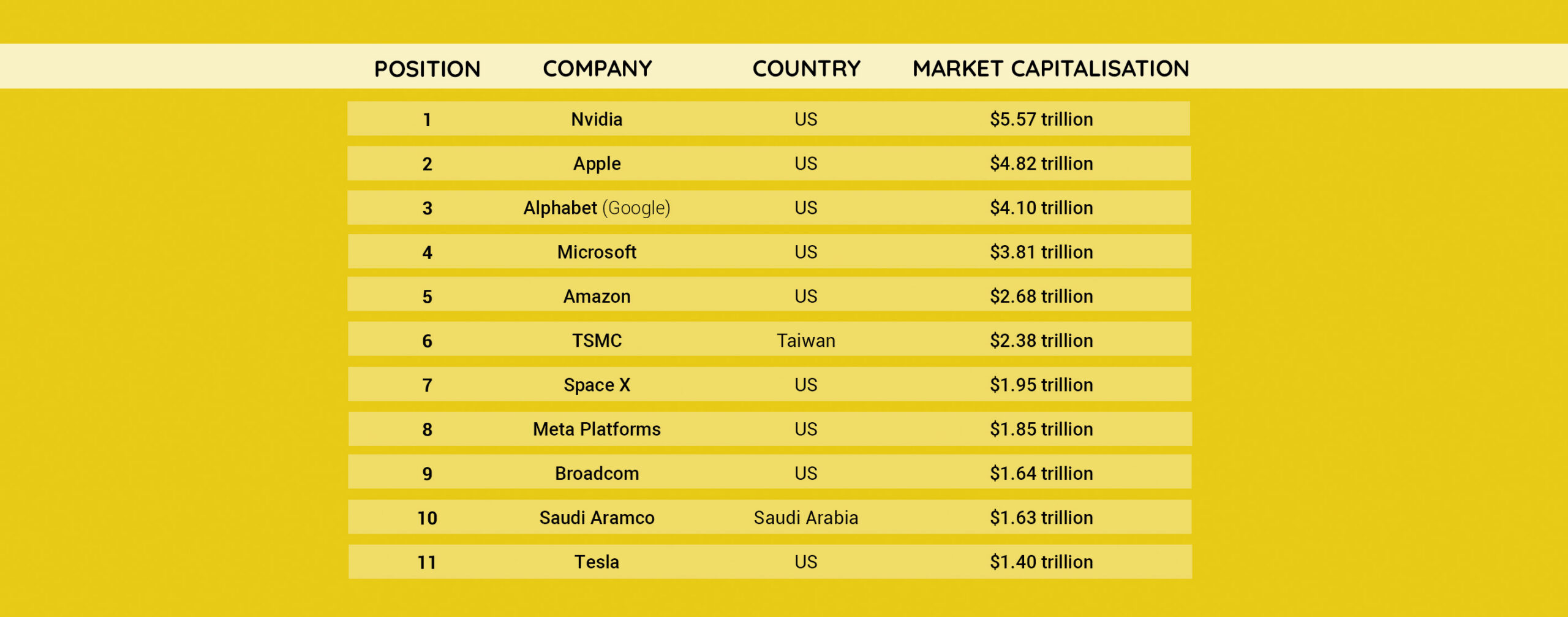
The picture is revealing. Nine of the eleven companies are American and none are from the European Union. Technology clearly dominates the ranking, while Saudi Aramco is the most visible exception among the major traditional sectors.
The list also shows the extent to which semiconductors have become a strategic industry. Nvidia, TSMC and Broadcom occupy three of the top eleven positions.
It is not just a ranking of large companies. It is a map of where global capital is concentrated today.
A figure that explains a lot, but not everything
Market capitalisation makes it possible to compare companies, better understand indices and observe how value is distributed across markets. But it is not an absolute measure of a company’s value. A company may have an enormous market capitalisation and be overvalued. Another may be highly profitable and have a much lower valuation. And sectors that are essential to the economy may have little presence on the stock market.
That is why, when we see that a company is “worth” one trillion, two trillion or five trillion dollars, the interesting question is not only how it got there. It is also what this scale allows it to do and what it tells us about the way global capital is being distributed.
At La Plaça by 11Onze, we continue to explain the concepts that move the markets in order to understand what lies behind the big financial figures. Because understanding how a company is valued also helps us understand where capital is heading.
Protecting savings with physical gold has been one of 11Onze’s greatest contributions to its community, and its range of products continues to expand. In today’s environment of market volatility, persistently high inflation and growing distrust in the banking system, gold is once again strengthening its role as a safe-haven asset. Discover Or Llavor at Preciosos 11Onze.
 Equip Editorial

