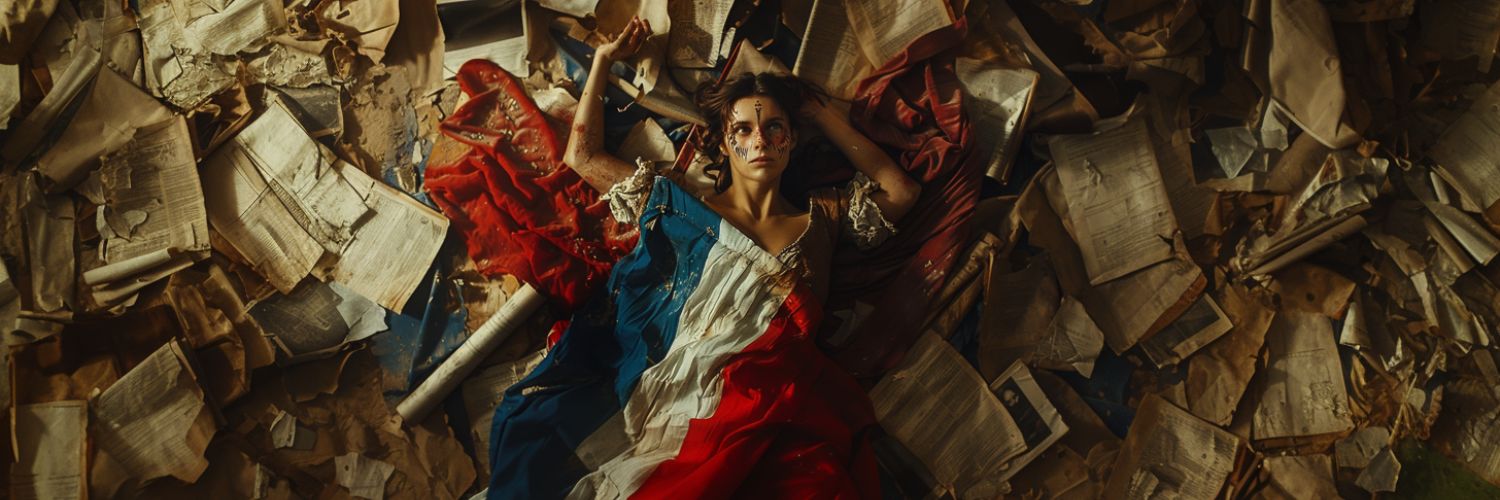
France is shaking. It is not a visible earthquake, but a deep one: its public finances are cracking and the walls of the old European building are beginning to show similar cracks. The country that for decades symbolised the strength of the continent, the cultural and political engine of the Union, has entered a crisis that goes beyond the numbers. Debt is only the thermometer; the problem, however, is much deeper.
With debt already exceeding 112% of GDP and a persistent deficit of more than 5%, France has become the pupil reprimanded by Brussels. The European Commission has opened proceedings for fiscal non-compliance, while impatient markets have raised France’s risk premium to its highest levels since the 2012 crisis. The figures are clear, but behind them lies a message that Europe still does not want to hear: its welfare model is no longer sustainable.
For decades, France believed that its wealth was eternal. The welfare state, born after the Second World War as a social shield and symbol of progress, became such a heavy structure that today it is almost immovable. The public sector accounts for more than 57% of GDP — the highest percentage in the OCDE — and yet the country is growing less than the European average.
Bureaucracy, subsidies, and aid have become the pillars of an economy numbed by debt. According to INSEE, industrial productivity has fallen by 8% in the last decade, while real wages remain stagnant and the tax bill increases. France is now an exhausted power that works like an average country but spends like an empire.
When credit replaces trust
In 2025, French public spending exceeds €1.6 trillion. Interest payments alone will cost more than the defence and health budgets combined. But Paris continues to borrow to keep its state machinery running. Patrick Artus, an economist at Natixis, summed it up bluntly: ‘France can no longer finance its standard of living on credit’.
However, the drama is not exclusively French. It is European. For years, the European Union has confused stability with prosperity. It imposed fiscal rules to contain spending, but at the same time allowed the European Central Bank to flood the markets with liquidity. The result is a paradox: indebted governments and markets addicted to low interest rates. When the ECB turns off the tap, the mirage vanishes and reality sets in, revealing a continent living beyond its means.
The weary giant of the eurozone
The French case is more than just a national crisis; it is a warning of systemic collapse. France is the second-largest economy in the eurozone, but its loss of competitiveness has called into question the balance of the European project. Its industry, once the heart of continental production, has relocated. Its young talent is emigrating from Germany or Northern Europe. Its welfare state, which had been a model of equality, is now a maze of inefficiencies.
Meanwhile, the Banque de France warns that the cost of debt will eat up a growing share of tax revenues until 2030. And in Brussels, the debate is no longer whether France will breach fiscal rules, but how many more exceptions will have to be invented to avoid acknowledging the obvious: neither France nor Europe can comply with them.
A system without sovereignty
When France joined the euro, it gave up its most powerful weapon: the ability to devalue and create currency. Today, Paris cannot adjust its economy without going through Frankfurt’s scrutiny. The European Central Bank sets the pace and governments dance to its tune.
This loss of sovereignty is the great European taboo. States have been reduced to managing their own debt. If they want to grow, they must spend; if they spend, Brussels sanctions them. It is a vicious circle. Every cut reduces consumption and tax revenues, and every stimulus generates more deficit. What was once an instrument of cooperation is now a straitjacket.
Mario Draghi, who saved the euro in 2012, recently warned: ‘Europe has created a monetary union without a true economic union.’ And France, the country that imagined the single currency as a tool of continental power, is today the most visible victim.
The European reflection
The French malaise has the same symptoms as the American one: debt, political polarisation and dependence on the central bank. On the other side of the Atlantic, Washington prints money to pay its soldiers. In Europe, Paris goes into debt to maintain its welfare state. These are two different strategies to sustain the same model: an economic system that promises more than it can deliver.
France is not, therefore, an isolated case. It is the seismograph of what is to come. If France falters, the eurozone trembles. Its risk premium exceeds 80 basis points, Fitch and Moody’s are threatening rating downgrades, and investment funds are reducing their exposure to European debt. The scenario is reminiscent of the days leading up to the 2010 crisis, when no one wanted to admit that the house was starting to burn.
A continent facing its own mirror
Europe finds itself, once again, facing its greatest contradiction: wanting to be an economic power without real political power. Its institutions can fine France, but they cannot bail it out without putting the entire system at risk. Their economies are interdependent, and their governments are prisoners of short-term voting.
The result is a feeling of general exhaustion. In Paris, protests over pension reform symbolise the deep unease of a society that wants to preserve rights it can no longer afford. This is not a moral problem, but a structural one. France, like the rest of Europe, lives between nostalgia for its past and fear of its future.
The agony of the European model
Ultimately, the issue is not debt, but a lack of vision. The European model was built on the idea that economic integration would automatically lead to prosperity. But without innovation, productivity or sovereignty, the project is wearing thin. France is its most dramatic reflection: too big to fail, too indebted to grow.
Unless the foundations of the system are rethought – a common fiscal policy, real reindustrialisation, a central bank at the service of citizens – Europe will condemn itself to slow decline.
France is today the voice that trembles, but behind it can be heard the murmur of an entire continent. The numbers can be dressed up, but reality cannot. The euro was born to unite, but it has also chained us together. And while European leaders debate tenths of a percentage point of deficit, the debt clock keeps ticking, like a precision bomb. Europe is not sinking suddenly; it is slowly running out of steam. And France, on the tightrope, is its clearest harbinger.
If you want to discover the best option to protect your savings, enter Preciosos 11Onze. We will help you buy at the best price the safe-haven asset par excellence: physical gold.


 Equip Editorial