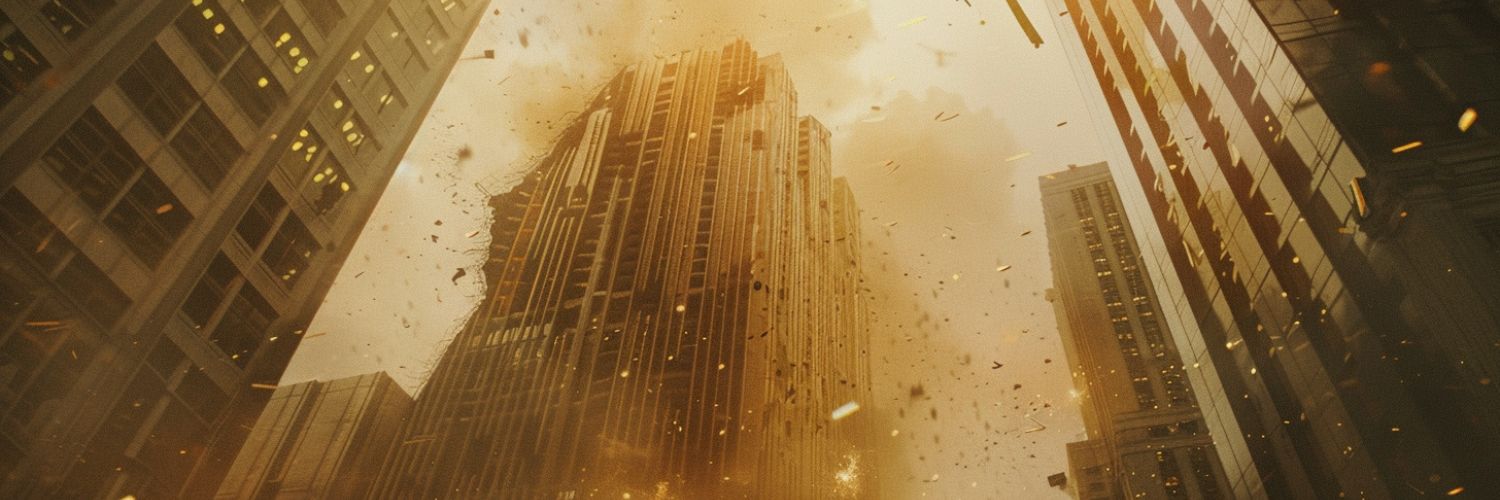
American magnates —Bezos, Dimon, Buffett, Ellison— are selling stocks in a moment of market euphoria. What do they know that the rest of us ignore? When those with privileged information flee the very markets they built, we may not be talking about conspiracies, but about a clear signal: the system is creaking from within.
At first glance, everything looks fine. The S&P 500 is hitting record highs, the Nasdaq has recovered from the 2022 crash, and the big tech companies are leading the party. The media speaks of a “new innovation cycle.” But beneath this radiant surface, something is stirring.
According to public data, Bezos sold about $737 million worth of Amazon shares at the end of June 2025. Jamie Dimon sold roughly $31.5 million in JPMorgan shares this year —the first sale since he became CEO—; Brian Chesky (CEO of Airbnb Inc.) sold 190,301 shares on February 12, 2025, worth approximately $26.7 million.
The University of Melbourne sums it up: “While institutional investors sell, retail investors buy.” Small investors, encouraged by media optimism, enter the market just as those who know it best are heading out the back door.
Those who see before we do
This is not about conspiracy, but information asymmetry. The big players have analytical systems and access to data that allow them to detect, months in advance, the symptoms of a brewing crisis. The indicators they track —tensions in the debt market, drops in real productivity, or signs of exhaustion in the Federal Reserve’s expansionary policy— are invisible to ordinary citizens.
When these warnings pile up, smart money moves. The rich don’t sell because they need liquidity; they sell because they want to leave before collective confidence breaks. It’s the same instinct that makes central banks hoard gold while assuring us that inflation is “transitory.”
Turkish economist Nouriel Roubini is known for his ability to foresee major financial crises. A professor at NYU’s Stern School of Business, he rose to global fame after accurately predicting the 2008 financial crisis, earning the nickname “Dr. Doom.” In his words: “Confidence in the financial system doesn’t collapse overnight; it unravels like a threadbare stocking.” The tycoons’ moves are precisely those first threads snapping.
Fear of the new financial order
Another factor haunting the ultra-rich is the structural shift in the global monetary system. The Bank for International Settlements (BIS) confirms that over 130 countries are now working on central bank digital currency (CBDC) projects. At first glance, they appear to be a natural technological evolution of money. But in practice, they enable total control over transactions and individual wealth.
Bloomberg recently warned that CBDCs could pose serious privacy and control challenges, as governments would gain direct access to transaction data and could impose restrictions on how money is used.
Meanwhile, dedollarization is advancing. Russia, China, India, and Brazil are promoting bilateral trade deals without the dollar, while central banks are hoarding gold at record levels. According to the World Gold Council, more than 1,000 net tons of gold were purchased in 2024 —the highest volume in half a century. Private capital is following the same path. They no longer trust the system they designed themselves.
The divorce between the market and the real world
Meanwhile, the gap between market valuations and the real economy widens. Corporate profits are not growing at the same pace as stock prices, and U.S. public debt already exceeds 125% of GDP.
Stock prices now reflect a fiction of prosperity, sustained by massive buybacks and money printing. The Federal Reserve has injected more liquidity in the last decade than in the entire 20th century. But cheap money has created an artificial economy where wealth isn’t produced —it’s mirrored.
This model increasingly resembles a pyramid: as long as new investors are willing to buy, the system stands. Once those at the top start selling, the countdown begins.
The return to real assets
When the air of the system becomes too toxic, the rich return to where there’s always oxygen: tangible assets. Gold, silver, farmland, energy, and even physical art become safe havens against monetary instability.
Gold keeps breaking records daily, the clearest example of all. While markets celebrate new technologies and digital ETFs, financial elites are buying physical metal. The Wall Street Journal notes that while gold-related companies grow, physical gold remains the only true safe haven —proof that trust has gone digital, but fear remains solid gold.
The logic is simple: an asset that depends neither on a government’s promise nor a company’s performance is the only one capable of weathering a systemic storm.
When flight becomes a warning for all
The rich fleeing is not an anecdote —it’s a metaphor for the end of a cycle. Financial capitalism, as we know it, is reaching saturation, driven by unlimited debt, wealth concentration, markets detached from reality, and confidence that is no longer blind but forced.
However, this flight could also be an opportunity. If those who control the system are stepping aside, it’s time for citizens to regain real financial power: to learn how money works, protect their savings, diversify, and invest with common sense.
As Raymond Thomas Dalio, one of the world’s most influential investors and founder of Bridgewater Associates, reminds us: “When things that seem permanent stop being so, those who understand change survive; the rest suffer.”
We need not see conspiracies where there is prudence —but we cannot ignore that when those who know the most about money leave the table, the game is about to change. The rich are fleeing their own system because they know trust is finite —and the next crisis won’t just be financial, but one of legitimacy.
In that scenario, the ordinary citizen has only one choice: understand the system to stop being its victim. Start thinking like those who are leaving —not to imitate them, but to anticipate. Because true economic freedom is born from knowledge, not faith in a system already taking on water.
If you want to discover the best option to protect your savings, enter Preciosos 11Onze. We will help you buy at the best price the safe-haven asset par excellence: physical gold.


 Equip Editorial