
Precarity is not an accident of the system — it is its new structure. It connects us all through uncertainty, dependence, and debt. And only by understanding this can we break the circle and regain sovereignty over our lives.
Polish sociologist Zygmunt Bauman captured the essence of our time like few others. What he called liquid modernity is now a tangible reality: everything that was once solid —work, relationships, economic security— has become fragile and fleeting. The worker who could plan a life, take out a mortgage, or raise children with some peace of mind has been replaced by an individual juggling temporary jobs, subsidies, and debts. This instability is not only economic: it is emotional, psychological, and civic. A citizen who lives in fear is easier to govern, but also far less free.
Insecurity as a Tool of Control
Crises —financial, health, energy, climate— have become constant. Uncertainty is no longer an exception but a structural condition. Each new wave of difficulties justifies another “temporary” package of measures that, over time, become permanent. Meanwhile, the population grows accustomed to living on the edge: wages that fail to cover the cost of living, inflation that erodes savings, rents that consume salaries, and ever-rising taxes that suffocate the middle classes.
This widespread precarity breeds dependence. Governments manage it through subsidies and one-off aids, while banks and major corporations offer easy credit to sustain consumption. It’s a vicious circle that turns social rights into favours and the worker into a perpetual debtor. The fear of losing one’s income or home becomes a powerful instrument of submission.
The result is a society obsessed with the next economic rebound or inflation index, confusing mere survival with progress. As Bauman warned, “freedom without security is a sentence, but security without freedom is an invisible prison.”
From Stable Work to Fragile Work
In just a few years, the concept of employment has changed radically. Flexibility —a seemingly positive word— has become synonymous with temporariness, outsourcing, and insecurity. Short-term contracts and part-time jobs have become the norm to the point that they no longer surprise anyone. Meanwhile, a permanent contract or a 40-hour week seems almost a privilege.
According to Spain’s INE, over 25% of young workers hold temporary contracts. In Catalonia, the real average salary has lost more than 7% of its purchasing power in the past five years, while housing costs have risen by 30%. The gap between wages and prices is now structural: having a job no longer guarantees a dignified life.
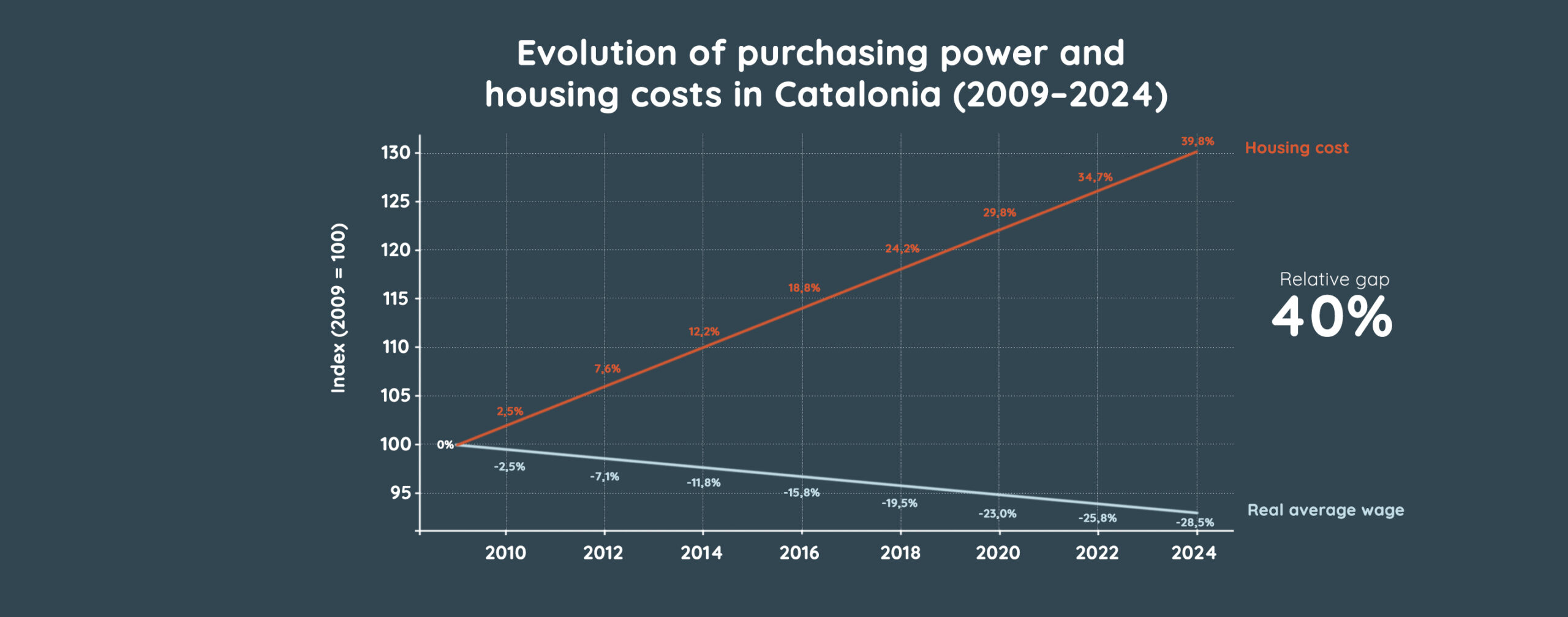
In fifteen years, the cost of living has risen by 30%,
but real wages have fallen by 7% in Catalonia. (Source: INE)
This fragmented labour model creates a permanently available and easily replaceable population. The worker cannot plan for the future or accumulate assets. When work ceases to provide stability and becomes a daily struggle for survival, the social contract breaks down.
Labour precarity is also civic precarity. A citizen without a horizon does not participate, protest, or demand — they simply survive. And that is perhaps the system’s new victory: transforming the worker into an obedient and exhausted consumer.
The Loss of Freedom and the Need for Economic Sovereignty
Economic insecurity silently erodes freedom. When everything depends on the month’s salary or a granted loan, personal autonomy fades away. We live in societies that appear free, yet are subjected to subtle forms of control: debt, technological dependence, and constant misinformation.
The challenge is to rebuild sovereignty. At the collective level, this means regaining control over basic resources —energy, housing, finance— and promoting resilient local economies. At the individual level, it means relearning self-management habits: saving, investing wisely, avoiding unnecessary debt, and embracing financial education as a tool for liberation.
Economic education is the key to transforming fear into power. When we understand how the system works, we no longer submit blindly to it. At 11Onze, we’ve long defended this idea: saving is sovereignty, information is freedom, and community is strength.
The path toward a less precarious society does not depend on waiting for external solutions but on building security from below —through cooperation and awareness. Perhaps Bauman was right: precarity is the new social bond. But there’s still time to turn that bond into a network of solidarity, not submission.
11Onze is the community fintech of Catalonia. Open an account by downloading the app El Canut for Android or iOS and join the revolution!


 Equip Editorial