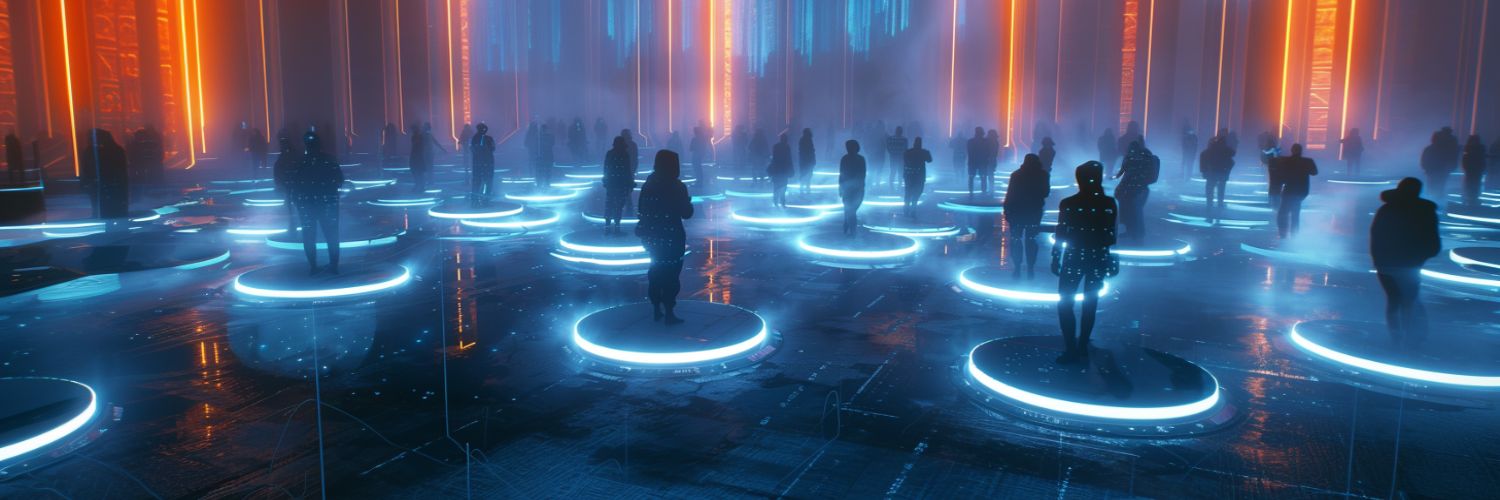
The 20th century educated us in an obstinate faith: the future would be better than the past. It was not only optimism; it was institutional architecture. After the Second World War, a new international economic order materialized which, with nuances and tensions, has endured to this day.
The victors of the conflict understood that, for this new order to function, it was necessary to establish a political-economic system capable of stabilizing currencies, rebuilding devastated economies and ensuring stable markets for large-scale commercial expansion, all regulated according to their own rules.
For this reason, the creation of institutions such as the World Bank and the International Monetary Fund (1945) was not merely a technical agreement; rather, it represented the insertion, within the broader collective imagination, of a powerful idea: growth could be organized, prosperity could be planned, and the future could be administered. From that conviction emerged two models of society —less antagonistic than often portrayed— which would compete for global hegemony for decades.
For years, that confidence —based on tensioning both models— produced tangible results. Industrial expansion, consolidation of the welfare state, and sustained increases in GDP per capita reinforced the narrative of linear progress. Tomorrow was not a threat, but a structural promise.
Between 1950 and 1973, the world experienced sustained and generalized growth that consolidated three basic pillars: material progress, expansion of social rights, and consolidation of a confident middle class. Western democracies seized the opportunity to project the idea that the future would be an improved continuation of the present.
But that future —which is our present— is no longer perceived in the same way.
Today, the future is a warning. The dominant narrative speaks of climate collapse —supported by reports from the Intergovernmental Panel on Climate Change— of structural indebtedness, and of systemic risks associated with artificial intelligence, debated in forums such as the Organisation for Economic Co-operation and Development and the European Parliament.
The future is no longer a promise of emancipation, but a scenario of supervision. The question, however, is not whether risks exist —history reminds us that they always have— but why all projections of the future seem to converge toward the same implicit conclusion: more centralization.
When we imagine a financial crisis, we imagine central banks with expanded powers; when we imagine informational chaos, we imagine massive regulation; when we imagine climate emergency, we imagine macro-infrastructures directed from above. Thus dystopia, almost always, ends in concentration.
Fear as the architecture of the center
The history of economic thought —from Karl Marx to Karl Polanyi— has pointed to an uncomfortable pattern: crises of capitalism are not simple interruptions, but accelerators of processes of concentration and institutional reordering. It is not an accident; it is a recurring dynamic. After 1929, the State expanded its competences to stabilize convulsed societies. After 2008, central banks expanded their balance sheets to unprecedented levels. And after 2020, global public debt recorded the largest increase since the Second World War. Crises do not dissolve power; they redistribute it.
In parallel, capital tends to regroup. In environments of uncertainty, it does not disappear: it seeks refuge. And refuge is usually large, concentrated, and institutionally protected. Crises do not only redistribute wealth; they redefine hierarchies.
Fear, in this context, becomes an architecture of power. When risk is perceived as systemic, society accepts —and often demands— more vertical structures. In this climate of insecurity, the rise of political forces offering order and identity as responses to global uncertainty is also understandable. Centralization does not appear as an imposition, but as a guarantee of order. Thus, security justifies concentration.
A more subtle mechanism operates here. Narrative conditions capital flows. John Maynard Keynes already warned of this with his “animal spirits”: expectations shape investment. If the future is imagined as energy scarcity, we will invest in macro-infrastructures; if conceived as technological war, we will reinforce surveillance and defense; if financial instability is feared, we will accept stricter control mechanisms. Imagining centralization ultimately produces centralization.
Yet this inertia forgets another historical tradition: mutualism and forms of organization based on cooperation and risk distribution. Throughout the 19th century and much of the 20th, cooperatives, savings banks and mutual aid societies demonstrated that it was possible to articulate financial systems without extreme concentration of power. Decentralization was not theory; it was institutional practice.
Today this logic reappears in new forms. Embedded finance —the integration of financial services within digital platforms— can dissociate banking from traditional infrastructure, reducing intermediaries and redistributing operational capacity. Just as electricity once separated production and consumption, or the internet was born as a distributed network, current technologies can reinforce large platforms or facilitate more open ecosystems. Technology does not concentrate or distribute power by itself; its institutional architecture does.
The dystopian narrative tends to present concentration as inevitable. But inevitability is often cultural before it is technical. When we assume only the center can protect us, we reinforce it. When we build networks, we multiply centers. And in that choice —more than in technology— the shape of the future is decided.
The community as center
Decentralizing does not mean abolishing the State nor glorifying chaos. It means reducing critical dependencies, diversifying risks and distributing decision-making. It means preventing a single actor —public or private— from concentrating vulnerabilities that, when they fail, drag down the entire system. Resilient societies are not those that accumulate more power in a center, but those that better distribute responsibility.
The real debate, therefore, is not technological; it is moral and cultural. If we assume the world is too complex for informed communities to manage, we will accept increasing verticality as the only possible solution. But if we assume technology can empower distributed networks, we will begin designing institutions that reflect that confidence —because before transforming infrastructures, we must transform imaginaries.
The 21st century is not yet written. The tools to decentralize energy, information and finance already exist. What is lacking is not technical capacity, but collective will. Every savings decision, every investment model, every financial architecture reinforces a particular type of system. The future depends not only on the risks we face, but on the mental framework through which we interpret them.
If we imagine an inevitably dystopian future, we will invest in walls, intermediaries and opaque structures. If we imagine a decentralized future, we will invest in networks, transparency and community. In economics, narrative is anticipatory capital: it directs flows, conditions expectations and consolidates hegemonies. Whoever defines the narrative of the future shapes the structure of the market.
In this context, financial sovereignty is not an ideological proclamation, but a strategy of resilience. Bringing resource management closer to the community, fostering financial education and reducing structural dependencies does not fragment the system; it strengthens it. Decentralization does not divide: it diversifies.
This is where 11Onze finds meaning as a fintech community. Not as a rhetorical alternative to the system, but as a different architecture within the system. A proposal committed to transparency, participation and financial awareness in an uncertain environment. Perhaps the future is neither apocalypse nor utopia. Perhaps it is simply architecture. And every architecture begins with a decision: to concentrate or to distribute.
If you want to discover the best option to protect your savings, enter Preciosos 11Onze. We will help you buy at the best price the safe-haven asset par excellence: physical gold.
If you would like to learn more about this topic, we recommend:

The current state of the extractive system
7 min readAs with the resolution of past conflicts, the meeting of the...


 Oriol Garcia Farré