
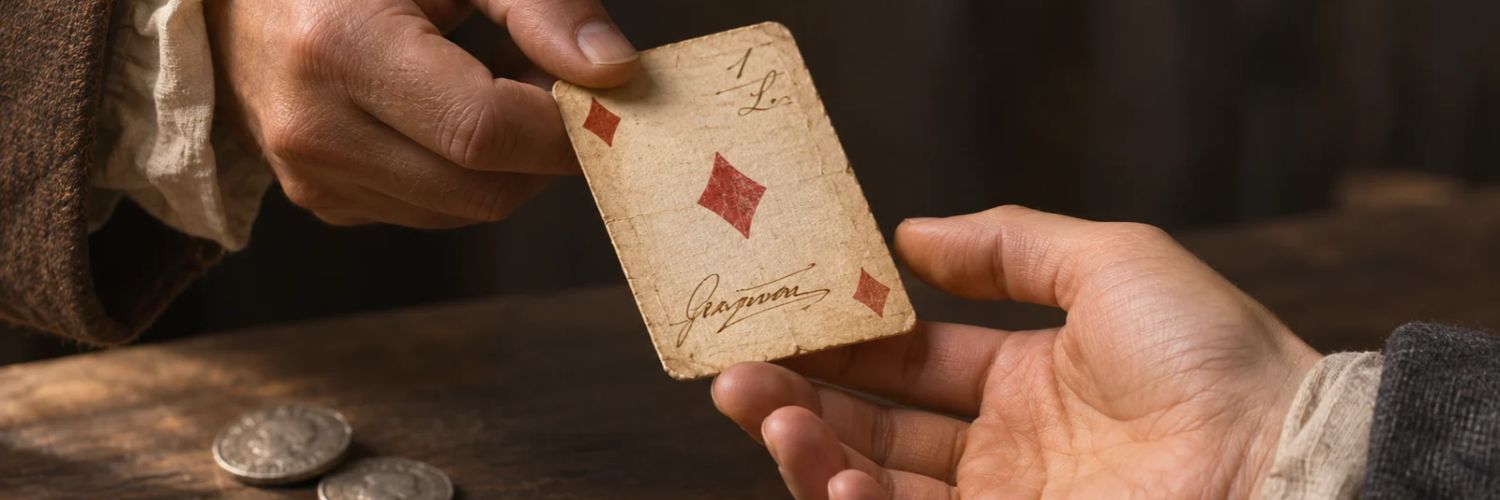
In 1685, in the French colony of Canada, the authorities paid soldiers with playing cards. It was neither a joke nor a game of chance. It was a desperate solution to a shortage of coins. Those pieces of cardboard, duly marked and validated, began to circulate as if they were money. The episode seems extravagant, but it raises a question that remains entirely relevant today: what turns an ordinary object into something that everyone is willing to accept as payment?
We tend to think that money has value because it is money. A circular explanation that falls apart as soon as we look at its history. For centuries, societies have used precious metals, paper, playing cards and, more recently, electronic records to pay debts and exchange goods.
The materials have changed. So have governments, technologies and rules. But behind every transformation lies the same need: to ensure that whoever receives a payment believes they will be able to use it later. Five seemingly minor curiosities allow us to discover how this trust has been built. And also how it can be lost.
When a playing card was worth as much as a coin
In seventeenth-century New France, coins arrived from Europe. When shipments were delayed, the colonial administration faced an immediate problem: it had to pay soldiers and suppliers without having enough cash. In 1685, the intendant Jacques de Meulles resorted to an unusual solution. He used playing cards, assigned them monetary values and authenticated them so that they could circulate as a means of payment.
The most surprising thing is not that he came up with the idea. It is that it worked. A card contained neither gold nor silver. Its value depended entirely on the promise that the authorities would accept it and, eventually, redeem it. As long as that promise remained credible, the card could pass from hand to hand like any other coin. But the system had a limit. Over time, excessive issuance and difficulties in withdrawing that money damaged its credibility. In 1717, the French authorities established a reimbursement of part of the colonial paper money at only half its face value.
The Bank of Canada records this episode as a lesson in monetary trust. Three centuries later, the question remains uncomfortable: if a playing card could become money thanks to a promise, to what extent does the value of today’s money also depend on the promises of those who issue it?
The ridges on coins tell a story of theft
Before paper money became widespread, a significant part of the value of coins came from the metal they contained. A gold or silver coin was not just a symbol of wealth: it was also material wealth. This created a temptation. Some individuals clipped small portions from the edges of coins and accumulated the metal. The coin continued to circulate with the same denomination, but it weighed less. The loss was spread among everyone who accepted it afterwards.
To make this practice more difficult, reeded edges and inscriptions were introduced. If someone clipped the metal, the tampering became visible. The ridges we see on many coins today are therefore the legacy of an ancient battle against fraud. The British Royal Mint documents the historical importance of coin clipping and the measures taken to combat it. Nowadays, everyday coins generally no longer have a metal value equivalent to their face value. Even so, their edges remain useful for identifying coins, distinguishing denominations and making certain forms of tampering more difficult. The detail is revealing. The form of money is not innocent. It often preserves the memory of abuses that societies have tried to prevent.
Why do we entrust our savings to a pig?
There is another piece of monetary history that we do not find in safes, but in children’s bedrooms: the pig-shaped money box. Its popularity has given rise to an explanation repeated for years. According to this story, in medieval England a type of clay called pygg was used to make containers. Its similarity to pig, the English word for the animal, supposedly led to those containers eventually taking the shape of pigs.
It is an appealing story. But it has not been sufficiently proven. The Bank of Canada Museum warns that the exact origin of pig-shaped money boxes remains uncertain and that the pygg theory should be treated with caution. The association between pigs and prosperity, however, has a long cultural tradition. In agricultural societies, raising an animal that could provide food and offspring represented a tangible reserve of resources.
The money box transfers this idea to the world of money. A coin seems insignificant when we put it away. Many accumulated coins, however, can become a financial cushion against an unexpected event. It is a simple metaphor for saving: giving up spending a small amount today in order to have more options tomorrow. And perhaps that is where the success of the piggy bank lies. It does not teach us to get rich quickly. It teaches us something more difficult: to be patient.
The green of the dollar: From a practical decision to a symbol of power
If we asked someone to draw a dollar bill, they would probably choose green. The colour has become one of the most recognisable visual identities in the world economy. But this association did not originate from a grand symbolic strategy. During the American Civil War, the federal government issued paper money that became known as greenbacks, a name associated with the green ink on the back of the notes. Over time, this colour became associated with the dollar. When the United States standardised the design and size of many of its banknotes in 1929, it retained green, among other reasons, because of the availability and properties of the ink.
The United States Bureau of Engraving and Printing itself points out that there is no definitive explanation for the original choice of colour. The paradox is that a printing detail ended up acquiring enormous political and economic significance. Green identifies a currency used internationally for trade, investment and holding reserves. Its prestige, however, does not come from the pigment. It depends on the institutional strength of the United States, the depth of its financial markets and the trust that economic agents place in the dollar. A banknote can retain the same appearance for decades while its purchasing power changes. Recognising a currency does not mean that its value is immutable.
“Black Money” is not another kind of money
Language also preserves clues about our relationship with money. We talk about being in the red when we have financial problems, about clean money when we want to emphasise its transparency, and about black money when referring to amounts hidden from the authorities. But what exactly is black money? The expression usually refers to undeclared income or payments. They may come from an activity that is, in itself, legal. A professional who is paid for a job and conceals the income, for example, participates in the shadow economy even though the service provided is perfectly lawful. This is not the same as obtaining money through a crime. Nor is it automatically equivalent to money laundering, which consists of making assets of criminal origin appear legitimate.
The European Commission defines undeclared work as a paid activity that is legal in nature but is not reported to the relevant authorities. The exact origin of the expression “black money” does not have a single, sufficiently substantiated etymological explanation. The metaphor, however, is understandable: what is hidden remains outside the light of official accounting. The consequences go beyond the taxes that are not collected. Opacity can encourage unfair competition, harm workers without adequate protection and weaken trust in shared rules. Money does not change colour when it is hidden. What changes is the transparency of economic relationships.
The value of money is not inside the banknote
A playing card turned into currency. Ridges that reveal a theft. A pig that teaches us to save. A colour that identifies an economic power. An expression that separates visible money from hidden money. These stories seem anecdotal until we place them side by side. Then a powerful idea emerges: money does not function solely because of what it is, but because of what a society accepts it represents. In the past, trust could rest on the gold or silver content of a coin. It could also rest on the seal of a sovereign or on the promise to convert paper into precious metal. Today, most of the money we use consists of bank deposits and electronic records supported by institutions, regulations and payment systems.
This does not mean that today’s money is a fiction without consequences. It means that its value is inseparable from the economic organisation that supports it. When we receive our salary, we do not usually receive a physical object. We see a figure on a screen. And we trust that this figure will allow us to pay the rent, buy food or set aside part of our income for the future. We have gone from checking the weight of coins to checking the balance on our phones. But the essential question is practically the same as the one the inhabitants of New France asked themselves when they accepted a playing card as payment: what guarantees that the money we receive today will still have value tomorrow?
Protecting savings with physical gold has been one of 11Onze’s greatest contributions to its community, and its range of products continues to expand. In today’s environment of market volatility, persistently high inflation and growing distrust in the banking system, gold is once again strengthening its role as a safe-haven asset. Discover Or Llavor at Preciosos 11Onze.
If you would like to learn more about this topic, we recommend:
 Culture
History of the dollar: from Hispanic empire to the USA
9 min readWhy is the dollar called a dollar? Where did the most used...
 Equip Editorial

