
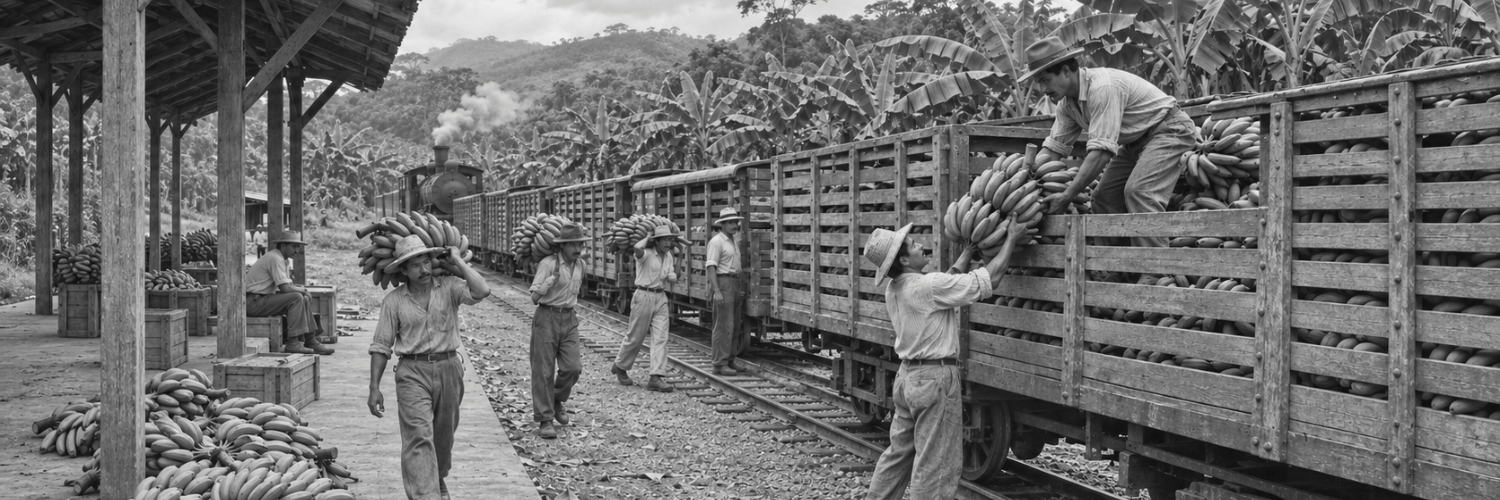
Can a fruit cause a political crisis? It seems like an absurd question, but the history of bananas is full of multimillion-dollar deals, diplomatic pressure and coups d’état. For decades, some fruit companies accumulated so much power in Central America that they even inspired an expression we still use today: “banana republic”.
In 1904, the American writer O. Henry published Cabbages and Kings, a work set in Anchuria, an imaginary country inspired by Honduras. It featured the expression banana republic, which would eventually become widely used to describe politically unstable, economically dependent states subject to the influence of foreign interests.
The name might have seemed like a literary joke, but the reality was no laughing matter. By the end of the 19th century, bananas had become an extraordinary business. They grew in the tropics, but the major buyers were in the United States. Because the fruit spoiled quickly, controlling railways, ports and ships was almost as important as owning the plantations.
The United Fruit Company, founded in 1899, knew how to take advantage of this. In countries such as Honduras and Guatemala, it accumulated land and infrastructure, employed thousands of people and established privileged relationships with governments. In some territories, a private company could have greater economic influence than many public institutions.
Honduras, the country that inspired the name
In Honduras, banana companies did not limit themselves to growing fruit. They built railway lines to transport it to ports, organised settlements for workers and negotiated concessions with the state. The problem was that much of this infrastructure served the needs of exports, not necessarily those of the population.
This created a dependency that was difficult to break: the country needed the companies to generate economic activity, but the companies could also exert pressure to preserve their privileges. Whoever controlled the banana business could end up influencing politics.
Guatemala: when business clashed with the government
The best-known case took place in Guatemala. In 1952, President Jacobo Árbenz introduced an agrarian reform to redistribute uncultivated land. The measure affected large landowners, including the United Fruit Company.
The scale of the conflict was considerable. According to official US documents, in 1953 the Guatemalan government ordered the expropriation of some 95,000 hectares of the company’s land, with compensation to be paid in government bonds. The multinational opposed the measure, while Washington interpreted the situation through the tensions of the Cold War.
In June 1954, a covert CIA operation known as PBSUCCESS helped overthrow Árbenz. Declassified documents show that several factors converged: US anti-communism, Washington’s strategic interests and the conflict with United Fruit. It would not be accurate to claim that a banana single-handedly caused a coup d’état. But that intervention cannot be explained without taking into account the power of the fruit company either.
The problem was not the fruit, but the power
The history of banana republics offers a lesson that goes far beyond Central America. When a country depends excessively on a single product or a handful of large companies, its ability to make decisions freely can be weakened. And this can happen with bananas, but also with oil, minerals or any other strategic resource.
That is why the expression “banana republic” should not simply be used to ridicule a country. It should also make us ask who benefits from its wealth and who really holds the power to make decisions.
The next time you buy a banana, remember that behind this everyday fruit lies a history of railways, multinationals and geopolitics. Not bad for something we eat in two minutes.
We tell you the most surprising stories from the world of economics to discover how the interests of the past continue to influence our present.
Protecting savings with physical gold has been one of 11Onze’s greatest contributions to its community, and its range of products continues to expand. In today’s environment of market volatility, persistently high inflation and growing distrust in the banking system, gold is once again strengthening its role as a safe-haven asset. Discover Or Llavor at Preciosos 11Onze.



 Equip Editorial

