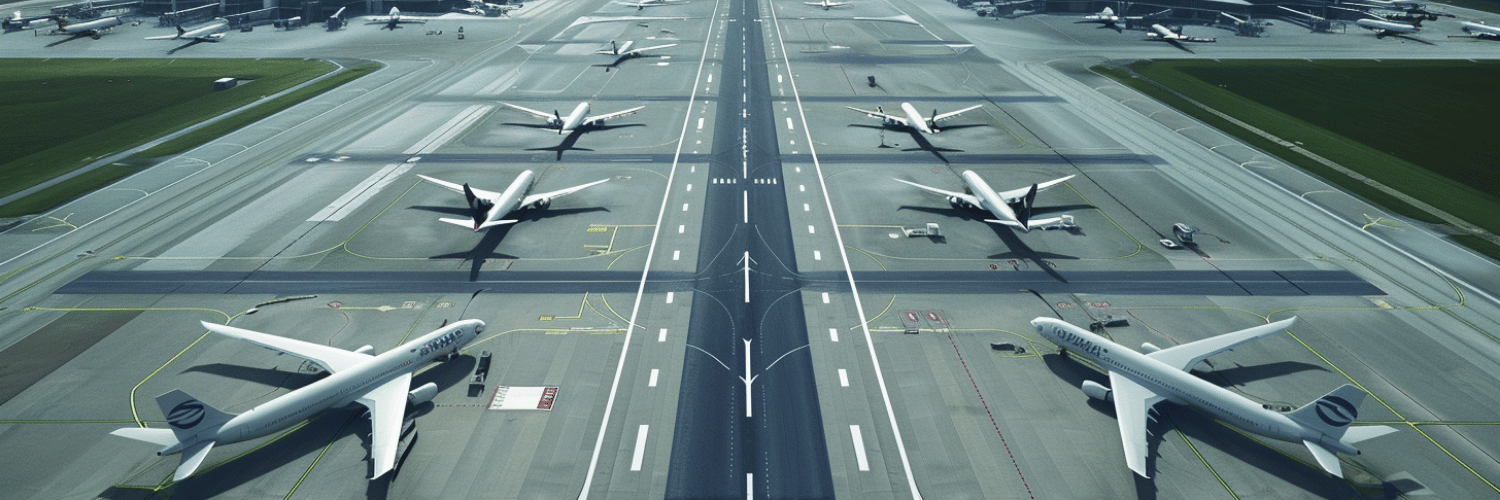
Demand for flights has returned to pre-pandemic levels, but the aviation industry has not recovered its capacity to manufacture aircraft, engines and parts at the same pace. At the same time, some of Europe’s major airports have little room left to accommodate more operations. The result is a perfect storm: airlines that want to grow but cannot find aircraft, grounded planes and increasingly contested airport slots. A bottleneck that also helps explain why flying remains expensive.
European airports are full again. According to EUROCONTROL forecasts, Europe ended 2025 with around 11.1 million flights, 4% more than the previous year and practically at the same level as in 2019. During the summer of 2026, the European network could approach 37,000 flights on the busiest days.
At first glance, aviation seems to have left the pandemic crisis behind. But there is a problem: passengers have returned faster than aircraft.
Many passengers, but not enough aircraft
Buying a commercial aircraft is not like buying a car. The market is essentially dominated by Airbus and Boeing, surrounded by a complex network of manufacturers of engines, electronics, landing gear and thousands of components. When a single part in this chain fails, the aircraft cannot be completed.
And the industry is still dealing with the consequences of recent years: the pandemic, a shortage of specialised labour, problems with some engines, supply difficulties and production delays.
IATA estimates that the accumulated delivery shortfall already exceeds 5,300 aircraft and that the global backlog of outstanding orders exceeds 17,000 aircraft. At the current production rate, this is equivalent to approximately twelve years of manufacturing.
Airbus is a good example. The European manufacturer delivered 793 commercial aircraft in 2025, but ended the year with a record backlog of 8,754 aircraft awaiting delivery.
It is like a bakery that can make one hundred loaves of bread every day but already has orders for the next twelve days. Even if more customers appear willing to pay, the oven cannot multiply production overnight. The same thing happens with aircraft. But the wait can last for years.
Having the aircraft does not guarantee that you can fly either
There is yet another problem: engines. Some manufacturers have experienced incidents that require extraordinary inspections and longer maintenance periods. Added to this is the shortage of parts and the saturation of maintenance workshops.
IATA noted that, at the end of 2024, there were around 5,000 aircraft parked worldwide for various reasons, around 700 of which were awaiting engine inspections.
The paradox is obvious: there is a shortage of aircraft while thousands of those that already exist cannot fly.
Extending the life of old aircraft
When an airline does not receive the aircraft it had ordered, it has few alternatives. It can continue using aircraft it had planned to retire, lease aircraft on the market or resort to a wet lease: temporarily hiring an aircraft with crew, maintenance and insurance included.
Lufthansa, for example, operated 66 aircraft through wet leases during 2025, partly to compensate for delays and reinforce capacity. It has also brought its eight Airbus A380s back into service in response to delays in the delivery of new long-haul aircraft.
Ryanair has also suffered from this situation. The airline explains that during its 2025-2026 financial year it carried 208.4 million passengers despite delays in the delivery of 29 Boeing 737 MAX 8-200 aircraft.
All of this comes at a cost. According to IATA, supply chain problems cost airlines more than 11 billion dollars during 2025. In addition, aircraft leasing prices have increased by between 20% and 30% compared with 2019.
The second major problem: slots
But having an aircraft available is still not enough. You also need a slot. A slot is, simply put, permission for an aircraft to take off or land at a specific airport on a particular date and at a particular time.
Imagine an airport as a car park in central Barcelona at eight o’clock on a Monday morning. You may have a car, fuel and a driver. But if all the spaces are occupied, you cannot get in. Something similar happens at Europe’s major airports.
Heathrow, Amsterdam-Schiphol, Paris-Charles de Gaulle and Frankfurt handle more than a thousand operations a day. In 2025, Istanbul led the European network with around 1,491 daily arrivals and departures, followed by Amsterdam, Heathrow, Charles de Gaulle and Frankfurt.
When demand exceeds an airport’s capacity, slots become a scarce and extraordinarily valuable resource.
The 80/20 rule
European regulations apply the principle known as “use it or lose it”. An airline that holds a series of slots must use them at least 80% of the time to retain priority over that series in the equivalent season the following year, except under certain justified circumstances. If it does not, the slots may be reassigned.
See European regulations on airport slots.
This explains why a time slot at Heathrow or Frankfurt has such strategic value. And also why a new airline may have aircraft and money but still face enormous difficulties competing at certain airports.
When scarcity reaches the ticket price
This is where the most direct consequence for consumers appears. In a normal market, when demand increases sharply, companies can increase production. Greater supply and greater competition tend to contain prices.
But European aviation has physical limits. There is a shortage of aircraft. Some are grounded. Leasing them is more expensive. And the most attractive airports have a limited number of slots. Therefore, capacity cannot grow as quickly as demand.
Globally, IATA observed that in 2024 passenger demand had increased by 10.4%, while capacity had grown by only 8.7%. The result was a record load factor of 83.5%. Put more simply: aircraft are flying fuller.
For airlines, this allows them to better protect their margins. For consumers, it means less need to sell the last seats at large discounts.
Scarcity alone does not determine the price of a ticket. Fuel, taxes, the season, the route and competition also play a role. But it helps explain why recovering the number of flights seen before the pandemic does not necessarily mean recovering the prices of previous times.
The European paradox
Europe ultimately faces a contradiction. Demand for mobility continues to grow, but expanding airports and increasing the number of flights comes into conflict with European climate objectives.
Replacing older aircraft with new, more efficient models could reduce fuel consumption and emissions per passenger. But these are precisely the aircraft that take years to arrive. Europe, therefore, wants to fly more, but neither can factories multiply the number of aircraft overnight nor can major airports create runways and slots indefinitely. This is the major bottleneck facing European aviation.
And it has a consequence that goes far beyond airlines: when a good is scarce and demand remains high, whoever controls the available capacity gains power over the market.
If you would like to explore this topic further, we recommend:
 Sustainability
The challenge of decarbonising commercial aviation
6 min readFaced with increasing pressure to reduce CO₂ emissions...


 Equip Editorial