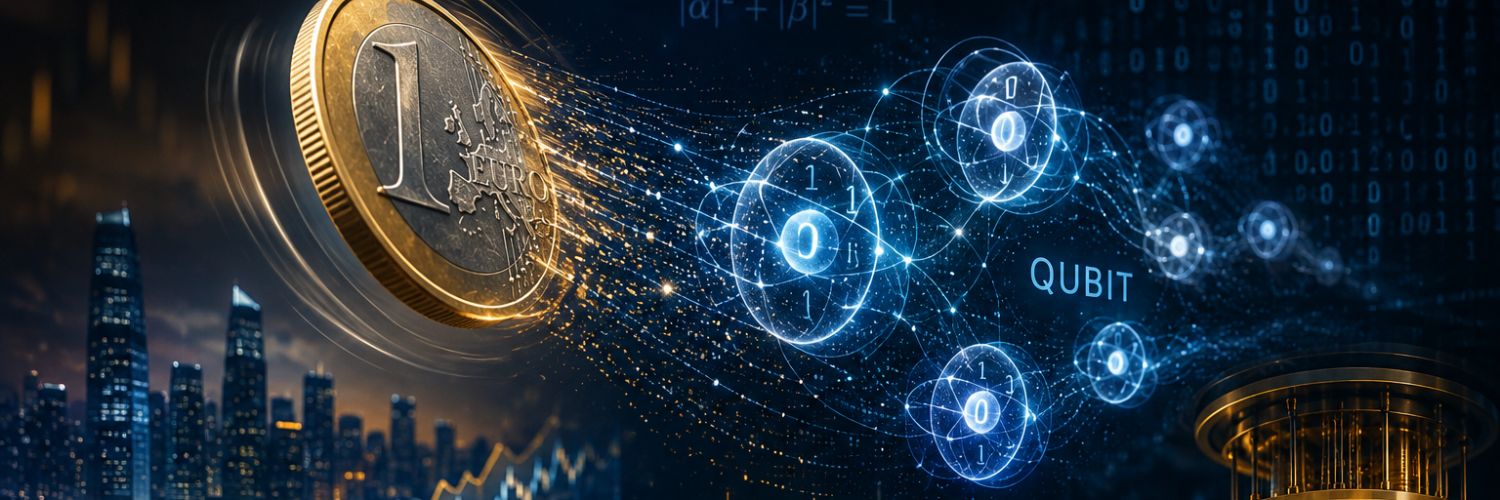
Quantum computing is no longer science fiction. The great technological powers are investing billions because they know it can transform the global economy. From banking security to logistics, artificial intelligence, or monetary control, quantum computers promise to solve in minutes problems that today would require decades. But who will control this power?
For decades, traditional computers have operated according to the same logic: the binary system. Everything is reduced to bits, which can be 0 or 1. This architecture has made it possible to build everything from the first computers to today’s artificial intelligence systems, but it also has obvious limits.
Some mathematical problems are so complex that, even with the world’s most powerful computers, they would take decades or centuries to solve. This is where quantum computing comes into play, working not with bits, but with qubits. These can exist in two states at once thanks to quantum superposition: like a coin spinning in the air, which is neither heads nor tails, but both things simultaneously.
This property allows quantum computers to explore certain calculations in parallel in a way that is impossible for a classical computer. The consequence is enormous: problems that we currently consider “impossible” could be solved in minutes. And this is not just a technological revolution. It is a change in economic paradigm.
The great threat to the financial system
The first major potential victim of quantum computing could be digital security. The global financial system is based on cryptography: banks, credit cards, international transfers, digital signatures, and cryptocurrencies depend on mathematical systems that today are practically impossible to break because they would require decades of computational calculation.
But a sufficiently advanced quantum computer could reduce that time to minutes. This means that a large part of the world’s financial infrastructure could become obsolete. What today protects bank accounts, personal data, or state reserves could cease to be secure. It is precisely this capacity that is triggering a new global technological race comparable to the nuclear race of the twentieth century.
The United States, China, and the European Union are competing to lead a technology that will transform not only the economy, but also world geopolitics. Quantum computing could alter the global balance of power in the same way that the internet, oil, or the atomic bomb did. Whoever leads quantum technology will have a decisive advantage in the economy of the future.
Quantum computing does not only affect financial security. It can also revolutionize global productivity: optimizing logistics networks, reducing energy costs, accelerating pharmaceutical development, and transforming financial markets. Major investment funds could analyze millions of scenarios simultaneously, insurers could calculate risks with unprecedented precision, and central banks could model crises almost in real time. The risk is clear: that this technology will further amplify global economic inequalities.
Europe wants to avoid falling behind
For years, Europe has exported technological talent while the great digital giants were born in the United States or China. But in quantum computing, the situation is different. The European Commission has increased investment in quantum research with programs such as the “Quantum Flagship”, designed to promote European companies, universities, and research centers. The objective is clear: to avoid absolute technological dependence on the great powers. And it is not only an economic issue, but also one of sovereignty.
In an increasingly digitized world, whoever controls technological infrastructure also controls information, finance, and a large part of political capacity. We have already seen this with the dominance of the dollar and global payment systems. Quantum computing could create an even deeper new dependency. And when it is combined with artificial intelligence, the shift could accelerate exponentially: from personalized medicine to financial prediction, the creation of new materials, or the development of autonomous weapons. The debate is no longer whether this revolution will arrive, but who will control it.
The risk of a new digital extractive capitalism
Every major technological revolution has been accompanied by a concentration of economic power. It happened with the Industrial Revolution, it happened with the internet, and it could happen again with quantum computing. The large technology corporations already accumulate data, computational capacity, and financial resources on an unprecedented scale.
Quantum computing could further reinforce this hegemony. It is a scenario that fits with the logic of modern extractive capitalism: controlling the infrastructure in order to control the economy. In this context, technology ceases to be a neutral tool and becomes a tool of power.
Economic history teaches us that every major technological change redefines the world’s centers of power. The steam engine propelled the British Empire, oil consolidated the United States, and the internet created today’s technology giants. Quantum computing could determine who will lead the global economy over the coming decades, because whoever dominates this technology will have not only an economic advantage, but also a geopolitical one.
A future that has already begun
We are still at the beginning of this revolution. Today’s quantum computers still have important limitations: computational errors are high and their stability is extremely delicate. But development is advancing quickly, much more than most of society perceives.
As happened with the internet in the 1990s, many people still see quantum computing as a distant technology. But major companies and governments are already competing to dominate it. This means that the world’s economic future could begin to be decided right now, inside laboratories that most citizens do not even know exist.
That is why it is essential to understand what is at stake. Quantum computing is not just technology: it is economy, power, and sovereignty. And for the 11Onze community, understanding these changes is a way to protect ourselves, anticipate risks, and make better decisions. Because the future is not written only by those who master technology, but also by those who have the knowledge not to be subjected to it.
11Onze is the community fintech of Catalonia. Open an account by downloading the app El Canut for Android or iOS and join the revolution!
If you would like to learn more about this topic, we recommend:
 Technology
QFS: between promise and operational reality
6 min readQuantum computing is no longer science fiction. Governments,...

 Equip Editorial