
There is a comfortable way to explain the present: to say that “everything is going up” and to point to an external culprit. China, war, the pandemic, or the markets. It is a simple, reassuring explanation, but an insufficient one. Because when the world seems expensive, it is often not that it is expensive, but that it is poorly understood.
What we are experiencing is not a structural inflation of the planet, but a fragmentation of the system that the West itself designed some thirty years ago. And as with all structures that break, the noise does not come from the final blow, but from the cracks that have accumulated.
After the Cold War, the West believed it had won something more than a conflict: it thought it had gained time. With the collapse of the USSR, the world seemed governable under a single logic, based on open markets, global production and cheap consumption. Politics stepped aside, allowing the economy to take center stage. In some way, that vision would eventually impose itself as common sense.
From that point on, the decisions were clear. Industry was offshored in order to reduce costs and increase margins. China entered this system not as a rival, but as a functional piece of a new large-scale productive model. In a short time it became the factory of the world, providing labor without comparable rights, cheap energy and strong state support.
Today, this narrative is often presented as a strategic mistake. But it was not. It was a mutual agreement. On one side, the West obtained low prices and controlled inflation; on the other, China gained access to growth, technology, and markets. No one deceived anyone. Everyone knew what they were buying and what they were selling.
Private profits, socialized risks
The problem did not arise with globalization, but with its moral management. Western companies achieved extraordinary margins, but did not reinvest them in their own industrial fabric or in long-term productive capacity. States, for their part, took advantage of cheap consumption to sustain an artificial political stability, financed by cheap debt. And the middle classes, without yet realizing it, began to pay a deferred bill: less industry, less job security, less bargaining power.
The effects were gradual but persistent. Stagnant wages, silent precarization, rising costs of living. Products were cheaper, but citizens were more fragile. Globalization reduced prices, yes; but it also eroded the consumer’s ability to sustain them in the long term. Here lies the central paradox of our time: never before had we bought so much with such a deep sense of economic insecurity.
The dollar and debt trap
This is where the system acquires a depth that often goes unnoticed. This entire mechanism —offshored production, sustained consumption, restrained wages— rested on an invisible but decisive pillar: trust. The dollar as the hegemonic currency and U.S. debt as an infinite safe asset allowed the world to function with a logic that was apparently paradoxical but stable. The United States could borrow without limit, the rest of the world could accumulate reserves, and the circuit closed with a shared faith in the center of the system.
But trust is neither eternal nor neutral. It creates monetary dependence, exposes geopolitical vulnerabilities and, over time, awakens the temptation to seek alternatives. When a global economy revolves too much around a single axis, any shock becomes systemic. And when the center begins to seem less reliable —due to excessive debt, political use of the currency or internal instability— the periphery stops wanting to orbit by inertia. Not out of hostility, but out of prudence.
It is at this point that real fragmentation begins. Not with Trump’s tariffs, which are merely its visible manifestation, but with the silent crack in trust. When the system ceases to be perceived as fair and predictable, attempts to create parallel routes, regional agreements and alternative currencies multiply. Globalization does not collapse all at once; it splits. And when this happens, the world does not immediately become more expensive, but it does become much more fragile.
When China stops being the workshop
The shift in the center of gravity is not only monetary, but also productive and political. The turning point comes when China decides to stop being merely a subordinate production space and aspires to become a strategic actor. It no longer only manufactures for others, but plans for the long term, subsidizes key sectors, exports surpluses and defines its own priorities. In a world where trust in the center is beginning to crack, this evolution is not an anomaly, but a logical consequence. Whoever depends too much on a system eventually tries to govern part of it.
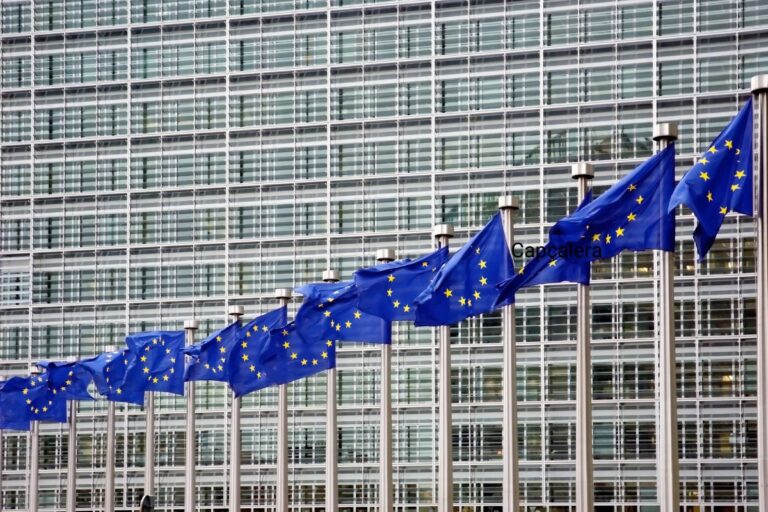
Europe, meanwhile, looks in the mirror and discovers its own structural nakedness. Expensive energy, the absence of a common industrial policy and an increasingly defensive response based on tariffs. But tariffs are not strength; they are the symptom. They indicate that the problem is not so much one of competition as of foundations, because when you cannot compete, you protect yourself. And when you protect yourself too late, you do not solve the problem; you merely postpone its diagnosis.
The world of blocs
The shift toward a fragmented world does not imply the disappearance of trade, but the end of a fiction: that of neutral trade, disconnected from politics and power. What emerges is a system of regional blocs, where economic decisions are once again conditioned by strategic interests. There is less globalization and more alignment; less efficiency and more politics. Flows are no longer free, they are negotiated. And this generates frictions, costs and tensions, but it also opens windows of opportunity for those actors who understand well where they are and with whom they want to align.
This new scenario is not necessarily more expensive by definition. It is, above all, a less fluid world, more aware of its limits and much more fragmented. Complexity replaces simplicity, and blind dependence gives way to a more closely monitored interdependence. Prices do not always rise; what changes is the ease with which everything used to circulate. And when that ease disappears, the system forces us to think, to prioritize and to make decisions that had been postponed for decades.
Faced with this panorama, fragmentation does not demand panic, but judgment. Understanding the context is already a form of financial defense. Fragmenting means diversifying, protecting savings and not trusting everything to a single system or a single promise. This is not about selling fear, but knowledge. Because history remembers it with relentless consistency: systems do not collapse when the world changes, but when people insist on interpreting it with old maps. And today, more than ever, the problem is not that the world is expensive; it is that it is no longer simple.
If you want to discover the best option to protect your savings, enter Preciosos 11Onze. We will help you buy at the best price the safe-haven asset par excellence: physical gold.

 Equip Editorial