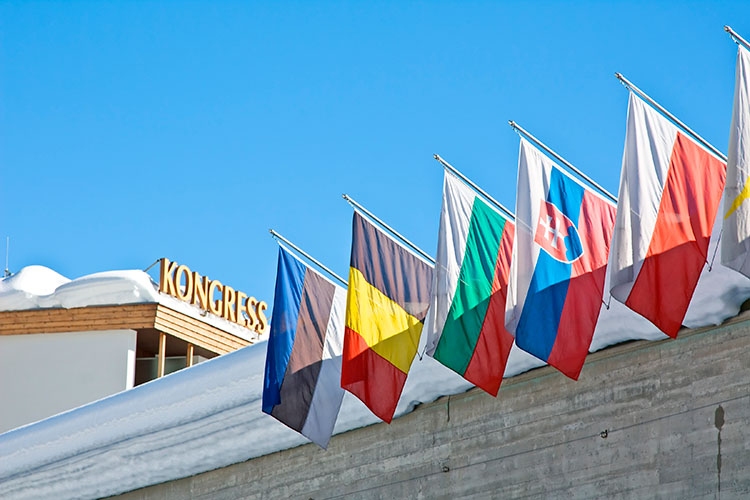
Every January, Davos becomes the nerve centre of global power. Presidents, bankers, major business leaders and international organisations deliver speeches on cooperation, sustainability and shared prosperity. But while the cameras focus on the main stages, there are glaring silences that go unnoticed. And it is precisely these silences that should concern citizens, savers, and anyone trying to protect their economic future the most.
The World Economic Forum was born in the 1970s with an apparently noble purpose: to facilitate public-private dialogue in an increasingly interconnected world. For decades, Davos was the showcase of triumphant globalisation. Growth, free trade and monetary stability were the keywords.
Today, the context is radically different. What was once a space of optimism has become a defensive space, where elites try to preserve a system that is showing cracks. Not because Davos has lost influence, but because the world it helped to build is entering a phase of structural friction.
And here appears the first major absence from the official narrative: the crisis of legitimacy. Davos does not pass laws, does not vote on budgets, does not account to citizens. But it sets the agenda. And it does so from a perspective that prioritises the stability of the system over the well-being of people.
Inflation and debt: the elephant in the room
One of the most frequently mentioned issues in the corridors —but rarely addressed in depth on stage— is the level of global debt. Governments, companies, and households are carrying historically high levels of debt. The institutional response of recent years has been clear: more liquidity, more stimulus, more money created out of thin air.
In Davos, there is talk of “monetary normalisation”, but almost no one explains the real cost of this process. Inflation is not a one-off accident: it is the direct consequence of years of expansionary monetary policies. And this inflation acts as a silent tax that erodes savings.
The silence is revealing. Because acknowledging it publicly would mean recognising that the purchasing power of the middle classes will remain under pressure for years —not as a temporary anomaly, but as a structural consequence of the model. It would mean admitting that saving in fiat money is intrinsically vulnerable, exposed to constant erosion that does not stem from poor individual decisions, but from deliberate monetary policies. And above all, it would require stating an uncomfortable truth out loud: that the current system needs inflation to sustain levels of debt that would otherwise be unpayable. Saying it would be admitting that stability is built by sacrificing value… and that this value almost always comes from the same pocket.
Davos speaks of “stability”, but avoids saying that this stability is often built at the expense of the saver.
Economic geopolitics: the end of the free market as we knew it
Another major hidden issue is selective deglobalisation. Officially, no one wants to talk about protectionism. But in practice, major powers use tariffs, sanctions, technological controls and aggressive industrial policies.
The free market is only free while it suits. When strategic interests come into play, the discourse changes. Davos knows this, but frames it with euphemisms: “resilience”, “secure supply chains”, “strategic autonomy”.
Translated into real life, this means less global trade, more economic blocs and, inevitably, more uncertainty. A scenario with immediate and very concrete consequences: more volatile markets, where sharp movements are no longer exceptional; increasingly politicised investments, subject to strategic interests and government decisions; and risks that are no longer merely economic, but clearly geopolitical, with conflicts, sanctions, and alliances shaping asset values. The free market, as we understood it, is no longer the playing field.
Yet this paradigm shift is rarely explained clearly. Perhaps because acknowledging it would mean admitting that the global model is changing… and not necessarily for the better.
Artificial intelligence: promise of productivity, social risk
If there is one omnipresent concept in Davos, it is artificial intelligence. The speeches are almost messianic: more productivity, more growth, more efficiency. But the debate about who wins and who loses is diluted.
Economic history teaches us this: every technological revolution creates wealth, but also displacement. The difference this time is the speed. And social structures are not adapting at the same pace.
What is not being said clearly is that this technological transformation will not be painless: many jobs will be replaced before real and stable alternatives emerge, creating periods of precariousness that are not always explained. At the same time, capital concentration may increase even further, strengthening the power of some actors who control technology, data, and infrastructure. And without solid and effective redistributive policies, the outcome is predictable: a wider, deeper and harder-to-reverse social gap.
Davos talks about “upskilling”, but avoids talking about the loss of workers’ bargaining power and the real impact on wages and job stability.
Green transition: discursive consensus, blurred bill
Climate is another apparent consensus. Everyone agrees that an energy transition is necessary. But the key question —who pays for it— remains unanswered.
The reality is that much of the cost of the transition falls on the same groups as always. On consumers, through taxes, tariffs and everyday price increases presented as inevitable. On medium-sized companies, with less financial and technological capacity to adapt to top-down imposed timelines. And on already heavily indebted states, which finance the transformation with more deficit, pushing the cost into the future while fiscal room for manoeuvre shrinks year after year.
Meanwhile, major financial players continue to play on both sides. In Davos, the discourse is green, responsible, and committed; away from the spotlight, however, many investments continue to follow strictly profit-driven criteria, with short horizons and little willingness to absorb real losses. The reassuring narrative thus conceals an uncomfortable truth: the transition will be economically painful if it is not carried out with judgement, fairness, and realism. Denying this only postpones social and economic conflicts that will eventually emerge with greater force.
All this may seem distant, abstract. But it is not. Davos does not speak directly to you, but its dynamics affect you every day: when inflation erodes savings, when volatility shakes markets, when debt conditions public policy, and when technology reshapes work. In this context, the key question is not what Davos says, but how you protect yourself. And this is where the official narrative fails: it asks for trust in the system, but offers few real guarantees. The system needs citizens to trust… even when its foundations are fragile.
The core idea Davos avoids
Perhaps what is not being said in Davos is precisely the most important thing: that the protection of wealth and the future will not come from above. It will not come from summits, solemn declarations or institutional promises. It will come from knowledge, personal judgement and informed decisions. Understanding how the system really works is not pessimism —it is responsibility. And in a world of structural uncertainty, the best tool is not blind faith, but economic awareness.
Davos will continue to exist. It will continue to set trends and generate headlines. But the ultimate responsibility is not its own. It is ours. At 11Onze, we are clear: talking about economics is talking about personal sovereignty. About how we protect savings, how we understand risks and how we stop being mere spectators to become informed actors. Because the future is not decided only in Davos… it is also decided at home.
If you want to discover the best option to protect your savings, enter Preciosos 11Onze. We will help you buy at the best price the safe-haven asset par excellence: physical gold.

 Equip Editorial