
In the rarefied world of global banking regulation, a quiet revolution is underway. It doesn’t involve picket lines or protest marches, but vaults—specifically, the vaults of the world’s most powerful financial institutions. The implementation of the final phases of the Basel III accords has cemented a profound shift in how regulators perceive gold, elevating it to its most exalted status in a generation. Reclassifying gold as a tier 1 asset sets a New Golden Rule of Banking.
James Sène, Chairman of 11Onze
For members of the 11Onze Club, who understand that true wealth preservation requires looking beyond the horizon, this isn’t just financial news; it’s a fundamental recalibration of the monetary landscape. But more than that, it demands a new mindset. The common advice to “be your own bank” is no longer sufficient. At 11Onze, we believe you must aspire higher: you must become the governor of your own central bank.
For decades, gold occupied a somewhat ambiguous position on bank balance sheets. Treated with a degree of skepticism by modern financial theory, it was often relegated to a secondary tier, marked down significantly in value for capital adequacy purposes. Under previous rules, physical gold was frequently classified as a “Tier 3” asset, subjected to a punitive 50% markdown from its market value when calculating a bank’s core capital reserve.
That era is now over.
Gold’s Promotion: From Tier 3 to Tier 1
As of the full rollout of the Basel III Endgame—with key effective dates solidifying in 2025 and 2026 across major jurisdictions—gold has been officially promoted. It is now classified as a Tier 1 asset. This is the highest echelon of financial assets, a category reserved for the most secure and loss-absorbing forms of capital, previously dominated by cash and highly-rated government bonds.
For a bank holding physical, allocated gold in its own vaults, this asset now carries a 0% risk weight. In practical terms, this means that gold counts fully, at 100% of its market value, towards a bank’s core capital reserves without requiring the bank to hold additional costly capital against it. The distinction is critical: gold is no longer treated as a mere commodity with fluctuation risk but as a foundational monetary asset, on par with cash.
The Truth About Private Market Demand
According to the World Gold Council, there are approximately 201,296 tonnes of gold above ground, worth more than US$12.2 trillion. The official sector holds 34,211 tonnes (17%), while bars and coins account for 40,621 tonnes (20%). Notably, the Council’s data includes a category for “Other and unaccounted” totaling 29,448 tonnes (15%)—a telling admission that official statistics cannot capture the full picture .
But at 11Onze, we operate on the front lines of the private market, and we know the truth: the volume of gold bought and sold privately is thousands of times superior to the figures reported by authorized organizations. The transactions we witness—the mandates, the family office allocations, the high-net-worth physical purchases—are genuinely far more important than what appears in the press.
This reality is now being validated by major financial institutions. A Goldman Sachs report from January 2026 confirms that “private-sector buyers — not just central banks — are becoming a structural force in price formation.” The bank explicitly highlights “physical purchases by high-net-worth families” and “harder-to-measure channels” as driving the upside surprise in gold prices . Unlike election-related hedges or short-term speculative positioning, these flows are tied to broader concerns about fiscal sustainability, monetary credibility, and currency debasement. They are structurally different—and far more persistent.
Goldman’s analyst Daan Struyven notes that “the perception of these macro policy risks appears stickier“, meaning these private buyers do not liquidate their holdings in 2026, effectively lifting the starting point of price forecasts . The old market rule that “high prices cure high prices” does not apply to gold, because annual mine output accounts for roughly only 1% of the total above-ground stock, leaving little room for production to surge even after sharp rallies .
A “Seismic Shift” for Financial Stability
Industry experts have described this change as “seismic,” a long-overdue recognition of a truth that prudent investors have always known: gold is money. The logic is impeccable. In an era of ballooning sovereign debt, aggressive currency debasement, and persistent geopolitical uncertainty, an asset that is no one else’s liability is invaluable. Unlike a government bond, gold carries no default risk. It cannot be printed into oblivion by a central bank’s fiat.
This regulatory validation is already sending powerful signals through the financial system. Central banks, always the first to move on such structural shifts, have been leading the charge. JPMorgan projects official sector purchases of 800 tonnes in 2026, while Metals Focus expects 700-800 tonnes—levels that remain structurally supportive .
The Urgency: Why You Must Act Now
A market crash is on the horizon. The confluence of geopolitical tensions, unsustainable debt levels, and fragile banking systems points to one inevitable conclusion: those who do not move their assets into liquidity and gold will be left vulnerable.
But here is the critical challenge: if you attempt to purchase gold now, you will likely find the market absolutely packed with demand and very little offer at a discount. Premium purchases are the new reality. Even if buying at a premium feels like a loss in the medium term, it is, in fact, a win.
The September 2025 Premium Purchase Simulation
Let us prove this with a real-world simulation. Imagine an investor who purchased physical gold in September 2025 at a +4% premium above the LBMA second price.
- September 2025 context: Gold was already at all-time highs. In India, for example, physical gold (999 purity) was trading near ₹1,09,140 per 10 grams in early September 2025 . Globally, gold had surged past $3,500 per ounce .
- The premium purchase: Our investor acquires physical gold at $3,640 per ounce (assuming a 4% premium on a $3,500 spot price).
- The outcome today (March 2026): Following gold’s historic volatility—including a sharp correction from $5,600 to $4,600—the spot price today hovers around $4,800-$5,000 per ounce. Even selling at the lower end of today’s spot range ($4,800), the investor realizes a gain of approximately 31.8% , despite having paid a premium at the peak of market exuberance.
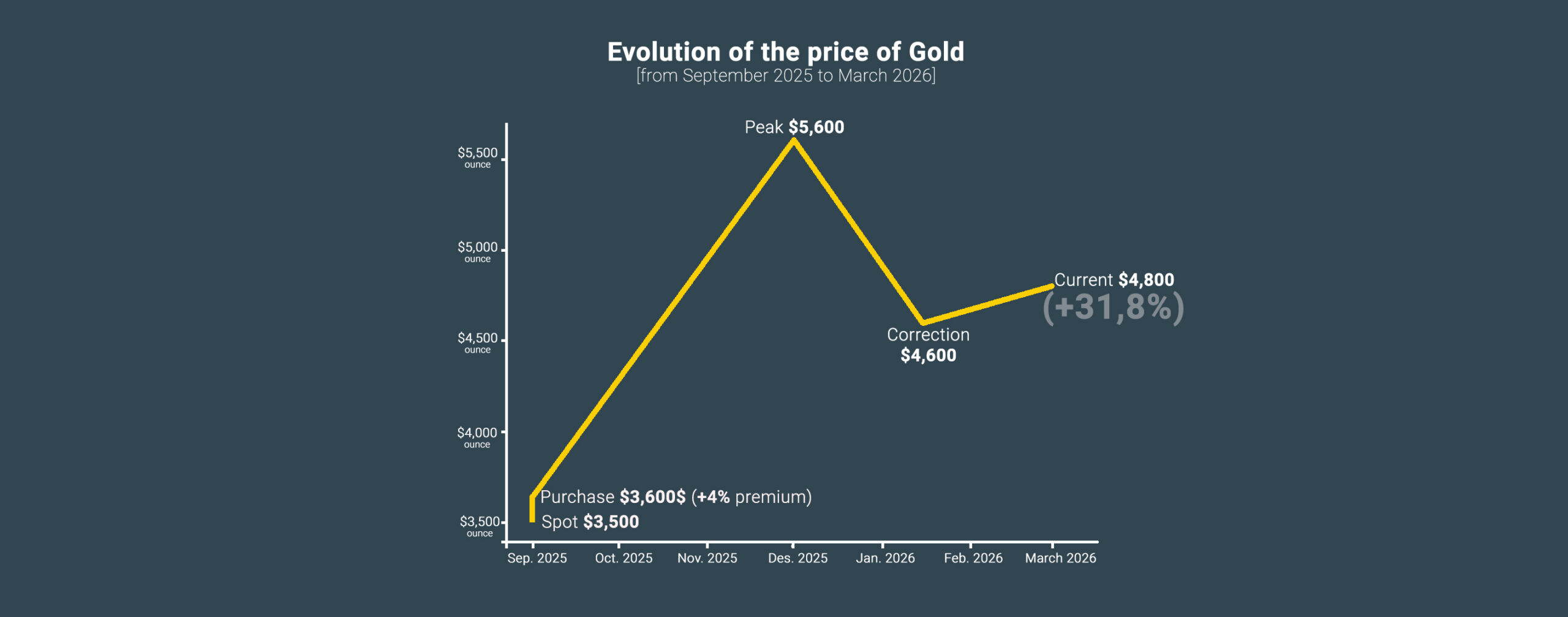
Real impact of a +4% premium entry in a context
of historical highs and subsequent volatility.
This simulation demonstrates a crucial principle: in a structural bull market driven by persistent private demand and central bank accumulation, the premium paid at entry becomes irrelevant over time. The only true risk is not owning the asset at all.
Beyond Gold: The Governor’s Duty to Diversify into Essential Sectors
A central bank governor, if he does his job properly, must place the assets of the central bank in sectors that are essential to sustain the price of money in the country. The same logic applies to your personal finances. You must trade not only in gold but also in other sectors likely to grow in case of global crisis.
At 11Onze, our personal advice is clear: FOOD.
Global agricultural markets face another year of uncertainty in 2026. Climate change, geopolitical tensions, and shifting trade flows mean that prices of key commodities like corn, soy, and wheat are no longer experiencing temporary fluctuations. Volatility has become a structural characteristic of the market .
Chris Trant, head of US Agriculture at Hedgepoint, paints a worrying picture: “After years of bumper harvests, farmers are under pressure from low prices and rising costs for loans, seeds, fertilizers, and transport. This could lead to fewer investments and lower production in 2026” . South America remains the main source of uncertainty, with La Niña potentially bringing drier conditions to Brazil and Argentina—the leading exporters of soy and corn .
Meanwhile, innovative financing models are emerging to fill the gap left by traditional banks. The “missing middle” of food infrastructure—mills, processors, storage facilities—is too capital-intensive for grants, too steady for venture capital, and too risky for traditional bank lending. Yet these assets are essential for giving farmers access to higher-value markets and an alternative to commodity systems.
The 11Onze Initiative: Financing the Food Ecosystem
At 11Onze, we are taking action. We are looking into creating Special Purpose Vehicles (SPVs) to help finance local farmers and the entire ecosystem that depends on them.
It is crucial that we seize the opportunity left by banks and big pockets. FOOD is going to become scarce and expensive. We must work with our local farmers to keep it abundant and profitable for the whole community. As demonstrated by projects like the Blue Mountain Mill—which secured over $50 million in funding through tribal ownership, mission-aligned lenders, and community investors—the “remarkable middle” of food infrastructure is viable when capital aligns around long-term outcomes .
A Call to Action: Join the Movement
In a financial world increasingly defined by complexity, leverage, and counterparty risk, the new golden rule of Basel III is a return to first principles: safety, stability, and the unprinted value of real money. For the 11Onze community, that is a rule worth following.
But we must go further. We must build resilience in our communities.
- If you are a farmer in need of financial support, please contact us. We want to help you access the capital you need to sustain and grow your operations.
- If you are a member of 11Onze interested in food security investments please fill out this form. Join us in building a portfolio that feeds our community while preserving wealth.
As one seasoned market observer aptly put it, the old advice was “be your own bank.” At 11Onze, we upgrade that mandate: Be the governor of your own central bank. Allocate to gold for monetary stability. Allocate to food for physical survival. The two together form the foundation of true wealth sovereignty.
If you want to discover the best option to protect your savings, enter Preciosos 11Onze. We will help you buy at the best price the safe-haven asset par excellence: physical gold.


 11Onze